
Review · PRIVATE WALKING TOURS
Private Walking Tour Berlin Third Reich Hitler and World War II
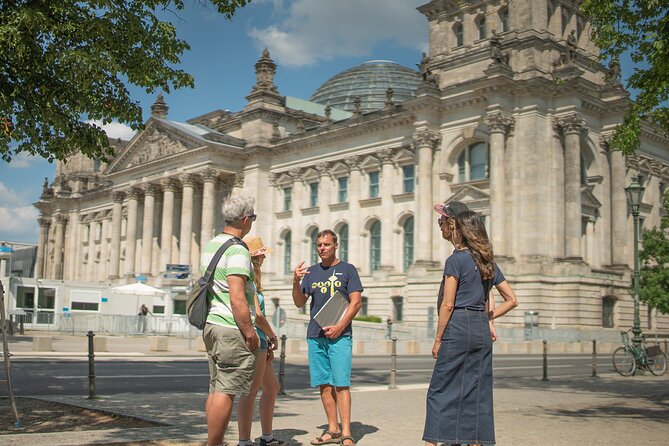
History feels different at street level. This private Berlin tour connects Nazi government offices, wartime battle sites, memorials, and places tied to Hitler’s final days into one serious, well-paced outing. I especially like the hotel pickup and drop-off, which remove some of Berlin’s transport guesswork, and the chance to shape the day around your own interests with a private guide. The main drawback is that several stops are brief, and some are outdoor locations rather than fully developed museums.
At $192.97 per person, this is not a budget walk. It can be good value for a family or small group that wants personal attention, a flexible pace, and one guide for a difficult subject. You should also expect plenty of walking, changing weather, and emotionally heavy material. The tour is offered in English and runs for about three to four hours.
Key points before you book
- The tour covers 12 major sites, from the Soviet Memorial in Tiergarten to Anhalter Bahnhof and the T4 memorial.
- Private guiding makes the difference, allowing the route and explanations to follow your interests.
- Hotel pickup and drop-off are included, a useful perk when you are staying outside central Berlin.
- The subject is serious and sometimes upsetting, especially at the Holocaust Memorial, T4 memorial, and former deportation sites.
- The Topography of Terror and Holocaust Memorial deserve more time, so consider returning independently after the tour.
- Guide quality is a major strength, with praised guides including Daniel, Jimmy, Jasper, Georgia, Simon, Emma, and others.
Why a private tour works well in Berlin
Berlin is full of important places that are easy to pass without understanding. A plain office building can once have housed a Nazi ministry. An empty patch of ground can mark the site of Hitler’s bunker. A railway station façade can recall deportations and broken families.
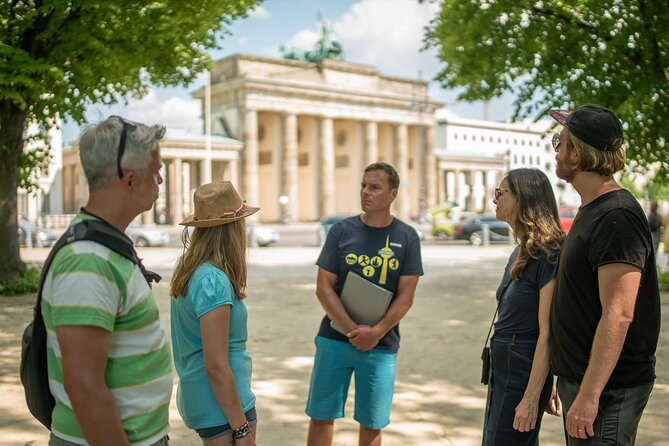
A private guide gives these places a voice. You can ask how the Nazi state took power, how ordinary government offices supported it, or how postwar Berlin chose to remember the crimes. You are not tied to the pace of a large group, and you can ask for more detail when a subject catches your attention.
This format also suits families. One parent can ask about military events, another about resistance, and children can ask direct questions without worrying about holding up a group. A guide can adjust the language and pace, which is especially useful when the history is difficult.
The tour is also flexible in another way. Several guides have been praised for avoiding places already seen, changing the route, and adding subjects such as the Cold War, Berlin’s Jewish history, or the city’s later development. That flexibility is one of the clearest reasons to choose a private outing instead of a standard group walk.
More Private Walking Tours in Berlin
- Berlin Private Complete History All Day Walking Tour
★ 5.0 · 474 reviews - Private Berlin: Iconic Sights and Hidden Gems Walking Tour
★ 5.0 · 292 reviews - Berlin Private Half-Day Walking Tour: Discover the German Capital’s History
★ 5.0 · 244 reviews
Starting at the Soviet Memorial in Tiergarten
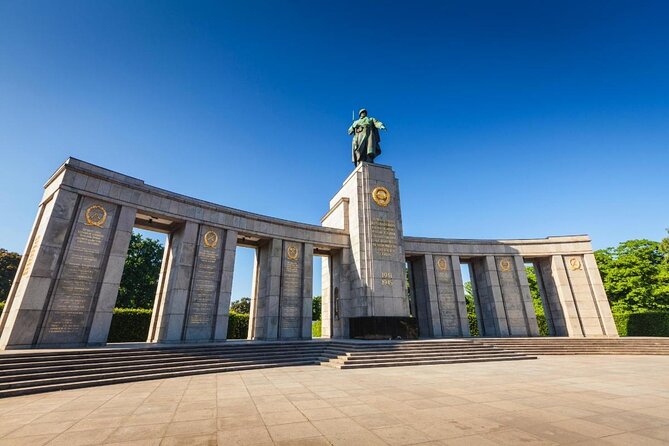
The Soviet Memorial in Tiergarten provides an immediate lesson in the final battle for Berlin. Opened in 1949, it honors Soviet soldiers killed during the 1945 Battle of Berlin. Its large statue of a soldier holding a sword and shield presents victory and sacrifice through the visual language of postwar Soviet power.
Your guide can explain how Soviet forces defeated Nazi Germany and why memorials like this one carry different meanings for different audiences. The site is not simply a war monument. It also reflects the political division of postwar Berlin and the role of Soviet memory in the city.
The planned stop is about ten minutes, so you should expect a focused explanation rather than a long visit. It works best as an opening chapter, giving you the military setting before the tour moves into the machinery of Nazi rule.
Wilhelmstraße and the former Ministry of Aviation
The Detlev-Rohwedder-Haus on Wilhelmstraße began as the Reichsbank headquarters in the 1930s and later housed the Ministry of Aviation under Hermann Göring. Today, the building is associated with the German Federal Treasury, but its earlier role is still important.
Here you begin to see how the Third Reich operated through offices, ministries, budgets, laws, and administration. Nazi power was not only rallies and uniforms. It also depended on people working in ordinary-looking government buildings.
The wider Wilhelmstraße area was the center of Nazi government. Your guide can point out where ministries and offices once operated and explain how decisions made along this avenue shaped Germany’s military and political policies. The scheduled time is short, around ten minutes at the building and about twenty minutes along Wilhelmstraße, so listen for the connections between the sites rather than expecting interiors.
The Topography of Terror and the machinery of repression
The Topography of Terror occupies the former grounds of the SS and Gestapo headquarters. Its indoor and outdoor displays use photographs, documents, and personal accounts to show how political repression worked.
This is one of the most useful parts of the route because it shifts the focus from Hitler alone to the institutions that carried out surveillance, imprisonment, torture, and persecution. You can learn how opponents were targeted and how state violence became part of daily government.
The planned visit lasts about twenty minutes. That is enough for an introduction, but not enough to read every display carefully. I would treat the guide-led visit as a first look, then return later if you want to study the material. One practical advantage is that the site can help you understand the rest of the tour, giving a framework for the people and organizations mentioned at later stops.
More Private Walking Tours in Germany
- Private Walking Tour: World War 2 and Cold War Sites in Berlin
★ 5.0 · 230 reviews - The History of Berlin: WWII PRIVATE Walking Tour With Locals
★ 5.0 · 209 reviews - Berlin Private Walking Food Tour With Locals: the 10 Tastings
★ 4.5 · 139 reviews - Kreuzberg Berlin: Off the Beaten Track PRIVATE Walking Tour
★ 5.0 · 128 reviews
Resistance at the Bendlerblock
The German Resistance Memorial Center at the Bendlerblock honors Germans who opposed the Nazi regime. The focus includes Claus von Stauffenberg and the failed July 20, 1944, attempt to kill Hitler.
This stop matters because it complicates the easy idea that all Germans supported Hitler. Resistance took many forms, and motives differed. Some opponents acted from religious conviction, military concerns, political belief, or moral outrage. Many paid with their lives.
The memorial also asks a hard question: what does it mean to oppose an unlawful government when the cost can be death? Your guide can connect the exhibits to the wider question of moral courage under dictatorship.
The planned visit is about twenty minutes. That is a reasonable introduction, though anyone especially interested in German resistance should allow extra time on another visit.
Bebelplatz and the destruction of free expression
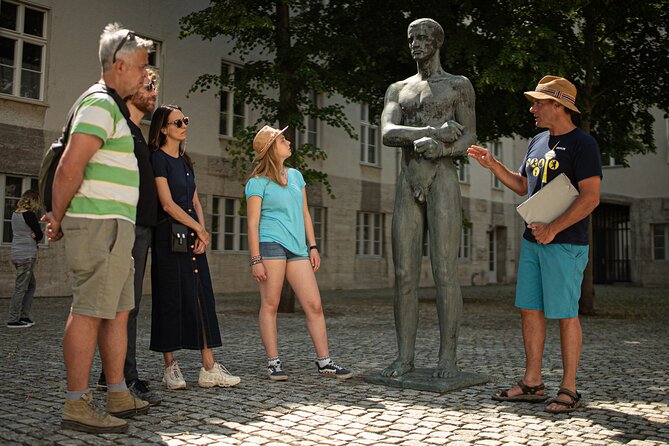
Bebelplatz is the site of the Nazi book burning on May 10, 1933. Thousands of books deemed un-German were destroyed here, in a public act designed to intimidate writers, scholars, and anyone who valued open debate.
Look down into the square for the underground memorial of empty bookshelves. The shelves are intentionally bare, representing the books that were lost or rejected. The surrounding State Opera House and Humboldt University help you understand that this happened in a major cultural and academic center, not at some distant fringe of public life.
The stop lasts about ten minutes. It is short, but the location is compact and easy to grasp. Your guide can explain why censorship was an early warning sign of the dictatorship and why the memorial remains relevant today.
The Reichstag and the Nazi seizure of power
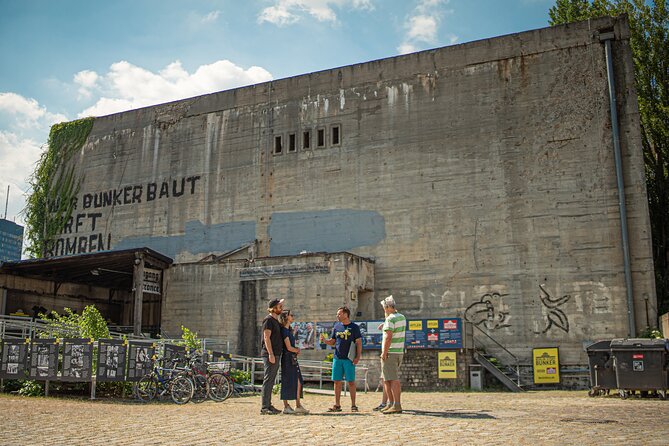
The Reichstag was completed in 1894 and became central to Germany’s political life. The 1933 Reichstag Fire gave the Nazis an opportunity to suspend civil liberties and suppress political opposition.
The building was badly damaged in World War II and later restored as a symbol of democratic government. That change in meaning is the heart of the visit. The same building can recall both the destruction of parliamentary democracy and the country’s effort to rebuild it.
The stop lasts around fifteen minutes, and admission to the building is not included. You will mainly hear about its Nazi-era role from outside unless you arrange separate access. Do not assume that this tour includes a visit to the dome or interior.
The Holocaust Memorial and the meaning of absence
The Memorial to the Murdered Jews of Europe covers a large open area with 2,711 concrete slabs of different heights. Walking between them creates a shifting sense of scale, direction, and uncertainty.
The design does not provide a single simple message. Its changing corridors and uneven ground can feel unsettling, which suits a memorial concerned with mass murder, loss, and the limits of memory. Your guide can provide the historical context, including the Nazi persecution and murder of Europe’s Jews.
The planned visit lasts about fifteen minutes. That is enough to walk through part of the memorial and discuss its purpose, but you may want to spend more time alone afterward. The memorial is more effective when you slow down rather than treat it as another quick photo stop.
Above the Führerbunker
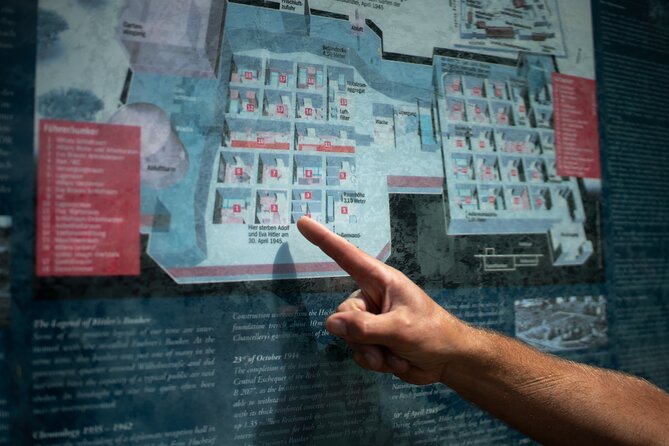
At the Führerbunker site, you stand above the location of Hitler’s final underground headquarters. The original structure was largely destroyed after the war, and there is no grand underground attraction to enter.
That absence is important. The site is intentionally restrained, and the guide supplies the context: Hitler’s final decisions, the collapse of Nazi Germany, and the atmosphere inside Berlin as Allied forces closed in. You learn where the bunker was and why it mattered without turning it into a shrine.
The visit is planned for about ten minutes. It is best approached as a sober historical marker, not as a dramatic attraction. A responsible guide should keep the focus on dictatorship, war, and human consequences rather than on Hitler as a personality.
Anhalter Bahnhof and the story of deportation
Anhalter Bahnhof was once one of Berlin’s major railway terminals. During the Nazi period, it became connected with the deportation of Jews to concentration camps.
The surviving façade and memorial references make this a painful stop. A railway station is usually linked with arrivals, departures, holidays, and reunions. Here, the same transport system helped separate families and move victims toward persecution and murder.
The planned visit lasts about ten minutes. You will not get a full railway museum experience, but the guide can help connect the station to the human stories behind the wider system of deportation. This is one of the places where personal stories can make the historical scale easier to understand.
The T4 memorial and Nazi euthanasia
The T4 Memorial on Tiergartenstraße 4 addresses the Nazi euthanasia program. The program targeted people with disabilities and mental illnesses, labeling them as unworthy of life and murdering them through an organized state campaign.
This is a crucial stop because it shows how Nazi racial and social policies were applied before and alongside the Holocaust. It also raises questions about medical ethics, discrimination, bureaucracy, and the language used to deny people their humanity.
The memorial includes design elements and information about victims and the program’s development. The planned visit is about ten minutes, so the guide’s explanation is especially important. The subject can be upsetting, but avoiding it would leave out a key part of how Nazi mass murder developed.
Moltkebrücke and the battle for Berlin
Moltkebrücke played a strategic role during the final fighting in 1945. Soviet forces crossed the bridge during their assault on Berlin, using it as a route into the city.
Here the tour returns to military history. Your guide can describe the fierce fighting nearby and explain how the Soviet advance changed Berlin’s immediate future. The bridge is an architectural landmark, but its value on this tour comes from its location within the final battle.
The stop takes about ten minutes. It helps connect the political and criminal history of the Third Reich with the physical destruction of the city in the war’s final days.
How the pace and transport shape the day
Although this is described as a walking tour, the route covers a wide area. Some guides have also used Berlin’s public transport system to connect major points, and one itinerary may finish at the Berlin Wall or another location suited to your interests.
The stated duration is three to four hours. The listed site visits add up to well over two hours, leaving the rest for walking, transport, explanations, and questions. You should wear comfortable shoes and dress for rain, cold, or heat because the experience operates in all weather.
Hotel pickup and drop-off are included, which is particularly useful if your accommodation is not near the central sights. Confirm the meeting plan when booking, since the exact route can change with your starting point and interests.
Guides, personalization, and what the praise means
The strongest part of this experience is the guide. Daniel is praised for meeting at the hotel, quickly building a custom plan, and offering ideas for the rest of the visit. Jimmy is described as relaxed, engaging, and especially good with children. Jasper is praised for his clear explanations and passion for the subject.
Other guides, including Georgia, Simon, Emma, Ariel, Callum, Tobi, Martin, Xavier, Oren, Artie, and Maria, have been praised for flexibility, storytelling, and clear historical background. One guide adjusted the route to avoid sights already seen. Another added personal stories connected to World War II and the Holocaust.
There is one useful caution. Guide backgrounds vary, and not every guide will fit every group’s expectations. One experience felt less tailored to the group’s wishes, so tell the company what you want to emphasize before the tour begins. Ask for more military history, Jewish history, resistance, the Cold War, or family-friendly explanations if those are priorities.
Is $192.97 per person good value?
The price makes most sense for a small group. If several people share the experience, you receive a private guide, hotel pickup and drop-off, and a route that would be difficult to organize efficiently on your own.
You are paying for interpretation and flexibility, not admission-heavy sightseeing. Most stops are free, and the Reichstag admission is not included. The value comes from understanding what you are seeing and being able to ask questions in real time.
For a solo visitor on a tight budget, a group tour or self-guided museum visit may cost less. For a family, couple, or group with limited time in Berlin, the private format can justify the higher price.
Who should book this experience?
I would choose this tour if you want a serious introduction to Nazi Berlin, prefer a private guide, or are traveling with family members who need different levels of explanation. It also suits first-time visitors who want to connect sites spread across central Berlin without planning every transfer.
I would not choose it if you want long museum visits, a lighthearted city walk, or a tour focused only on Hitler. The subject is grim, and the route moves quickly. You should also plan a separate visit to the Topography of Terror or Holocaust Memorial if you want time to read the displays in full.
Final verdict: a strong private introduction to Nazi Berlin
Book this tour if personal attention matters more to you than the lowest price. The route covers an unusually broad set of places, from Nazi ministries and resistance sites to deportation points, memorials, and the final battle for Berlin.
The best result comes when you speak up. Tell your guide what you already know, which subjects matter most, and which sites you have visited. With the right guide and an agreed focus, this can turn a difficult history lesson into a clear, humane way to understand Berlin.
Free cancellation is available up to 24 hours before the start time. Changes or cancellations inside that window are not accepted for a refund.
FAQ
How long does the private Berlin Third Reich tour last?
The tour lasts approximately three to four hours.
What language is the tour offered in?
The tour is offered in English.
Is hotel pickup included?
Yes. Hotel pickup and hotel drop-off are included.
Is this a private experience?
Yes. Only your group participates in the private tour.
How much does the tour cost?
The listed price is $192.97 per person.
Is admission to the Reichstag included?
No. Admission to the Reichstag is not included.
Are food and drinks included?
No. Food and drinks are not included.
Does the tour operate in bad weather?
Yes. The tour operates in all weather conditions, so you should dress appropriately.
What is the cancellation policy?
You can cancel up to 24 hours before the start time for a full refund. Cancellations or changes made less than 24 hours before the experience are not accepted for a refund.
Just added around Berlin
- Berlin Walking Tour★ 4.5 · 378 reviews
- Berlin Highlights Private Guided Walking Tour★ 4.5 · 89 reviews
- Small Group Walking Tour of East Berlin with a French Guide★ 5.0 · 176 reviews
- Berlin Street Art Walking Tour – Off The Grid★ 5.0 · 270 reviews
- Private Walking Tour: World War 2 and Cold War Sites in Berlin★ 5.0 · 230 reviews
- East Meets West: Berlin Food Culture & Street Art★ 5.0 · 157 reviews
- Kreuzberg Berlin: Off the Beaten Track PRIVATE Walking Tour★ 5.0 · 128 reviews
- The History of Berlin: WWII PRIVATE Walking Tour With Locals★ 5.0 · 209 reviews
Private Walking Tours, compared.
Private 3 hrs Venice Tour: St Mark’s, Walking tour & Boat tour
Read our review →
Private Street Food Evening Walking Tour in Ho Chi Minh City
Read our review →
Old Quebec City: Grand Walking Tour with Private Option
Read our review →
Barcelona Helicopter, Sailboat & Old Town Private Walking Tour
Read our review →
Browse the lists this tour appears in