
Review · UK WALKING TOURS
Fascinating Walking Tours Of Roman Chester With An Authentic Roman Soldier
Roman Chester is hiding under your feet. This lively 90-minute walk brings its military past into focus, with a costumed Roman soldier-guide leading you from the amphitheater to old fortress walls, Roman gardens, and less obvious remains. I especially like the chance to ask questions as you go, and the small group limit of 15 keeps the walk personal. The main drawback is that much of Roman Chester survives as scattered remains rather than a single grand monument, so you need to listen closely to picture the original fortress.
I also like the way the guides connect stonework to daily life. You may hear about legionary pay, ranks, hygiene, living quarters, risks, trades, and even the possibility of women serving in the Roman army. The experience is best for anyone who enjoys stories and archaeological clues, though a lively group can sometimes make it harder to hear every point.
Why this Roman walk is worth your time

- A 90-minute route through Chester’s Roman core: See the amphitheater, fortress walls, Roman gardens, and other remains without giving up a whole day.
- Guides in Roman military dress: Julius, Marcus, Gaius, Tiberius, Faustus, Hippolyta, and other guides have led this walk, each adding personality and humor.
- Britain’s biggest Roman amphitheater: Learn about the people who fought and died there, using the surviving remains and archaeological evidence.
- Original stones and underground remains: The walk may include a basement with Roman columns or other remains beneath a modern cafe.
- Useful for families and history fans: Children can follow the visual character of the soldier-guide, while serious students may still pick up new details.
- Good value at $16.64: The price covers a focused small-group walking tour in English, with no separate admission charge for the listed stops.
Starting at Chester Town Hall

The walk begins outside Chester Town Hall on Northgate Street, an easy central meeting point. You should arrive ready to walk through city streets, open areas, and historic sites for about an hour and a half.
The group can include no more than 15 people. That matters here. Roman Chester is not explained from one viewing platform. Your guide may pause beside a wall fragment, point out stonework in an unexpected place, or gather you around a detail that would be easy to miss alone. A smaller group gives you a better chance to hear and ask questions.
The tour is offered in English and comes as a mobile ticket. It is close to public transport, and most people can take part. Service animals are allowed. Wear sensible shoes and bring weather protection, since the experience requires good weather and takes place outdoors for much of the route.
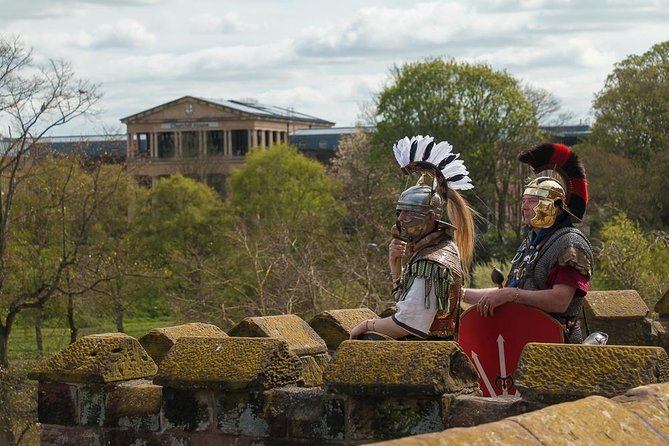
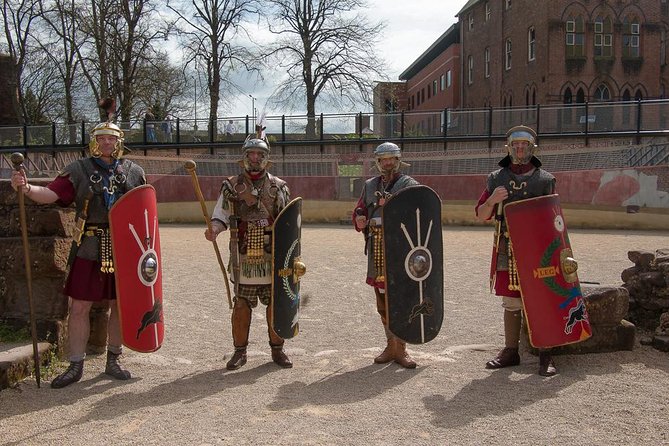
The guide’s Roman clothing is more than a photo opportunity. It gives the walk a clear theme and helps younger members of your group stay interested. Guides such as Marcus, Julius, Gaius, Tiberius, Faustus, and Hippolyta have been praised for mixing facts with jokes, stories, and a relaxed approach to questions.
A few more walks around the UK worth a look
- Magical London: Harry Potter Guided Walking Tour
★ 4.7 · 22,044 reviews - Edinburgh: Harry Potter Magical Guided Walking Tour
★ 4.8 · 11,944 reviews - Edinburgh Castle: Guided Walking Tour with Entry Ticket
★ 4.7 · 11,699 reviews
The amphitheater: Roman Chester’s most powerful stop
The Chester Roman Amphitheatre is the natural high point of the route. It is described as Britain’s biggest Roman amphitheater, and the open remains give you a sense of the scale of Roman public entertainment.
Your guide uses the site to discuss the people who fought and died here. That human focus helps. You are not simply looking at a curved wall and trying to imagine the building. You are asked to think about the soldiers, spectators, performers, and workers who made the place function.
The stop lasts about 15 minutes, with no separate admission charge. That is enough time for a clear explanation and questions, though not enough for an extended archaeological lecture. If you want a long, quiet study of every visible stone, you may need to return on your own.
The amphitheater also shows the limits of ancient remains. You will not see a fully restored arena with intact seating and stage machinery. Instead, the guide helps you read the surviving outline and understand what archaeological evidence can and cannot tell us. That is one reason the experience works better with a good guide than with a quick solo walk past the site.
Walking the fortress walls and spotting Roman stonework
From the amphitheater, the route turns toward the Roman fortress that once occupied Chester. The modern city has grown around it, so the remains appear in pieces rather than as one complete compound.
Some sections of the fortress wall survive to more than five metres high. That is an impressive reminder of the scale of the military base, especially when you compare the old masonry with today’s streets and buildings.
Your guide may point out places you would otherwise pass without notice. One particularly memorable feature is a set of Principia columns beneath a cafe. The Principia was the fortress headquarters, so seeing Roman columns preserved under a modern business gives the city a pleasing collision of old and new.
This part of the walk is especially useful if you have only a short time in Chester. You get a quick framework for understanding the city: the fortress, its defenses, its public buildings, and the later streets built over or around them.
The route can feel less dramatic than visiting a complete Roman site. You may find yourself looking at foundations, reused stones, or a section of wall beside ordinary urban buildings. That is not a weakness if you enjoy detective work, but it does require imagination.
Roman Gardens and the hypocaust lesson

The Roman Gardens provide another 15-minute stop. Here, the focus shifts from military walls to Roman engineering and bathing.
You will see a reconstructed hypocaust system using original pila stones, along with reconstructions or mosaic flooring connected with the Roman military baths. A hypocaust heated rooms from below. The guide explains how the system worked, why the materials matter, and why some pieces were moved to the gardens.
This is a good example of how the tour adds value beyond simply naming a ruin. A row of short stone supports can seem ordinary until you learn that they held up a floor while hot air moved beneath it. The explanation turns scattered archaeological material into part of a working building.
The Roman Gardens are also a useful place to think about preservation. Some pieces are original, while other parts are reconstructed to help you understand the system. Your guide can explain the difference, which is important when you want a clear sense of what remains from Roman times and what has been recreated for display.
Same streets, a different way to see them:
- Underground Vaults Walking Tour in Edinburgh Old Town
★ 4.5 · 8,506 reviews - London: The Original Jack the Ripper Walking Tour
★ 4.7 · 7,833 reviews - Oxford University Walking Tour With University Alumni Guide
★ 5.0 · 6,905 reviews - Edinburgh Castle: Guided Walking Tour with Entry Ticket
★ 5.0 · 5,540 reviews
A basement, real objects, and details of soldier life
The strongest surprise on the route may be an underground space beneath a modern cafe. The walk can include a visit to a basement containing Roman remains, including the Principia columns or other genuine Roman material.
Access to a cellar may not suit every person. One person using an electric wheelchair missed only this portion while the rest of the walk remained accessible, so it is worth asking the guide about the exact route if access is important for your group.
Some guides also bring reproduction and real artifacts connected with Roman military life. You may be able to handle selected objects and examine the guide’s custom-made legionary kit. This adds a useful physical element to the tour. Roman equipment can be difficult to understand from a picture, but seeing its shape and construction helps you imagine how it was worn and used.
The everyday details are often as memorable as the buildings. You may learn about a soldier’s pay, rank, training or trade, personal hygiene, living quarters, and risks. The walk can also raise the role of women in Roman military communities, including the possibility that some soldiers came from areas now associated with Ukraine and Russia.
That range gives the tour more depth. You are not only hearing about emperors and battles. You are getting a picture of ordinary military life in a frontier city.
Why the guides make such a difference
The guide is the heart of this experience. Names that have been used on the route include Marcus, Julius, Gaius, Tiberius, Faustus, and Hippolyta. You may meet a male or female Roman character, and the tone can vary slightly from one guide to another.
Marcus has been praised for his humor, enthusiasm, and willingness to answer questions. Julius has been described as a young historian with a strong command of the subject. Gaius and Tiberius have been noted for keeping children engaged, while Faustus has brought plenty of energy to the walk. Hippolyta has used anecdotes to make Roman Chester easier to picture.
These details matter because the tour depends on spoken explanation. A guide who can connect a wall to a story makes the site memorable. A guide who simply recites dates would make the same stones feel flat.
The walk also seems comfortable with different kinds of groups. Families can ask simple questions without embarrassment. People with advanced knowledge of ancient history can still find fresh material, especially in the archaeological details and unusual facts about military life.
There is one fair warning. A single group included people who kept interrupting to show their own knowledge, which made the presentation less enjoyable. That is not a normal feature of the tour, but on any small walking group, other people’s behavior can affect the experience.
What you get for $16.64
At $16.64 per person, this is a strong-value introduction to Roman Chester. The walk lasts about 90 minutes, includes a costumed guide, and covers several Roman sites without separate admission charges for the listed stops.
The value comes from the connections between places. You could walk past the amphitheater, walls, gardens, and modern buildings by yourself, but the guide explains how they fit into the old fortress and military settlement.
You are also paying for interpretation rather than entry to a large museum. If you want elaborate displays, full reconstructions, or a long indoor visit, this is not that kind of experience. If you want a focused introduction before exploring Chester independently, the price is easy to justify.
The tour is booked an average of 14 days ahead, so it is sensible to reserve early if your Chester dates are fixed. Confirmation arrives when you book, and free cancellation is available up to 24 hours before the start time. Changes or cancellations inside that window are not accepted for a refund. Since the activity requires good weather, poor conditions may lead to a new date or a full refund.
Who should take this walk?
I would choose this tour if you want Roman history explained in plain language, with enough personality to keep the walk moving. It suits first-time visitors to Chester, families, curious local residents, and anyone who enjoys seeing how archaeology fits into a living city.
It is especially useful for:
- Families with older children: The Roman costume, artifacts, humor, and stories give younger minds something concrete to follow.
- History students and enthusiasts: Details about military rank, pay, hygiene, architecture, and archaeology add more than a basic sightseeing circuit.
- Short-stay visitors: Ninety minutes gives you a compact introduction without taking over your day.
- Visitors who prefer small groups: A maximum of 15 people makes questions and conversation easier.
- People using mobility equipment: Much of the walk may work well, but ask about cellar access because one section may be missed.
You may prefer another activity if you dislike outdoor walking, want a fully accessible route with no uncertain sections, or expect every Roman building to survive intact. The tour asks you to use your imagination.
Practical details before you book
The meeting point is Chester Town Hall, Northgate Street, Chester CH1 2HJ. The supplied information also gives 23 Little St John Street as an end address, but it notes that tours terminate at the Roman Amphitheater and that the guide directs you to your next destination. Confirm the final meeting and finishing instructions when you receive your booking details.
Bring a charged phone for the mobile ticket. Wear shoes suited to city walking, and take a waterproof layer because the activity can be canceled in poor weather. The tour is in English, and most people can participate.
The advertised stops have no separate admission charge. The biggest practical choice is timing. Since this is a compact route, you might want to schedule it early in your Chester visit, then revisit the places that interest you most at your own pace.
Should you book this Roman Chester tour?
Yes, if you want a friendly, fact-filled introduction to Chester’s Roman remains without spending half a day indoors. The best parts are the costumed guide, the small group, the unexpected basement remains, and the practical details about how Roman soldiers lived.
I would book it for the stories and interpretation, not just for the ruins. Chester’s Roman remains are spread through a modern city, and the guide helps you notice what is easy to miss. At $16.64, it is a sensible choice for families, history fans, and first-time visitors who want the ancient city to make sense.
FAQ
How long does the Roman Chester walking tour last?
The tour lasts approximately 1 hour and 30 minutes.
Where does the tour begin?
It begins at Chester Town Hall on Northgate Street, Chester CH1 2HJ, UK.
Where does the tour finish?
The tour information gives 23 Little St John Street as an end address, while also stating that tours terminate at the Roman Amphitheater. The guide directs you to your next destination from there.
How much does the tour cost?
The listed price is $16.64 per person.
Is the tour offered in English?
Yes, the tour is offered in English.
How many people can join the tour?
The maximum group size is 15 people.
What Roman sites are included?
The route includes Chester Roman Amphitheatre, sections of the Roman fortress walls, and Chester Roman Gardens with a reconstructed hypocaust system. It may also include Roman remains beneath a modern cafe.
Are admission tickets included for the stops?
The listed stops have no separate admission charge.
Can I cancel for a full refund?
Yes, you can cancel up to 24 hours before the experience start time for a full refund. If poor weather causes the provider to cancel, you are offered a different date or a full refund.
Just added around the UK
- Birmingham Slogging Gangs Walking Tour with Edward Shelby★ 4.5 · 306 reviews
- Birmingham Walking Tour: Canals, Victorians & Today (1:30pm)★ 5.0 · 346 reviews
- Discovering Birmingham 2 hour Walking Tour to the Jewellery Quarter★ 5.0 · 333 reviews
- Birmingham City Centre Daily Walking Tour (10:30am & 2pm)★ 5.0 · 265 reviews
- The Real Eclectic Belfast City Walking Tour/Experience.★ 5.0 · 152 reviews
- Belfast Political Tour-Conflicting Stories Walking Tour★ 4.5 · 459 reviews
- Belfast Eclectic Walking City Center Experience, The Marti Way★ 5.0 · 348 reviews
- The Real Story of Belfast walking tour with a local guide★ 5.0 · 144 reviews
UK Walking Tours, compared.

Magical London: Harry Potter Guided Walking Tour
Read our review →

Edinburgh Castle: Guided Walking Tour with Entry Ticket
Read our review →
Underground Vaults Walking Tour in Edinburgh Old Town
Read our review →

Oxford University Walking Tour With University Alumni Guide
Read our review →Edinburgh Castle: Guided Walking Tour with Entry Ticket
Read our review →
Edinburgh Castle Guided Walking Tour in English
Read our review →Browse the lists this tour appears in