Review · SMALL-GROUP WALKING TOURS
Amsterdam: Small-group Guided Walking Tour (French/English)
Amsterdam rewards a slow walk. I like the way this small-group tour links famous sights with lesser-known corners, and I like the guide’s focus on stories, local customs, and useful tips for food and drinks. At $33, it offers a strong introduction to central Amsterdam without taking up your whole day.
The main consideration is pace. You cover many stops in two to three hours, so this is primarily a lively orientation walk with photo stops, not a deep visit inside museums or churches. The guide may adjust the route for construction, weather, or group interests, and cobbled streets, bikes, and busy crossings call for sensible footwear and attention.
Key points to know before you book
- A wide city-center route: You walk from Amsterdam Centraal through Zeedijk, the Old Side, Dam Square, the canal belt, and Jordaan.
- Chris brings the history to life: His style combines facts, humor, visual aids, and practical help with restaurants, cafés, pubs, and other sights.
- French or English guiding: You can join in either language, with private and small-group options available.
- A useful first-day tour: The route helps you understand Amsterdam’s layout and gives you ideas for the rest of your stay.
- Plenty of photo stops: Most listed landmarks receive about five minutes of explanation, so expect an outside look rather than long interior visits.
- Good practical value: Food and drinks cost extra, but you receive dining, shopping, boating, and sightseeing suggestions to use after the walk.
Starting beside the ferries at Amsterdam Centraal
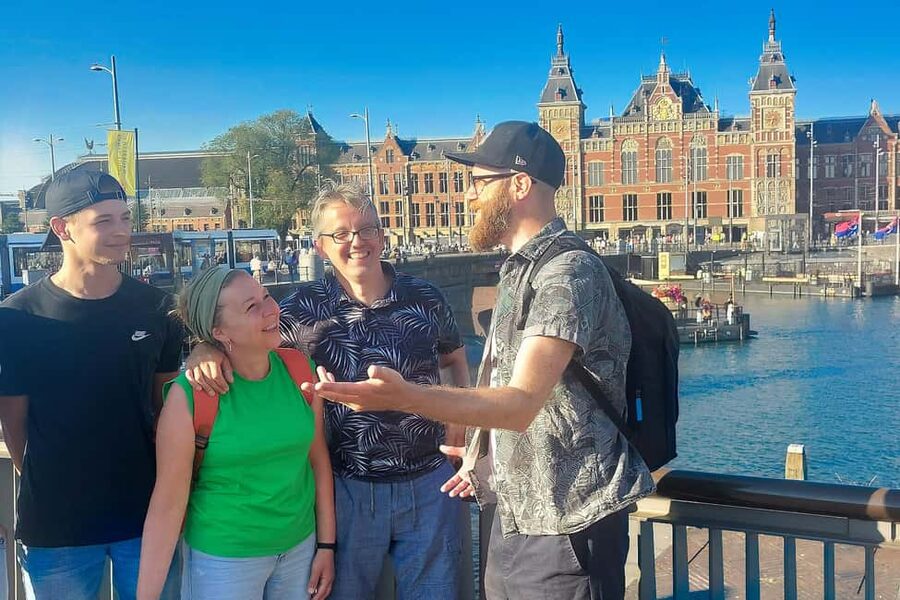
The meeting point is behind Amsterdam Centraal Station, beside the white and blue ferries going to Amsterdam North. Look for Pancakes Amsterdam at the IJ, the large D ferry-stop sign beside the bike lane, and a guide wearing glasses, a beard, and a baseball hat.
This location is easy to connect with if you have just arrived by train, but it can feel confusing at first. Amsterdam Centraal has several exits, ferry lanes, cyclists, buses, and streams of pedestrians. Give yourself time to get behind the station and down toward the water rather than relying on a last-second dash.
The walk begins near the city’s transport hub, which makes the opening useful. You quickly see how Amsterdam works: the station faces the IJ, the historic center begins just south of it, and water, commerce, and movement have shaped the city from the start.
Your guide is expected to speak French or English. Chris, also referred to as Christian by some guests, has earned praise for his easy manner, humor, and ability to answer questions without making the walk feel like a school lecture. He also uses visual displays to explain certain places and past events, a helpful touch when a modern street no longer looks much like the scene being described.
More Small-Group Walking Tours in Amsterdam
- Amsterdam Anne Frank: Small-Group Walking Tour & Local Guide
★ 4.8 · 12,789 reviews - Amsterdam: Anne Frank Guided Small Group Walking Tour
★ 4.8 · 2,722 reviews - Amsterdam Highlights Walking Tour: Small Group Experience
★ 5.0 · 1,132 reviews
From the station to the old waterfront streets
The first stops include Amsterdam Centraal, the Dancing Houses, and the Basilica of Saint Nicholas. These give you three quick views of the city’s changing face.
The station is more than a place to catch a train. It marks the northern edge of the historic center and helps explain why so many visitors begin their Amsterdam visit here. The Dancing Houses offer one of those classic Amsterdam photo moments: narrow buildings that appear to lean and shift beside the water.
The Basilica of Saint Nicholas adds a different note. Amsterdam is often presented through canals, merchant houses, and liberal modern culture, but this church points to the city’s Catholic past and its layered religious story.
The short talks at these stops are best treated as visual introductions. You should not expect a full architectural study or time to wander inside each site. The benefit is that you keep moving and see how the city’s main pieces fit together.
Zeedijk, Chinatown, and the city’s less polished stories
Zeedijk leads you into one of the oldest parts of Amsterdam. The street has a distinct character, with a mix of food, old buildings, nightlife, and cultural influences. Nearby, Amsterdam Chinatown adds another part of the city’s modern identity.
The Major Alida Bosshardt statue offers a human story within this busy central district. The stop helps shift attention away from grand buildings and toward people who shaped daily life and social work in Amsterdam.
Our Lord in the Attic Museum is one of the route’s most intriguing exteriors. The building points to a time when religious practice was shaped by legal and social limits, and worship could take place out of public view. You may want to return later for a proper museum visit, since five minutes outside cannot replace the full interior experience.
The Oude Kerk gives you another sharp contrast. It is one of the city’s major historic buildings, yet it sits right in the Red Light District. That proximity can surprise first-time visitors and helps explain why Amsterdam cannot be reduced to one neat postcard image.
At Burgwallen Oude Zijde, the guide connects the old eastern side of the center with the city’s growth around trade and water. This portion can feel crowded, especially around popular streets, so stay close to the guide and watch for bicycles.
The trading city behind De Waag and the VOC
De Waag is a strong stop for understanding Amsterdam as a commercial city. The building has served different civic and trade-related roles over time, and its heavy form contrasts with the narrow canal houses nearby.
The route also touches on the Dutch East India Company, often known by its initials VOC. This is where the tour moves beyond attractive façades and into the forces that made Amsterdam wealthy. Trade, shipping, business, and overseas activity all shaped the city’s Golden Age, though the subject also carries difficult questions about power and exploitation.
A good guide can give this subject useful context without turning a short walking tour into a long academic talk. Chris is praised for small details and side stories, so you can expect the historical frame to include bits about Dutch daily life, trade, food, and customs.
The Narrowest House in Europe adds a lighter moment. It is the sort of sight you could easily walk past without help. The stop shows how Amsterdam’s tight plots and old taxes encouraged narrow building fronts, while also giving you a memorable photo opportunity.
More Small-Group Walking Tours in the Netherlands
- Amsterdam Small-Group Walking Tour
★ 4.7 · 995 reviews - Small Group Walking Tour – Hello Amsterdam
★ 5.0 · 505 reviews - Amsterdam: Guided Anne Frank Small-Group Walking Tour
★ 4.2 · 485 reviews - Small Group Walking Tour in Amsterdam with Friendly and Fun Guide
★ 5.0 · 281 reviews
Dam Square, the Royal Palace, and Magna Plaza
Dam Square is the central stage of the city. It can be crowded, noisy, and full of movement, but that is part of its value. Here you get a clear look at the Royal Palace, the National Monument, and the broad public space that has hosted ceremonies, demonstrations, celebrations, and ordinary city life.
The Royal Palace is viewed from outside on this tour. The guide can explain its role and place in Amsterdam’s story, but entrance is not part of the walk. If you want to see the interior, plan a separate visit and check opening details for your date.
Magna Plaza sits close by and gives you a quick architectural change. Its grand design and current shopping use show how older central buildings can take on new purposes. It is also a handy reference point if you plan to shop after the tour.
This section is useful for orientation. From Dam Square, you can easily continue toward the main canals, the Jordaan, or other central sights. The guide’s recommendations can help you decide where to spend your limited time instead of wandering without a plan.
The canal belt from Torensluis to the Anne Frank House
Torensluis Bridge is one of the route’s pleasant canal views. Bridges are often the best places to understand Amsterdam’s design because you can look along the water, see rows of narrow houses, and watch boats, cyclists, and pedestrians share the same compact space.
The Grachtengordel, or canal belt, is the architectural heart of the walk. This 400-year-old area is a UNESCO World Heritage site, and the guide explains how the canals supported housing, transport, business, and urban expansion.
You will hear about the city’s development from a small fishing settlement on the Amstel River into a major European trading center. That broad story becomes easier to grasp when you see how carefully the canals were laid out and how the houses still crowd their narrow plots.
The canal belt is photogenic, but do not expect a quiet stroll at every point. Bikes move quickly, tour groups gather, and bridges can be slippery in rain. Comfortable shoes, water, an umbrella, and clothing suited to the weather are sensible choices.
The Anne Frank House is another outside stop. The guide can share the story connected with the building and place it within Amsterdam’s wartime history, but admission to the house is not included. If you want to visit inside, you need to arrange that separately. This tour stop works best as historical context and orientation, not as a substitute for the museum.
Westerkerk sits close to the Anne Frank House and adds a prominent landmark to the canal view. Its tower is one of the most recognizable features in this part of town. Again, the walking tour focuses on explanation and photographs rather than an extended interior visit.
Finishing in Jordaan, where the route becomes more local
The Jordaan is a fitting final area. It is known for canals, narrow streets, courtyards, shops, cafés, and a more residential feel than the busiest parts around Dam Square.
This is where the guide’s personal suggestions matter most. Chris provides links and recommendations for restaurants, cafés, pubs, souvenir shops, food, drinks, boat trips, and further sightseeing. One particularly practical food tip from the tour is bitterballen, a classic Dutch snack that can be hard to choose confidently if you do not know what you are ordering.
The route may also include hidden courtyards and small gardens when conditions and time allow. These places reward a guide who knows where to look, though you should understand that access and timing can vary. The route may change because of construction, weather, group interests, or other conditions.
Several people have found the walk useful immediately after arriving in Amsterdam. That makes sense. You learn the shape of the center, hear what different districts are known for, and finish with a list of places to explore on your own.
What the two to three hours really give you
The advertised duration is two to three hours, and the route contains many stops. That means the guide has to keep the walk moving. A five-minute explanation at each listed place gives you a broad sweep, not a full treatment of every building.
I would choose this tour if you want to cover a lot of central Amsterdam on foot and prefer stories to a rigid lecture. It is especially useful on your first day, when a city can seem like a maze of canals and lanes.
The pace has been described as comfortable, but this is still a walking tour over urban streets. There are bikes, bridges, crowds, and weather to manage. Wheelchair access is listed, but if you have specific mobility needs, it is wise to confirm how the current route handles bridges, narrow pavements, and construction before booking.
Private and small-group formats are available. A small group should give you more room to ask questions and hear the guide clearly. A private option may suit families or friends who want the route adjusted more closely to their interests.
Is $33 good value in Amsterdam?
At $33 per person, the price is reasonable for a two to three-hour guided introduction in central Amsterdam. You are paying for a local guide, a carefully connected route, historical context, and recommendations that can save you time later.
Food, drinks, museum admission, and boat rides are not included. That keeps the base price clear, but you should budget separately if you want to continue with lunch, a canal cruise, or an indoor visit to places such as Our Lord in the Attic Museum or the Anne Frank House.
The best value comes from using the tour as a launchpad. Ask about the neighborhoods, restaurants, snacks, and sights that match your interests. At the end, you receive helpful links, so you can continue planning without starting from scratch.
Who should book this walking tour?
I would recommend it to first-time visitors, couples, families with older children, solo visitors who want friendly company, and anyone who likes history explained through streets and buildings. It also suits people who want French-language guiding in Amsterdam, since that option is available alongside English.
You should book it if you enjoy asking questions. Chris’s strongest quality is his ability to respond to them and add useful detail without losing the group. The repeated praise for his warmth, humor, local knowledge, and restaurant suggestions suggests that the guide is a major part of the experience.
I would choose another format if you want long museum visits, a slow photography walk, or a tour focused on only one subject. This route covers a lot, and its strength is breadth. You see the city’s main story, get your bearings, and leave with practical ideas for the rest of your stay.
FAQ
How long does the Amsterdam walking tour last?
The tour lasts approximately two to three hours. Starting times vary, so check availability when booking.
What languages are available?
The live guide speaks English or French.
Where does the tour meet?
It meets behind Amsterdam Centraal Station, beside the white and blue ferries to Amsterdam North. Look for Pancakes Amsterdam at the IJ, near the water and the large D ferry-stop sign beside the bike lane.
How will I recognize the guide?
The guide is described as wearing glasses, a beard, and a baseball hat.
Is the tour offered in a small group?
Yes. Small-group and private options are available.
Is the walking tour wheelchair accessible?
The activity is listed as wheelchair accessible. Because Amsterdam has bridges, narrow pavements, bikes, and possible construction, confirm any specific access needs before booking.
Does the tour enter the Anne Frank House?
The route stops at the Anne Frank House for a guided explanation and photo stop. Admission inside is not included.
Does the price include food or drinks?
No. Food and drinks are not included.
What should I bring?
Bring comfortable shoes, water, an umbrella, and clothing suited to the weather.
Can the route change?
Yes. The route may be adjusted for group interests when possible, construction work, weather, or other unexpected conditions.
Just added around Amsterdam
- Small Group Walking Tour in Amsterdam with Friendly and Fun Guide★ 5.0 · 281 reviews
- Amsterdam: Private Introduction Walking Tour (TOP RATED)★ 5.0 · 223 reviews
- Humans of Amsterdam: Cultural Walking Tour incl. meeting 2 locals★ 5.0 · 320 reviews
- Amsterdam Private Historical Walking Tour★ 5.0 · 75 reviews
- Private Tour: Amsterdam City Walking Tour and Canal Cruise★ 4.5 · 142 reviews
- Anne Frank and Jewish Quarter Amsterdam Private Walking Tour★ 5.0 · 684 reviews
- Small Group Walking Tour – Hello Amsterdam★ 5.0 · 505 reviews
- Amsterdam: Anne Frank and World War II Walking Tour (TOP RATED)★ 4.5 · 72 reviews
Small-Group Walking Tours, compared.

Amsterdam Anne Frank: Small-Group Walking Tour & Local Guide
Read our review →
Freedom Trail History Small Group Walking Tour
Read our review →
New Orleans Food Walking Tour of the French Quarter with Small-Group Option
Read our review →
Barcelona Tapas and Wine Experience Small-Group Walking Tour
Read our review →
Reykjavík Small group Walking Tour – by CityWalk
Read our review →
Best of Lisbon Small-Group Guided Walking Tour
Read our review →
Small Group Boat Cruise and Guided Walking Tour
Read our review →