Review · HISTORY WALKING TOURS
Boston: Freedom Trail History Small Group Walking Tour
Boston’s Revolution is best understood on foot. This 2.5-hour walk links the city’s major colonial sites with a clear focus on the tense years from 1760 to 1775. I like the small group limit of 16 people, which makes it easier to hear the guide and ask questions. I also like that the route covers all 16 official Freedom Trail landmarks, from Boston Common to Paul Revere’s North End.
The main drawback is that you see the buildings from outside rather than touring their interiors. The walk is also exposed to Boston weather, and you will be on your feet for most of the experience. Still, at $35.10 per person, it offers a useful first look at central Boston and its Revolutionary story.
Key points at a glance
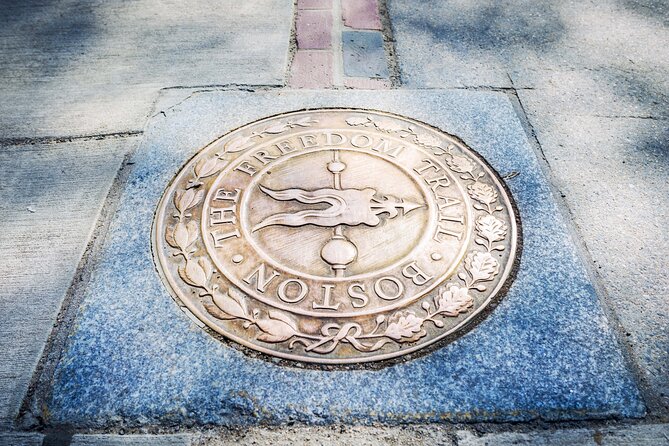
- All 16 Freedom Trail landmarks: Follow the complete official route from Boston Common to Copp’s Hill Terrace.
- A focused historical period: The guide centers on the years leading to the American Revolution, especially 1760 through 1775.
- Small group format: With no more than 16 people, questions and conversation are easier than on a large city tour.
- A practical first-day activity: The route cuts through Boston Common, the historic center, Faneuil Hall, and the North End.
- Strong guide-led storytelling: Guides such as Jon, Maura, Mark, Alejandro, Maz, and Cal are praised for clear explanations and lively delivery.
- Free outdoor sightseeing: The tour price includes the walk and landmarks, but museum and church admission costs extra.
Why this walking tour works for a first Boston day
The Freedom Trail can look simple on a map: follow the red line and stop at old buildings. In practice, the story is easier to follow when someone explains how the sites connect. This tour gives you that structure, moving in a mostly chronological way through Boston’s colonial streets and Revolutionary flashpoints.
I like the way the tour links famous places with less obvious details. You do not simply photograph the Boston Massacre Site, for example. You hear how the event fit into the growing dispute between British soldiers, local residents, and political leaders. At the Old South Meeting House, you connect a religious meeting place with the gathering that led to the Boston Tea Party.
The route also gives you a feel for several different parts of Boston. Boston Common feels open and civic. Downtown brings you into the city’s political and commercial core. The North End has a tighter street plan and a more intimate feel, with Paul Revere’s home, Old North Church, and Copp’s Hill near the water.
This is a history walk first, not a food tour, shopping tour, or general sightseeing bus ride. You will see plenty of the city along the way, but the guide’s attention stays on colonial Boston and the birth of the United States.
More History Walking Tours in Boston
- Boston: Freedom Trail History Small Group Walking Tour
★ 4.9 · 1,590 reviews - Boston Pizza Lovers Food and History Walking Food Tour
★ 4.5 · 1,082 reviews - Boston History Tour: Scenic Walk Through Time & Landmarks
★ 5.0 · 627 reviews
Starting at the Boston Foundation Monument
Meet inside Boston Common at the Boston Foundation Monument, near the park’s northern boundary and opposite 50 Beacon Street. The granite memorial includes a bronze relief showing two men shaking hands, referring to the Puritans’ arrival in 1630.
It is a fitting starting point because the tour begins before the Revolution. Boston’s political and religious culture did not appear overnight, and the opening explanation gives you a little context before the story turns toward conflict.
The nearby Massachusetts State House also enters the conversation. Completed in 1798, it is associated with Boston’s political life and the famous description of the city as the Hub of the Solar System. You may not spend a separate, timed stop there, but its position near the start helps place Boston’s civic center in view.
Boston Common: pasture, park, and public stage
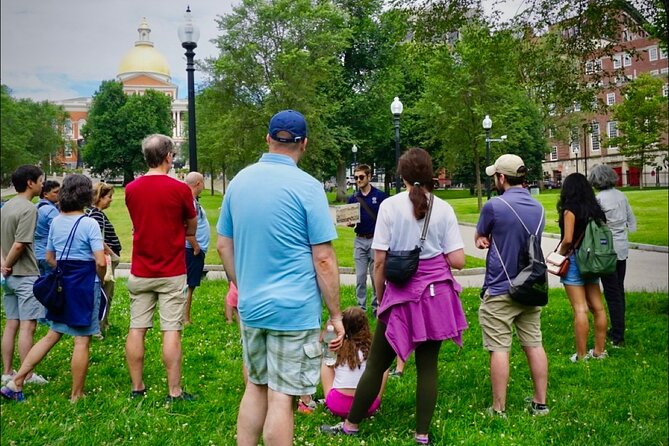
Boston Common receives about 20 minutes. Founded as communal grazing land in 1634, it is described as the oldest public land in the Americas. That fact alone makes the park more than a pleasant patch of green.
The guide uses the Common to explain how early Boston functioned as a compact settlement. Public land served practical purposes, while nearby churches, burial grounds, meeting houses, and government buildings created the framework of daily life.
The open space is also a useful introduction to the tour’s walking rhythm. You begin outdoors, with room to gather around the guide. After this point, the route becomes more urban and the sidewalks can feel tighter, particularly as you approach Downtown Crossing and the North End.
Granary Burying Ground and Boston’s early leaders
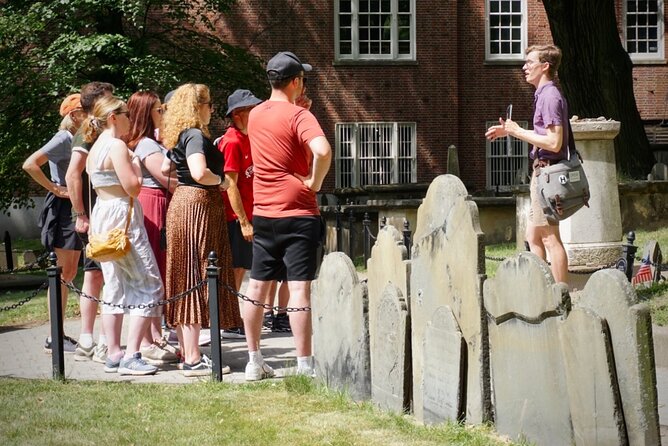
Granary Burying Ground is one of the tour’s longer stops, at about 20 minutes. Founded in 1660, it is Boston’s third-oldest burying ground and the final resting place of several major figures from Revolutionary Boston.
This stop matters because it puts names and dates into a physical setting. The Revolution can feel abstract when you only read about laws, protests, and battles. Here, the guide can connect political leaders and public events to the people who shaped them.
The itinerary also points out several nearby historic places along the way. These include King’s Chapel, Boston’s first Church of England congregation in Puritan Boston, and King’s Chapel Burying Ground, the city’s oldest cemetery. You also pass the Old South Meeting House, a Congregationalist meeting house founded in 1729 and the place where thousands gathered before the Boston Tea Party.
The tour does not include entry into these buildings. That limits what you can see, but it keeps the route moving and holds down the price. If you want interiors, Old South Meeting House and Old North Church offer discounted admission with a Hub Town Tour ticket, according to the tour information. King’s Chapel is also expected to offer that discount soon.
More History Walking Tours in the USA
- Boston: 2-Hour Historic Walking Tour
★ 4.7 · 88 reviews - History and Hauntings of Salem Guided Walking Tour
★ 5.0 · 14,564 reviews - Historic Charleston Guided Sightseeing Walking Tour
★ 5.0 · 6,216 reviews - Savannah History and Haunts Candlelit Ghost Walking Tour
★ 5.0 · 3,235 reviews
Benjamin Franklin, Boston politics, and the Old State House
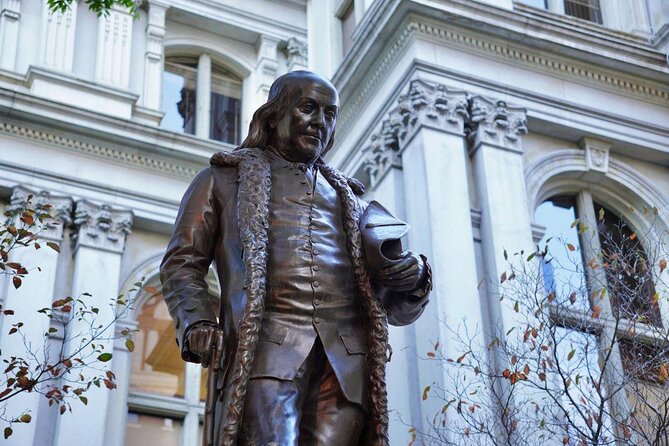
The statue of Benjamin Franklin marks the site of Boston Latin School, founded in 1635 and described as the oldest public school in the Americas. The stop lasts about 10 minutes.
Franklin’s statue is a good reminder that Boston’s Revolutionary story includes education, publishing, civic debate, and personal ambition, not just battles. The route also passes places connected with Boston politics, including the former publishing house of Ticknor & Fields and the Old State House.
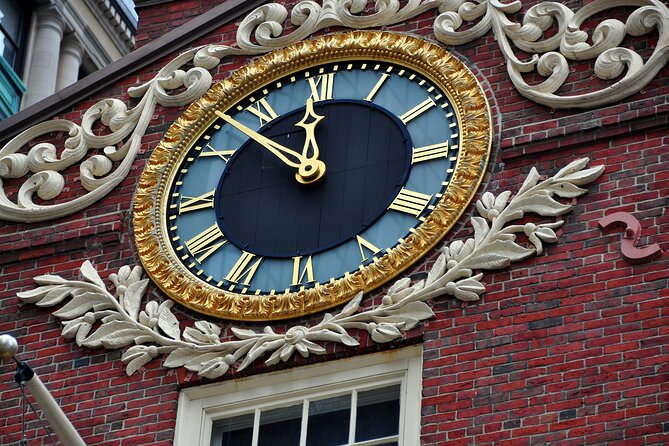
The Old State House served as the colonial capitol of the Massachusetts Bay Colony and dates to 1713. It is the oldest public building in Boston. Its age is impressive, but its location is even more useful: this was the center of colonial government, close to the streets where arguments over British rule became public confrontations.
The guide’s job here is to show how close together these locations are. Boston’s colonial power structure, business community, religious institutions, and public meeting places were packed into a small area. That compact setting helps explain why events could spread quickly.
The Boston Massacre Site and the road to protest
The Boston Massacre Site receives about 20 minutes. On March 5, 1770, British soldiers killed five Bostonians here. The event became a powerful political tool for opponents of British rule.
This is one of the most important stops on the route, and it benefits from a guide who can explain the competing viewpoints. A good account must deal with both the violence and the way political leaders used images and reports of the incident to build opposition.
The tour also points out the political figures associated with Boston’s Sons of Liberty. That helps connect the street-level event with the organized campaign against British policies. You are not just looking at a circular marker in the pavement. You are standing where public anger, military occupation, and political messaging collided.
Faneuil Hall and Boston’s civic voice
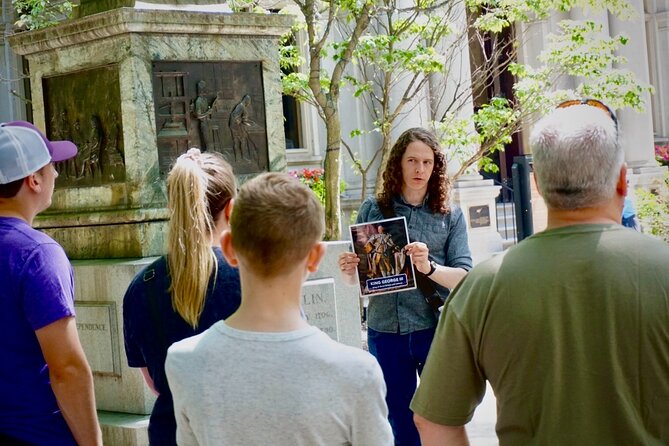
Faneuil Hall Marketplace receives about 10 minutes. The hall hosted Boston town meetings and earned the name The Cradle of Liberty.
This is a shorter stop, but it carries plenty of weight. Public meetings gave Boston residents a place to argue, organize, and respond to new policies. The building’s role makes clear that the Revolution was driven not only by famous leaders but also by citizens gathering in public.
The area is also a practical pause point. Faneuil Hall is surrounded by places to eat and shop, though those purchases are not part of the tour. Nearby is the Union Oyster House, founded in a building dating to 1704 and recognized as the oldest restaurant in the United States.
Because the tour is still moving on a schedule, you should not expect time for a meal here. Think of it as a landmark explanation, with the option to return later if you want to explore the market area.
North Square and Paul Revere’s neighborhood
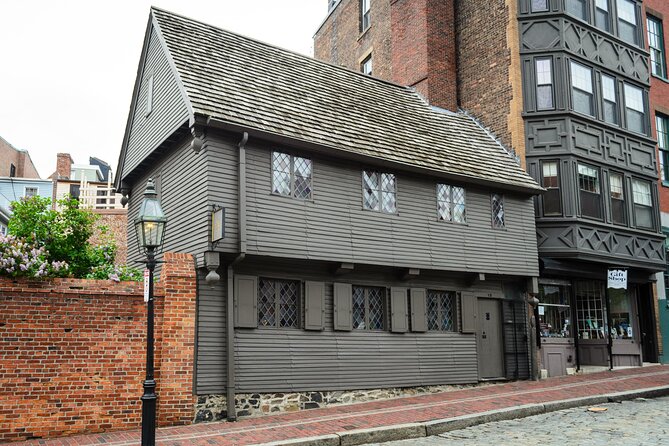
North Square Park gets about 20 minutes and marks the shift into the North End. Founded in 1634, it is one of Boston’s oldest public squares.
This part of the walk feels different from Boston Common and the Downtown sites. The streets are narrower, the buildings sit closer together, and the setting makes it easier to picture a colonial neighborhood. The North End is also home to restaurants and pastry shops, so the tour’s endpoint puts you near good options for a later break.
Paul Revere House comes next. Built around 1680, it is the oldest structure in Downtown Boston and was Revere’s home during the period associated with his famous ride. The stop gives the guide a chance to separate the real person from the simplified schoolbook image.
You see the house from the outside unless you pay separately for admission. That is an important distinction. If Paul Revere is a major reason you are visiting Boston, you may want to return for the interior after the walking tour.
Paul Revere Statue and Old North Church
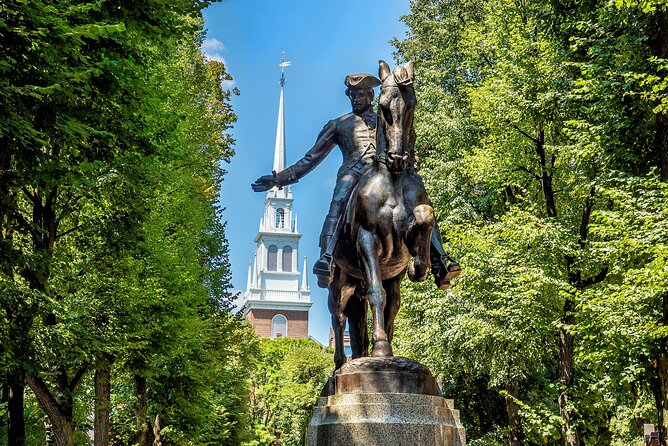
The Paul Revere Statue stands in a pedestrian-only space that honors the Midnight Ride of 1775. The tour spends about 20 minutes in this area.
The statue is a natural place for the guide to explain what Revere did, what he did not do, and how the story became part of American memory. The nearby Old North Church is tied to the signal lanterns used during the Midnight Ride.
This section often becomes one of the most memorable parts of the walk because the locations are close together. You can see Revere’s home, the statue, and the church in the same neighborhood rather than treating them as disconnected attractions.
Again, admission inside Old North Church is not included. The outdoor explanation gives you the basic setting, while a separate visit lets you spend more time with the building and its educators.
Copp’s Hill Terrace and the final view
The tour ends at Copp’s Hill Terrace after about 20 minutes at the final area. Copp’s Hill Burying Ground is Boston’s second-oldest cemetery, founded in 1659.
The terrace provides a strong finish. Across the Charles River, you can look toward the USS Constitution, launched in 1797, and the Bunker Hill Monument, associated with the 1775 battle. These landmarks are not part of the walking route because Charlestown is excluded, but the view gives you a useful next step if you want to continue Boston’s Revolutionary story.
Ending in the North End is also convenient. You are close to Hanover Street, with Italian restaurants, pizza, pastry shops, and other places to continue your day. The finish is not at the starting point, so plan your return route before the tour begins.
Guides, pace, and the small group setting
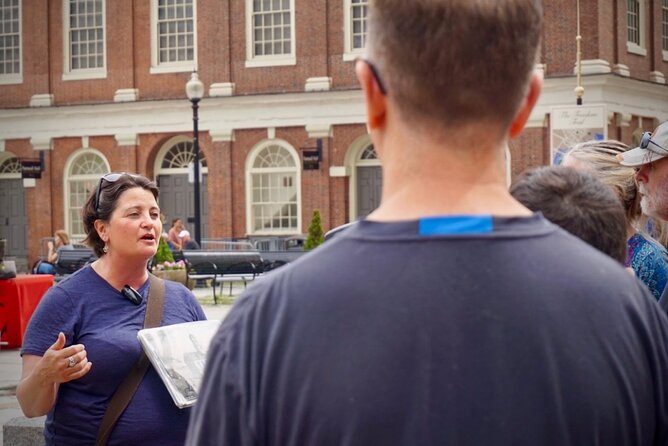
The guide makes a major difference on a history walk, and this experience uses historians and educators who bring different strengths. Jon is praised for moving through events in chronological order and delivering a powerful final talk. Maura is known for vivid storytelling, while Mark combines strong subject knowledge with a friendly manner.
Other highly praised guides include Alejandro, Maz, Cal, Nick, Kiera, Miles, Amelia, Meaghan, and Cyrus. The repeated strengths are clear explanations, enthusiasm, humor, and the ability to answer questions. A small group helps because you can ask about details that interest you instead of simply listening from the back of a crowd.
The walk is described as manageable for families, including one group with children aged 11 and 14. Still, you should be comfortable standing and walking for about two and a half hours. The tour is wheelchair and stroller accessible, and service animals are allowed, but the tour is not recommended for people who have difficulty standing for extended periods.
Cold weather deserves serious attention. Several winter tours were described as worthwhile despite freezing temperatures, and guides sometimes use indoor or covered spaces for short warm-up breaks. That helps, but you should still dress for wind and cold. Summer weather can bring its own challenges, and the tour requires suitable conditions to operate.
Is $35.10 a fair price?
At $35.10, this tour is priced reasonably for a 2.5-hour guided walk through central Boston. You are paying for a focused history lesson, a guide who handles the route, and coverage of all 16 official landmarks.
The value is strongest if you are new to Boston or want a clear foundation before visiting museums on your own. You can then return to places such as the Old State House, Paul Revere House, Old North Church, or Old South Meeting House with a better sense of why they matter.
The price is less attractive if you want to enter several buildings during the same outing. Admission is not included, and the tour keeps moving. In that case, you may prefer a shorter outdoor orientation followed by paid visits at your own pace.
You can cancel for a full refund up to 24 hours before the start time. Cancellations within 24 hours are not refunded. Poor weather or failure to reach the minimum group size can lead to a different date or a full refund.
Who should book this Freedom Trail walk?
I would choose this tour for a first visit, a history-focused couple, a solo visitor who wants context, or a family with older children who can manage a long walk. It is especially useful if the American Revolution is your main interest and you want more than plaques and photographs.
I would not choose it if you dislike outdoor walking, need frequent sitting breaks, or want extensive interior visits. I would also avoid scheduling it as your only North End experience. The walk ends near restaurants and historic sites, so plan to stay in the area afterward.
Should you book it?
Yes, if you want the full Freedom Trail in one organized walk and value strong storytelling over museum interiors. The 16-person cap, reasonable price, and excellent guide feedback make it a practical choice for getting your bearings and understanding Boston’s Revolutionary period.
Book it with sensible expectations: you will walk steadily, most stops are outdoors, and the buildings are viewed from the street. Dress for the forecast, wear comfortable shoes, and consider adding a separate church or museum visit afterward. For many people, this is the best way to turn Boston’s famous red line into a connected story.
FAQ
How long is the Boston Freedom Trail walking tour?
The tour lasts approximately 2 hours and 30 minutes.
What is the tour price?
The listed price is $35.10 per person.
How many people can join the tour?
The maximum group size is 16 people.
What landmarks are included?
The experience covers all 16 official Freedom Trail landmarks, including Boston Common, Granary Burying Ground, the Boston Massacre Site, Faneuil Hall, Paul Revere House, Old North Church, and Copp’s Hill.
Where does the tour start?
The meeting point is the Boston Foundation Monument inside Boston Common, near 49 Beacon Street in Boston.
Where does the tour end?
The tour ends at Copp’s Hill Terrace at 520 Commercial Street in Boston’s North End.
Is admission to museums and historic buildings included?
No. The tour includes the outdoor Freedom Trail walk, but admission inside museums, churches, and historic buildings is not included.
Is Charlestown included?
No. Charlestown is not included in this experience, although the final view from Copp’s Hill Terrace looks toward the USS Constitution and Bunker Hill Monument.
Is the tour wheelchair and stroller accessible?
Yes, the experience is wheelchair and stroller accessible. Service animals are also allowed.
What happens if I need to cancel?
You can receive a full refund if you cancel at least 24 hours before the start time. Cancellations or changes made within 24 hours are not refunded. If poor weather or an insufficient number of bookings cancels the tour, you can receive a full refund or choose another option offered by the provider.
More Small-Group Walking Tours in Boston
- Amsterdam Anne Frank: Small-Group Walking Tour & Local Guide
★ 4.8 · 12,789 reviews - Barcelona Tapas and Wine Experience Small-Group Walking Tour
★ 5.0 · 5,804 reviews - Reykjavík Small group Walking Tour – by CityWalk
★ 5.0 · 5,076 reviews - Best of Lisbon Small-Group Guided Walking Tour
★ 5.0 · 4,869 reviews
More Small-Group Walking Tours in the USA
- The Full Revolutionary Story Epic Small Group Boston Walking Tour
★ 5.0 · 2,356 reviews - Boston: Full Revolution Story Epic Small Group Walking Tour
★ 4.9 · 132 reviews - New Orleans Food Walking Tour of the French Quarter with Small-Group Option
★ 5.0 · 6,118 reviews - Hidden Alleyways and Historic Sites Small-Group Walking Tour
★ 5.0 · 2,335 reviews
Just added around Boston
- Cambridge, Massachusetts: MIT and Harvard Walking Tour★ 4.7 · 486 reviews
- Boston: Full Revolution Story Epic Small Group Walking Tour★ 4.9 · 132 reviews
- Boston: Freedom Trail Guided Walking Tour in French★ 4.9 · 106 reviews
- Boston: Salem by Boat – Witch Trials & Walking Tour★ 4.3 · 263 reviews
- Boston: North End Pizza Walking Tour with 3 Slices & Cannoli★ 4.8 · 162 reviews
- Boston: 2-Hour Historic Walking Tour★ 4.7 · 88 reviews
- Self Guided Classic Freedom Trail Location Aware (GPS) Walking Audio Tour★ 4.5 · 258 reviews
- Boston History Tour: Scenic Walk Through Time & Landmarks★ 5.0 · 627 reviews
History Walking Tours, compared.
History and Hauntings of Salem Guided Walking Tour
Read our review →
Historic Charleston Guided Sightseeing Walking Tour
Read our review →
Tapas Walking Tour with Food, Wine, and History
Read our review →
Savannah History and Haunts Candlelit Ghost Walking Tour
Read our review →
A History of Terror – Belfast City Centre Walking Tour
Read our review →