
Review · ITALY WALKING TOURS
Pompeii: Guided Walking Tour with Entrance Ticket
Pompeii makes ancient Rome feel startlingly close. This two-hour walk brings you to the Forum, Thermal Baths, and Lupanare, while a live guide explains how people worked, worshipped, shopped, and lived before Vesuvius erupted in 79 A.D. I like the included €20 entrance ticket and the headsets, which help you follow the commentary in a large or noisy group. Guides such as Elisa, Salvatore, Maria, and Francesca have earned praise for making the ruins lively, funny, and easy to understand.
The main drawback is not the archaeology but the organization at the start. The meeting area can be crowded and hard to identify, and a few groups have started 30 to 45 minutes late. You also cover only a small part of Pompeii in two hours, so this works best as a focused introduction rather than a complete visit.
Key points to know before you book
- The €50 price includes the €20 Pompeii entrance ticket, a professional guide, and headsets.
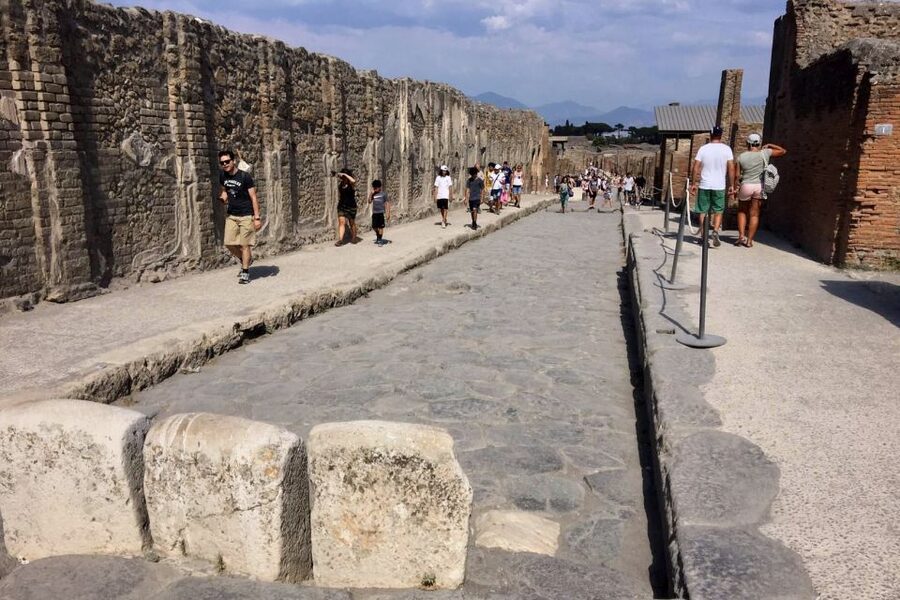
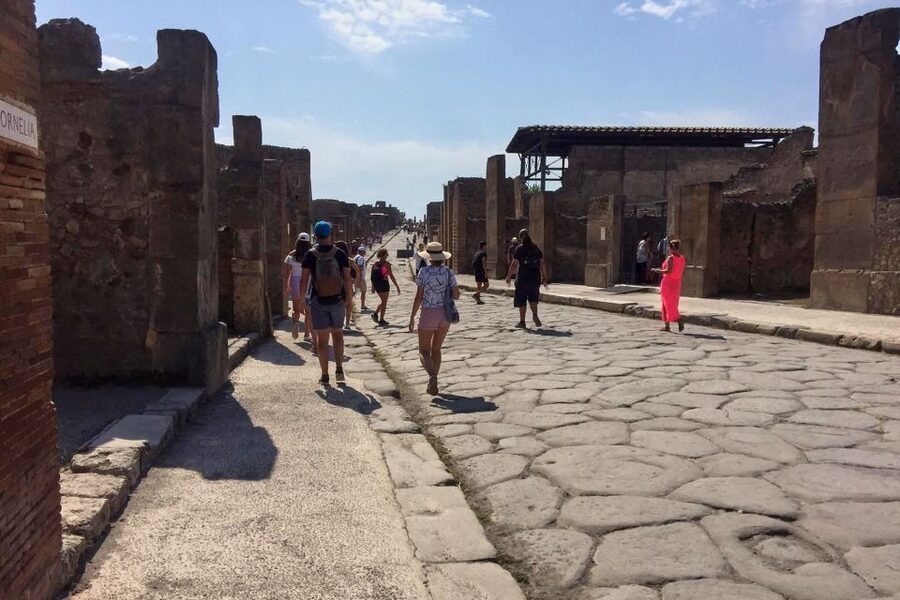
- The Forum, Thermal Baths, Lupanare, shops, and ancient streets form the core of the visit.
- The meeting point is outside the site, at the garden of Hotel Vittoria near the Cellini coral shop.
- Guides are available in English, French, Italian, and Spanish, but your preferred language is not guaranteed if only one person requests it.
- The walking surface and site size make this unsuitable for wheelchair users and people with mobility impairments.
- Two hours gives you a useful overview, but Pompeii is large enough to reward a longer independent visit afterward.
Why Pompeii works best with a guide
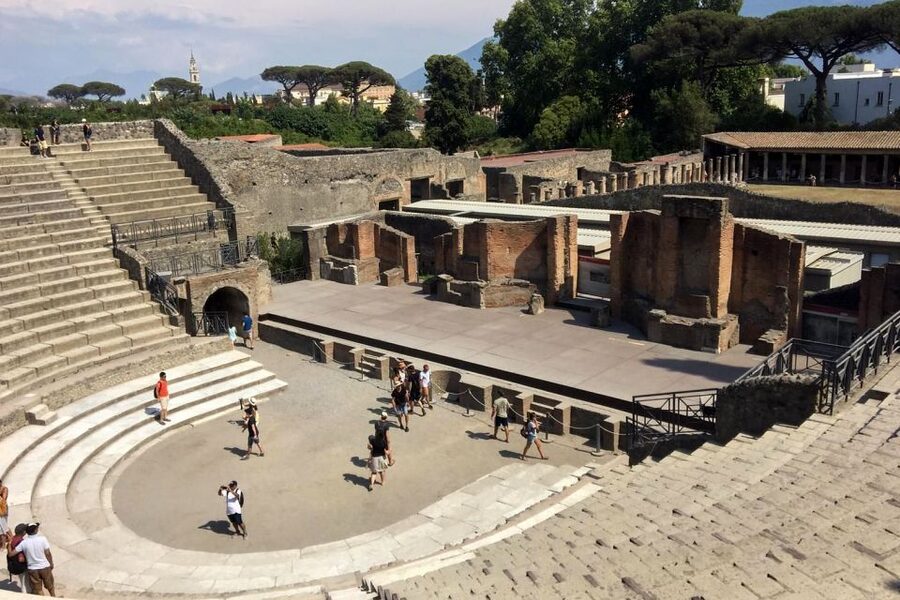
Pompeii is not a single grand monument with one clear route. It is a huge Roman town made up of streets, houses, shops, public buildings, and half-excavated areas. Without context, you can look at a wall or doorway and have no idea what it once meant.
A guide gives those stones a purpose. You learn how the Forum functioned as the civic center, why the baths mattered, and how shops were built into the street fronts. You also hear about the eruption and the slow excavation of a city buried under ash and volcanic debris for almost 2,000 years.
I especially like this kind of tour for a first visit. You do not need a background in Roman archaeology. Several guides have been praised for explaining difficult ideas in clear English, using humor, pictures, and simple comparisons. Francesca, Elisa, Maria, Imma, Mattia, and Salvatore are among the guides singled out for being engaging as well as well informed.
The style can vary from one guide to another. Some give a lively, informal talk with jokes and vivid stories. Others offer a calmer, more academic explanation. If you want detailed excavation data or a full study of Roman architecture, two hours will feel light. If you want to understand what you are looking at, the guided format is a strong choice.
More Tickets and Entries in Italy:
- Milan: Guided Walking Tour & Last Supper Visit with Ticket
★ 4.7 · 5,409 reviews - Florence: Duomo Complex with Tickets & City Walk Guided Tour
★ 4.7 · 2,057 reviews - David & Accademia Guided Tour with Time Entry Ticket
★ 4.5 · 1,705 reviews
Meeting at Hotel Vittoria near the Cellini shop
The stated meeting time is 10:50 a.m. The pickup point is in the garden of Hotel Vittoria, outside the coral shop called Cellini, at Via Mare, 80045 Pompei. Your guide should have a sign with the booking name.
This is close to the Pompeii Scavi area, but the entrance zone can be confusing. The site has a busy forecourt, tour groups, shops, and people looking for different operators. A few people have had trouble locating the guide, even when they had read the instructions carefully.
Give yourself extra time. Look for the guide rather than assuming the group will be obvious. Keep your phone available, since the company has contacted people by phone or WhatsApp when they were delayed or lost. Staff have also walked around calling names and helped late arrivals find the group.
The organization has generally been helpful when transport goes wrong. Some people arrived late because of traffic, a missed train, or a Circumvesuviana strike, and the company made a real effort to help them join. Still, waiting for late arrivals can push back the start, so do not schedule a tight train, bus, or lunch reservation immediately after the tour.
Entering Pompeii without buying a separate ticket
Your Pompeii Archaeological Area entrance ticket is included in the price. The listed ticket value is €20, which makes the $50 cost reasonable if you want a guide and do not want to sort out admission on your own.
Skip-the-ticket-line access saves the most time when the entrance is busy. It does not mean you walk straight through every security or ticket check, and it does not remove the need to find the group first. The meeting point and site entrance are not the same thing, so follow the instructions carefully.
The ticket arrangement is also useful for families. Children booked at the child rate must carry a valid passport or identity card. Staff can ask to see it at the ticket office, and without proof, the full adult fare may be required.
Once inside, collect or use the headset provided. The equipment matters here. Pompeii’s streets are wide in places, and the guide may stop ahead of you or beside a building. The audio system lets you listen while taking a few steps back for a photo. One person found the headset uncomfortable and would have preferred an earbud, but most people considered it important for hearing the commentary.
The Forum and the public heart of the city
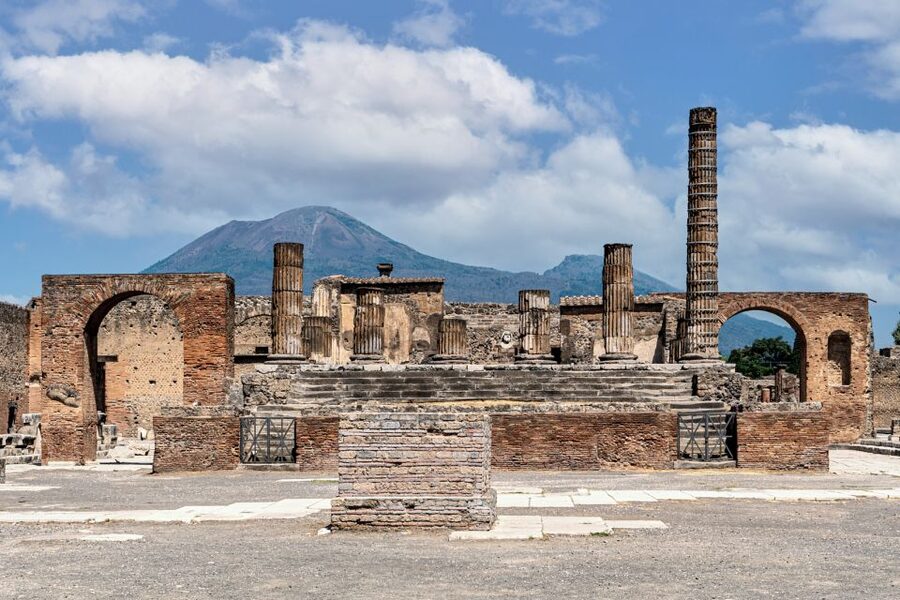
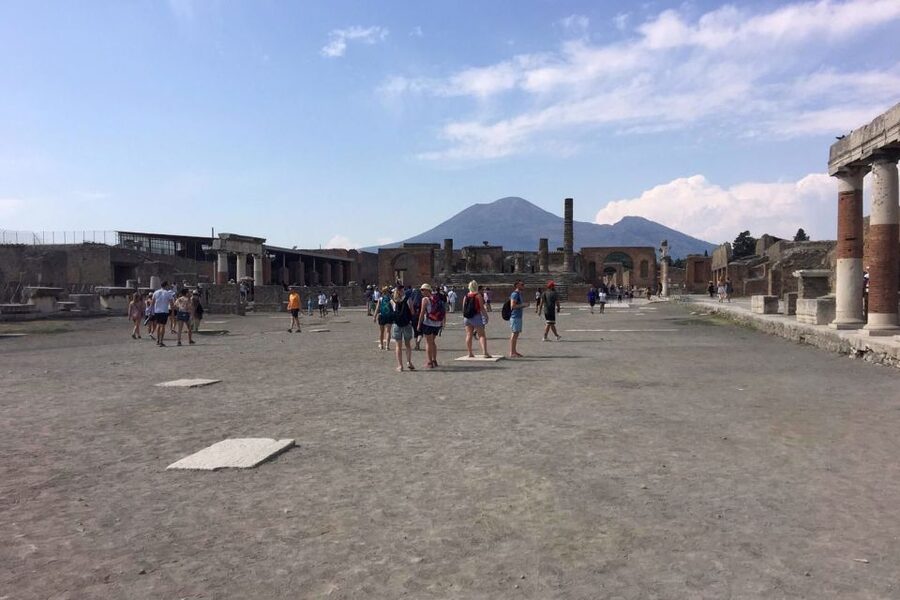
The Forum is one of the essential stops. This open civic space helps you picture Pompeii as a working Roman town rather than a collection of ruins.
Your guide explains how public life gathered here and points out the surrounding buildings. The value is not just seeing columns and broken walls. You begin to understand the layout of the city and the difference between private homes, commercial streets, religious spaces, and public institutions.
This is also where a guide can prevent a common mistake: judging Pompeii by its missing roofs and damaged walls. The eruption did not leave a neat museum display. Buildings were exposed gradually, and excavation is still incomplete. Roughly two-thirds of the site has been uncovered, so what you see is only part of the ancient town.
Allow time for photographs, but listen closely here. The Forum provides the basic map in your head that makes the rest of the tour easier to follow.
More Guided Walks in Italy:
- Naples: Street Food Walking Tour with Local Guide
★ 4.9 · 4,976 reviews - Florence: Highlights Walking Tour with Expert Guide
★ 4.6 · 4,662 reviews - Rome: Guided Food Walking Tour with Wine in Trastevere
★ 4.9 · 3,105 reviews - Venice: City Center Historical Guided Walking Tour
★ 4.2 · 1,873 reviews
Thermal Baths and the Roman daily routine
The Thermal Baths show how ordinary activities could become social rituals. A visit to the baths was not simply about washing. It was part of the rhythm of Roman life, and the rooms give you a useful look at the engineering and public habits of the period.
The guide connects the physical spaces to daily routines, helping you imagine how people moved through the complex. You may find the rooms easier to appreciate after hearing how they were used, since bare stone walls do not explain themselves.
This stop is especially good for families and first-time visitors because it links the ruins to familiar activities. You are not only looking at ancient construction. You are learning how the town’s residents spent time, met other people, and used public facilities.
The Lupanare and Pompeii’s less polite history

The Lupanare is one of Pompeii’s most famous buildings. It is also one of the places where a guide adds real value, because the site raises questions about Roman sex work, social class, and public behavior.
The commentary is generally direct rather than shy. One guide was praised for explaining the subject without taboos, while still keeping the tour accessible to people who did not already know much about Roman culture. This stop may not suit very young children, depending on your family’s comfort level.
The Lupanare can attract plenty of interest, so the group may need to move carefully and wait its turn. The guide’s explanation gives the building context instead of leaving you with a quick look and a funny story.
Streets, shops, wine signs, and ordinary life
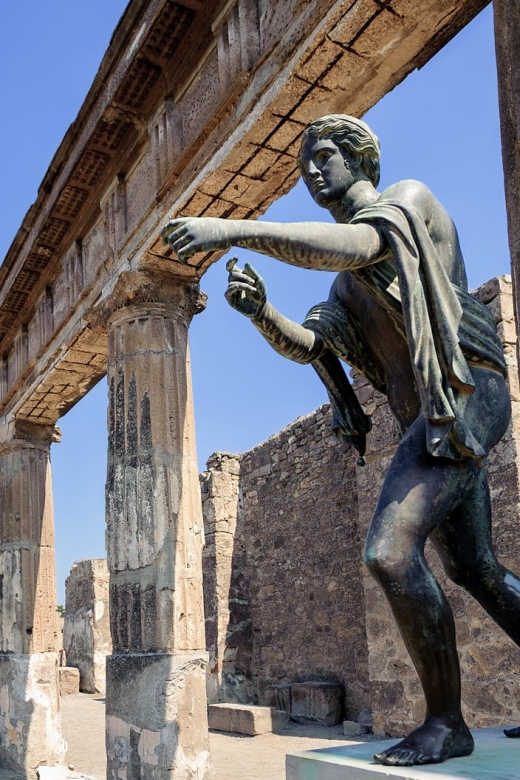
Some of the most memorable parts of Pompeii are not the grand public buildings. They are the streets and storefronts.
You will see roads with raised stepping stones and shops that once sold goods, including wine and produce. Signs and counters help you picture a town where commercial life opened directly onto the pavement. This is where Pompeii feels most like a neighborhood rather than an archaeological site.
I like this part of the route because it brings attention to people who were not emperors or generals. You see evidence of cooking, trade, domestic life, and local business. The buildings may be damaged, but the basic pattern of urban life remains easy to recognize.
The route also shows why comfortable shoes matter. You will walk over uneven ancient paving for two hours, often under open skies. Wear clothing suited to the forecast, bring water, and prepare for heat in sunny weather. Even a mild day can feel hot among the stone streets, with limited shade.
What the eruption adds to the experience

The eruption of Mount Vesuvius is not treated as a distant date to memorize. It explains why Pompeii looks the way it does.
Your guide describes what happened in 79 A.D. and how ash and volcanic material covered the town. That burial protected walls, paintings, streets, and household details for nearly two millennia, while also preserving a painful record of sudden disaster.
The emotional effect can be strong. You may move from a light explanation of a shop or bath to a quiet reminder that this was a real town whose residents had little warning. The experience is both fascinating and sobering.
Do not expect every object found at Pompeii to remain on site. Many important artifacts are displayed in museums, including the archaeological museum in Naples. What remains at Pompeii is the shape and feel of the town itself: streets, houses, public spaces, art, and fragments of daily life.
Two hours is useful, but it is not enough for all of Pompeii
The advertised duration is two hours. That is long enough to see several major highlights and gain a working understanding of the city, but it is not enough to see everything.
Pompeii is large, and the route may cover only a small section. One guide explained that a full visit could take far longer, even close to a week for someone intent on exploring every area. That is an exaggeration as a practical holiday plan, but it makes the point: this is not a complete survey.
The short format is helpful if you are visiting Pompeii as part of a wider Campania trip. It gives you a clear introduction without consuming an entire day. At the end, you may be able to remain inside and explore areas not covered by the guide, though the precise arrangement can depend on site rules and timing.
If you have a deep interest in Roman homes, paintings, or excavation work, plan extra time beyond the tour. If you are traveling by train, keep a generous buffer after the scheduled finish because late starts have occurred.
Guides, group feel, and language choices
The tour offers live commentary in English, French, Spanish, and Italian. A multilingual guide may operate the visit, and the preferred language is not guaranteed if only one person requests it.
The strongest feature across the experience is the quality of the guiding. Guides have been described as funny, patient, clear, energetic, and able to involve children. Mattia was praised for combining humor with strong explanations, while Alex was noted for keeping children engaged. Elisa received repeated praise for her warmth and ability to make the ruins feel alive.
Group size can affect the experience. A large group may be less intimate, and one late-starting tour became unwieldy after a guide failed to appear. On the other hand, the headset helps you hear even when you are not standing right beside the guide.
Do not book this expecting a private archaeological consultation. You are paying for a shared walking tour with a set route. For most first-time visitors, that tradeoff keeps the price manageable.
Is $50 good value?
At $50 per person, the tour costs more than entering Pompeii alone, but the comparison is not simply $50 versus €20. The price includes admission, a two-hour professional guide, and audio equipment.
I think the value is strongest if you are new to Pompeii, short on time, or uneasy about finding your way through a huge excavation. A guide helps you use two hours well and gives meaning to buildings you might otherwise pass without understanding.
The value is weaker if you already know the site, prefer reading at your own pace, or plan to spend a full day exploring independently. You may also feel disappointed if you expect a small group or a perfectly timed start.
The high overall rating of 4.3 from 1,423 ratings reflects a generally positive experience, but the weaker points are worth taking seriously: meeting-point confusion, occasional delays, headset comfort, and the limited route. Those are manageable concerns, not reasons to dismiss the tour.
Who should book this Pompeii walking tour?
Book it if you want a clear introduction to Pompeii, prefer a human explanation to a printed guide, or have only a short window in Campania. It is also a good fit for families who want the history told as stories rather than dates.
The tour suits people who can walk steadily over uneven ground and handle heat or rain. It is not suitable for wheelchair users or people with mobility impairments.
I would choose it for a first visit, especially if I had two hours and wanted to see the main public buildings, shops, and the Lupanare without planning a route myself. I would arrive early, confirm the exact meeting point, wear sturdy shoes, and leave extra time before my next train.
If you want a slower, more complete study of Pompeii, buy entry and allow much longer on site. If you want the major ideas and a useful route at a fair combined price, this guided walk is an easy recommendation.
FAQ
How long does the Pompeii guided tour last?
The tour lasts two hours. This covers several major highlights but not the entire archaeological area.
What is included in the price?
The price includes entrance to the Pompeii Archaeological Site, listed as a €20 ticket, a professional guide, and headsets to hear the commentary.
Where is the meeting point?
Meet at 10:50 a.m. in the garden of Hotel Vittoria in Pompeii, outside the Cellini coral shop at Via Mare, 80045 Pompei. The guide should have a sign with the booking name.
Which languages are available?
Live guides are available in English, French, Spanish, and Italian. If only one person requests a particular language, that language is not guaranteed.
What should I bring?
Bring comfortable shoes, weather-appropriate clothing, and a passport or identity card for children booked at the child rate.
Is the tour suitable for wheelchair users?
No. The activity is not suitable for wheelchair users or people with mobility impairments.
Can I cancel the booking?
You can cancel up to 24 hours before the tour for a full refund. A reserve-now, pay-later option is also available.
Just added around Italy
- Private Bologna Food & Market Tour with 6 Tastings & Wine★ 5.0 · 102 reviews
- Bologna Walking Tour with Audio and Written Guide★ 4.5 · 132 reviews
- Bologna historical art walking tour with hidden gems and tastings★ 5.0 · 108 reviews
- Bergamo: Digital guide made by a local for your walking tour★ 5.0 · 184 reviews
- Full Day Tour by Car and Walking among the Apulian Beauties★ 4.5 · 182 reviews
- The Original Street Food Walking Tour in Bari★ 4.5 · 226 reviews
- Bari Walking City Tour★ 4.5 · 511 reviews
- Bari: Street Food Walking Tour with a Local Guide★ 5.0 · 160 reviews
Italy Walking Tours, compared.

Doge’s Palace and St Mark’s Basilica Walking Tour
Read our review →
Guided Walking Tour & Last Supper Visit with Ticket
Read our review →

San Marco to Rialto Walk & Spritz Like a Local
Read our review →
Uffizi & Accademia Timed Entry: Small Group Duomo Walking Tour
Read our review →

Browse the lists this tour appears in