
Review · PRIVATE WALKING TOURS
Assisi Private Walking Tour including St. Francis Basilica
Assisi rewards a slower, guided walk. This private tour gives you your own guide and a flexible route, so the visit can match your interests instead of following a fixed script. I especially like the way it connects St. Francis and St. Clare with Assisi’s Roman past, and the attention given to the Basilica of St. Francis, where art and devotion share the same walls. The main drawback is the town’s steep streets, plus the chance that church access will be limited on Sundays, holidays, or during the 2026 relic display.
The price is $278.16 for up to 15 people, which can be good value for a family or full group but feels much less attractive for one or two people. Guides such as Michele, Francesca, Antonella, Alessandra, Andrea, and Daniela have been praised for their storytelling, art knowledge, patience, and willingness to tailor the walk.
The 2.5-hour outing begins at Piazza Santa Chiara and ends at the Basilica of St. Francis. You will need modest clothing for churches, and the Basilica requires a separate €3 headset fee per person.
Key points to know before booking
- A truly private format: Only your group takes part, with a maximum of 15 people.
- A strong saint-and-art focus: The walk brings together St. Clare, St. Francis, Roman Assisi, and the major basilicas.
- A useful guide advantage: Guides can adjust the pace and explain paintings, architecture, religious traditions, shops, restaurants, and local transport.
- A hilly route: Assisi involves plenty of uphill and downhill walking, which matters in hot weather or if you have a back or knee problem.
- Basilica rules can change the visit: On Sundays and major holidays, the guide may explain the church outside while you enter alone in silence.
- Best group value: The flat group price works best when shared by a family or larger party.
Why a private walk works well in Assisi
Assisi is compact enough to explore on foot, but it is not a flat, simple town. Its streets rise and fall across the slope, churches sit at different ends of the historic center, and the meaning of a building often depends on knowing what came before it.
That is where a private guide earns the fee. You are not just pointed toward a church and left with a name. A good guide explains how St. Francis and St. Clare fit into Assisi’s religious life, how Roman buildings were reused, and how medieval paintings communicated stories to people who could not read.
The private setup also gives you room to ask questions. If your group cares most about Franciscan spirituality, the guide can lean that way. If you prefer art, architecture, or local history, guides such as Alessandra and Andrea have been praised for explaining painters, fresco methods, and visual details.
This is especially helpful for families. One guide, Werner, is noted for keeping four teenagers engaged while also explaining St. Francis, St. Clare, and Carlo Acutis. Other guides have adjusted the pace for older participants, hot weather, and physical limits.
More Private Walking Tours in Italy
- Private 3 hrs Venice Tour: St Mark’s, Walking tour & Boat tour
★ 4.0 · 3,372 reviews - Private Best of Venice Walking Tour with St Mark’s Basilica
★ 4.0 · 1,063 reviews - Venice: Private Walking Tour with a Local
★ 4.6 · 761 reviews
Starting at Santa Chiara and Chiesa Nuova
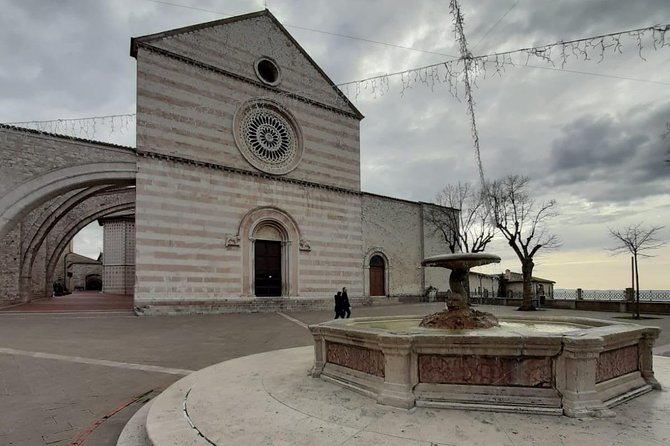
The meeting point is Piazza Santa Chiara, outside the Basilica of Saint Clare. This is a practical starting place because St. Clare’s church immediately places you in the central story of Assisi.
The Basilica of Saint Clare contains the remains of Clare, the follower of Francis who founded the Order of Poor Ladies, now known as the Order of Saint Clare. The church is not just an opening photo stop. It gives you a chance to understand Clare as a major religious figure in her own right, rather than simply a supporting character in Francis’s story.
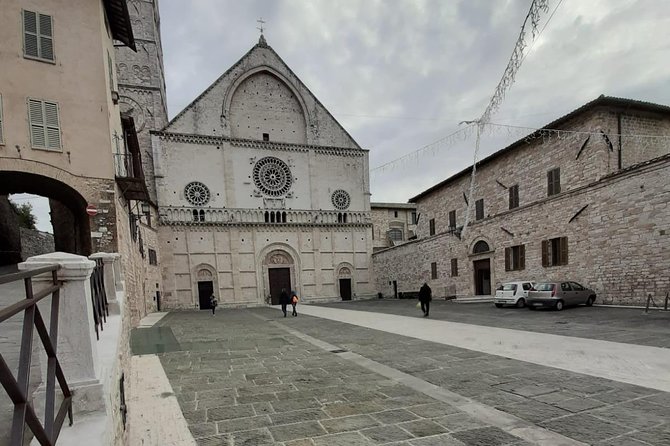
The route then includes Chiesa Nuova, built in 1615 on the site believed to have been St. Francis’s home. Its Renaissance design is easy to read from the outside, with a brick façade, four pillars, a Doric entablature, an attic gable, and a rounded dome.
You get about 20 minutes here, and admission is free. The value is in the guide’s explanation of the site and its connection to Francis. Without that context, you might see a handsome church and move on. With it, the building becomes part of the town’s effort to preserve the physical memory of its most famous son.
Piazza del Comune and the Roman center
Piazza del Comune occupies the site of Assisi’s ancient Roman Forum. It is one of the best places on the route for seeing how several periods of history sit on top of one another.
The square is rectangular and connects toward the Basilica of Santa Chiara along Corso Mazzini. You will also see the sixteenth-century Fountain of the Three Lions, revised in 1762 by Giovanni Martinucci.
The scheduled stop is short, about 10 minutes, so do not expect a long pause here. That brevity makes sense on a walking tour with several churches ahead, but you may want to use the moment to look around and listen carefully to the guide’s explanation.
Piazza del Comune is also a useful orientation point. The tour helps you understand how the modern town relates to the Roman settlement and the Rocca Maggiore above it. Even without a separate visit to the fortress, its presence helps explain Assisi’s position on the hillside.
Santa Maria sopra Minerva, a Roman temple with a church inside
This is one of the most striking stops because the building began as something very different from the church you see today.
The Temple of Minerva was built in the first century at the request of Gnaeus Caesius and Titus Caesius Priscus, two local officials who helped finance it. The ancient Roman structure now houses Santa Maria sopra Minerva, a church built in 1539 and later renovated in Baroque style.
You are scheduled to spend about 30 minutes here, and that is enough time to notice the unusual pairing of Roman temple architecture and Christian worship. I like this stop because it broadens the tour beyond saints and basilicas. Assisi is not only a pilgrimage town. It is also a Roman town that was repeatedly adapted over the centuries.
The guide’s role matters here. A quick visit might leave you with the impression of an old façade and a church interior. A clear explanation helps you see the building as a record of changing beliefs, uses, and architectural tastes.
Same streets, a different way to see them:
- Venice: Doge’s Palace and St Mark’s Basilica Walking Tour
★ 4.4 · 6,291 reviews - Milan: Guided Walking Tour & Last Supper Visit with Ticket
★ 4.7 · 5,409 reviews - Naples: Street Food Walking Tour with Local Guide
★ 4.9 · 4,976 reviews - Florence: Highlights Walking Tour with Expert Guide
★ 4.6 · 4,662 reviews
The Basilica of Saint Francis and its sacred setting
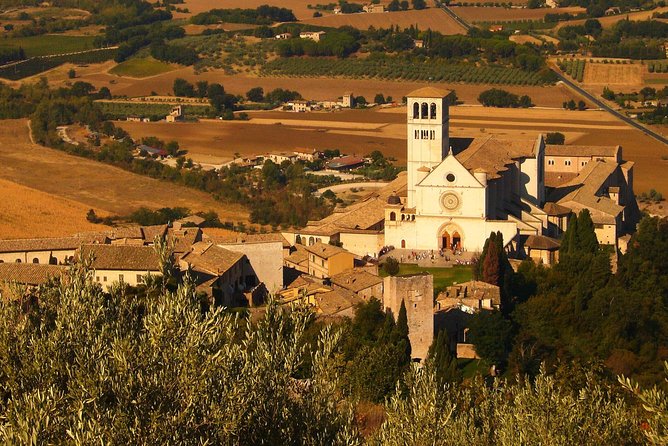
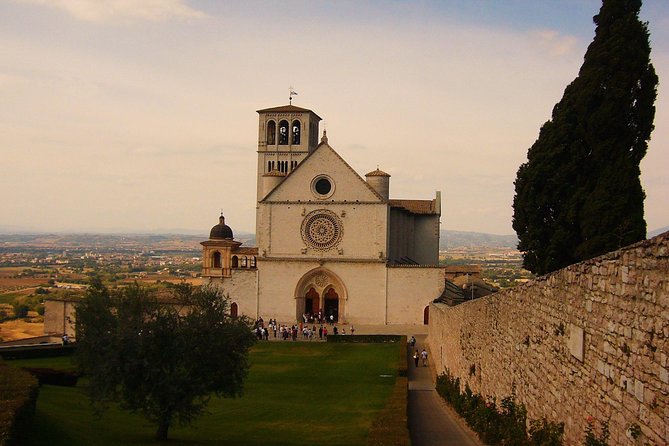
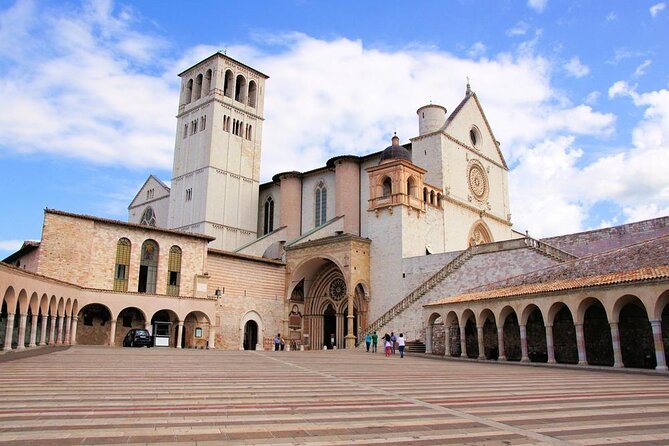
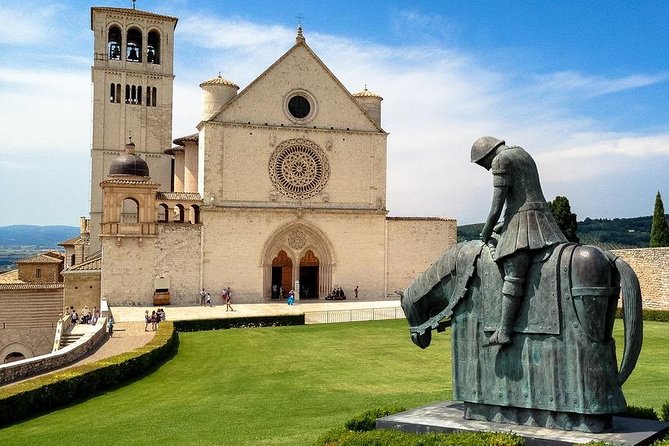
The tour ends at the Basilica of St. Francis, the church of the Order of Friars Minor Conventual and the principal religious site associated with Francis’s life and death.
The basilica is more than a single church. It is a large complex with a lower and upper church, the Sacred Convent, and a setting that has drawn pilgrims for centuries. The route allows about 45 minutes for the basilica, with another 45-minute segment describing its bright, spacious interior and painted vaults.
That time is useful, but do not expect to see every detail. The basilica contains too much art and religious symbolism to absorb in one short visit. A good guide helps you focus on the most important sections rather than leaving you to scan a vast interior without a plan.
The architecture described for the church includes a single four-bay nave, a cross-vaulted ceiling, a transept, and a polygonal apse. The vaults alternate between golden stars on blue backgrounds and painted decoration. Look up often, but also look at the walls and listen to the stories behind the images.
One especially strong part of the guiding style is the explanation of medieval art as a form of public teaching. Alessandra, for example, has explained how paintings and frescoes served as visual lessons in an age before television, film, or widespread literacy. That context changes how you see the art. The images were not simply decoration. They helped people understand religious stories.
She also explained how wet and dry fresco techniques age differently, and how paints containing iron can oxidize and create a photographic negative effect. Details like this are valuable if you care about art, because they help explain why some colors and faces look altered today.
What happens on restricted church days
The basilica visit comes with important limits. On Sundays, major Catholic holidays, and Italian national holidays, guided tours inside the Basilica of St. Francis are forbidden.
In that case, your guide explains the church from outside, and you enter alone in silence. That still gives you access to the building, but it is not the same as having a guide beside you to point out details and answer questions.
There is also a special restriction from February 15 through April 6, 2026, when access to the basilica is suspended because of the public display of St. Francis’s relics. During that period, the guide provides the explanation from outside.
Check your date before paying. If the basilica is the main reason you want this tour, these restrictions matter more than the private format.
The guides are the heart of the experience
The strongest pattern in the guide feedback is not one single personality. It is the quality of explanation and personal attention.
Michele is praised for adapting a family tour to the group’s interests and for explaining both Assisi and the wider Umbrian region. He also paid attention to a participant with a back injury and hot-weather concerns. That sort of awareness can make a steep walking route much easier.
Francesca is described as friendly, clear, and strong at telling the story of the town and its basilicas. Antonella has been praised for her command of art, church history, St. Clare, and St. Francis. Andrea is especially valued for answering questions and explaining art.
Other guides have helped with practical matters after the tour, including restaurant suggestions, shops, taxi and bus information, a bank for buying euros, and places to seek shelter during thunderstorms. These extras are not guaranteed, but they show how a private guide can make the rest of your Assisi visit easier.
The guide quality can vary from person to person, as it does with any guide service. One participant felt the explanations took too long and that the price was not justified without headsets. That is a fair caution. If you already know Assisi well and prefer to move quickly, a private guide may feel unnecessary.
Walking conditions, clothing, and the headset fee
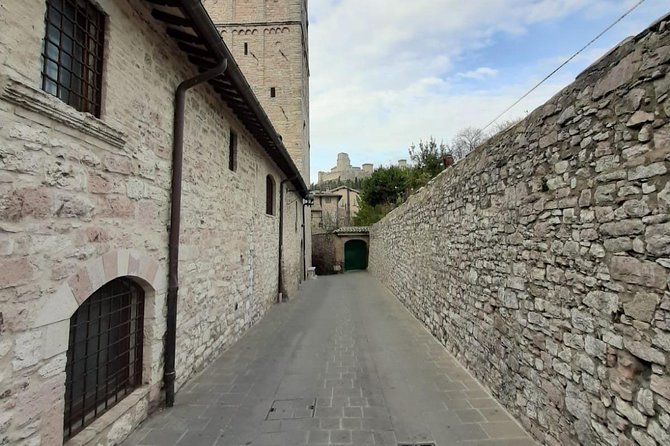
You should be ready for hills. Assisi has plenty of uphill and downhill walking, and the heat can make the route feel harder. Wear shoes with good support, bring water, and tell the guide early if you need a slower pace.
The tour is generally suitable for most people, but the physical demands are real. A private group helps because the guide can adjust the rhythm more easily than a large scheduled group.
Church dress rules are strict. Men and women must cover their knees and shoulders, and shorts or sleeveless tops can lead to refused entry. Carry a light layer if you are visiting in warm weather.
Headsets for the Basilica of Saint Francis cost €3 per person and are not included. This small charge matters because the basilica can be large and quiet, and it may be difficult to hear without audio equipment. One participant specifically found the lack of headsets frustrating. Budget for them, especially if your group includes children, older adults, or anyone with hearing difficulty.
Is $278.16 a fair price?
The flat price covers a private tour for up to 15 people. For a full family or group, the math is appealing. Split among 10 people, it works out to about $27.82 each. Split among four, it is about $69.54 each. For only two people, the cost is much harder to justify.
The price includes a professional guide and the private format. It does not include the €3 headset fee per person, and the tour does not list separate admission for the basilica because the church access rules can vary.
I would see this as a value purchase for three types of groups: families with mixed ages, visitors who care deeply about Franciscan history, and people who want an art-focused explanation instead of a quick church visit. It is less compelling for independent visitors who are happy using a guidebook and following signs.
The tour is often booked about 60 days ahead, so the date you want may require planning. Free cancellation is available if you cancel at least 24 hours before the start time. Cancellations or changes made inside that window are not refunded or accepted.
Who should book this private Assisi tour?
I would book it if you want Assisi to make sense as a whole. The route links Clare, Francis, Roman Assisi, medieval art, Renaissance architecture, and present-day religious life in one walk.
It is also a good choice if your group has specific interests. Tell the guide if you want more time for paintings, saints, church architecture, local shops, food, or practical transport advice. The private format gives you a better chance of getting that personal focus.
I would skip it if you strongly prefer exploring alone, already know the town, or are visiting on a date when the basilica cannot be guided from inside. You can walk through Assisi without a guide, and one participant felt that was the better value.
For most first visits, though, the guide adds real substance. The town’s beauty is easy to see. The harder part is understanding why each church, painting, and street matters. That is where this tour earns its place.
FAQ
How long does the private Assisi walking tour last?
The tour lasts approximately 2 hours and 30 minutes.
Where does the tour begin?
It begins at Piazza Santa Chiara in Assisi.
Where does the tour end?
It ends at the Papal Basilica and Sacred Convent of Saint Francis at Piazza Inferiore di San Francesco, 2.
How many people can join the private tour?
The price covers one private group of up to 15 people. Only your group participates.
Is the Basilica of Saint Francis included?
The tour includes a visit and explanation of the Basilica of Saint Francis, but headsets are not included. They cost €3 per person.
What should I wear?
You must cover your knees and shoulders to enter places of worship and selected museums. Shorts and sleeveless tops are not allowed.
Can the basilica be visited with the guide on Sundays and holidays?
On Sundays, major Catholic holidays, and Italian national holidays, guided tours inside the Basilica of Saint Francis are forbidden. The guide explains the church from outside, and you enter alone in silence.
Can I cancel for a full refund?
Yes. You can cancel up to 24 hours before the experience starts for a full refund. Cancellations or changes made less than 24 hours before the start time are not accepted.
Just added around Italy
- Bergamo: Digital guide made by a local for your walking tour★ 5.0 · 184 reviews
- Full Day Tour by Car and Walking among the Apulian Beauties★ 4.5 · 182 reviews
- The Original Street Food Walking Tour in Bari★ 4.5 · 226 reviews
- Bari Walking City Tour★ 4.5 · 511 reviews
- Bari: Street Food Walking Tour with a Local Guide★ 5.0 · 160 reviews
- Bari Walking Tour with Pasta Experience★ 4.5 · 270 reviews
- Private St. Francis Basilica of Assisi and City Walking Tour★ 5.0 · 114 reviews
- Milan: City Highlights Walking Tour with The Last Supper★ 4.9 · 195 reviews
Private Walking Tours, compared.
Private 3 hrs Venice Tour: St Mark’s, Walking tour & Boat tour
Read our review →
Private Street Food Evening Walking Tour in Ho Chi Minh City
Read our review →
Old Quebec City: Grand Walking Tour with Private Option
Read our review →
Barcelona Helicopter, Sailboat & Old Town Private Walking Tour
Read our review →
Browse the lists this tour appears in