
Review · ATHENS WALKING TOURS
Athens Acropolis and Parthenon Walking Tour
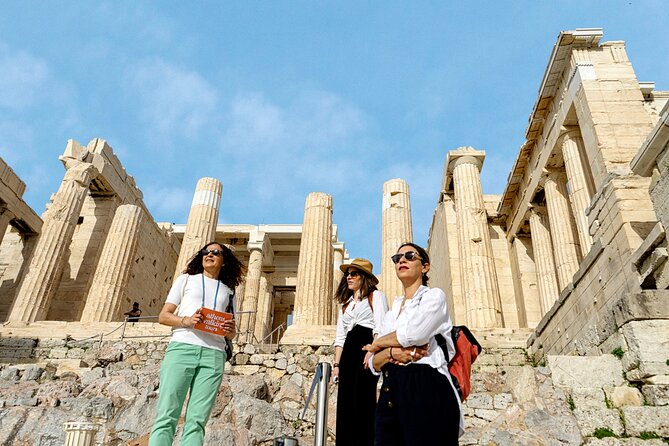
Ancient Athens rewards a good guide. This two-hour walk gives you clear historical context for the Acropolis, Parthenon, Theatre of Dionysus, and other major monuments instead of leaving you to decode broken stones alone. I especially like the personal earsets, which help you hear the guide in a crowded place, and the steady stops on the uphill route. The main catch is the ticket setup: the $41.12 base price does not include the €30 Acropolis admission unless you choose the ticket option or arrange your own valid ticket.
You meet near the base of the Acropolis at a yogurt bar on Dionysiou Areopagitou Street. From there, a licensed guide leads a group of up to 24 people through the archaeological site, with time for photos and questions. Bring water, a hat, sunscreen, and shoes with a firm grip. The ground is uneven, the route climbs, and the midday sun can be fierce.
Key points to know before booking
- The guide makes the ruins readable: You get background on the buildings, Greek gods, drama, medicine, architecture, and modern Athens.
- The tour uses personal earsets: These usually make it easier to follow the commentary in a large group, though wind and occasional headset faults can affect the sound.
- The route covers the essential monuments: Expect the Theatre of Dionysus, Asklepeion, Odeon of Herodes Atticus, Propylaea, Temple of Athena Nike, Erechtheion, and Parthenon.
- The ticket choice matters: Admission costs €30 per person unless it is included in the option you book. A valid ticket is required to join the walk.
- The climb is manageable but real: People in their 70s have completed it at a comfortable pace, but the uneven surfaces require care.
- You get useful Athens extras: The tour includes a city map and an Athens guide magazine for planning the rest of your stay.
Why a guided Acropolis walk is worth your time
The Acropolis is easy to admire and surprisingly hard to understand on your own. You see grand columns, weathered foundations, and theaters cut into the hillside, but the meaning of each place can blur together without a clear story.
A good guide gives the hill a sequence. You learn how religion, theater, healing, politics, architecture, and daily life met on this rocky height. The Parthenon becomes more than a famous photograph, and the Theatre of Dionysus becomes more than a semicircle of stone.
This tour is also useful if you have only a short time in Athens. The route stays focused on the Acropolis archaeological site and the major monuments around it, rather than adding a long museum visit or a broad city tour. In about two hours, you get an organized introduction and still have much of the day left.
The guides receive especially strong praise for their energy and storytelling. Names singled out in the feedback include Alexia, Andrea, Elena, Dora, Phillipa, Victor, Hermes, and Annie. Their styles vary, but the best moments come when a guide answers questions rather than reciting a fixed speech. One guide, Phillipa, was praised for handling questions about mythology, architecture, ancient history, and modern Athens while leaving time for photographs.
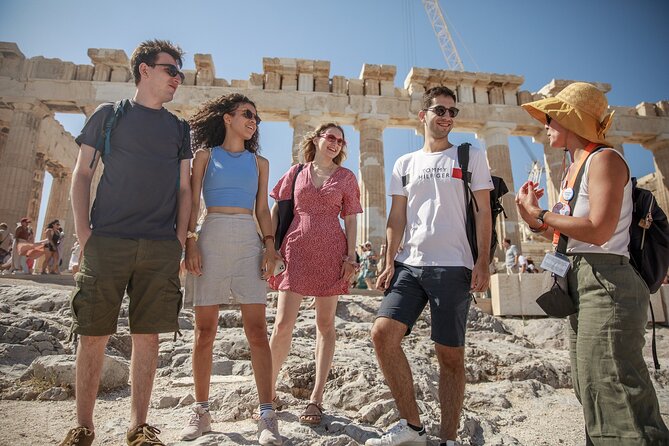
The personal audio units are an important practical feature. Each person receives an earset connected to the guide’s microphone, so you do not need to crowd around the guide to hear. This worked very well for some visitors, even in busy spaces. Still, do not treat the equipment as foolproof. Wind made one tour difficult to hear, and another headset produced static and cut in and out.
A few more walks around Athens worth a look
- Athens: Acropolis and Parthenon Guided Walking Tour
★ 4.6 · 5,882 reviews - Acropolis and Parthenon Guided Walking Tour
★ 5.0 · 4,755 reviews - Greek Food Walking Tour in Athens
★ 5.0 · 4,740 reviews
Meeting at LUKUMADES and starting uphill
The meeting point is LUKUMADES, at Dionysiou Areopagitou 3, near the base of the Acropolis. The tour ends near Acropoli station in Athens, so you finish in a useful part of the city for continuing on foot or by public transportation.
Arrive early. Acropolis entry times are strict, and the guide cannot wait for late arrivals. There are also airport-style security checks, which can create waits of 30 minutes or more during the busiest periods. A late start is not simply an inconvenience here, since the group’s admission time is tied to a fixed slot and late arrivals receive no refund.
If you book the option without admission, pay close attention to the instructions after booking. You receive a separate email with a link to purchase your Acropolis ticket, and you must complete that step within 48 hours of booking and no later than 24 hours before the tour. You need a valid entrance ticket in hand to join the group.
The ticket arrangement is the least simple part of this experience. The base price is $41.12 per person, but the €30 admission fee is extra unless you select the ticket-included option. If you qualify for a reduced admission price, bring valid identification or a passport to prove your age and nationality at the site.
Theatre of Dionysus: where Greek drama began
The walk introduces the Theatre of Dionysus early in the route. This is one of the most meaningful stops because it connects the stones under your feet with the plays of Aeschylus, Sophocles, and Euripides.
Your guide explains the theater as the birthplace of formal Western drama. You can picture ancient audiences sitting on the hillside while tragedies and comedies unfolded below. The stop is scheduled for about 15 minutes, enough for an explanation and a look around without turning the tour into a long lecture.
The uphill route begins to feel real here. The walk is not a flat stroll through a museum. You will be moving over stone and climbing gradually, so take the guide’s stops as chances to catch your breath, look around, and take photographs.
Asklepeion and the ancient search for healing
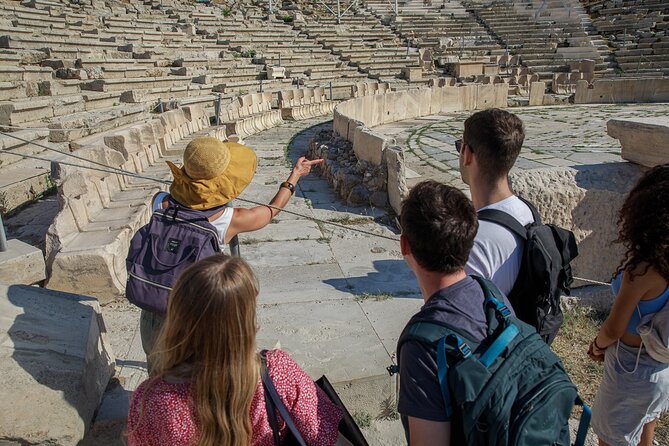
The Temple of Asclepios, or Asklepeion, offers a different view of Greek life. This sanctuary was dedicated to Asclepius, the god of medicine, and ancient Athenians came here seeking cures or giving thanks for restored health.
This stop helps balance the usual focus on temples and war. The Acropolis was not only a place for grand public religion. It also held spaces connected to illness, recovery, and hope.
The scheduled visit is about 10 minutes. I like this stop because it gives the tour a human scale, though visitors mainly interested in the Parthenon may find the extra context less memorable than the monuments at the summit.
Same streets, a different way to see them:
- Acropolis: Acropolis and Parthenon Guided Walking Tour
★ 4.7 · 3,442 reviews - Athens: Guided Greek Food Walking Tour with Tastings
★ 4.9 · 2,859 reviews - Acropolis monuments & Parthenon Walking Tour with Optional Acropolis Museum
★ 5.0 · 2,678 reviews - Acropolis, Parthenon & Athens Old City Heritage Walking Tour
★ 4.5 · 876 reviews
Odeon of Herodes Atticus and Philopappos Hill
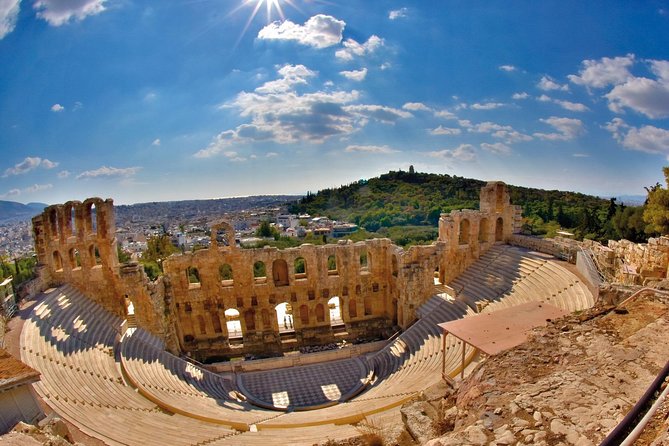
The Odeon of Herodes Atticus is a large stone theater built in AD 161. Unlike many ancient structures that survive only as fragments, this one still hosts performances and concerts today.
The guide explains how the venue links ancient Athens with the modern city. You get about 10 minutes here, usually enough to take in the dramatic shape of the theater and understand why it remains a working cultural site.
The route also gives you views toward Philopappos Hill, called the Hill of the Muses. Its monument honors Philopappos, a Roman benefactor, and the hill provides a pleasant pause with broad views over Athens. The supplied route description treats this as a viewing and reflection point rather than a full climb of the hill, so do not expect a separate excursion there.
Temple of Athena Nike and the Propylaea
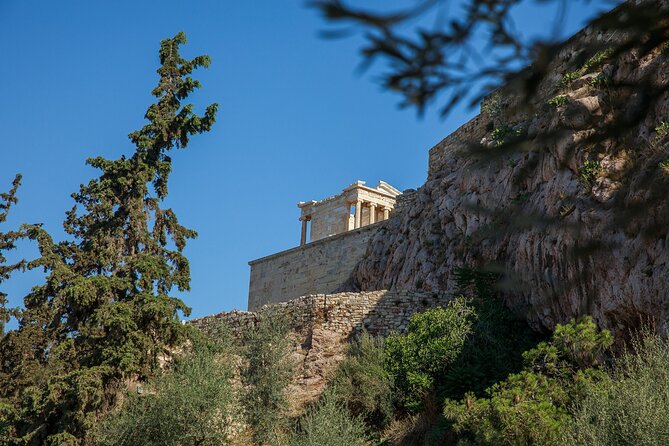
The Temple of Athena Nike sits on a bastion at the southwest edge of the Acropolis. Its small scale and graceful position make it a fine contrast to the bulk of the Parthenon. The guide explains Athena in her role as the goddess of victory, while the location offers views over the city.
The planned stop lasts about five minutes. That is brief, but the temple is part of a tightly timed route, and you will still have time to look closely as the guide speaks.
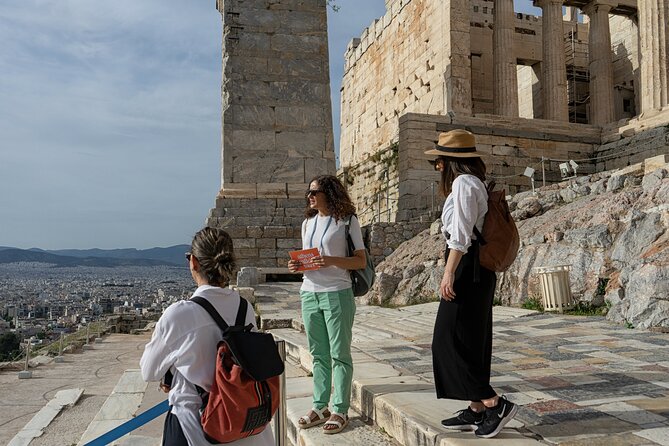
Next comes the Propylaea, the monumental gateway to the Acropolis. Designed by Mnesikles, it was meant to create a grand approach to the sacred hill. Even in its damaged condition, the entrance gives you a sense of ceremony. You pass through it as ancient visitors once did, though the modern crowd and security process are less poetic.
The Propylaea stop is also about five minutes. Keep your group in sight here. The entrance area can feel crowded, and the audio system works best when you remain close enough to the guide.
Erechtheion and the famous Caryatids
The Erechtheion is one of the most visually distinctive buildings on the Acropolis. Its unusual design reflects the fact that it served more than one sacred purpose, including worship connected with Athena and Poseidon.
The Caryatid Porch is the star attraction. Six carved female figures support the porch roof, creating one of the most recognizable images on the hill. The guide explains the architecture and the religious associations, giving you a better reason to look closely rather than simply taking the expected photograph.
You spend around 15 minutes here. That is enough time for the guide’s explanation and some pictures, though the area can be crowded. Stay alert to where the group is standing and avoid blocking narrow viewing points.
The Parthenon: the main event
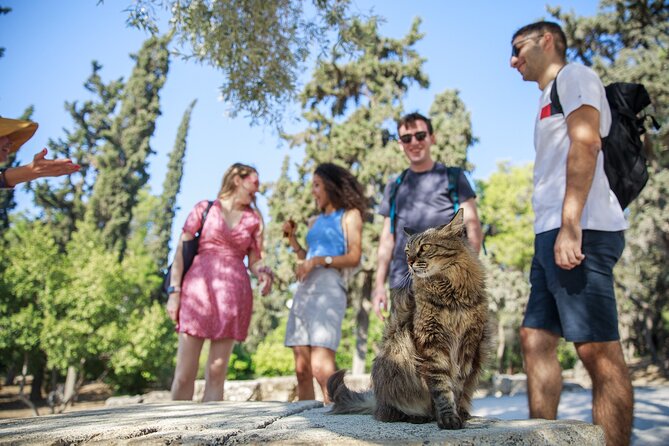
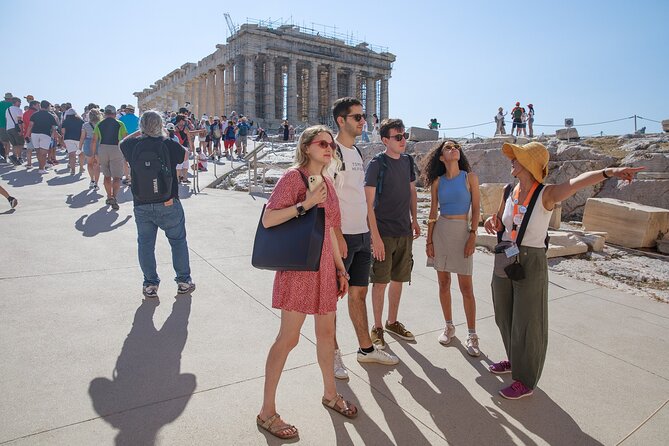
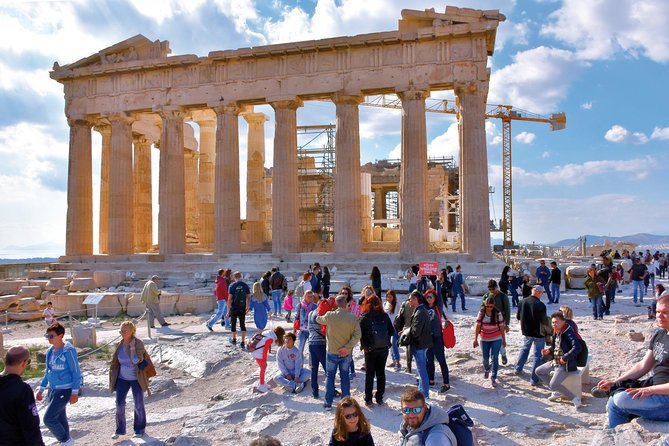
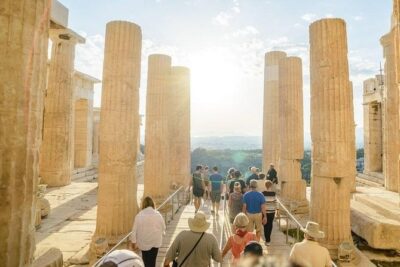
The final major stop is the Parthenon, the temple dedicated to Athena Parthenos. This is the moment most people have been waiting for, and the tour gives it about 25 minutes, the longest scheduled stop on the route.
A guide can help you see details that disappear at first glance. You learn about the temple’s role in classical Athens, its architectural achievement, and its place as a symbol of Greek civilization. You also get time to step back, look across the city, and take photographs without being rushed through in a few minutes.
The Parthenon is not a perfect, untouched building. It has suffered damage, weathering, conflict, and the removal of major sculptures. The broken condition is part of what you are seeing, and a good guide helps separate ancient design from later loss.
This is also where the physical demands of the site can catch up with you. The surfaces are uneven and can be slippery or unstable, and there is little relief from heat on a clear day. The tour’s measured pace helps, but it cannot remove the climb. Wear comfortable shoes and bring water rather than hoping to buy what you need inside.
Group size, pace, and sound quality
The maximum group size is 24 people. That is not a private tour, but it is small enough for a guide to keep the group together and answer questions without losing half the party.
The pace appears to be one of the tour’s strongest features. Several comments praise the guides for making frequent stops, allowing photographs, and adjusting the walk so people did not feel exhausted by the summit. Two people in their 70s found the uphill route manageable, while others emphasized that the ground is rough and the tour is not suited to someone who wants a completely effortless outing.
The earsets are a smart answer to the site’s crowds. When they function properly, you can listen while walking between monuments instead of standing shoulder to shoulder around the guide. One guide also used shade whenever possible, and guides made an effort to keep groups comfortable during rain.
Still, sound quality is not guaranteed on every outing. Wind can interfere, and a faulty unit can produce static or a broken signal. If you cannot hear, tell the guide immediately instead of quietly missing half the explanation.
Price and what the €30 ticket changes
At $41.12 per person before admission, the tour is reasonably priced for a short guided visit, especially if you value a licensed guide, the earset, and a structured route through the main monuments. You are paying for interpretation and organization, not just entry to the hill.
The admission fee changes the total cost considerably. The Acropolis entrance is €30 per person unless the ticket-included option is selected. Compare the final price of both choices before booking. The ticket option is simpler because it removes the need to arrange admission yourself and may let you skip the ticket-office line.
The tour is not a bargain if you want only to enter, wander at your own speed, and read the signs. It is better value if you want the major sights explained in a short window and prefer not to manage the ticket process alone.
The Athens map and guide magazine are modest extras, but useful. You can use them to plan another walk after the tour, especially since the Acropolis introduction does not attempt to cover every corner of Athens.
Who should book this experience
I would choose this tour if you are visiting Athens for the first time, have limited time, or want the ancient site explained by a local professional. It is also a sensible choice for families and mixed-age groups because the guide can set a common pace and answer questions as they come up.
It suits people who enjoy stories about mythology, religion, architecture, theater, and ancient daily life. The best guides add humor and warmth, turning a hot climb into a more engaging experience.
You should think twice if you dislike fixed entry times, group touring, or uneven ground. A stroller is not allowed on the archaeological site, and there is no cloakroom at the side entrance used by the group. A baby pouch is recommended instead. There are also no toilets once you are inside the site, so plan ahead before entering.
The experience requires good weather. If poor weather cancels the tour, you are offered another date or a full refund. Normal cancellation is free up to 24 hours before the start time, while later cancellations and changes are not refunded.
My verdict on the Acropolis and Parthenon walk
Book this tour if you want the Acropolis to make sense, not merely appear in your camera roll. The guide quality is the biggest reason to go, with strong reports of clear explanations, lively storytelling, patience with questions, and thoughtful pacing.
Choose the ticket-included option if you want the simplest arrival. If you arrange admission yourself, set a reminder for the separate ticket email and check the entry time carefully.
I would not book it for a lazy morning or a completely independent visit. You will climb, walk on uneven stone, follow a group, and manage heat or wind. But for a focused two-hour introduction to Athens’ most important ancient site, the combination of a licensed guide, audio equipment, and a well-planned route offers solid value.
FAQ
How long does the Acropolis and Parthenon tour last?
The tour lasts approximately two hours.
Is the Acropolis admission ticket included?
Admission is included only if you select the ticket-included option. Otherwise, the €30 entrance fee is not included, and you must have a valid ticket to join the tour.
Where does the tour meet?
The meeting point is LUKUMADES at Dionysiou Areopagitou 3, Athens 117 42, near the base of the Acropolis.
Where does the tour end?
The tour ends near Acropoli in Athens, at 117 42.
Is the tour offered in English?
Yes. The tour is offered in English.
Are headphones or earsets provided?
Yes. Earsets are provided so you can hear the guide while moving through the site.
Can I bring a baby stroller?
No. Baby strollers are not allowed on the Acropolis archaeological site, and there is no cloakroom at the side entrance. A baby pouch is recommended.
What should I bring to the tour?
Bring comfortable walking shoes, sunscreen, a hat, water, and clothing suited to the weather. You should also arrive on time because strict entry times mean late arrivals cannot be accommodated.
Just added around Athens
- Acropolis monuments, Parthenon and Plaka, Monastiraki walking tour★ 5.0 · 182 reviews
- The Acropolis, Athens Walking City Tour and Acropolis Museum★ 5.0 · 442 reviews
- Athens Street Art Walk★ 5.0 · 309 reviews
- Athens Street Food Walk★ 5.0 · 385 reviews
- Athens Shore Excursion: Acropolis Walking Tour★ 4.5 · 131 reviews
- Athens Off the Beaten Track Private City Walking Tour★ 5.0 · 304 reviews
- Athens at Night Small-Group Walking Tour with Dinner★ 5.0 · 230 reviews
- Athens Highlights: Myths & Philosophers Walking Tour★ 5.0 · 125 reviews
Athens Walking Tours, compared.

Acropolis: Acropolis and Parthenon Guided Walking Tour
Read our review →
Acropolis monuments & Parthenon Walking Tour with Optional Acropolis Museum
Read our review →
Acropolis, Parthenon & Athens Old City Heritage Walking Tour
Read our review →
Athens Authentic Greek Food Walking Tour (Small Group)
Read our review →Browse the lists this tour appears in