
Review · PRIVATE WALKING TOURS
Private Tour Spanish Civil War & Franco’s Dictatorship
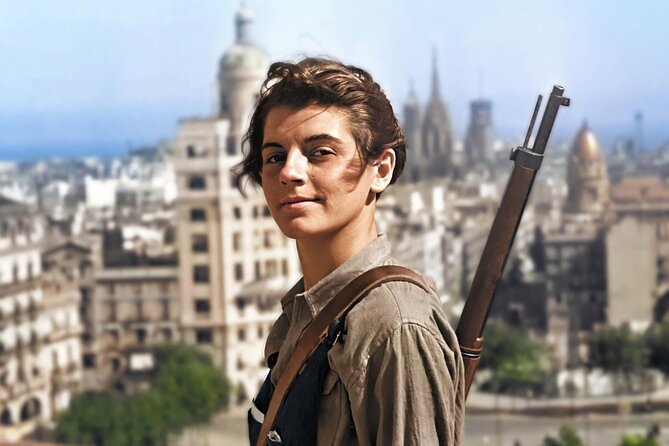
Barcelona remembers its Civil War in fragments: a damaged church wall, an old hospital, a building once fought over street by street. This private walking tour connects those fragments, giving you a clearer picture of the conflict and its effect on ordinary people. In about two and a half hours, you walk from Plaça de Catalunya to the Cathedral area with an English-speaking guide focused entirely on your group.
I like the private format, since difficult subjects are easier to discuss when you can ask direct questions. I also like the route itself. It links political conflict, working-class resistance, international volunteers, air raids, and the later cultural repression under Franco. The main consideration is the price: at $181.41 per person, it is a serious expense, especially for a solo visitor or a small party.
I would choose this tour if you want more than a general Barcelona walk. You will not spend the morning admiring grand architecture without context. Instead, you will examine places connected to street fighting, wounded civilians, anarchism, George Orwell, the International Brigades, and the bombing of Plaça Sant Felip Neri. The guide Yannis has received particular praise for his passion and ability to explain the causes of the war, so requesting him may be worth considering if he is available.
Five things to know before you book
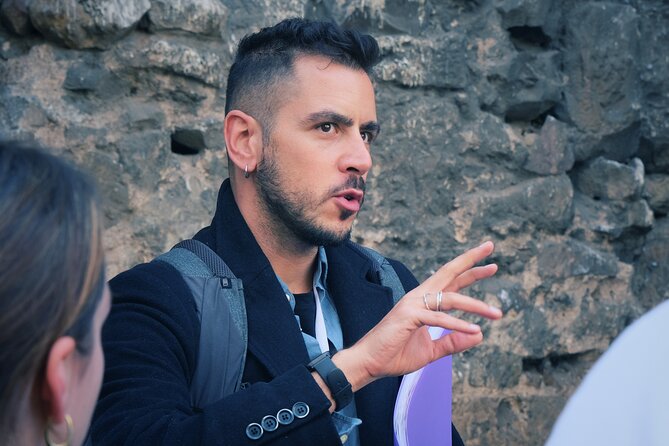
- The route begins at Plaça de Catalunya: You start with the Telefonica building and the struggle for control of a key communications site.
- George Orwell’s Barcelona appears on La Rambla: One stop links the war to Orwell’s time in the city.
- Raval adds the working-class view: Plaça de Vicenç Martorell opens a discussion of poverty, resistance, and anarchism.
- Plaça Sant Felip Neri shows wartime damage: This is the clearest visible reminder of Barcelona’s air raids.
- The tour is private and flexible: Only your group participates, and flexible departure times can help fit the walk into a busy visit.
Why Barcelona’s Civil War story needs a walking tour

The Spanish Civil War can feel confusing if you approach it only through dates and political labels. Barcelona’s story involved competing political groups, military pressure, foreign intervention, street battles, shortages, wounded civilians, and a later dictatorship that restricted culture and public expression.
A walking tour helps because the city becomes the evidence. You begin at a major urban square and finish near the Cathedral, passing through streets and buildings that carry different parts of the story. The subjects are serious, but the route gives them a human scale.
I especially value the way this experience joins the war itself with what came afterward. The final stages of the conflict and Franco’s dictatorship are not treated as separate subjects. You learn how defeat affected culture, public life, and the people who had already suffered through years of violence.
The private setup matters here. With a shared group, a guide may need to keep moving or simplify an answer. On this walk, you can ask about political factions, the role of foreign powers, or the experience of civilians without worrying that you are holding up a large crowd.
More Private Walking Tours in Barcelona
- Barcelona Helicopter, Sailboat & Old Town Private Walking Tour
★ 5.0 · 1,395 reviews - Barcelona: Sagrada Familia, Park Guell & Tapas Private Tour
★ 5.0 · 903 reviews - Barcelona 1.5h Private Old Town, Gothic & Ramblas Walking Tour
★ 5.0 · 318 reviews
Plaça de Catalunya and the fight for Telefonica
The tour starts outside Foot Locker at Plaça de Catalunya, 20. This is a practical meeting place in a central part of Barcelona, close to public transport and easy to recognize.
The opening discussion focuses on the fight over the Telefonica building during the Civil War. That detail gives the tour a strong beginning. You are not simply hearing a general introduction to the conflict. You are looking at a real fight for control of a communications center in the middle of the city.
Allow about 30 minutes here. The stop sets up the political and military tension that shaped the rest of the walk. It also gives your guide a chance to explain the forces involved before you move into the smaller streets of the old city.
Plaça de Catalunya is a large, active urban space, so do not expect a quiet museum-like setting. You will be standing outdoors near traffic and everyday city activity. That contrast is useful. Modern Barcelona moves around you while the guide explains how this same central area became a place of confrontation.
La Rambla and George Orwell’s wartime Barcelona
The second stop takes you to La Rambla, where the guide points out the hotel in which George Orwell stayed during the war. The visit lasts about 20 minutes.
This stop adds a personal and literary angle. Orwell’s experience in Barcelona helped shape his account of the conflict, and his presence offers a way to connect international political ideas with the city’s street-level reality. You are not only studying generals and governments. You are considering what it meant for an individual foreign volunteer and writer to witness the conflict firsthand.
La Rambla is one of Barcelona’s busiest public spaces, so it can be crowded and noisy. That is worth knowing if you prefer quiet historical sites. At the same time, the location keeps the discussion grounded in the city as it is now. You stand in a major public thoroughfare while learning how political struggle once played out in these central streets.
The short length of this stop works well. It gives the subject enough space without turning the tour into a full lecture on Orwell. If you have read his work, you may find this part especially useful. If you have not, the guide can still use the location to explain the wider conflict.
Plaça de Vicenç Martorell and the Raval’s working-class story
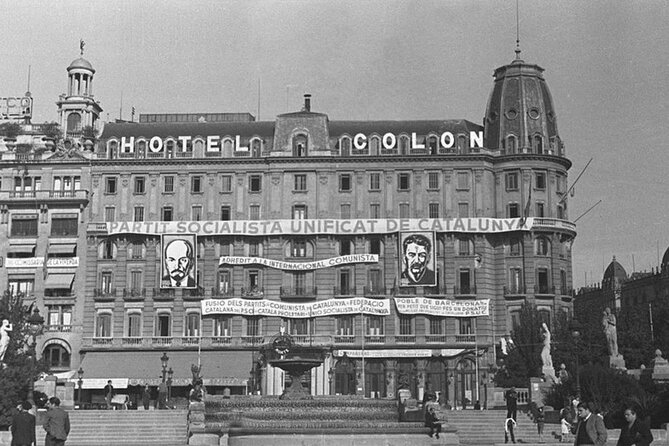
From La Rambla, the walk continues toward Plaça de Vicenç Martorell in the Raval neighborhood. Plan on about 20 minutes here.
The Raval is used to explain a side of the Civil War that can be missed in a purely political account. This was a working-class area associated with hardship, resistance, and anarchism. The stop gives attention to people whose daily lives were shaped by poverty and political upheaval, rather than focusing only on famous leaders.
I like this part because it broadens the tour. The war was not only a contest between armies. It also affected neighborhoods, families, workers, and political communities. The discussion of anarchism is particularly useful for anyone who wants to understand why Barcelona became such an important center of radical politics.
The stop is relatively brief, so you should expect a focused explanation rather than a complete history of the Raval. That is a fair trade on a two-and-a-half-hour route. The guide must keep the walk moving, but the private format gives you room to ask for more detail if this subject interests you.
More Private Walking Tours in Spain
- Barcelona: Private Walking Tour with a Local
★ 4.5 · 202 reviews - Semi-Private Montserrat Monastery, Funicular & Scenic Nature Walk
★ 5.0 · 172 reviews - Barcelona Private Food Tour: Tapas, Paella & 8+ Food Tastings
★ 5.0 · 164 reviews - Barcelona: Old Town Private Walking Tour of Past and Present
★ 5.0 · 160 reviews
Antic Hospital de la Santa Creu and the war’s human cost
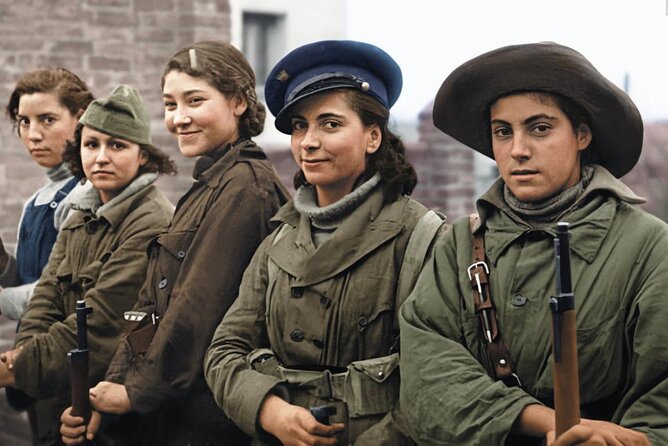
The Antic Hospital de la Santa Creu is one of the route’s most affecting locations. This fifteenth-century hospital treated many wounded soldiers and civilians during the conflict. You spend roughly 20 minutes here.
The age of the building creates a strong contrast. This was not a modern military hospital built for wartime. It was an older civic institution that had to receive people injured by a modern political and military crisis. The guide uses the site to discuss the end of the war and the cultural oppression that followed under Franco.
That connection is important. A tour about the Civil War can stop too soon, treating 1939 as a neat endpoint. Here, the story continues into dictatorship. You learn that the end of open fighting did not mean an immediate return to normal life, especially for culture and public expression.
The hospital is also a useful pause in the route. After discussions of political battles and street resistance, the focus turns to wounded people and the consequences of violence. I would listen closely here if you want to understand the civilian cost of the war.
Basilica de Santa Maria del Pi and the International Brigades
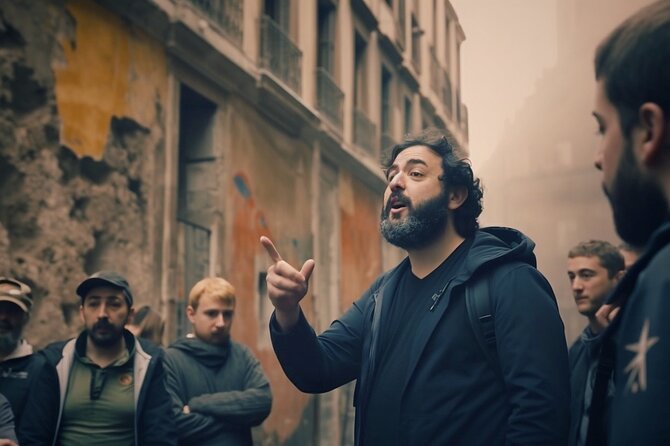
The basilica of Santa Maria del Pi hides a lesser-known reminder of the Civil War in plain sight. The guide spends about 30 minutes discussing the International Brigades.
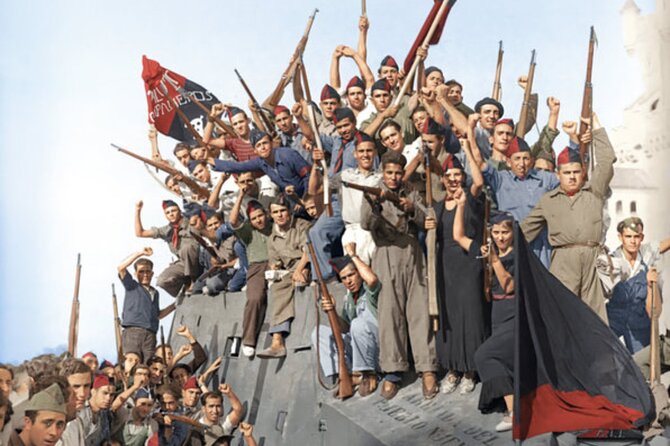
This stop adds an international dimension to the tour. Volunteers from outside Spain came to support the Republican side, and their role has become one of the most recognizable parts of the war’s wider story. At the basilica, the subject is tied to a specific place rather than presented as a detached list of foreign names and countries.
The church itself also shows how historical evidence can be easy to miss. You may pass through central Barcelona and see a historic religious building without realizing that it contains a connection to the conflict. That makes the guide especially useful. Without explanation, the clue would be easy to overlook.
The 30-minute timing suggests a fuller discussion than at some of the shorter stops. Use this chance to ask how international volunteers fit into the political and military structure of the war. The tour is offered in English, and the private arrangement should make it easier to pause for questions.
Plaça Sant Felip Neri and the scars of aerial bombing
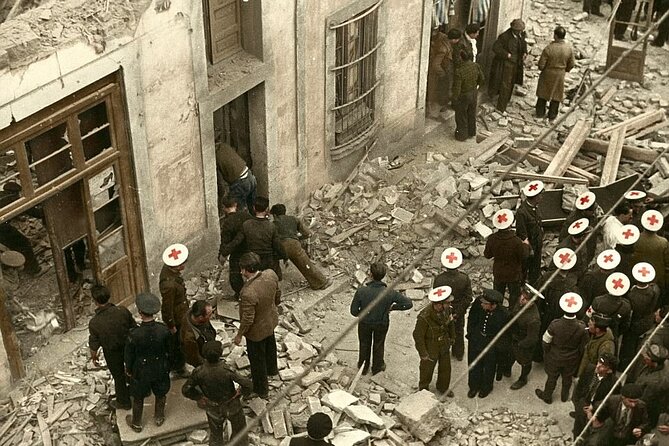
The final major stop is Plaça Sant Felip Neri, where Barcelona’s most visible Civil War damage can be seen. The discussion lasts about 30 minutes and covers the tragic bombing of the square and the involvement of the Axis powers.
This is likely to be the most visually direct part of the walk. Many historical subjects leave little physical evidence, but the damage here remains visible. The old walls give the guide a fixed point from which to explain aerial warfare and the participation of outside powers.
The subject is painful, and the site deserves a respectful approach. You are not visiting a war museum with displays arranged behind glass. You are standing in an actual city square, where the physical setting carries much of the emotional weight. The guide’s explanation supplies the context that the walls alone cannot provide.
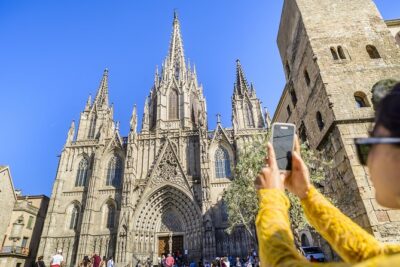
Ending here is effective because the tour moves from political conflict to the human consequences of bombing. The route finishes at Plaça Nova, near the Cathedral, so you are well placed to continue sightseeing in the old city afterward.
What the private format is worth at $181.41
At $181.41 per person, this is not a casual budget walk. Its value depends heavily on how much you want personal attention and a focused treatment of the subject.
For a larger group, the price can make more sense because the cost is tied to the private tour rather than a standard large-group outing. Group discounts are available, which may improve the value for families or friends traveling together. A private guide also lets you set the pace within the fixed route and spend more time on subjects that matter to you.
For one person or two people, the price is harder to justify unless the Spanish Civil War is a major interest. You are paying for specialized guidance, not entrance tickets. Every stop has free admission, and no food or drink is included.
The strongest value comes from the guide’s interpretation. The experience depends on the person leading it, since the sites themselves are public places rather than ticketed attractions. The praise for Yannis is specific: he has been described as passionate and highly informed, with a strong ability to explain the war and the conditions that led to it. That is exactly the skill this tour requires.
Timing, walking, and practical planning
The experience lasts approximately two hours and 30 minutes. It is long enough to cover six stops without taking an entire day from your Barcelona plans.
You should expect an outdoor city walk with repeated standing. The route begins at Foot Locker on Plaça de Catalunya and ends at Plaça Nova, close to the Cathedral. Since the route stays in central Barcelona, it is near public transportation, but you should still plan your day around walking rather than treating this as a seated presentation.
Departure times are flexible, which is useful if you want to fit the tour between museum visits, meals, or a morning in another part of the city. The tour is offered in English. Service animals are allowed, and most people can participate.
There is no lunch, snack, or drink included. Bring what you need for the walk, especially since the experience takes place outdoors. Good weather is required. If poor weather forces cancellation, you will be offered another date or a full refund.
You can cancel for a full refund up to 24 hours before the start time. Changes made inside that 24-hour window are not accepted, so check your plans before booking.
Who should book this Barcelona history tour?
I would recommend this experience most strongly to visitors who have already seen Barcelona’s famous buildings and now want to understand the city’s political past. It also suits readers interested in Orwell, anarchism, the International Brigades, or the role of foreign powers in the Civil War.
The private format makes it a good choice for families with older children, university students, history-minded couples, and small groups who want to ask questions. It is also useful for anyone who finds the Spanish Civil War confusing and wants a clear explanation tied to real places.
I would be more cautious about recommending it to someone seeking a broad introduction to Barcelona. The tour is tightly focused and serious. You will not get a general overview of Catalan art, food, architecture, or daily life. You also pay a premium for a walk in which the main attractions are streets, squares, and exterior sites with free admission.
Still, the 100 percent recommendation rate and perfect five-star score reflect what this tour does best: it gives a difficult subject a clear route and a human voice. The strongest praise centers on the guide’s passion and ability to explain causes, not just events. That is the difference between walking past an old wall and understanding why it matters.
Should you book it?
Book this tour if the Civil War and Franco’s dictatorship are central to your Barcelona plans, or if you want a private guide who can answer questions as the city unfolds around you. The route covers an impressive range of subjects in a short time, from Telefonica and Orwell to the Raval, wounded civilians, the International Brigades, and aerial bombing.
Skip it if you are watching your budget, prefer indoor attractions, or want a general city tour. At $181.41 per person, the experience needs to match your interests.
For the right visitor, this is a thoughtful and well-focused way to read Barcelona’s older streets. Consider asking about Yannis when you book, since his passion and clear explanations have been singled out as a major strength.
FAQ
How long does the private Barcelona Civil War tour last?
The tour lasts approximately two hours and 30 minutes.
Where does the tour begin?
It begins at Foot Locker, Plaça de Catalunya, 20, Ciutat Vella, Barcelona.
Where does the tour finish?
The tour ends at Plaça Nova in Ciutat Vella, close to the Cathedral.
Is the tour offered in English?
Yes. The experience is offered in English.
Are entrance tickets included?
The listed stops have free admission, and the tour includes an expert guide. Food and drinks are not included.
What happens if bad weather cancels the tour?
The experience requires good weather. If it is canceled because of poor weather, you will be offered a different date or a full refund.
Just added around Barcelona
- Barcelona Private Food Tour: Tapas, Paella & 8+ Food Tastings★ 5.0 · 164 reviews
- Barcelona Gothic Quarter Walking Tour with Tapas★ 5.0 · 248 reviews
- Picasso Museum and Walking Tour Plus Optional Wine & Food Tasting★ 5.0 · 596 reviews
- Private Barcelona Old Town and Gothic Quarter Walking Tour★ 5.0 · 134 reviews
- Barcelona Architecture Walking Tour With Casa Batlló Upgrade★ 5.0 · 137 reviews
- Montjuïc Walking Tour With Optional Flamenco Show★ 5.0 · 196 reviews
- Semi-Private Montserrat Monastery, Funicular & Scenic Nature Walk★ 5.0 · 172 reviews
- Barcelona: La Boqueria Food, Wine & History Walking Tour★ 5.0 · 126 reviews
Private Walking Tours, compared.
Private 3 hrs Venice Tour: St Mark’s, Walking tour & Boat tour
Read our review →
Private Street Food Evening Walking Tour in Ho Chi Minh City
Read our review →
Old Quebec City: Grand Walking Tour with Private Option
Read our review →
Barcelona Helicopter, Sailboat & Old Town Private Walking Tour
Read our review →
Browse the lists this tour appears in