
Review · USA WALKING TOURS
The Constitutional Walking Tour of Philadelphia
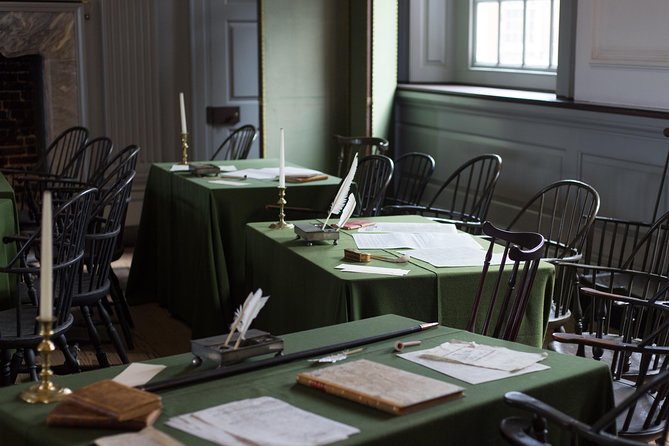
Philadelphia’s founding story fits neatly into a 1.25-mile walk. I like the wide sweep of 20-plus sites and the way this 75-minute tour connects Independence Hall, the Liberty Bell, Franklin, and the early government. I also like the friendly, energetic guides, especially the praise for Connor, PJ, Will, Avi, and Michael. The main catch is simple: you see the historic buildings from outside, but admission inside is not included.
This is an orientation tour, not a full museum visit. At $30, it can be a smart first look at Philadelphia’s historic center, but you should plan separate visits if you want to enter Independence Hall, the Liberty Bell Center, or other buildings. Wear good walking shoes, bring water, and arrive 15 minutes early at the three stone benches outside the National Constitution Center.
Key points before you book
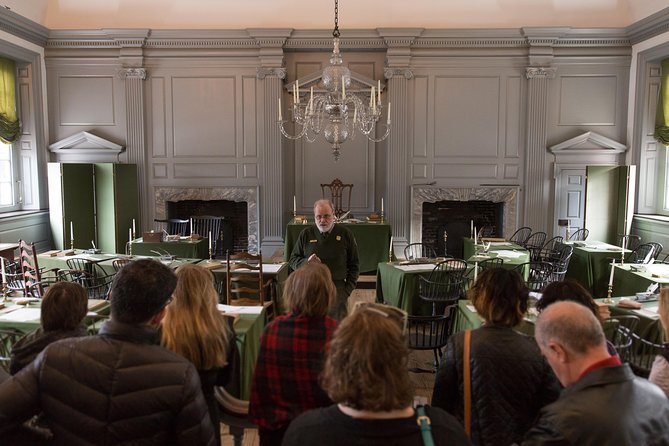
- A fast tour of 20-plus sites: The route covers about 1.25 miles in roughly 75 minutes, with frequent stops for short explanations.
- Outdoor views, not interior visits: Independence Hall and the Liberty Bell are part of the route, but entry tickets and security lines are not included.
- A strong first-day activity: The tour gives you a clear map of the historic district so you can return to the places that interest you most.
- Guides make the difference: Connor, PJ, Will, Avi, Michael, Jon, Viv, Abby, and others have received praise for clear storytelling and friendly service, though guide quality can vary.
- Rain or shine: Philadelphia weather matters here. Bring water in warm weather and rain gear or extra layers in poor weather.
- Small enough to hear, but not always quiet: The maximum group size is 40, and traffic, wind, and a fast-speaking guide can occasionally make listening harder.
Why this short walk works in Philadelphia
Philadelphia is easy to understand on foot because the key sites sit close together. The Constitutional Walking Tour makes good use of that compact setting, moving from the National Constitution Center toward the buildings and public spaces tied to the Declaration of Independence, the Constitution, and the first years of the federal government.
The tour is not built around one grand interior visit. Instead, it gives you a series of brief stops, each adding another piece to the story. You might hear about the city as the national capital, the debates over banking, the work of Benjamin Franklin, and the lives of people connected to the American Revolution.
That broad approach is the tour’s strength and its limit. You cover a surprising amount of ground in 75 minutes, but no single stop gets a long treatment. I see this as a good way to get your bearings before choosing which historic sites deserve more of your afternoon.
The tour price is $30 per person. That is reasonable if you want a guided introduction and prefer not to research every building yourself. It is less appealing if you expect museum admissions, a detailed visit inside Independence Hall, or a long lecture at each stop.
A few more walks around the USA worth a look
- History and Hauntings of Salem Guided Walking Tour
★ 5.0 · 14,564 reviews - New Orleans Premier Ghost, Voodoo and Vampire Walking Tour
★ 4.5 · 12,856 reviews - Little Havana Food and Walking Tour in Miami
★ 5.0 · 8,882 reviews
Starting outside the National Constitution Center
Meet outside the main entrance of the National Constitution Center at 525 Arch Street. The exact meeting spot is by three large stone benches, not inside the building. That distinction matters because one person missed the group after entering the Constitution Center and being directed toward the museum instead.
Check in 15 minutes before departure. Confirmation is provided when you book, and mobile tickets make the arrival process fairly simple. The group can include up to 40 people, so staying close to the guide matters, particularly near busy streets.
The opening stop is brief, about three minutes. It sets the theme for the walk and places you beside one of the country’s major institutions devoted to constitutional government. Admission to the Constitution Center is not included, so you would need a separate visit if you want to explore its exhibits.
From the President’s House to Jefferson’s Declaration House
The first part of the route links the early national government with the Declaration of Independence.
At the open-air President’s House site, you learn about the building where George Washington and John Adams lived while Philadelphia served as the national capital from 1790 to 1800. The site helps correct a common assumption: the first presidents did not begin their administrations in Washington, D.C.
The stop is only about two minutes, so expect a concise explanation rather than a full interpretation of presidential life. Still, it gives the rest of the walk useful context. Philadelphia was not simply the setting for the Revolution. It also served as the working center of the new federal government.
Next comes Declaration House, also called the Graff House. This is associated with Thomas Jefferson’s residence while he wrote the Declaration of Independence. The stop connects a physical address with a document most people know from school, making the story easier to picture.
Again, the tour pauses outside. If you want a longer presentation on Jefferson or the writing of the Declaration, you will need to return separately.
The Liberty Bell and Independence Hall
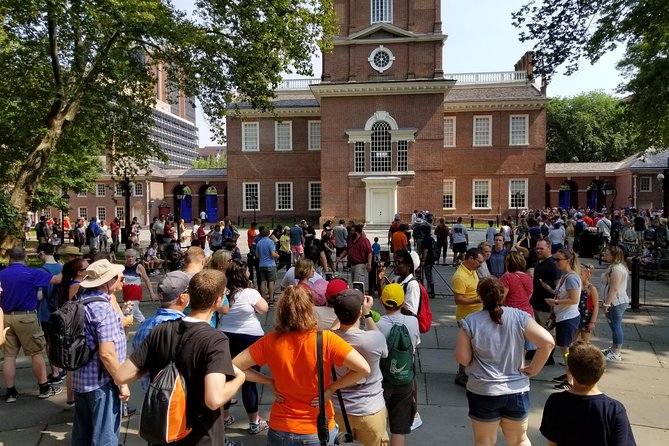
These are the two stops many people expect to experience most fully. The tour brings you to both, but it does not take you through the interiors.
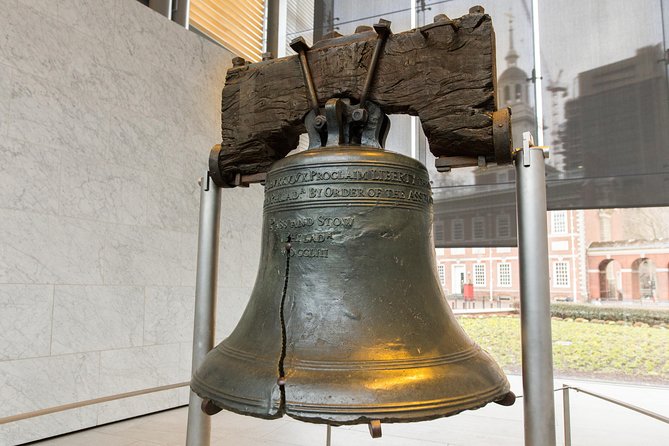
The Liberty Bell Center is the quickest stop on the route, listed at about two minutes. You get the essential connection between the bell and American freedom, along with a close look at the exterior setting. The important practical point is that you do not receive a private or timed entry through this tour. Security and museum access are separate matters.
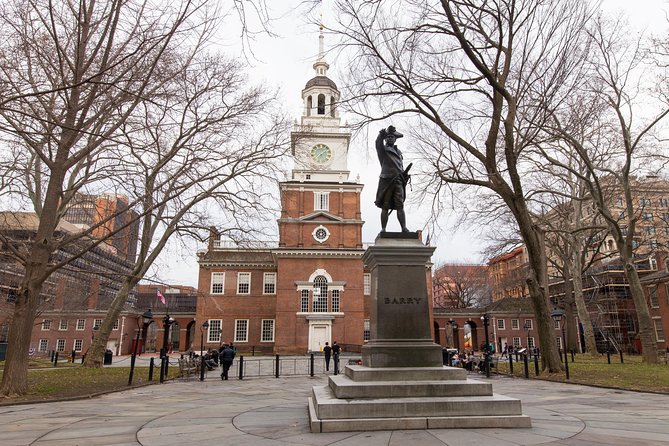
Independence Hall receives about three minutes. Built in 1732 as the Pennsylvania State House, it is tied to both the Declaration of Independence and the United States Constitution. The building is the central symbol of the district, but the tour treats it as one stop among many rather than the entire focus.
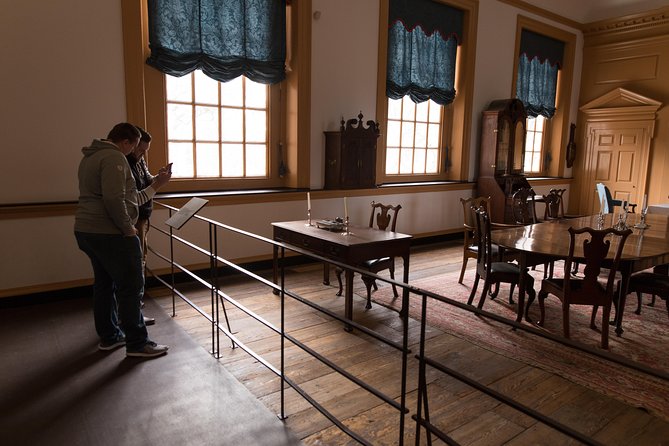
Independence Hall requires timed tickets arranged in advance, and security can take time. That makes interior entry impossible to fit into this 75-minute route. Plan a separate visit if walking through the Assembly Room is important to you.
This distinction has caused confusion, so I would make it part of your booking decision. The tour shows you where these events happened and explains why the buildings matter. It does not replace an admission ticket.
Same streets, a different way to see them:
- Chicago: Gangsters and Ghosts Walking Tour
★ 5.0 · 7,155 reviews - Boston: Freedom Trail History Small Group Walking Tour
★ 5.0 · 6,450 reviews - Historic Charleston Guided Sightseeing Walking Tour
★ 5.0 · 6,216 reviews - New Orleans Food Walking Tour of the French Quarter with Small-Group Option
★ 5.0 · 6,118 reviews
The first federal government in Congress Hall and Old City Hall
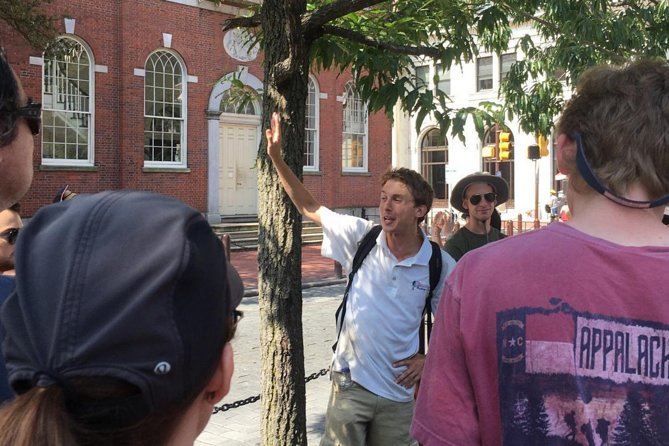
The next cluster turns from revolution to government.
Congress Hall served as the United States Capitol from 1790 to 1800, when Philadelphia was the national capital. It was originally built as the Philadelphia County Courthouse, a useful reminder that early American government often worked in buildings with earlier civic purposes.
Old City Hall follows as the former home of the United States Supreme Court. The stop is short, but together these buildings show how many parts of the federal government operated within a compact city center.
You also see The Signer, a statue inspired by George Clymer. It is a smaller stop, yet it adds a human figure to a route otherwise dominated by institutions and famous documents. The tour does not linger long, so listen for the specific details your guide chooses to emphasize.
The intellectual and financial heart of early Philadelphia
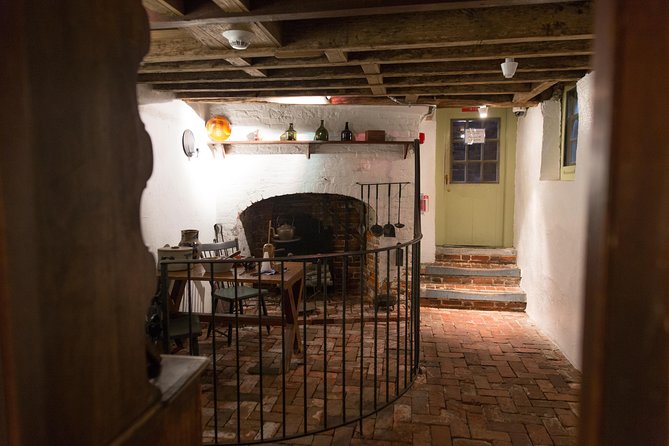
The middle section gives you a look at the city’s intellectual and financial life.
The American Philosophical Society Museum is identified as the oldest scholarly society in the United States. Philadelphia’s founding story was not only about battles and political speeches. It also involved science, ideas, correspondence, and organized study.
Library Hall recalls the nation’s first public library and the former Library of Congress. This is another good example of why the walking format works. A few blocks can take you from constitutional debate to the institutions that helped spread learning.
The Second Bank of the United States shifts the subject to money and federal power. It was once one of the world’s most influential financial institutions and now serves as a portrait gallery. The building helps explain why banking became one of the early republic’s major constitutional arguments.
At the First Bank of the United States, the guide can connect architecture, finance, and the first major constitutional dispute over federal authority. You get only about three minutes here, so think of the stop as a prompt for further exploration rather than a complete lesson.
For me, this part gives the walk extra value. Many visitors come looking only for the Liberty Bell. These banks, libraries, and scholarly buildings show how the new nation tried to govern, borrow money, educate citizens, and define federal power.
Carpenters’ Hall and the military story
Carpenters’ Hall is linked to the First Continental Congress and to the development of an American identity. The building’s importance is easy to miss if you rush through the historic district on your own, so having a guide point it out is useful.
The New Hall Military Museum adds another angle by interpreting the role of the military in early United States history. These two stops widen the story beyond famous founding fathers. They bring in trade groups, organized defense, and the practical work of building a new country.
Each visit lasts only a couple of minutes. That pace keeps the group moving, but it also means you should not expect displays, extended discussion, or time to browse indoors.
Franklin Court and the final Philadelphia stops
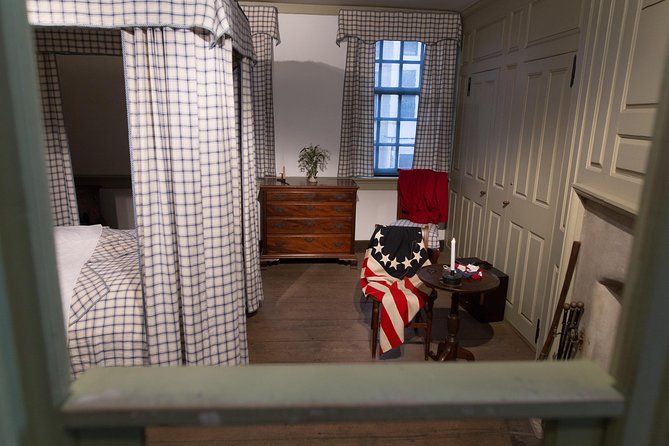
Franklin Court receives one of the longer pauses, about five minutes. It is associated with Benjamin Franklin’s home and includes the only Colonial-themed post office. Franklin is one of the few figures who appears naturally across several parts of Philadelphia’s story: printer, inventor, diplomat, civic organizer, and founder.
The route then moves to Christ Church, an active parish dating to 1695 and often called the Nation’s Church. This stop places the political story in a religious setting and reminds you that early Philadelphia was a working city, not a preserved stage set.
At the Betsy Ross House, the guide connects the site with the making of the first Stars and Stripes. The stop is brief, and the story has long been part of Philadelphia’s popular history. If you want to investigate the evidence and interpretation in more detail, return on your own.
The Arch Street Meeting House introduces the Society of Friends, whose members shaped Philadelphia’s religious and civic life. It is a useful counterpoint to the political landmarks because it shows another tradition that influenced the city.
The final listed stop is Christ Church Burial Ground, where Benjamin Franklin is buried. The cemetery also connects you with other early American figures, although the short tour does not allow time to identify every grave in detail. If you want to spend time reading the markers, plan to return after the group walk.
The tour ends back at the meeting point near the National Constitution Center. That is convenient because you can continue to the museum or retrace the route to visit one of the sites you found most interesting.
What the guides do well, and where the experience varies
Guide quality is the biggest variable. The strongest guide comments describe clear stories, good historical command, friendly answers, and enthusiasm without turning the tour into a political speech.
Connor receives especially strong praise for combining serious knowledge with a pleasant manner and keeping personal opinions out of a politically charged subject. PJ is often described as friendly, attentive, and ready to answer questions. Will is praised for enthusiasm and for helping people see Philadelphia’s older layers.
Avi, Michael, Viv, Abby, and Jon have also been singled out for helpful explanations, warmth, and historical detail. That range of names suggests a team with several strong guides, but no walking tour can guarantee one particular person unless the booking specifically says so.
The weaker experiences point to two practical risks. A guide may perform more than explain, or may stick too closely to basic facts without enough context. Some people also find it hard to hear when traffic and wind compete with a fast speaker.
I would stay near the guide and ask questions when the group pauses. If you have hearing concerns, a smaller group may be easier, but the listed maximum is 40 and the actual group size can vary.
Walking conditions, weather, and timing
The distance is about 1.25 miles, which is manageable for most people, but the tour moves at a steady pace. There are stops to catch your breath, yet there are few places to sit and rest.
Wear comfortable tennis shoes or other supportive walking shoes. On sunny days, a hat and lightweight clothing will help. Bring water, especially in warm weather. Since the tour runs in rain or shine, pack rain protection when the forecast looks uncertain.
Cold weather deserves equal attention. One successful tour took place in the low 30s, with the guide continuing normally, but you will enjoy the experience more with warm layers and gloves.
The short duration is useful if you have limited time, children in your group, or a full Philadelphia schedule. It is also brisk. If you prefer long conversations at each site, a longer or private tour may suit you better.
Who gets the most value from this tour
I would choose this tour for a first visit, a family that wants a clear introduction, or anyone who likes history in small, manageable portions. It also works for locals who want a refresher or for a visitor who has only one morning or afternoon to understand the historic district.
It is particularly helpful for families with older children. The route has statues, famous buildings, a bell, a cemetery, presidents, inventors, and revolutionary figures, so the guide can connect the story to different interests.
You may want something else if your main goal is entering historic buildings. This tour does not include admission to any site, food, or drinks. You will need to arrange and pay for those separately, and Independence Hall requires advance timed tickets.
The tour is also not the best choice if you want a slow, highly detailed account of every stop. It is a broad introduction. Think of it as a guided map with stories attached.
Booking details and cancellation
The cost is $30 per person, and the experience is offered in English with a mobile ticket. It is often booked about 12 days ahead, so reserving early is sensible if your Philadelphia dates are fixed.
Free cancellation is available up to 24 hours before the start time. Cancellations or changes made less than 24 hours before departure are not refunded or accepted.
Most people can participate, but remember that this is a walking activity with limited seating. The tour operates in all weather, and the group returns to the starting point.
Should you book the Constitutional Walking Tour?
Book it if you want a well-priced, guided overview of Philadelphia’s historic core. You will see more than 20 important sites, learn how the Revolution connects to the first federal government, and leave with a better idea of which places deserve your own time.
Do not book it expecting entry into the Liberty Bell Center or Independence Hall. For those interiors, arrange separate tickets and allow extra time for security.
My practical plan would be to take this walk early in your visit, then return to the Liberty Bell, Independence Hall, Franklin Court, or another favorite stop afterward. At $30, the tour earns its value by helping you choose wisely. Its best feature is not a single landmark. It is the way a short walk turns Philadelphia’s scattered historic addresses into one understandable story.
FAQ
How long is the Constitutional Walking Tour of Philadelphia?
The tour lasts approximately 75 minutes and covers about 1.25 miles.
Where does the tour meet?
The meeting point is outside the main entrance of the National Constitution Center at 525 Arch Street, by three large stone benches. Check in 15 minutes before departure.
Does the tour go inside Independence Hall?
No. The tour views Independence Hall from outside. Admission is not included, and interior visits require separate timed tickets.
Can I enter the Liberty Bell Center during the tour?
No. The Liberty Bell Center is a stop on the outdoor route, but admission and security access are not included.
What happens if it rains?
The tour operates rain or shine. Dress for the weather and bring rain protection when needed.
Can I cancel for a full refund?
Yes. You can cancel at least 24 hours before the experience start time for a full refund. Changes or cancellations made less than 24 hours before the start time are not accepted or refunded.
Just added around the USA
- Delicious Donuts of Brooklyn: Fun, Food, History and Culture Tour★ 5.0 · 84 reviews
- Brooklyn NYC Food & Walking Tour with a 5th Generation New Yorker★ 5.0 · 73 reviews
- Boston’s North End Food and History Walking Tour★ 5.0 · 459 reviews
- Freedom Trail Guided Walking Tour (SMALL GROUP)★ 4.5 · 98 reviews
- Boston Private Food Tour of 6+ Tastings, Cannoli, Lobster Roll★ 5.0 · 165 reviews
- 2 Hour North End ‘Little Italy’ Walking Tour★ 4.5 · 125 reviews
- Beacon Hill Boston History + Photo Walking Tour (SMALL Group)★ 5.0 · 163 reviews
- Boston’s Architecture, History + Photo Walking Tour (SMALL Group)★ 5.0 · 91 reviews
USA Walking Tours, compared.

History and Hauntings of Salem Guided Walking Tour
Read our review →
New Orleans Premier Ghost, Voodoo and Vampire Walking Tour
Read our review →
Freedom Trail History Small Group Walking Tour
Read our review →
Historic Charleston Guided Sightseeing Walking Tour
Read our review →
New Orleans Food Walking Tour of the French Quarter with Small-Group Option
Read our review →
St. Louis Cemetery No. 1 Official Walking Tour
Read our review →Browse the lists this tour appears in