Review · TOURS
Tirana Walking Tour
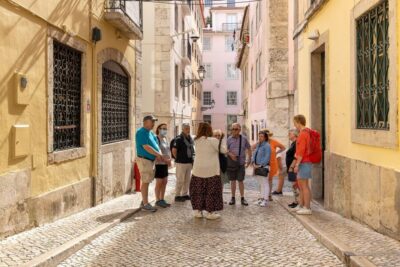
Tirana changes fast. This three-hour walk makes sense of the capital’s old monuments, communist scars, and shiny new city center. I especially like the personal history many guides bring, and the easy coffee or cocktail stop in Blloku. The main drawback is that some explanations may come while walking, so you may need to ask the guide to pause in noisy places.
At $17 per person, this is a strong first-day choice. You get a qualified guide, a broad route, and useful advice on restaurants, customs, transport, and what to see next. Guides such as Gloria, Ilir, Iris, Thomas, and Aron have earned especially warm praise for their clear English, flexibility, and ability to connect Albania’s past with life today.
Key points to know before booking
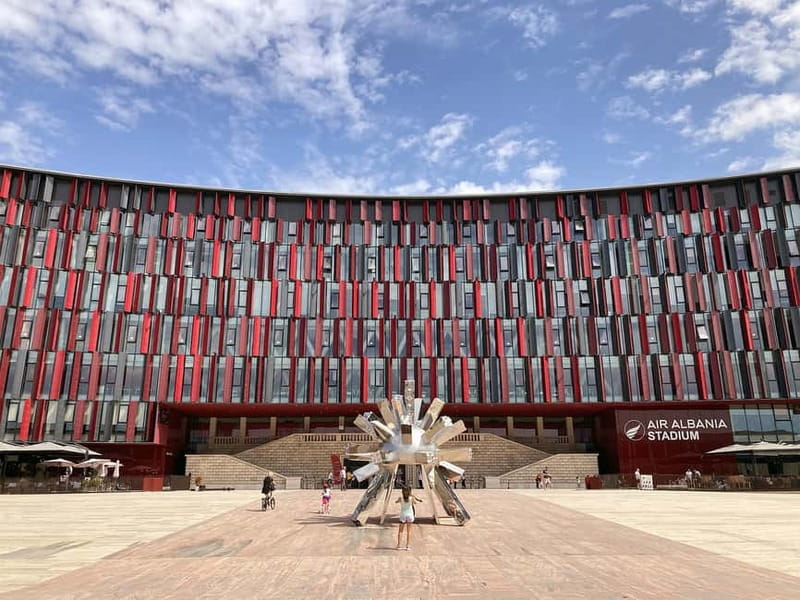
- Three hours on foot: The route links Skanderbeg Square, the old center, the Pyramid, Mother Teresa Square, and Blloku.
- History drives the tour: You move from Ottoman-era traces to Italian planning, severe communist architecture, and post-1990 change.
- Guides make the difference: Gloria, Ilir, Iris, Thomas, and Aron are praised for personal stories and helpful local advice.
- Coffee is part of the rhythm: A stop in Blloku gives you time for a drink and questions, but food and drinks cost extra.
- It can run with one person: A rainy-day booking with only one participant still went ahead, making this useful for solo visitors.
- Comfortable shoes matter: This is a real walking tour, not a quick circuit by vehicle.
Why this Tirana walk is worth your first morning
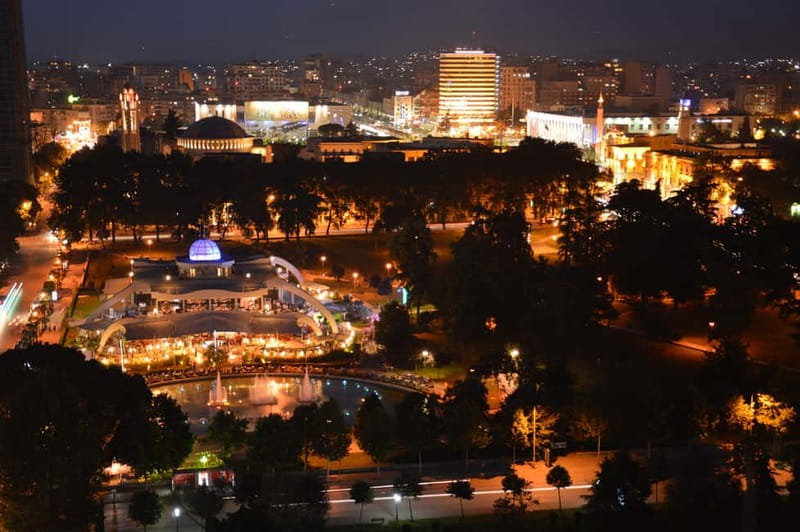
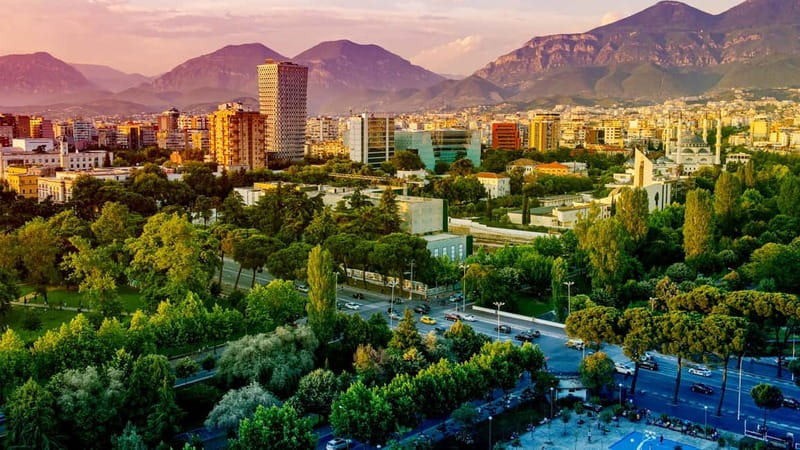
Tirana is not a city you understand from one postcard view. Its center puts several different Albanias almost side by side. Italian government buildings from the 1920s face the broad communist-era Palace of Culture and National History Museum. A mosque from the Ottoman period sits close to modern towers, busy cafes, and public spaces still being reshaped.
That contrast is the tour’s main strength. You are not only ticking off sights. You are learning why the city looks unfinished in places, why construction is everywhere, and how Albania moved from one of Europe’s most isolated communist states into a capital eager to catch up.
The meeting point is generally in front of the Tirana International Hotel, with the exact starting point depending on the option booked. The route finishes back at the hotel, which is handy if you want to continue exploring from the same central spot.
A guide gives you something a map cannot: a way to connect buildings with political change. Thomas, for example, has used old photographs to show how Tirana looked a century ago. Iris has been praised for explaining politics and recent change in a clear, engaging way. Ilir has guided even on wet days, sometimes with only one participant, and has been described as friendly, flexible, and easy to talk with.
A few more walks around the world worth a look
- Magical London: Harry Potter Guided Walking Tour
★ 4.7 · 22,044 reviews - Reykjavik Food Walk – Local Foodie Adventure in Iceland
★ 5.0 · 18,952 reviews - History and Hauntings of Salem Guided Walking Tour
★ 5.0 · 14,564 reviews
Skanderbeg Square and the city’s competing eras
The walk begins in Tirana’s monumental center, around Skanderbeg Square. This is the right place to start because so much of the capital’s story gathers here.
The National History Museum and Palace of Culture represent the heavy hand of the communist period. Their scale can feel imposing, especially when compared with the more decorative Italian government buildings created under Armando Brasini in the 1920s. Your guide explains how Tirana was reshaped from an Ottoman-style town into a more Western-looking capital, first through Italian influence and later through communist planning.
The statue of Skanderbeg, Albania’s national hero, gives the square its historical focus. It is also a useful orientation point. From here, many important central sights are close together, which helps you get your bearings early in your stay.
The National History Museum may be included as a sight or visit, but do not assume that a full museum visit is guaranteed during the three hours. One visitor found the museums closed on a Monday and had a sightseeing-only tour. If the museum is open and you want to spend serious time inside, plan to return separately. The building’s exterior and central location are still part of the walk.
Et’hem Bey Mosque and the old center
From the square, the route continues to Et’hem Bey Mosque and the Watch Tower. These landmarks point to Tirana’s earlier growth, before the city’s twentieth-century upheavals changed its shape.
The mosque is one of the most important older buildings in the center, while the Watch Tower offers a reminder of the city’s nineteenth-century expansion. Your guide can help place these sights in sequence: Ottoman-era Tirana, Italian-era modernization, communist rule, and the present-day building boom.
The exact access arrangements can vary, so treat the mosque as both an architectural sight and a working religious place. Dress and behavior should be respectful. The walk also includes the Resurrection of Christ Orthodox Cathedral and Saint Paul’s Cathedral later on, giving you a useful look at several religious traditions within the capital.
The city’s religious mix is easier to understand when you see the buildings in person. The tour does not reduce Albania to one faith or one political story. It shows a capital shaped by Ottoman rule, Italian planning, communism, and a modern secular public life.
Bunk’Art 2 and the harder communist story
Bunk’Art 2 is one of the stops that gives the tour emotional weight. It relates to the communist security state and the surveillance and repression that affected Albanian life under Enver Hoxha.
You may get a visit, a photo stop, or an explanation from outside depending on timing and access. The tour also passes the House of Leaves Museum, another place tied to surveillance and the work of the former security services. Together, these sites help explain why Albania’s twentieth-century story can feel so personal and raw.
The guide’s role matters here. A list of dates will not tell you what life under isolation and dictatorship felt like. Several guides bring family or childhood memories into their explanations. That personal angle was one of the most praised features of the tour, particularly with Thomas and Iris.
If you want to explore Bunk’Art 2 or the House of Leaves in detail, allow extra time on another day. A three-hour walk can introduce the subject, but it cannot replace a museum visit. That is not a flaw in the tour. It is simply the tradeoff for covering such a wide section of central Tirana.
Same streets, a different way to see them:
- New Orleans Premier Ghost, Voodoo and Vampire Walking Tour
★ 4.5 · 12,856 reviews - Amsterdam Anne Frank: Small-Group Walking Tour & Local Guide
★ 4.8 · 12,789 reviews - Edinburgh: Harry Potter Magical Guided Walking Tour
★ 4.8 · 11,944 reviews - Edinburgh Castle: Guided Walking Tour with Entry Ticket
★ 4.7 · 11,699 reviews
Tirana Castle, Tanners’ Bridge, and the older city
The route turns toward Tirana Castle and the Tanners’ Bridge, bringing you closer to what remains of the city’s older core.
Tirana Castle is now a reopened public area with shops and places to pause. It is not the kind of fortress where you should expect vast walls or a long archaeological visit. Its value lies in seeing how the city has repurposed an older site for modern urban life. You may have time for a short break, photos, or browsing.
The Tanners’ Bridge is a smaller but telling stop. This stone bridge is a surviving fragment of earlier Tirana, when movement through the city worked differently from today. It gives the walk a welcome change of scale after the broad square and oversized communist buildings.
The old bazaar area is discussed as part of this section. Much of Tirana’s historic fabric has changed, but the guide helps you see what remains and what has been rebuilt. If you like cities where old traces sit beside new construction, this is one of the most useful parts of the route.
The Pyramid and Tirana’s new public spaces
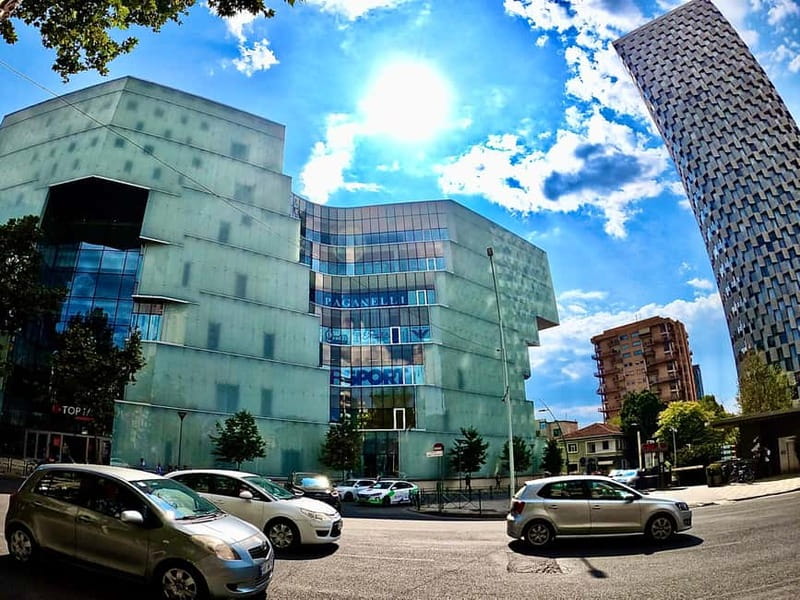
The Pyramid of Tirana is one of the city’s most recognizable buildings and one of its strangest. Built during the communist period for Enver Hoxha, it later became a symbol of changing attitudes toward that era. The repurposed building now fits into Tirana’s effort to create new public spaces from difficult political landmarks.
The stop is usually brief, with time for photos and an explanation. That is enough to understand the building’s unusual place in the city, though you may want to return if you are interested in its interior and later redevelopment.
The wider center is full of similar contrasts. New high-rise buildings and redesigned plazas reflect the capital’s rapid growth. Some architecture has drawn international attention, while other construction can feel abrupt beside older buildings. Your guide gives you a better way to judge the change than simply calling it attractive or ugly.
I like this part because it avoids treating Tirana as a finished historic city. You see a capital still deciding what to preserve, what to rebuild, and how to express a modern Albanian identity.
Mother Teresa Square and the southern city center
The walk continues toward Mother Teresa Square and Saint Paul’s Cathedral. This section broadens the tour beyond the compact historic center and shows a more formal, spacious side of Tirana.
Mother Teresa Square is associated with the city’s Italian-planned architecture and its grand civic scale. The surrounding buildings make a sharp contrast with the crowded commercial center. The guide can help explain how different political periods used public space to project power, order, and national identity.
Saint Paul’s Cathedral adds another religious landmark to the route. Along with Et’hem Bey Mosque and the Orthodox Cathedral, it helps you see Tirana as a city where several traditions share a relatively compact center.
The route covers a lot in three hours, so expect photo stops and explanations rather than long visits inside every building. You will get the outline and the connections. You can then choose which places deserve a second visit.
Postbllok and Enver Hoxha’s former neighborhood
Postbllok, or Checkpoint, is one of the most direct reminders of communist control. The memorial area includes objects associated with political imprisonment and the restrictions of the former regime. It is a short stop, but it can carry more force than a grand building.
From here, the tour reaches Blloku, the district once reserved for communist leaders and party officials. Enver Hoxha’s former villa is part of the area’s story. The contrast is striking: a once-closed zone is now known for cafes, restaurants, nightlife, and designer-style shops.
Blloku is where the tour’s title idea of Tirana’s new Dolce Vita makes the most sense. You can have a coffee or cocktail, talk with the guide, and ask about local customs, food, politics, or other plans in Albania. The drink is not included, but the pause is valuable. It breaks up the walking and gives you a chance to turn a general tour into a personal conversation.
Guides have also offered restaurant suggestions, help with taxi arrangements, and tips for shopping or later visits. That practical advice can be worth as much as another monument, especially if Tirana is your first stop in Albania.
How the guides shape the experience
The tour’s strongest feature is the guide, not a skip-the-line promise or a particular building.
Gloria is repeatedly praised for being warm, flexible, and able to explain history, culture, customs, and everyday behavior. Ilir is described as fluent in English, friendly, and especially good at answering questions. Thomas brings personal insight and old photographs, while Iris is noted for her grasp of Tirana’s political changes. Aron has also been praised for explaining Albania within the wider Balkan setting.
That range matters because this is a conversation-heavy tour. You should ask questions. If you prefer explanations at a complete stop, say so early. One group found it difficult to hear while walking, then asked for a walk, stop, and explain rhythm. The guide adjusted, and the tour worked better.
This is useful advice for everyone, not only that group. City streets can be noisy, and information delivered while moving is easy to miss. A good guide will usually respond well when you ask for a pause.
Price, pace, and practical comfort
At $17, the tour offers good value if you want a broad introduction to Tirana. A private museum visit or specialist historical tour would cost more, while exploring alone costs less but leaves you to connect the dots yourself.
The value is highest on your first day. You learn the city’s layout, identify places worth revisiting, and get direct suggestions for food and further sightseeing. It is also useful for solo visitors because the tour may operate with only one participant.
Wear comfortable shoes. The route is fully on foot, and the three-hour duration is long enough for heat, rain, or hard pavement to matter. A summer booking may include drink stops and time in the shade, but you should still prepare for the weather.
Languages offered are Albanian, English, and Italian. Children must be accompanied by an adult, and unaccompanied minors are not allowed. The tour is wheelchair accessible, and a private group option is available. Hotel pickup and drop-off are not included.
You can cancel up to 24 hours ahead for a full refund, and the reserve-now, pay-later option keeps your plans flexible. Check the starting time and meeting point when booking, since the point can vary by option.
Who should book this Tirana walking tour?
Book it if you want context more than a fast list of photo stops. It suits first-time visitors, history fans, solo visitors, and anyone curious about how Albania changed within a single generation.
It is also a good fit if you like asking questions and getting local suggestions. The best version of this tour is interactive, with time to stop, clarify, and follow a subject that interests you.
You may want something else if you dislike walking, want long museum visits, or prefer a tightly scripted tour with every interior guaranteed. In that case, use this walk as an introduction and return independently to Bunk’Art 2, the House of Leaves, or the National History Museum.
For $17, I would book this tour early in a Tirana stay. Ask the guide to pause when needed, bring comfortable shoes, and save a little time for the Blloku cafe stop. You will leave with a workable map of the city and a much clearer sense of why Tirana feels both old and completely new.
FAQ
How long does the Tirana Walking Tour last?
The tour lasts three hours.
How much does the tour cost?
The listed price is $17 per person.
Where does the tour start?
The usual meeting point is in front of the Tirana International Hotel, though the meeting point may vary depending on the option booked.
Where does the tour finish?
The tour finishes at the Tirana International Hotel.
Which languages are available?
The tour is available in Albanian, English, and Italian.
Is a guide included?
Yes. A qualified live guide is included.
Are food and drinks included?
No. Meals, drinks, and personal expenses are not included. The tour includes time for a coffee or cocktail stop, but you pay for your own order.
Is the tour wheelchair accessible?
Yes, the activity is listed as wheelchair accessible.
Can I cancel the booking?
Yes. You can cancel up to 24 hours in advance for a full refund. You can also reserve now and pay later.
Just added around the world
- Walking Tour of Boston’s Freedom Trail★ 4.5 · 77 reviews
- Downtown Freedom Trail Walking Tour – History & Architecture★ 4.5 · 194 reviews
- Boston Seafood Lovers Food and History Walking Tour★ 5.0 · 208 reviews
- Boston “Death and Dying” Walking Ghost Tour★ 4.5 · 223 reviews
- Boston Food of the North End Private Walking Tour★ 5.0 · 174 reviews
- Boston Movie Mile Walking Tour★ 4.5 · 119 reviews
- 1 If By Land Walking Tours★ 5.0 · 95 reviews
- Boston History and Freedom Trail Private Walking Tour★ 5.0 · 117 reviews
Tours, compared.

Magical London: Harry Potter Guided Walking Tour
Read our review →
History and Hauntings of Salem Guided Walking Tour
Read our review →
New Orleans Premier Ghost, Voodoo and Vampire Walking Tour
Read our review →
Amsterdam Anne Frank: Small-Group Walking Tour & Local Guide
Read our review →
Edinburgh Castle: Guided Walking Tour with Entry Ticket
Read our review →
Anne Frank’s Story – Guided Walking Tour through Amsterdam
Read our review →