
Review · JEWISH HERITAGE WALKING TOURS
Jewish Quarter of Budapest Walking Tour
Budapest’s Jewish Quarter tells two stories at once. This 90-minute walking tour links the district’s three main synagogues, personal accounts of Hungarian Jewish life, wartime courage, street art, and the ruin-bar scene that now defines much of the area. I especially like the human stories and the way the guide connects painful history with present-day Budapest. I also like that the tour ends with a local pub stop rather than simply dropping you beside a landmark.
The main drawback is that the tour does not include entry to the synagogues. You will see and discuss the Jewish Triangle from outside, then decide for yourself if you want to pay for interior visits. The English level is also fairly demanding, so you should be comfortable following an upper-intermediate conversation.
Key points at a glance
- Three synagogues in one compact route: The tour introduces Budapest’s Jewish Triangle and explains why each place matters.
- Personal stories, not just dates: Guides such as Judit, Ester, Gary, Dora, Edith, Ursula, and Emmy are praised for clear storytelling and thoughtful answers.
- A serious subject handled with care: The tour covers Hungarian Jewish history, the Holocaust, and the Righteous Gentiles without treating the subject as a checklist.
- A modern ending: The route brings you toward a ruin bar, often identified in guide recommendations as Szimpla, showing how the old quarter has changed.
- Very low upfront cost: The booking fee is about $2.27, but the guide depends on your donation, with €10 per person suggested.
- Small-group limits matter: Groups of eight or more cannot book, even if they reserve separately.
Why this quarter deserves a walking tour
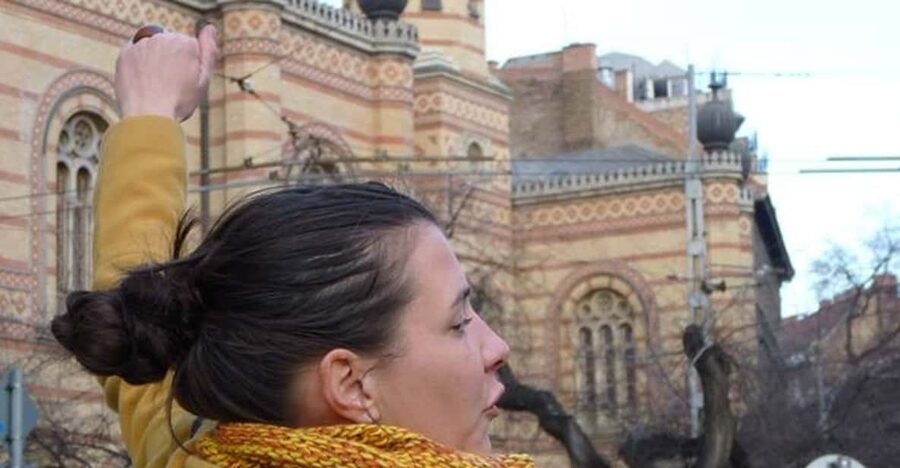
Budapest’s Jewish Quarter is not a district you understand by ticking off buildings. Its streets carry layers of religious life, persecution, survival, memorials, nightlife, murals, and everyday city life. A guide helps you connect those pieces instead of seeing them as unrelated sights.
The tour focuses on the historical Jewish District while also pointing out contemporary urban art and nightlife. That mix is useful because the quarter can feel confusing at first. One street may contain a synagogue, a colorful mural, a memorial marker, and a ruin bar within a short walk. The guide explains how those different parts fit together.
I like the decision to keep the tour to 1.5 hours. That is long enough to establish a serious sense of place without turning into an exhausting lecture. Several guides are praised for keeping the group moving, pausing at suitable spots, and balancing difficult material with lighter observations about Budapest today.
You should not expect a complete study of Hungarian Jewish life in one short walk. One particularly useful criticism is that the tour could say more about ordinary Jewish daily life before the Second World War. If that is your main interest, treat this as an introduction and leave time for a synagogue visit or museum afterward.
More Jewish Heritage Walking Tours in Budapest:
- Budapest: Jewish History Guided Walking Tour with Historian
★ 4.8 · 205 reviews - Amsterdam Anne Frank: Small-Group Walking Tour & Local Guide
★ 4.8 · 12,789 reviews - Anne Frank’s Story – Guided Walking Tour through Amsterdam
★ 5.0 · 11,619 reviews
Meeting at the Budapest Eye
The starting point is the Budapest Eye ferris wheel, beside the fountain. Look for the royal blue flag. This is a busy central location, so the flag matters more than a vague instruction to meet near the wheel.
Arrive with comfortable shoes and water. The walk lasts about 90 minutes, and you will be standing outdoors while listening. Guides have made an effort to find shade and quieter places for explanations, which helps in warm weather and makes it easier to hear.
The tour is listed as wheelchair accessible. Still, a walking route through a busy historic district can involve ordinary street conditions, so anyone with specific mobility needs should confirm the current route when booking.
The tour is conducted in English. The required level is upper intermediate, not basic conversational English. You will get much more from the experience if you can follow explanations about political events, religious life, and changing borders without needing constant translation.
Following the Jewish Triangle
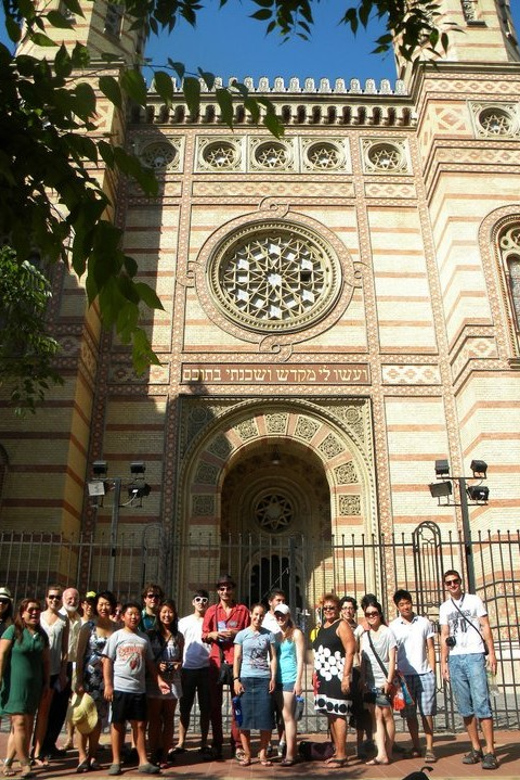
The main historical framework is the Jewish Triangle, formed by three important synagogues in Budapest. The walk visits all three from the outside and explains their place in the district.
That arrangement gives the tour a useful structure. Instead of jumping randomly between stories, you move from one major religious landmark to another while the guide fills in the social and political background. You learn about Hungarian Jews, the role of religious institutions, and the way the district changed over time.
The buildings themselves provide the visual anchors, but the guide’s explanation is the real value. Without context, a synagogue exterior can be impressive yet hard to interpret. With a good guide, you begin to understand why these sites matter to the community and how their presence reflects the quarter’s past.
The tour does not include synagogue admission. This keeps the walking tour inexpensive and avoids turning the route into a long interior visit, but it also means you will miss architectural details inside. If seeing the interiors is important to you, plan a separate visit and check opening arrangements on the day you go.
Meeting Hungarian Jewish history through people
The strongest part of the experience is its use of personal stories. The subject can become cold when presented only through dates and political events. Stories about families, loss, survival, courage, and ordinary life give the quarter a human scale.
The tour also discusses the Righteous Gentiles, people who helped Jews during the Holocaust. This adds an important layer. The story is not reduced to victims and perpetrators alone, but it also does not soften the terrible facts. The best guides keep the tone respectful and direct.
Judit is repeatedly praised for being patient, clear, and well prepared. She explains difficult subjects without rushing and leaves space for questions. Ester is noted for making the history personal and holding attention, while Edith is praised for a clear speaking voice and a caring manner.
Gary brings a more energetic style. He is described as enthusiastic about both Budapest and the Jewish community, and he gives suggestions for restaurants and bars after the walk. Dora is praised for being attentive and willing to answer questions. Emmy is remembered for mixing humor with serious historical material.
Your guide will determine the exact mood. The names and styles vary, but the consistent strength is a combination of strong preparation, compassion, and openness to questions. That matters here. A careless joke or rushed explanation would damage the experience, while a thoughtful guide can make a difficult subject accessible.
A few more walks around Budapest worth a look
- Budapest: Buda Castle Walk with Saint Stephen’s Hall
★ 4.5 · 3,012 reviews - Big Bus Budapest Hop-On Hop-Off Bus and Walking Tour
★ 3.5 · 2,206 reviews - Budapest: Buda Castle District Walking Tour
★ 4.6 · 2,108 reviews - Budapest City Landmarks Walking Tour in 2 Hours
★ 5.0 · 2,048 reviews
The missing piece: everyday life before the war
The tour’s focus is strongest when it covers major historical events, the Jewish Quarter itself, and the city’s wartime experience. One limitation is that the ordinary texture of Jewish life before the Second World War receives less attention than some people may want.
You may hear more about persecution, survival, memorials, and the district’s changing identity than about family routines, work, food, schools, and neighborhood customs before the war. That is not a flaw in every guide’s presentation, but it is worth knowing before you book.
If you want a fuller picture, use the walk as a foundation. Write down the names of places that interest you, then return independently for a synagogue visit or further historical study. The guides are also willing to suggest other things to do in Budapest, which makes the tour useful beyond its official end.
Street art, miniature statues, and the modern quarter
The walk is not only about the past. Guides also point out urban art and small public sculptures, including Budapest’s miniature statues. These details help you read the streets in a different way.
The miniature figures are easy to miss when you are walking alone. A guide can show you where to look and explain the story behind them. They also offer a gentler change of pace after the more serious historical sections.
Street art serves a similar purpose. The quarter has a strong modern identity, and murals help show how Budapest’s younger culture uses old walls and public spaces. You get a sense of a district that is not frozen in memory, even though its past remains impossible to ignore.
This blend is one of the tour’s best choices. The experience does not treat the Jewish Quarter as a memorial site with no present-day life. At the same time, the nightlife and art are not allowed to erase the history beneath them.
Ending at a ruin bar
The final pub stop gives the walk a local Budapest finish. Guides commonly end near a ruin bar, with Szimpla frequently identified as the place to visit. If you have never seen one, this is a useful introduction to the city’s famous nightlife style.
The timing is helpful. Finishing before the late-night crowds gives you the option of looking inside without committing to a full evening there. One guide is praised for ending at Szimpla at a time when it is easier to enter, and several guides offer restaurant and bar suggestions afterward.
This stop also makes a point about the neighborhood’s current identity. Ruin bars occupy old buildings and have become a major part of Budapest’s urban culture. After hearing about the district’s past, seeing this lively modern use of old spaces gives you something to think about.
The pub is not a substitute for the historical portion, and you should not book the tour only for nightlife. The bar works best as a short final contrast, especially if you want to continue exploring afterward.
The stated activity ends back at the original meeting point, so pay attention to your guide’s instructions about the final stop and return. The exact closing routine can vary by guide and route.
Price, donation, and real value
The upfront booking fee is about $2.27 per person. That is remarkably little for a 90-minute guided walk, but it is not the full cost of the experience.
The booking fee covers administration and helps secure your place. It does not pay the guide. Guides depend on donations at the end, and €10 per person is the suggested amount. You can give more if the tour is especially useful to you.
That makes the practical cost closer to the donation you choose, plus the small booking fee. At €10, you are paying a modest amount for a personal introduction to one of Budapest’s most important districts. I consider that good value when the guide is as clear and engaged as Judit, Ester, Gary, Dora, Edith, Ursula, or Emmy.
Still, the donation model requires honest expectations. The tour is not truly free in the ordinary sense, and you should budget for the guide’s payment. The low booking price should not be used as a reason to skip the tip.
The three synagogue interiors are also extra. If you want to go inside, admission costs are separate and are not included in this walking experience.
Who will get the most from this tour?
I would choose this tour if you want a compact introduction to Budapest’s Jewish Quarter, especially early in your stay. It gives you historical context, points out details you might miss, and leaves you with practical ideas for food, bars, and other sights.
It suits adults and older children who can listen carefully in English. One guide noted that toddlers are manageable only if they remain quiet in a stroller, which is fair advice. The subject matter is serious, and the group needs to hear the guide.
It is also a good fit for people who prefer stories and discussion over a formal museum visit. You can ask questions, hear different guides’ personal presentation styles, and connect the old quarter with modern Budapest.
You may want a different option if you need extensive synagogue interiors, a long architectural study, or a detailed account of daily Jewish life before the war. You may also find the English too demanding if you are not comfortable with upper-intermediate speech.
Group size is restricted. Eight or more people cannot book, even if you try to split the reservation into smaller bookings. That rule protects the scale of the walk and is worth knowing before you plan it for a large party.
Should you book the Jewish Quarter walk?
Yes, if you want a thoughtful first look at Budapest’s Jewish Quarter and are prepared to make a donation at the end. The tour’s best features are its careful handling of painful history, its personal stories, and its ability to connect synagogues, street art, miniature statues, and ruin bars in one short route.
Book it early in your Budapest visit so the guide’s restaurant, bar, and sightseeing suggestions can shape the rest of your stay. Just remember that you will see the synagogues from outside, not tour their interiors, and that strong English comprehension is essential.
For roughly $2.27 upfront, plus the suggested €10 donation, this is a practical and meaningful way to get your bearings in one of the city’s most layered districts.
FAQ
How long does the Jewish Quarter walking tour last?
The tour lasts 1.5 hours. Starting times vary, so you need to check availability for the date you want.
Where does the tour start?
Meet beside the fountain at the Budapest Eye ferris wheel. The guide will be holding a royal blue flag.
Where does the activity end?
The activity information states that it ends back at the meeting point. The walking route also includes a final stop at a local ruin bar, so follow the guide’s instructions about the closing point.
Does the tour enter the synagogues?
No. The tour visits the three synagogues that form the Jewish Triangle from the outside. You can visit the interiors independently.
What language is the tour conducted in?
The live tour is conducted in English. An upper-intermediate level of English is essential so you can follow the guide and the historical explanations.
How much should I donate to the guide?
The suggested donation is €10 per person. The guide depends entirely on donations, while the small booking fee goes toward administration and does not contribute to the guide’s earnings.
Can groups of eight or more book the tour?
No. Groups of eight or more are not allowed to book, even if they reserve separately.
Just added around Budapest
- Budapest: Street Art and Underground Movements Walking Tour★ 5.0 · 365 reviews
- Budapest 3-Hour Walking Tour in Italian★ 4.6 · 217 reviews
- Budapest: Buda Castle District Walking Tour with a Historian★ 4.9 · 867 reviews
- Budapest: Walking Tour to the Shoes Memorial and Parliament★ 4.7 · 151 reviews
- Budapest: Jewish History Guided Walking Tour with Historian★ 4.8 · 205 reviews
- Budapest: Castle District Walking Tour★ 4.8 · 223 reviews
- Budapest Guided Food Walking Tour with Drinks Included★ 4.8 · 472 reviews
- Budapest: Walking Tour and Photoshoot with Digital Photos★ 4.7 · 82 reviews
Jewish Heritage Walking Tours, compared.

Amsterdam Anne Frank: Small-Group Walking Tour & Local Guide
Read our review →
Anne Frank’s Story – Guided Walking Tour through Amsterdam
Read our review →
Jewish Quarter Walking Tour with Admission Tickets
Read our review →
Anne Frank Guided Walking Tour in DE/EN/IT/ES
Read our review →
Old Town and Jewish Quarter Guided Walking Tour
Read our review →

Anne Frank Walking Tour Amsterdam Including Jewish Cultural Quarter
Read our review →
Anne Frank’s Last Walk & See Anne Frank House in Virtual Reality
Read our review →Browse the lists this tour appears in