
Review · CITY HIGHLIGHTS WALKING TOURS
Budapest City Landmarks Walking Tour in 2 Hours
Budapest reveals itself quickly on foot. This low-cost walk links grand churches, Danube views, Holocaust memorials, cafés, and the Hungarian Parliament in one useful route. I like the broad city overview and the generous dose of practical advice about food, nightlife, language, and places to visit later. The main consideration is simple: it is a donation-based tour, so the advertised price does not cover the guide’s earnings.
The route covers Pest rather than Buda, and it moves at a steady pace through busy central streets. Guides such as Gary, Dora, Esther, Rita, Judit, Andy, and Marton have been praised for clear storytelling, humor, local recommendations, and strong voices. Bring water, wear comfortable shoes, and arrive early at the Budapest Eye so you do not spend your first Budapest hour hunting for a small blue flag.
Key points at a glance

- A compact Pest orientation: See major landmarks from Erzsébet Square to the Parliament before choosing where to spend more time.
- More than dates and buildings: The walk includes Hungarian food, public art, basic language, inventions, politics, Jewish history, and everyday customs.
- Excellent low advertised price: At $3.63 per person, the booking cost is tiny, but you should budget an optional tip for the guide.
- Strong guide-led experience: Gary, Dora, Esther, Rita, Judit, Andy, Marton, and others are noted for warmth, humor, clarity, and useful advice.
- No interior admissions: You see the Basilica, Parliament, and other sights from outside, so plan separate visits if you want to go inside.
- A practical first-day choice: The final recommendations can help shape the rest of your Budapest visit.
Why this two-hour walk works so well on day one
Budapest can feel like two cities at once. Buda rises across the river with its castle and hills, while Pest spreads flat along the eastern bank, filled with grand avenues, cafés, shops, churches, and government buildings. This tour gives you a clear first picture of the Pest side.
I like the way the guide connects different subjects instead of treating each monument as an isolated photo stop. You may hear about architecture at Gresham Palace, Hungarian cooking at St. Stephen’s Square, language at the Academy of Sciences, and twentieth-century persecution at the Shoes on the Danube Bank.
The route takes about two hours, though the full experience may stretch closer to two and a half hours depending on the walking pace and questions. That leaves most of the day open. You can return to the Basilica, explore the riverfront, visit the Parliament, or cross the Chain Bridge into Buda with a much better sense of direction.
The group may include up to 30 people. That is manageable, but it is not an intimate private walk. One useful detail from the experience is that some guides use a speaker, which makes a real difference when you are standing beside traffic, trams, or a large group.
More City Highlights Walking Tours in Budapest:
- Budapest Historical Sightseeing – Free Walking Tour
★ 5.0 · 1,302 reviews - Historic Charleston Guided Sightseeing Walking Tour
★ 5.0 · 6,216 reviews - Dublin Highlights and Hidden Gems Guided Walking Tour
★ 5.0 · 6,020 reviews
Meeting the guide beside Budapest Eye
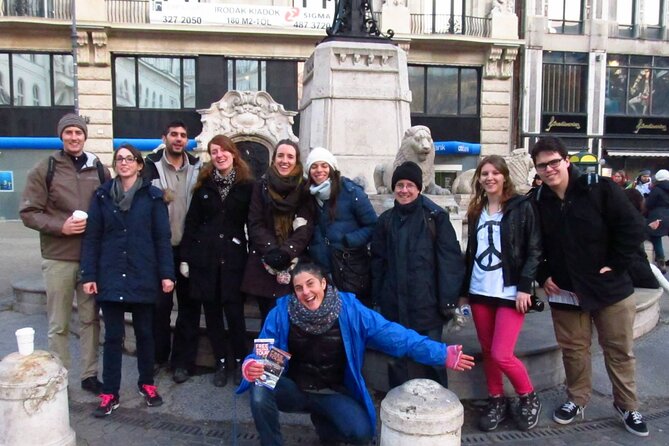
The walk begins at Erzsébet Square, about 20 meters from the Budapest Eye Ferris wheel. Look for the licensed local guide holding a small blue flag. This is the one practical detail you should take seriously. One person missed the group after looking for the wrong guide marker and losing time asking for directions.
Arrive early, check the exact meeting point on your confirmation, and keep the tour provider’s contact information handy. The square is central and close to public transportation, but a busy city center is still a poor place to begin a scavenger hunt.
The opening talk sets up the route with a map. You receive a quick guide to the major landmarks and a preview of less obvious streets along the way. The subjects are broad: history, buildings, public art, society, food, basic Hungarian, and what people in Hungary are like.
That mix is one of the tour’s strengths. You are not only learning where the Parliament is. You are also getting clues about how to use the city after the walk.
St. Stephen’s Basilica and the art of eating well
St. Stephen’s Basilica is the first major stop. The guide explains the church’s size, architecture, and changing fortunes. It can seat about 8,500 people, making it the largest church in Budapest.
You do not go inside as part of this walk. That is important to know if the interior is high on your list. Still, the exterior and surrounding pedestrian square offer plenty to discuss, including the handsome buildings around the church and the way different periods shaped Budapest’s architecture.
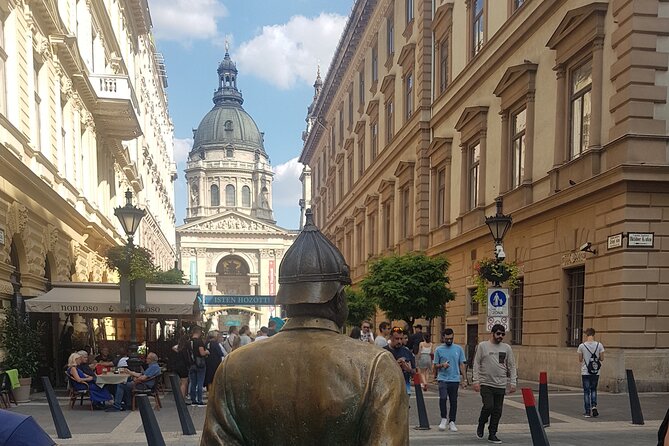
At St. Stephen’s Square, the focus turns from stone to food. A public sculpture of a famously well-fed policeman provides a light moment, then the guide moves into Hungarian cooking, what to eat, and how to avoid tourist traps.
This practical food advice may be more useful than another list of royal dates. Guides have offered recommendations for restaurants, nightlife, shopping, and budget-friendly choices at the end of the route. One visitor even planned much of the rest of the stay around suggestions from Gary. Treat those recommendations as starting points, then check current opening hours yourself.
Habsburg stories, porcelain, and Váci utca
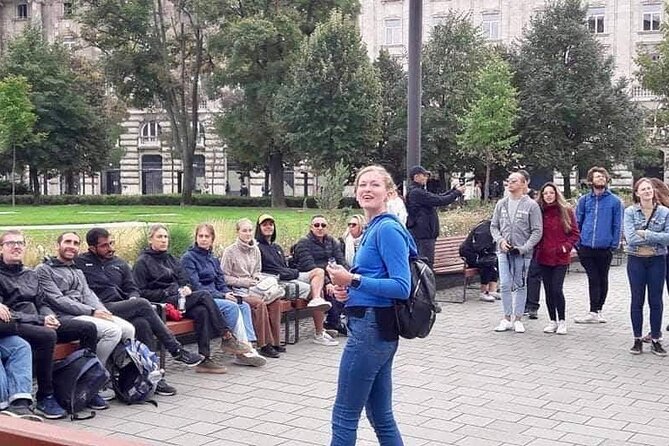
József Nádor Square brings up the Habsburg connection to Hungary, with attention to the figure described as the most Hungarian Habsburg. The stop also introduces two famous ceramic traditions.
Herendi porcelain is known for hand-painted pieces, while Zsolnay is associated with colorful glazed ceramics. You may not become an expert in either, but you will begin to recognize these names in museums, shops, and grand interiors around the city.
The next stop is Vörösmarty Square, a popular gathering place at the end of Váci utca. The square is useful for orientation because it links pedestrian shopping streets, cafés, public transit, and the Danube area.
The guide points out the historic Gerbeaud café and explains the second-oldest underground railway in the world, including its terminal near the square. The stop also covers Budapest’s Christmas markets and seasonal customs. It is brief, so do not expect a detailed shopping tour. Instead, you get a quick sense of why this square matters to local city life.
A few more walks around Budapest worth a look
- Berlin’s Best: 2 Hour Walking Tour Third Reich and the Cold War
★ 5.0 · 5,486 reviews - Leipzig: 2-Hour Guided Walking Tour in German
★ 4.8 · 1,612 reviews - Lucca: 2-Hour City Center Walking Tour
★ 4.7 · 1,314 reviews - 2-Hour Bonaventure Cemetery Walking Tour
★ 5.0 · 1,270 reviews
The Danube promenade delivers the best views
The walk reaches the Korzó, the Danube embankment, where Budapest begins to look like the postcard you had in mind. From here, you can see Castle Hill, Matthias Church, Fisherman’s Bastion, Buda Castle, and Gellért Hill with its Citadel.
The guide also points out riverside buildings, the panoramic tram line, and Budapest’s first non-Communist statue. Several sights visible from the embankment belong to the UNESCO World Heritage area.
This is a good place for photographs, but do not let the camera distract you from the orientation. The guide helps you understand how Buda and Pest fit together, which bridges connect them, and why the river is central to the city’s identity.
A short stop follows at the Little Princess statue. You can touch the statue’s shiny knees while making a secret wish. It is a tiny, playful tradition, and a welcome change after the heavier historical material.
At Vigadó Square, the guide explains the location’s imperial and musical past. Franz Joseph and Sissy held a coronation banquet here in the nineteenth century, and musicians including Franz Liszt, Debussy, and Brahms performed in the area. The stop is only a couple of minutes, so think of it as a useful story attached to a street corner rather than a full site visit.
Crossing the Chain Bridge through the city’s past
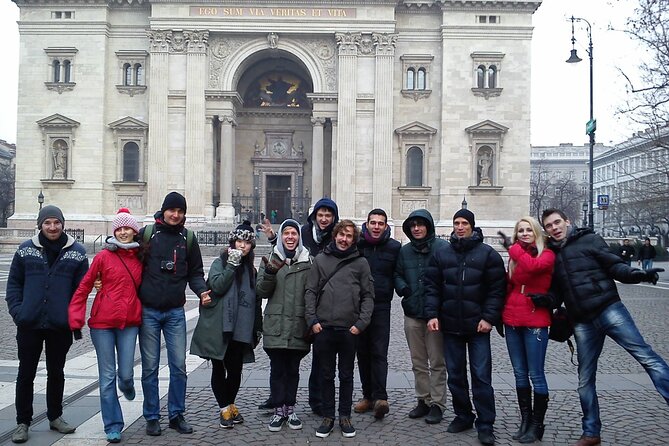
The Chain Bridge receives a short but meaningful stop. It was the first permanent bridge connecting Buda and Pest, and its story helps explain the growth of the modern city.
The bridge is more than a handsome crossing. It represents the physical and political joining of the two sides. The guide uses it to explain the difference between Buda and Pest and to place the rest of the city in context.
The route does not cross the bridge as part of the stated finish. Instead, you continue along the Pest side toward Gresham Palace and the Academy of Sciences. If you want to explore Buda Castle, Matthias Church, or Fisherman’s Bastion, plan that for another outing. The walk gives you a view and an orientation, not a full Buda tour.
Gresham Palace and Budapest’s golden age
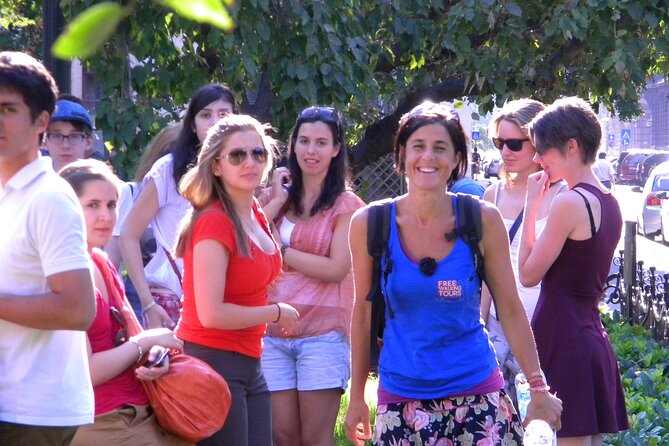
Gresham Palace is one of the route’s visual highlights. The building represents the turn-of-the-century golden age of Budapest and is a fine introduction to the city’s secessionist, or Art Nouveau, style.
The guide explains the decorative details and the broader design ideas behind the building. This is especially useful if you enjoy architecture but do not know the local terms. You will start noticing the curves, ornaments, ceramics, and decorative choices elsewhere in the city.
The stop is outside. The building is worth seeing even without an interior visit, and its position near the Danube makes it an easy landmark to find again later.
Hungarian words, inventions, and national pride
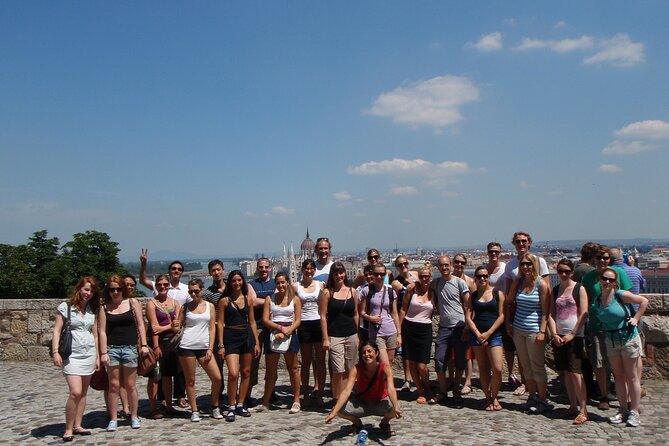
At the Hungarian Academy of Sciences, the tour takes a lighter educational turn. You learn a few Hungarian words and phrases, including enough to impress friends with your effort, if not enough to conduct a business meeting.
The guide also discusses Hungarian Nobel Prize winners, famous people of Hungarian origin, and inventions connected to everyday life. This section helps correct the common mistake of treating Hungary as only a place of old buildings and imperial memories.
The presentation also touches on Hungarian identity and the country’s contribution to science and culture. Guides such as Dora have been praised for making difficult historical subjects easy to follow and for answering questions without overwhelming the group.
The Shoes on the Danube Bank requires quiet attention
The most serious stop comes at the Shoes on the Danube Bank memorial. Sixty pairs of metal shoes commemorate Jewish people murdered along the river during the Holocaust.
The guide discusses World War II, deportations, and the more recent history of Hungary’s Jewish community. The memorial is small in physical size but heavy in meaning. The shoes represent people who were ordered to remove their footwear before being killed and pushed into the river.
The tour asks you to pause and picture the people represented here, from synagogue worshippers and assimilated Jewish citizens to grandparents, children, factory workers, and business owners. The tone is appropriately reflective, and this is not a place for a rushed group photo.
Some people may find the transition from playful statues and food tips to Holocaust history abrupt. That is part of Budapest’s reality. The city’s beauty and painful past sit close together, and a useful city walk should not avoid that fact.
Parliament is the finish, not the full visit
The Hungarian Parliament Building is the final stop. The guide explains its neo-Gothic architecture, recent history, and elections, then gives final orientation and suggestions for restaurants, nightlife, and activities for the following days.
The building is one of Budapest’s great sights, but this experience views it from outside. If you want a guided interior visit, you need a separate ticket and plan. The tour does not include admission to Parliament or any other attraction.
Ending here makes practical sense. Kossuth Lajos Square is a clear location, and you can continue along the Danube, find public transportation, or walk toward other central districts. You finish with both a landmark and a list of possible next steps.
What the $3.63 price really means
The advertised cost is $3.63 per person, making this one of the easiest Budapest activities to fit into a tight budget. The booking fee covers administration and does not contribute to the guide’s earnings.
The tour depends entirely on donations to the guide, and the amount is up to you. That makes the price attractive, but you should not think of it as a fully paid guided tour for $3.63. Bring enough cash or another suitable way to leave a tip that reflects the time and quality of the experience.
At this price, the value is excellent if you want orientation, stories, and recommendations rather than admissions or a private group. You are paying very little for access to a local guide who can help you avoid wasting the rest of your stay.
Who will get the most from this walk
I would choose this tour early in a first Budapest visit. It is especially useful if you want to:
- Learn the basic layout of Pest quickly
- See the major central landmarks without filling an entire day
- Decide which buildings deserve a later interior visit
- Get restaurant and nightlife suggestions
- Hear local perspectives on food, language, politics, and daily life
- Combine light sightseeing with serious historical context
It suits most people who can manage a normal city walk. Service animals are allowed, and most people can participate, but the route includes outdoor walking, standing, and urban streets. Ask about any specific mobility concern before booking because the supplied information does not describe step-free access or rest stops.
The walk may be less suitable if you want a quiet private experience, extensive time inside monuments, or a detailed tour of Buda Castle. A group of up to 30 can feel crowded at popular viewpoints, though a clear voice or speaker helps.
Timing, weather, and cancellation details
Confirmation is provided at booking, and free cancellation is available until 24 hours before the start time. Changes or cancellations inside that 24-hour window are not accepted for a refund.
The experience requires good weather. If poor weather causes cancellation, you are offered another date or a full refund. Since the route is outdoors from start to finish, check the forecast and dress for walking rather than relying on the short duration alone.
Should you book the Budapest City Landmarks Walking Tour?
I would book it if this is your first visit, your budget is limited, and you want a useful introduction before exploring on your own. The combination of landmark views, food advice, Hungarian phrases, architecture, national identity, and difficult history gives you more context than a simple photo walk.
I would skip it only if you need a private tour, want interior access to the Basilica or Parliament, or have already explored central Pest in detail. For everyone else, the price is unusually low, the route is sensible, and the final recommendations can shape the rest of your trip. Arrive early at the Budapest Eye, bring water, listen closely at the Danube memorial, and treat the donation as part of the real cost.
FAQ
How long does the Budapest City Landmarks Walking Tour last?
The tour is advertised at about two hours, with the full walk sometimes taking around two and a half hours depending on the pace and questions.
Where does the tour begin?
It begins at the Budapest Eye in Erzsébet Square, Budapest 1051. The guide meets the group about 20 meters from the Ferris wheel while holding a small blue flag.
Where does the tour finish?
The final stop is the Hungarian Parliament Building at Kossuth Lajos tér 1-3, Budapest 1055.
Is the tour offered in English?
Yes. The tour is offered in English.
Does the tour enter St. Stephen’s Basilica?
No. The Basilica is discussed and viewed from outside, but admission is not included and the tour does not enter.
Is admission to the Parliament Building included?
No. The tour finishes outside the Parliament Building and does not include interior admission.
What is included in the $3.63 price?
The price includes the booking fee. That fee covers administration and does not contribute to the guide’s earnings.
Do I need to tip the guide?
Tips are not included. The guides depend entirely on donations, and the amount is your choice.
Can I cancel for a full refund?
Yes, if you cancel at least 24 hours before the experience start time. Poor-weather cancellations offer a different date or a full refund.
Just added around Budapest
- Budapest: Street Art and Underground Movements Walking Tour★ 5.0 · 365 reviews
- Jewish Quarter of Budapest Walking Tour★ 4.7 · 369 reviews
- Budapest 3-Hour Walking Tour in Italian★ 4.6 · 217 reviews
- Budapest: Buda Castle District Walking Tour with a Historian★ 4.9 · 867 reviews
- Budapest: Walking Tour to the Shoes Memorial and Parliament★ 4.7 · 151 reviews
- Budapest: Castle District Walking Tour★ 4.8 · 223 reviews
- Budapest: Jewish History Guided Walking Tour with Historian★ 4.8 · 205 reviews
- Budapest Guided Food Walking Tour with Drinks Included★ 4.8 · 472 reviews
City Highlights Walking Tours, compared.

Historic Charleston Guided Sightseeing Walking Tour
Read our review →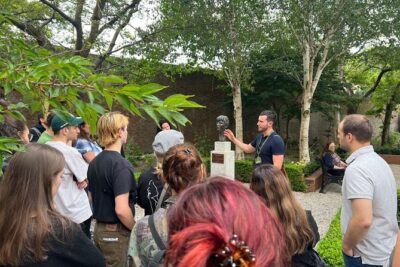
Dublin Highlights and Hidden Gems Guided Walking Tour
Read our review →
Guided Walking Tour of City Center Highlights
Read our review →

City Highlights Temple and Market Walking Tour
Read our review →
Montmartre Hidden Gems and Scenic Highlights Walking Tour
Read our review →
Browse the lists this tour appears in