
Review · USA WALKING TOURS
Portland, Oregon: Soul of the City Walking Tour
Portland reveals itself one block at a time. This two-hour walk connects architecture and city planning with the parks, politics, art, and oddball spirit that give Portland its personality. You begin at Director Park and finish at Pioneer Courthouse Square, covering about 2 miles through the central city.
I especially like the way the tour explains why downtown looks the way it does, rather than simply pointing out attractive buildings. I also like the mix of old cast iron fronts, public sculpture, green spaces, and modern political history. The main consideration is that the tour covers a fairly limited downtown area, and the guide’s views on social and political issues may be clear rather than neutral.
Guides including Nancy, Shannon, Kelly, Rachel, and Sarah have led this experience. The strongest praise goes to their storytelling, local insight, and ability to adjust the walk to the group. Nancy is a Portland native, Shannon grew up in the city, and Kelly brings the perspective of someone who moved to Portland and adopted it as home.
Key points to know before you book
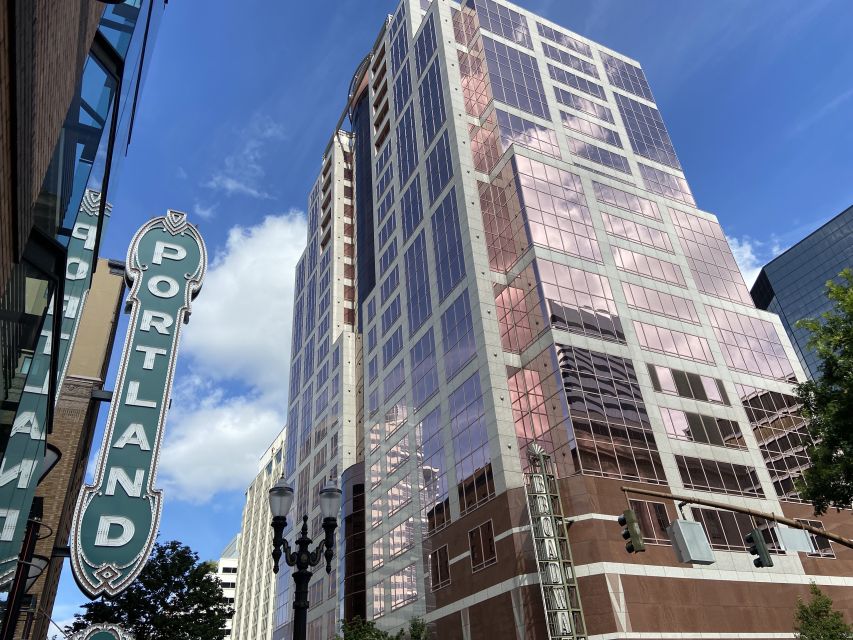
- Two miles through central Portland: Expect about two hours of walking between Director Park and Pioneer Courthouse Square.
- Architecture with a backstory: You see cast iron-fronted buildings, the Portland Building, public plazas, museums, concert halls, and the Portlandia sculpture.
- Parks are part of the city plan: The South Park Blocks and surrounding plazas show how Portland made open space a central part of downtown.
- History meets current affairs: The tour links Oregon’s founding, urban planning, racial justice, activism, hippie culture, and present-day Portland politics.
- Strong guide-led experience: Nancy and Shannon receive especially warm praise for their local knowledge and lively delivery.
- Rain or shine: Wear comfortable shoes and weather-ready clothing. Some hills and stairs can be avoided, and the tour is wheelchair accessible.
Starting at Director Park in the Cultural District
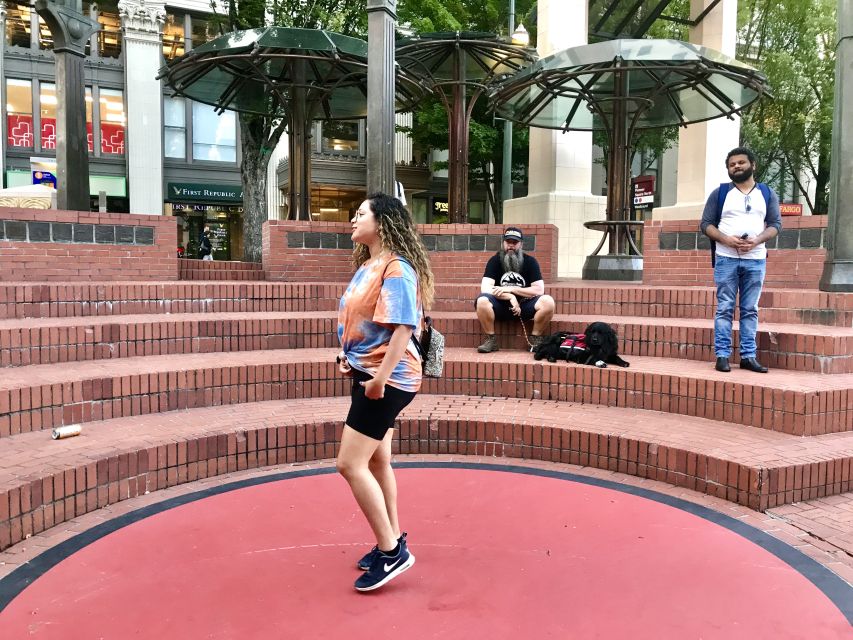
Meet your guide at the northeast corner of Director Park, at the corner of Southwest Yamhill Street and Southwest Park Avenue. The meeting point is across from Elephants Delicatessen on the Park, near the globe-shaped fountain.
This is a smart starting place because you are already close to Portland’s Cultural District. It puts you near museums, performance spaces, public art, and the South Park Blocks, so the tour can begin with the city’s physical structure rather than a long walk to reach the sights.
Director Park also gives the group a clear place to gather. Still, look for the globe fountain and the Elephants Deli reference carefully, especially if you are new to downtown. Your guide will be the key person to identify.
The opening part of the walk sets up the central question of the tour: why does Portland feel so different from many American cities? You begin looking at street layouts, blocks, public squares, and the decision to preserve or create open spaces downtown.
That approach is more useful than a simple list of dates. You learn to read Portland as you walk. A plaza is not just a nice place to sit. A street is not merely a route between buildings. Each reflects choices made by planners, officials, developers, artists, and residents.
A few more walks around the USA worth a look
- History and Hauntings of Salem Guided Walking Tour
★ 5.0 · 14,564 reviews - New Orleans Premier Ghost, Voodoo and Vampire Walking Tour
★ 4.5 · 12,856 reviews - Little Havana Food and Walking Tour in Miami
★ 5.0 · 8,882 reviews
The South Park Blocks and Portland’s open-space habit
The South Park Blocks provide one of the tour’s clearest lessons. Portland’s downtown parks are not scattered leftovers. They are woven into the city center, giving office blocks, museums, and public buildings breathing room.
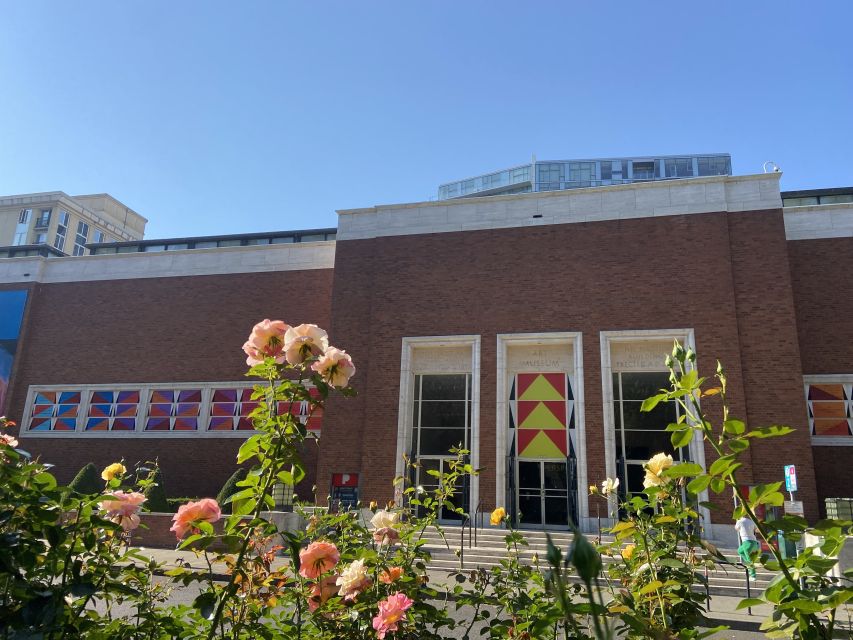
As you walk, the guide explains what led Portland to prioritize parks. You also look at the plazas connected with the Portland Art Museum and the Oregon Historical Society, along with spaces near concert halls and other cultural buildings.
This is where the tour’s urban-planning theme becomes practical. You can see how cultural institutions relate to sidewalks, trees, plazas, and traffic patterns. The result is a city center that invites you to move on foot, even when the weather is not perfect.
The parks also provide a setting for Portland’s public life. Activists have used these spaces for demonstrations and gatherings that drew attention far beyond Oregon. The tour connects those recent events with older traditions of civic debate and social reform.
The presentation is not likely to be politically blank. One participant appreciated the guide’s clear point of view, while another would have preferred more attention to both sides of political and social questions. If you like tours that acknowledge current issues, this is a strength. If you want a strictly detached account, keep that in mind.
Cast iron fronts, museums, and the city’s built story
Portland’s older commercial buildings help explain how the city grew. Cast iron-fronted structures give you a physical link to the city’s early development and changing commercial life.
The important point is not only the appearance of the facades. Your guide explains who built the city, how industries shaped it, and how Portland’s early growth influenced the streets you see today. The discussion can include Oregon’s industries, demography, and the people remembered in street names.
This is where a good guide makes a major difference. Nancy was praised for explaining both downtown buildings and the city administration, while Shannon received repeated praise for connecting architecture with local stories. Kelly’s approach offers another angle, presenting Portland through the eyes of someone who came to the city and embraced it.
The route also passes murals, sculptures, and public art. You will not simply stop at major museum entrances. You may be asked to notice a work that is easy to pass without understanding its setting.
On days when attractions are open, the guide may briefly take the group inside one or two buildings. That is a useful bonus, but it should not be the main reason you book. The tour is fundamentally an outdoor walk, and interior access depends on opening conditions.
The Portland Building and an argument about design
The Portland Building brings the city’s architectural story into the modern era. Its postmodern design is often described as grandly disastrous, which gives you a clue about the tone of the discussion.
The building is useful because it raises a question that many architecture tours avoid: can a building be historically important and widely disliked at the same time? The answer here is not reduced to a simple yes or no. You consider how modern designers look at the past, how they plan for the future, and how public buildings reflect changing ideas about civic identity.
This section should appeal to anyone who enjoys architecture with a little friction. You are not just admiring handsome facades. You are looking at decisions that divided opinion and helped shape how people think about Portland’s downtown.
The guide also explains how current design relates to older planning choices. That connection gives the walk a useful rhythm. One moment you are looking at an older commercial structure, and the next you are asking what later architects were trying to accomplish.
Same streets, a different way to see them:
- Chicago: Gangsters and Ghosts Walking Tour
★ 5.0 · 7,155 reviews - Boston: Freedom Trail History Small Group Walking Tour
★ 5.0 · 6,450 reviews - Historic Charleston Guided Sightseeing Walking Tour
★ 5.0 · 6,216 reviews - New Orleans Food Walking Tour of the French Quarter with Small-Group Option
★ 5.0 · 6,118 reviews
Oregon’s unusual origins and Portland’s changing identity
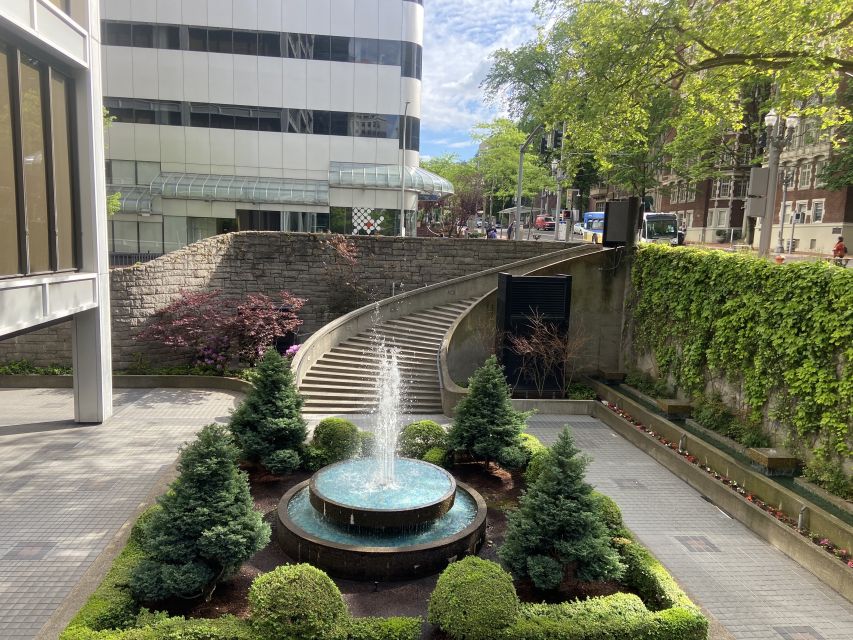
The tour tackles how Oregon was founded and why the state developed its particular identity. That part may surprise you, especially if you know Portland mainly through coffee, bicycles, food carts, or independent shops.
The discussion moves through Oregon’s demographics, industries, urban growth, and cultural self-image. It also addresses Portland’s nicknames and the forces that shaped the city’s reputation for progressivism and experimentation.
The tour does not treat Portland’s identity as something that appeared overnight. You hear about the city’s early planners, its street layout, its civic decisions, and the later residents who helped reshape its culture.
Hippies receive a meaningful place in that story. The tour explores how counterculture helped enrich Portland’s arts, public life, and independent spirit. That does not mean every modern feature can be credited to one group, but it does give you a way to understand why Portland became associated with alternative culture and social experimentation.
The guide may also discuss racial justice and social progressivism. This is one of the more current parts of the walk, and it helps explain why Portland has become a focus of national attention. You get more than a postcard image of a quirky Northwest city. You get a city still arguing with its past and testing its ideals.
Public sculpture, Portlandia, and a surprising finale
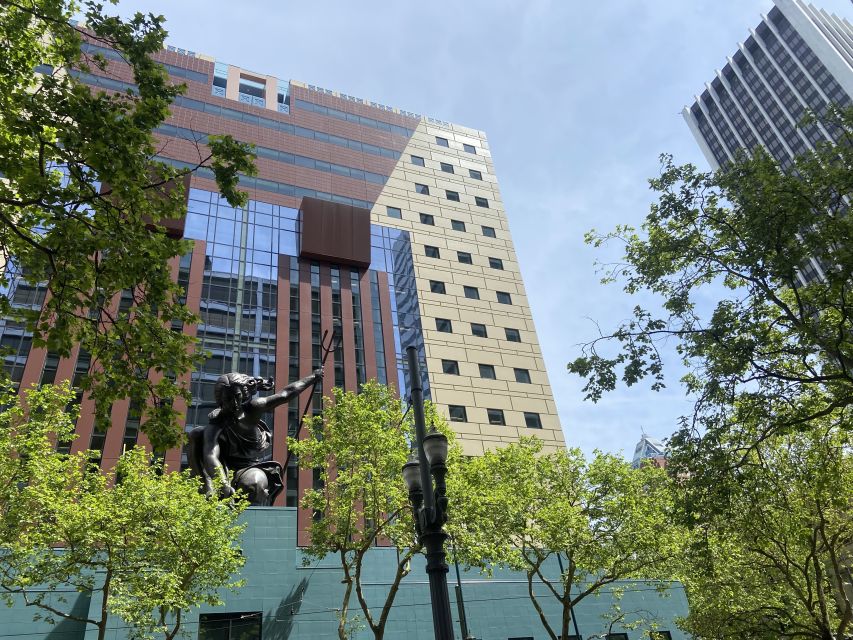
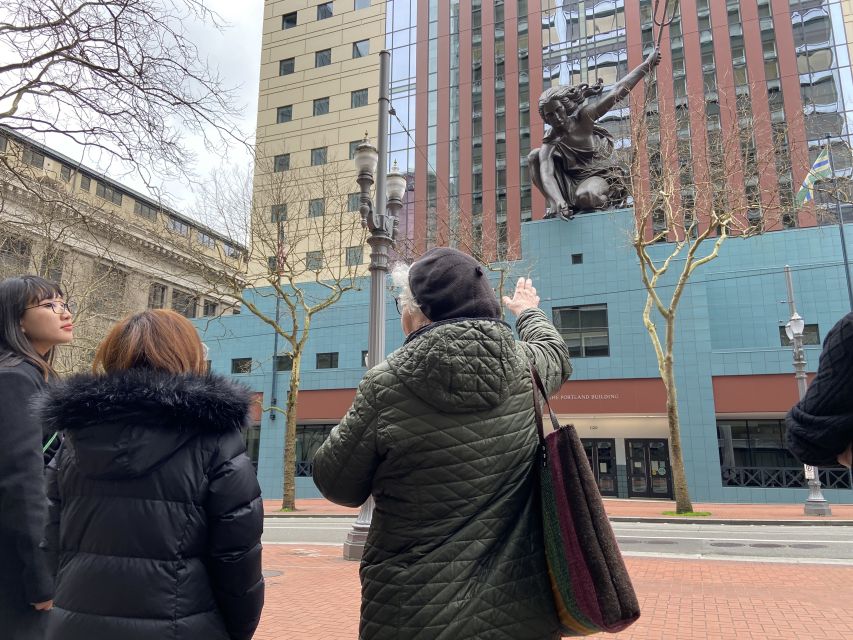
One highlight is meeting Portlandia, the large sculptural figure that personifies the city. The work is easy to miss if you do not know where to look, and the tour explains its place in Portland’s public identity.
The sculpture also provides a chance to talk about how cities represent themselves. A city symbol can be grand, playful, political, or all three at once. Portlandia fits Portland’s tendency to combine civic pride with a sense of humor.
The tour also points out what is described as the city’s most extravagant sculptural work, hidden in plain sight. That phrase captures one of the walk’s pleasures. The experience trains you to look above, beside, and behind the obvious landmarks.
You may see public art that would not make your standard sightseeing list. This is one reason the tour works well early in a Portland visit. Afterward, you will likely notice more sculpture, murals, unusual building details, and public spaces as you continue exploring on your own.
Ending at Pioneer Courthouse Square
The walk ends at Pioneer Courthouse Square, one of downtown Portland’s main public gathering places. Finishing here makes practical sense. You are still in the central city, near major streets and other downtown sights, and you have a clear point from which to continue your day.
By this point, the square functions as more than a final stop. It brings together the themes of the tour: planning, public space, civic identity, architecture, activism, and the everyday life of the city.
The route does not cover every Portland neighborhood. It focuses on central downtown and may include an overview of the Pearl District, depending on the guide and route. One participant found the area fairly limited, while another considered it an excellent introduction to downtown.
That difference is worth understanding. If you want a broad tour covering many districts, this is not that experience. If you want to understand the city center before exploring farther out, the focused route is an advantage.
How much walking and how hard is it?
The tour covers about 2 miles, or 3.5 kilometers, over two hours. That is a steady walk rather than an all-day hike, but you should still wear comfortable shoes.
There are a few hills and some stairs. The stairs and hills can be avoided, and the tour is wheelchair accessible. Still, tell the guide about your needs at the start so the route can be adjusted smoothly.
Portland’s weather matters. The tour operates rain or shine, so bring a waterproof layer or other weather-appropriate clothing when needed. One guide was praised for finding shelter from cold wind and even carrying hand warmers for the group. That kind of practical attention can make a real difference on a gray day.
Some attractions do not allow dogs. If you are bringing a dog, ask the guide about the day’s route and interior stops before setting out.
The guides are the main reason to book
The subject matter is strong, but the guide makes or breaks this tour. The most repeated praise centers on clear explanations, local stories, humor, and enthusiasm for Portland.
Nancy receives especially strong marks for her wide range of subjects, from architecture and city government to Oregon’s industries and population. She is also a Portland native, which adds a personal connection to the material.
Shannon is praised for friendly delivery, local knowledge, restaurant suggestions, and the ability to connect hidden details with the larger story of the city. Her background growing up in Portland gives her a direct link to the changes she describes.
Kelly offers an interesting alternative perspective. She is not originally from Portland, but she has adopted the city and tells its story as a Portland convert. That can be useful if you enjoy a guide who knows the city well while also remembering what it feels like to discover it.
Rachel is praised for answering questions carefully and explaining the city’s past in an approachable way. Sarah received positive comments for her understanding of downtown, though one participant found the political perspective somewhat one-sided.
The overall rating is 4.8 from 90 reviews, with many perfect scores. The pattern is clear: you are mainly paying for the guide’s interpretation, not for entry tickets or elaborate transportation.
Is $29 a fair price?
At $29 per person, the tour offers good value if you want context rather than just sightseeing. You receive two hours with a certified live guide, a structured route, local stories, and a useful introduction to central Portland.
There are no major admission costs built into the experience. The value comes from learning how to read the buildings, streets, parks, art, and politics. If you would otherwise spend two hours wandering downtown without much context, the price is easy to justify.
The value is lower if you already know central Portland well or prefer exploring at your own pace. You will not see the whole city, and the tour does not replace visits to museums or attractions.
Flexible booking also helps. You can reserve and pay later, and cancellation is available up to 24 hours before the tour for a full refund. Check the available start times when planning because the duration is fixed at two hours.
Who will enjoy this walk most?
I would recommend it to first-time visitors who want to understand Portland before venturing farther afield. It also suits architecture fans, urban-planning enthusiasts, people interested in public art, and anyone curious about the city’s political and cultural character.
It is a good choice for locals showing family around, too. One participant said the tour revealed facts that surprised a brother who had lived in Portland for years.
You may prefer another activity if you want food tasting, extensive neighborhood coverage, a nature walk, or a fully neutral presentation of political subjects. The focus here is central Portland, and the guide’s personality is part of the experience.
Should you book Portland’s Soul of the City walk?
Book it if you want a thoughtful introduction to downtown Portland that links visible places with the choices and conflicts behind them. The architecture, parks, public art, and city planning give the walk substance, while the guides add humor and local color.
I would schedule it near the beginning of your stay. You will finish with a better sense of where you are, what to notice, and which parts of Portland deserve more time.
Skip it if you already know downtown thoroughly or want a tour built around food, nightlife, or destinations outside the central city. For most first-time visitors, though, $29 is a fair price for two hours of useful orientation and lively local interpretation.
FAQ
How long is the Soul of the City Walking Tour?
The tour lasts two hours.
How far does the tour go?
The walk covers about 2 miles, or 3.5 kilometers.
Where does the tour begin?
It begins at the northeast corner of Director Park at Southwest Yamhill Street and Southwest Park Avenue, across from Elephants Delicatessen on the Park and near the globe-shaped fountain.
Where does the tour end?
The tour ends at Pioneer Courthouse Square.
What language is the tour offered in?
The tour is conducted in English.
Is the tour wheelchair accessible?
Yes, the tour is wheelchair accessible. A few hills and stairs can be avoided.
Does the tour operate in bad weather?
Yes. The tour operates rain or shine, so bring weather-appropriate clothing.
What should I wear?
Wear comfortable shoes and clothing suitable for the weather.
Can I bring a dog?
Some attractions visited during the tour do not allow dogs, so plan accordingly.
Can I cancel the tour for a refund?
Yes. You can cancel up to 24 hours in advance for a full refund. You can also reserve now and pay later.
Just added around the USA
- Savor Bar Harbor Culinary Walking Tour in Maine★ 5.0 · 169 reviews
- Savor Bar Harbor Culinary Walking Tour★ 4.5 · 75 reviews
- 90-minute Ghost Walking Tour in Bar Harbor★ 4.5 · 161 reviews
- Baltimore Walking Foodie Tour in Fells Point★ 5.0 · 182 reviews
- The Original Fells Point Ghost Walk by Baltimore Ghost Tours★ 4.5 · 73 reviews
- The Story of Austin: Downtown History Walking Tour★ 5.0 · 216 reviews
- Austin Small Group Morning Walk★ 5.0 · 412 reviews
- The Madam’s Curse Walking Ghost Tour★ 4.5 · 103 reviews
USA Walking Tours, compared.
History and Hauntings of Salem Guided Walking Tour
Read our review →
New Orleans Premier Ghost, Voodoo and Vampire Walking Tour
Read our review →
Freedom Trail History Small Group Walking Tour
Read our review →
Historic Charleston Guided Sightseeing Walking Tour
Read our review →
New Orleans Food Walking Tour of the French Quarter with Small-Group Option
Read our review →
St. Louis Cemetery No. 1 Official Walking Tour
Read our review →Browse the lists this tour appears in