
Review · CITY HIGHLIGHTS WALKING TOURS
Syracuse: Highlights of Ortigia Guided Walking Tour
Ancient stones, living streets, and one very odd spring. This two-hour Ortigia walking tour gives you a useful first look at Syracuse’s old center, moving from the Greek Temple of Apollo to Piazza Duomo and the freshwater Arethusa Spring. I like the compact route and the strong local storytelling, especially when guides explain the myths behind the Fountain of Diana and Arethusa. At $29 per person, it is a fair price for a guide-led introduction, though the experience can slow down if English and Italian are combined in one group.
The tour is especially good for first-time visitors who want context before exploring on their own. Guides such as Michael, a Philadelphia native who has lived in Syracuse for 22 years, Giuseppe, Letizia, Vincenzo, and Eva have been praised for clear explanations and friendly service. Just arrive early, wear suitable clothing for the cathedral, and be ready for the possibility that the visit may finish a little sooner than the advertised two hours.
Key points to know before booking
- The route links Ortigia’s main sights: You visit the Temple of Apollo, Piazza Archimede, Piazza Duomo, Syracuse Cathedral, and Arethusa Spring.
- Myth is part of the tour: The Fountain of Diana and Arethusa Spring bring Greek legends into the streets and monuments.
- The price is reasonable: At $29, you pay for a local guide and a focused introduction, while cathedral admission costs extra.
- The meeting point is easy to identify: Look for the guide with a badge under the pomegranate tree near the Temple of Apollo.
- English and Italian may be combined: Repeated explanations can lengthen the route and make the walk feel slower.
- The route is exposed in summer: A guide named Michael was praised for keeping the group in the shade during a 96-degree heatwave.
Why Ortigia works so well on foot
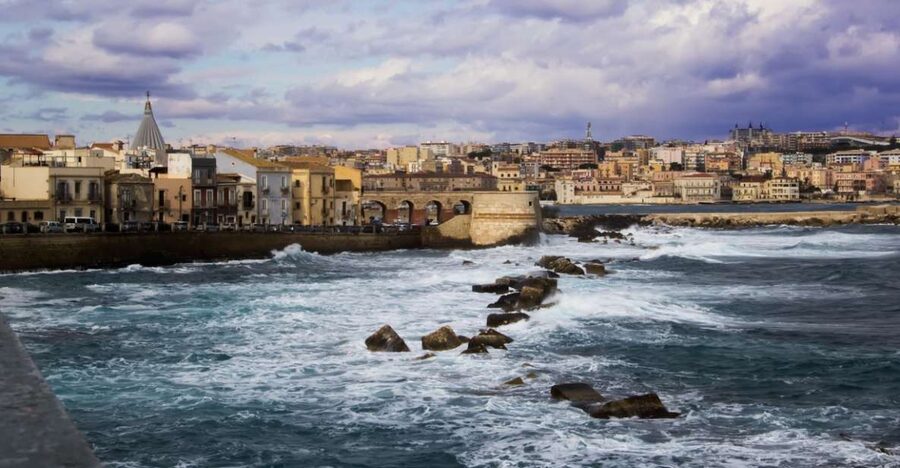
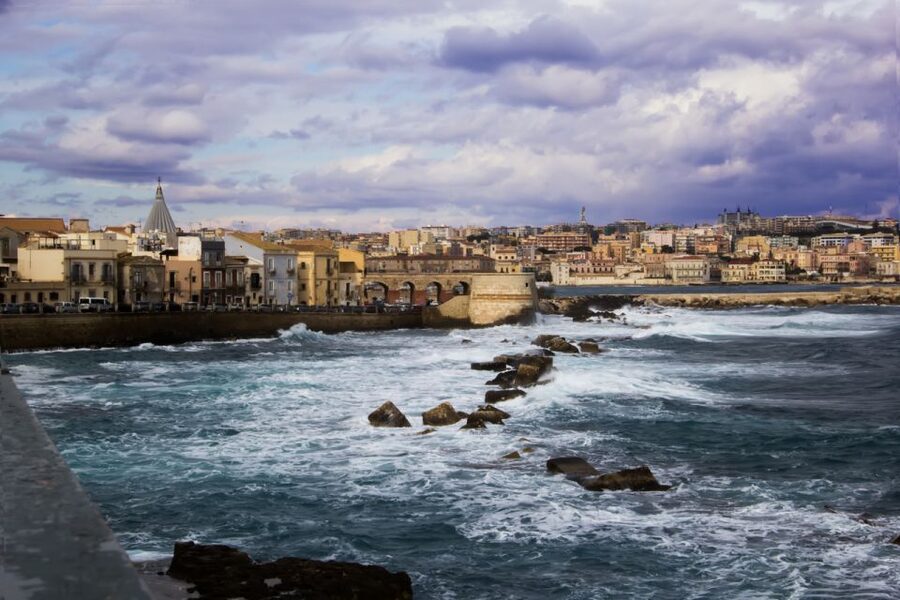
Ortigia is the small island at the heart of Syracuse, linked to the mainland but packed with the city’s oldest sights. A walking tour makes sense here because the route connects several important places without needing a bus, taxi, or complicated directions.
You begin at Largo XXV Luglio, close to the Temple of Apollo. From there, the walk heads toward Piazza Archimede, continues to Piazza Duomo, and finishes beside the sea at Arethusa Spring. The stops are close enough to fit into two hours, but each one opens a different chapter of Syracuse.
I like this order because it moves through time as well as space. You start with Greek remains, see later layers around the central square, enter the cathedral, and end with a natural spring tied to an ancient love story. It gives you a clear framework for exploring Ortigia afterward.
This is not a tour built around long museum visits. It is a street-level introduction, with the guide doing much of the work through explanation. That makes it a good choice if you want to understand what you are seeing rather than simply collect photographs.
More City Highlights Walking Tours in Italy
- Florence: Highlights Walking Tour with Expert Guide
★ 4.6 · 4,662 reviews - Skip-the-Line Florence Highlights and David Walking Tour
★ 5.0 · 1,127 reviews - Venice: Walking Guided Tour of the City Must-See Sites
★ 4.7 · 1,095 reviews
Meeting the guide at the Temple of Apollo
The meeting point is under a pomegranate tree in front of the Temple of Apollo, at the roundabout where Corso Matteotti begins. Look for a guide wearing a badge. Arrive 10 minutes early, since the group is expected to leave on time and the area can be confusing if you arrive at the last moment.
The Temple of Apollo is a strong starting point. It is described as the oldest Greek temple in the Western world, and its weathered columns immediately show how far back Syracuse reaches. The tour allows about 30 minutes here, enough time for the guide to explain the remains and place them within the story of the city.
The value of this stop is not just the monument itself. Ancient ruins can look like a pile of stones when you see them without context. A guide can point out the shape of the temple, explain what survives, and show how the site fits into the later development of Ortigia.
You should expect an outdoor explanation rather than a long archaeological visit. Bring water in warm weather, and wear shoes that are comfortable for walking on old paved streets. The route is not described as strenuous, but Syracuse can be hot, particularly in summer.
Piazza Archimede and the Fountain of Diana
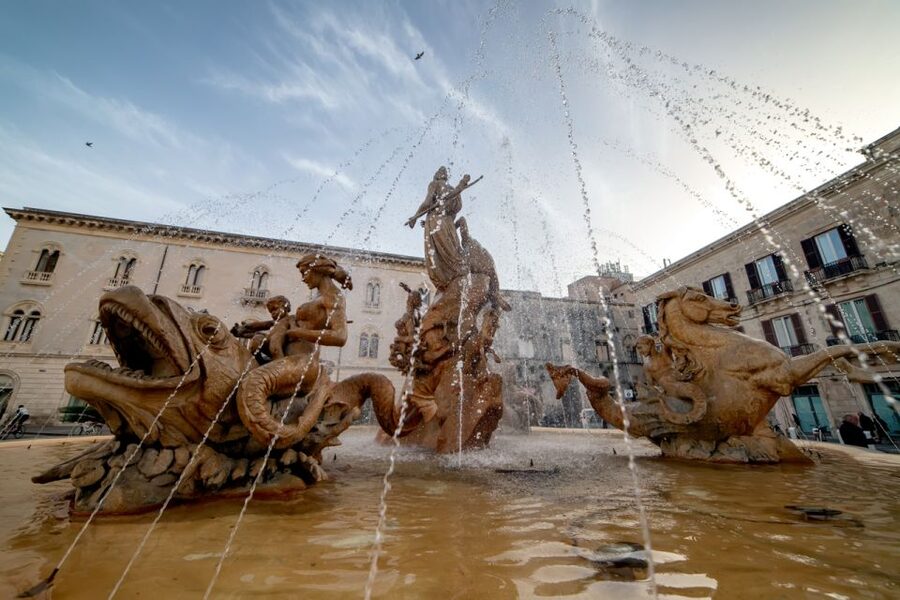
From the Temple of Apollo, the walk continues to Piazza Archimede. The square is named for Archimedes, the famous mathematician and engineer associated with Syracuse, and its focal point is the Fountain of Diana.
The fountain shows Diana, the Roman name for the Greek goddess Artemis, alongside the nymph Arethusa. The scene refers to the moment when Arethusa is transformed into a spring. This is one of the tour’s more useful stops because the guide connects a public monument with the myths that shaped the identity of the city.
I like this part of the route because it slows the tour down from ancient ruins and lets you read the city through its sculpture. The fountain is not simply decoration. It presents a local story in stone, and the guide explains why Arethusa appears again later at the spring near the water.
The scheduled explanation here lasts about 20 minutes. That is long enough for the myth, the sculpture, and the surrounding square without turning the stop into a lecture. Still, the pace depends on the language arrangement. If your group receives the same explanation in English and Italian, each stop can take longer.
Piazza Duomo and the marble Cathedral
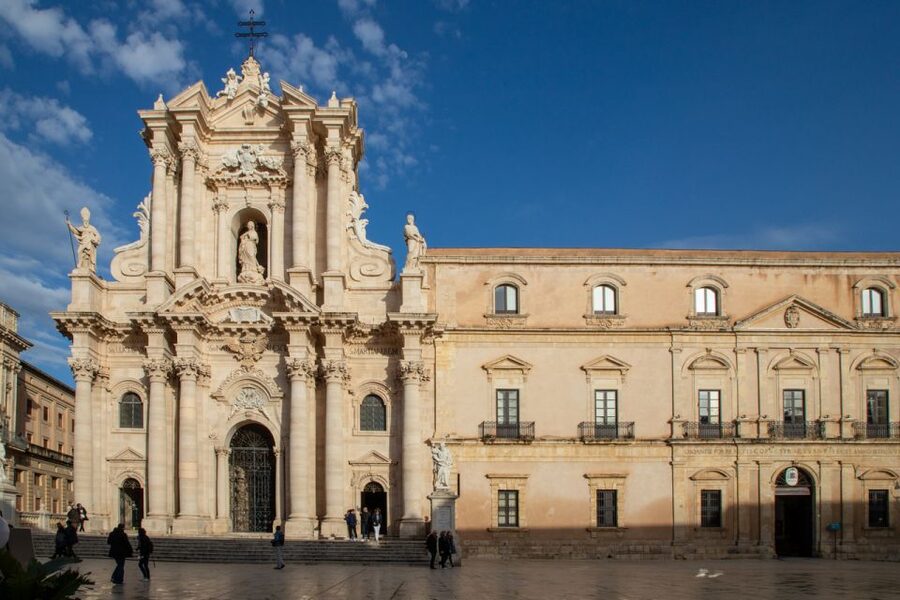
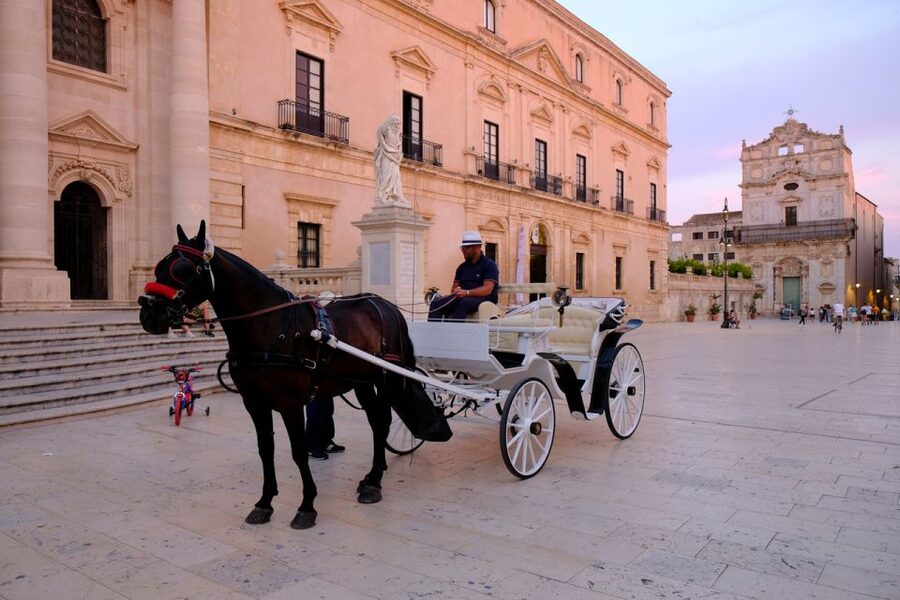
Piazza Duomo is the visual center of the walk. The square is known for its pale marble and grand buildings, and it is widely regarded as one of Italy’s most beautiful urban spaces. It is also tied to the earliest Corinthian settlers who founded Syracuse.
The planned visit to this part of Ortigia lasts about 45 minutes, making it the longest section of the tour. That time allows the guide to explain the square, the buildings around it, and the Syracuse Cathedral.
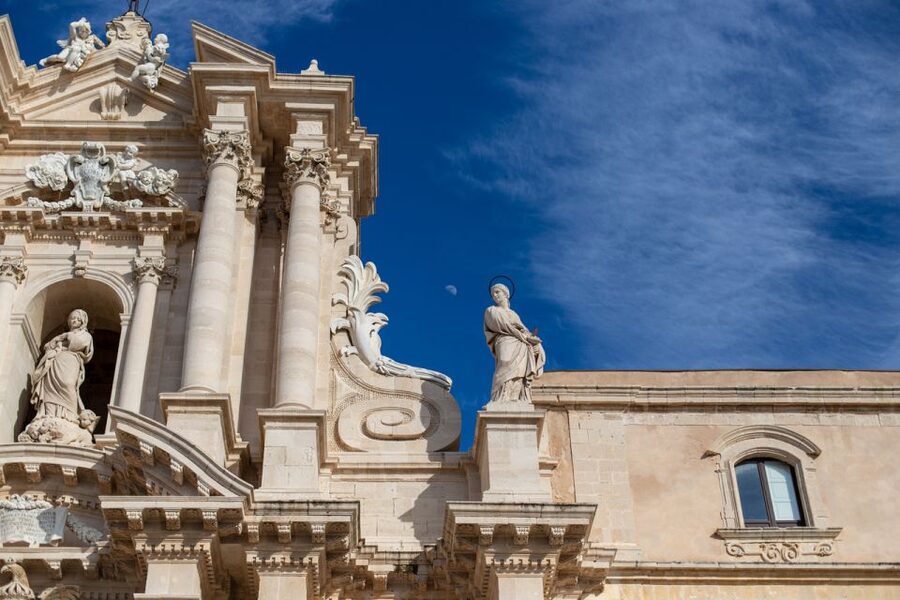
The cathedral is particularly interesting because it is not a single-period monument. Its current form includes later Christian architecture, but the building incorporates the columns of an earlier Greek temple. That mixture is exactly what makes Ortigia rewarding. You are not looking at a city frozen in one era. You are seeing ancient, medieval, and later Syracuse layered together.
Cathedral admission is not included in the $29 tour price. You must pay the entry ticket on site. The exact access arrangement can change with holidays and opening hours, so do not assume that the interior visit will always be identical.
Dress carefully for this stop. A certain dress code is required to enter places of worship. Cover your shoulders and knees as needed, and avoid treating the cathedral like a quick photo stop. The guide can provide the historical setting, but you also need enough time to look at the marble work and the interior details for yourself.
One practical issue is timing. One participant found that the tour lasted about an hour and a half, with only 15 minutes inside the cathedral. That may not happen every time, but it is a useful warning. If entering the cathedral and spending time inside matters greatly to you, ask at the start how much time is planned for the interior.
Same streets, a different way to see them:
- Venice: Doge’s Palace and St Mark’s Basilica Walking Tour
★ 4.4 · 6,291 reviews - Milan: Guided Walking Tour & Last Supper Visit with Ticket
★ 4.7 · 5,409 reviews - Naples: Street Food Walking Tour with Local Guide
★ 4.9 · 4,976 reviews - Venice: San Marco to Rialto Walk & Spritz Like a Local
★ 4.2 · 3,651 reviews
Arethusa Spring, where myth meets the sea
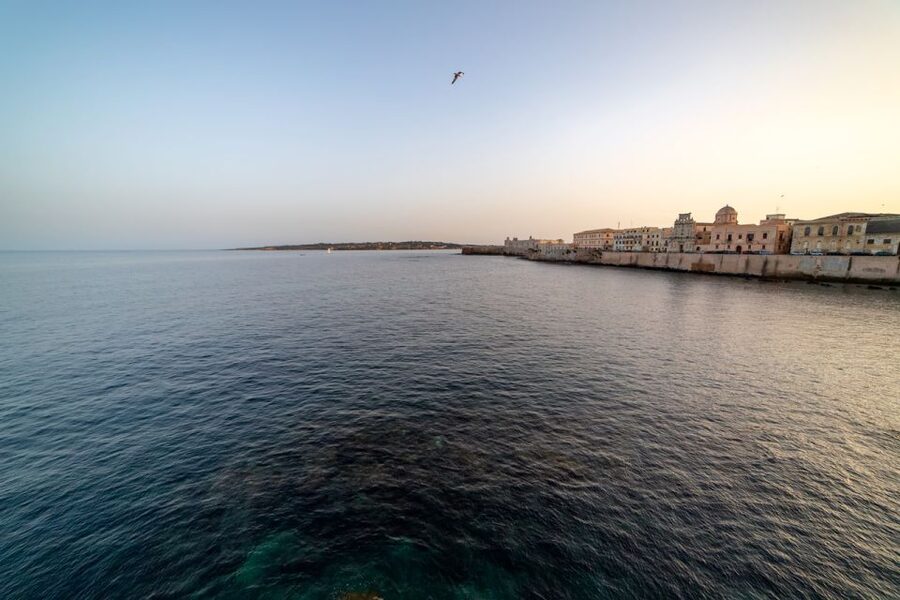
The final stop is Arethusa Spring, a freshwater spring only a few meters from the sea. This unusual meeting of fresh water and salt water gives the site its appeal even before the mythology is explained.
The spring is linked to the story of Arethusa and Alpheus. In the myth, Arethusa escapes and is changed into a fountain, while Alpheus is connected to the water that follows her. The exact telling varies, but the basic idea is one of pursuit, transformation, and water crossing distance.
The tour sets aside about 40 minutes for this final section. That makes sense. Arethusa is more than a quick viewpoint. It is the place where the story introduced at the Fountain of Diana returns in physical form.
I would treat this as a good closing stop because the spring leaves you with something to think about after the guide finishes. It also provides a calmer end to the walk than another crowded square. The nearby sea helps explain why ancient people found this place so striking.
Keep your expectations realistic. This is a guided stop, not a long nature visit, and the tour does not include food, drinks, or a separate attraction ticket. The appeal comes from the unusual water source and the story attached to it.
The guides make the difference
The strongest part of this experience is the guide. Several guides have received especially warm praise for combining local knowledge with a friendly manner.
Michael was described as a man from Philadelphia who has lived in Syracuse for 22 years. That kind of background can be useful: he brings an outsider’s clarity but has had years to learn the city. During a severe heatwave, he also made a point of keeping the group in the shade, a small act that matters when temperatures reach 96 degrees.
Vincenzo was praised for explaining how Ortigia changed over time and for answering questions rather than simply reciting dates. Letizia was appreciated for covering major sights while also pointing out less obvious details. Giuseppe was described as friendly and well informed, while Eva was remembered as especially pleasant and helpful.
The best guides also add local lore. One example involved a story about heirs of Dolce & Gabbana owning an apartment near the Duomo. Details like this are not the reason to book the walk, but they can make a familiar square feel more personal and less like a string of monuments.
The quality can vary by guide and by the language setup. One English booking was combined with Italian, requiring every explanation to be repeated. That made the tour slower, though the guide still worked hard in hot conditions. If you want a brisk English-only visit, ask about the language arrangement when you arrive.
Is $29 a fair price?
At $29 per person, I consider this a reasonable introduction to Ortigia. You get a two-hour walking route, a live guide, and explanations at several of Syracuse’s key sites. The price is most worthwhile if you are new to the city and want a clear orientation before sightseeing alone.
The value is less obvious if you already know Ortigia well or prefer to move at your own pace. You will still need to pay for entry to the cathedral, and food and drinks are not included. You are paying mainly for interpretation, organization, and the chance to ask questions.
That is often money well spent in Syracuse. The city’s monuments are impressive, but many of their connections are easy to miss. The guide links the Temple of Apollo to the cathedral, the Fountain of Diana to Arethusa, and the city’s physical layout to its myths and ancient beginnings.
The free cancellation policy also reduces the risk. You can cancel up to 24 hours before the start for a full refund, and the reserve-now, pay-later option lets you keep plans flexible. These policies are useful when your Sicily schedule may change.
Timing, heat, and the small practical details
The advertised duration is two hours, but the actual length can vary. Late arrivals have caused waiting, and a bilingual format can stretch explanations while reducing walking time. Arriving 10 minutes early is the simplest way to avoid adding another delay.
The tour is offered in English and Italian. It may be conducted in both languages at once, so ask the guide at the beginning how the explanations will work. This is especially important if you have limited time in Syracuse.
Bring water and sun protection in warm months. The route includes open squares and outdoor monuments, though a thoughtful guide may seek shade when possible. An evening departure can be especially appealing, since one participant enjoyed the softer light and the way Ortigia looked after the heat of the day eased.
You may use your own headset, or buy a disposable one on site for €1. This matters if the group is large or the streets are noisy. The equipment has not always been perfect, so having your own simple earphones may help, provided they work with the guide’s system.
Monument visits can change because of holidays and opening hours. The route may be adjusted, and cathedral access is not guaranteed in exactly the same form every time. Think of the walk as a guided overview rather than a fixed museum schedule.
Who should book this Ortigia walk?
I would recommend it to first-time visitors, couples, families with older children, and anyone who wants to understand Syracuse before exploring alone. It is also useful if you have only a short stay and want to cover the principal sights without spending hours planning a route.
It suits people who enjoy stories about gods, saints, rulers, architecture, and local life. The guides tend to answer questions, and the best ones explain how the city developed rather than listing dates.
You may want a different plan if you need a guaranteed English-only group, a fixed two-hour duration, or a long cathedral visit. Independent walkers who prefer quiet stops and their own pace may also find the group format limiting.
Final verdict: a useful first walk through Syracuse
I would book this tour if you want a friendly, reasonably priced introduction to Ortigia. The route covers the right core sights, and the connection between the Fountain of Diana and Arethusa Spring gives the walk a clear story rather than a random list of stops.
The main cautions are the possible bilingual format, variable timing, extra cathedral admission, and heat in summer. Arrive early, dress suitably for the church, bring water, and ask how much cathedral time is planned.
For a first look at Syracuse, the tour offers solid value. It gives you the basic map, the key myths, and enough background to make the rest of your time in Ortigia more meaningful.
FAQ
How long does the Ortigia walking tour last?
The advertised duration is two hours. Actual timing may vary because of bilingual explanations, late arrivals, opening hours, or changes to monument visits.
Where does the tour begin?
The meeting point is at Largo XXV Luglio, 7. Look for the guide with a badge under the pomegranate tree in front of the Temple of Apollo, near the roundabout where Corso Matteotti starts.
Which languages are available?
The tour is offered in English and Italian. The guide may conduct the tour in both languages at the same time.
Is entry to Syracuse Cathedral included?
No. Admission to the Syracuse Cathedral is not included in the tour price. Cathedral entry tickets must be paid for on site.
What sights are included in the route?
The route includes the Temple of Apollo, Piazza Archimede and the Fountain of Diana, Piazza Duomo, Syracuse Cathedral, and Arethusa Spring.
Is there a dress code?
Yes. You must follow a dress code to enter places of worship, including the cathedral. Arrive prepared with suitable clothing that covers the required areas.
Can I use a headset during the tour?
Yes. You may bring your own headset or purchase a disposable one on site for €1.
Can I cancel the booking?
You can cancel up to 24 hours in advance for a full refund. The reserve-now, pay-later option allows you to hold a place without paying immediately.
Just added around Italy
- Private Bologna Food & Market Tour with 6 Tastings & Wine★ 5.0 · 102 reviews
- Bologna Walking Tour with Audio and Written Guide★ 4.5 · 132 reviews
- Bologna historical art walking tour with hidden gems and tastings★ 5.0 · 108 reviews
- Bergamo: Digital guide made by a local for your walking tour★ 5.0 · 184 reviews
- Full Day Tour by Car and Walking among the Apulian Beauties★ 4.5 · 182 reviews
- The Original Street Food Walking Tour in Bari★ 4.5 · 226 reviews
- Bari Walking City Tour★ 4.5 · 511 reviews
- Bari: Street Food Walking Tour with a Local Guide★ 5.0 · 160 reviews
City Highlights Walking Tours, compared.

Historic Charleston Guided Sightseeing Walking Tour
Read our review →
Dublin Highlights and Hidden Gems Guided Walking Tour
Read our review →
Guided Walking Tour of City Center Highlights
Read our review →
City Highlights Temple and Market Walking Tour
Read our review →
Montmartre Hidden Gems and Scenic Highlights Walking Tour
Read our review →
Browse the lists this tour appears in