
Review · FOOD WALKING TOURS
Bologna historical art walking tour with hidden gems and tastings
Bologna rewards curious walkers. This three to four-hour tour links the city’s major sights with overlooked art, medieval canals, university traditions, and local food culture. Guide Riccardo Bacchi brings a strong personal connection to Bologna, and his lively explanations give the route much more shape than a quick stroll through the center.
I especially like the way the tour joins art and everyday city life. You move from grand churches and civic halls to market lanes, guild signs, wooden pillars, and a canal built for silk and hemp production. I also like that Riccardo has been willing to adjust the tour to match a visitor’s interests, offer suggestions for later sightseeing, and, in some cases, arrange access to places closed to the general public.
The main caution is pace. There is a lot packed into roughly three and a half hours, and the tour may feel intense if you prefer long stops or quiet time in each church. At $175.36 per person, it is also a serious investment, though group discounts may improve the value.
What makes this Bologna walk worth considering
- Riccardo Bacchi’s art and history focus: Expect detailed explanations of medieval, Renaissance, and Baroque Bologna rather than a simple list of dates.
- A broad route through the historic center: Piazza Maggiore, San Petronio, the Archiginnasio, Santo Stefano, the Quadrilatero, Santa Maria della Vita, and the old canals all appear.
- Art with unusual details: Look for the world’s largest sundial, Niccolò dell’Arca’s emotional terracotta sculpture, Parmigianino’s work, and Renaissance frescoes.
- Food and craft traditions: The route passes Bologna’s old market quarter and can include a taste of rice cake based on a medieval recipe and local wine.
- A good first-day orientation: Riccardo has offered additional sightseeing suggestions, making this useful at the start of a Bologna stay.
- Small enough to remain personal: The maximum group size is 25, though a full group will feel less intimate than a private outing.
Starting in Piazza Maggiore, Bologna’s great outdoor room
Meet at Bar Vittorio Emanuele at Piazza Maggiore, 1. This is a sensible place to begin because Bologna’s central square gathers the city’s political, religious, and commercial stories in one view.
The opening stop takes about 20 minutes. You will look at the medieval buildings around the square, the Renaissance Fountain of Neptune, and the old clock facade of the Council Palace. Riccardo also explains the four speaking corners and the secrets of the former textile market.
That phrase is a useful clue to the tour’s method. Instead of treating the square as a postcard backdrop, the guide connects architecture to the people and trades that shaped it. The old market stories help explain why Bologna became such an important center of commerce and production.
The square is open and easy to reach by public transportation, but it can be busy. Pay attention to where you stand and keep water handy, especially during warmer weather. Much of the appeal here comes from listening while looking upward, so a guide who points out small details earns his fee quickly.
More Food Walking Tours in Italy
- Naples: Street Food Walking Tour with Local Guide
★ 4.9 · 4,976 reviews - Eat Like a Local: Venice 3-Hour Small-Group Food Tasting Tour
★ 5.0 · 3,137 reviews - Rome: Guided Food Walking Tour with Wine in Trastevere
★ 4.9 · 3,105 reviews
Palazzo d’Accursio and the machinery of power
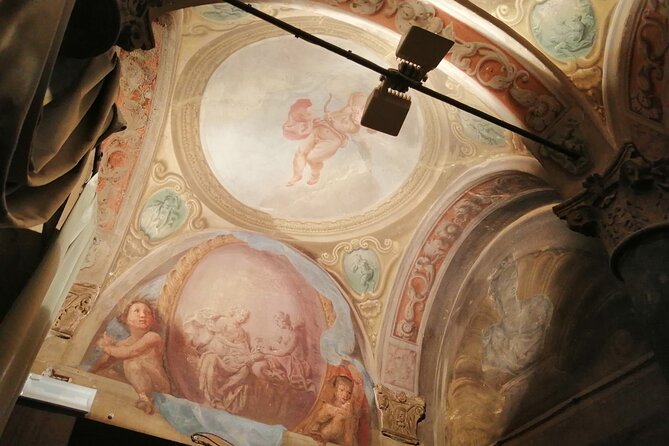
The next section moves into Palazzo d’Accursio, the city’s historic civic palace. The scheduled visit lasts about 30 minutes and covers noble rooms on the first and second floors, frescoes, a private chapel connected with the bishop, and the large Bramante staircase designed for horses.
That last detail is the kind of thing you could easily miss alone. A staircase built to accommodate horses tells you something about ceremonial power and how buildings functioned before modern transport. The rooms of the seniors, the frescoed interiors, and Francesco Francia’s earthquake Madonna add layers of politics, belief, and public memory.
Palazzo d’Accursio is not simply an attractive old building. It shows how Bologna’s government, church, and elite life occupied the same architectural world. I would listen closely here, since the value lies less in one spectacular object than in the connections between rooms, users, and civic authority.
The itinerary later includes another look at Palazzo Comunale, with Renaissance and Baroque ceilings, frescoes, sculptures, and another Bramante staircase for horsemen. These two palace sections may feel related, but together they reinforce the importance of Bologna’s civic center. If you have limited time in the city, this is a useful way to understand why the square mattered.
San Petronio, where astronomy meets painting
Basilica di San Petronio receives about 35 minutes, with admission included. The church is one of the tour’s major anchors, and Riccardo uses it to bring together science, religion, and art.
One highlight is the church’s enormous sundial, described as the biggest in the world. It is a practical instrument inside a sacred building, a reminder that medieval and Renaissance institutions did not keep astronomy, worship, mathematics, and public life in separate boxes.
You will also see the medieval frescoes of the Cappella Bolognini, four ancient crosses, and paintings associated with Parmigianino and Lorenzo Costa. The range is wide. You are not looking at one period or one style, but at several centuries of artistic work layered into one church.
Thirty-five minutes is enough for a guided introduction, not a slow study session. If a particular painting catches your eye, make a note and return later if your schedule allows. The tour gives you a strong framework, then leaves you better prepared to spend extra time on the art that speaks to you.
The Archiginnasio and Bologna’s university tradition
The Archiginnasio takes roughly 30 minutes and shifts the focus from church art to education, medicine, and intellectual power. This Renaissance palace served as the headquarters of Europe’s oldest university, and its walls carry a huge collection of coats of arms.
The coats of arms are not mere decoration. They record the people and institutions tied to university life, turning the building into a visual record of academic influence. Riccardo also points out signs connected with the secretive power of medicine, a subject that gives this stop a more human edge.
The wooden anatomical theater is a major draw. Its design reflects the practical study of the body, while the Stabat Mater room and long halls for books and ancient codes show the other side of scholarship. The itinerary also identifies a precious book connected with Leonardo da Vinci’s Flights of the Birds.
This stop is especially strong for anyone interested in how knowledge was taught and controlled. You get architecture, medicine, books, symbols, and university politics in one compact visit. The downside is that the detail can come quickly, especially in a group of up to 25 people. I would stay near Riccardo and ask questions when a subject grabs you.
Same streets, a different way to see them:
- Venice: Doge’s Palace and St Mark’s Basilica Walking Tour
★ 4.4 · 6,291 reviews - Milan: Guided Walking Tour & Last Supper Visit with Ticket
★ 4.7 · 5,409 reviews - Florence: Highlights Walking Tour with Expert Guide
★ 4.6 · 4,662 reviews - Venice: San Marco to Rialto Walk & Spritz Like a Local
★ 4.2 · 3,651 reviews
The Quadrilatero, where history still smells like lunch
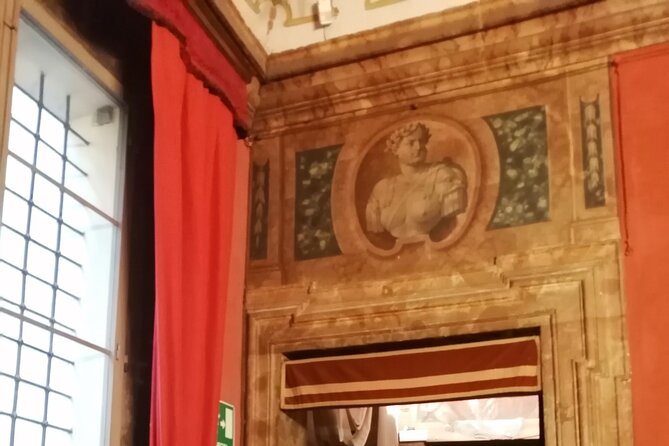
The Quadrilatero changes the mood. This medieval market maze takes about 20 minutes and brings the tour back to commerce, food, guilds, and ordinary street life.
You will pass stalls, old food shops, ancient coats of arms, and signs linked with the guilds. Bologna’s food reputation is not floating free from its past. It grew from markets, trades, rules, workshops, and the daily business of feeding a city.
This is also where the tasting element makes the most sense. A food stop is not just a snack break when it connects to older recipes and local customs. One experience on this route included rice cake made from a medieval recipe and local wine. Those samples are a pleasant bonus, but you should treat them as part of the cultural story rather than expect a full meal.
The market lanes can be crowded, and 20 minutes goes fast. I would avoid arriving hungry enough to expect lunch. Instead, use this stop to collect ideas for your own meal later.
Santo Stefano, Bologna’s church complex in miniature
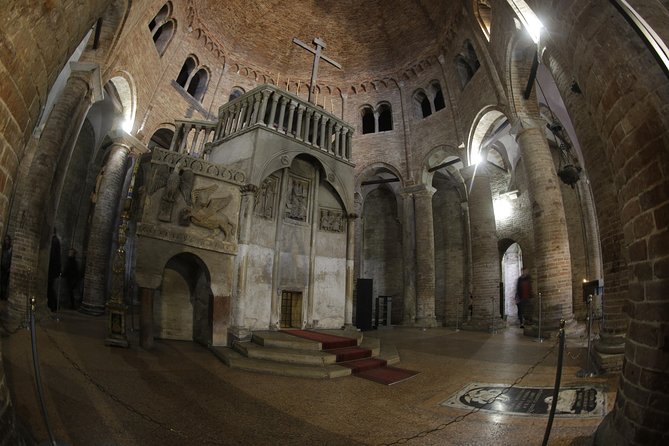
The Basilica and Santuario di Santo Stefano receives the longest scheduled stop, about 40 minutes. That extra time is welcome because this is not one church in the simple sense. It is a complex of churches that brings together many stages of Bologna’s past.
The route includes the remains of a Roman temple built near a natural spring, cloisters, monks’ cells, and capitals carved with animal faces. The complex also connects with Dante Alighieri through its cloister, adding literary importance to the architectural story.
Santo Stefano rewards patient looking. The buildings are not presented as isolated monuments. Instead, you can trace how a sacred site changed over time, absorbing Roman, medieval, and later religious traditions.
The animal-headed capitals are a particularly good reason to have a guide. Small carvings often disappear into the larger scene when you walk alone. Riccardo’s strength, according to the supplied comments, is showing what is plainly in front of you but easy to overlook.
Because the complex is free to enter, some people may wonder why it belongs on a paid tour. The answer is interpretation. The buildings become far more meaningful when someone explains how the parts relate to one another and why the site matters to Bologna.
Santa Maria della Vita and the force of movement
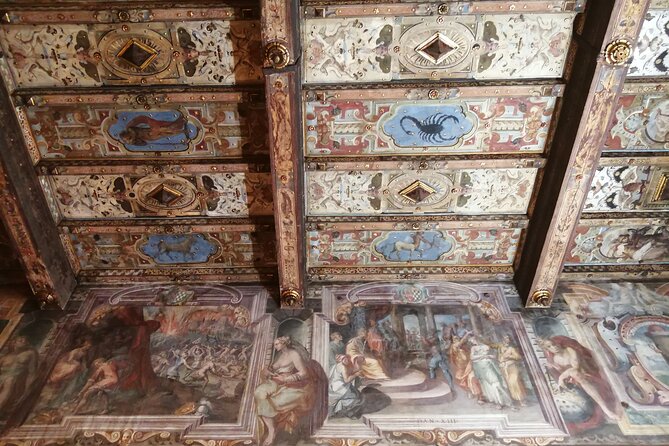
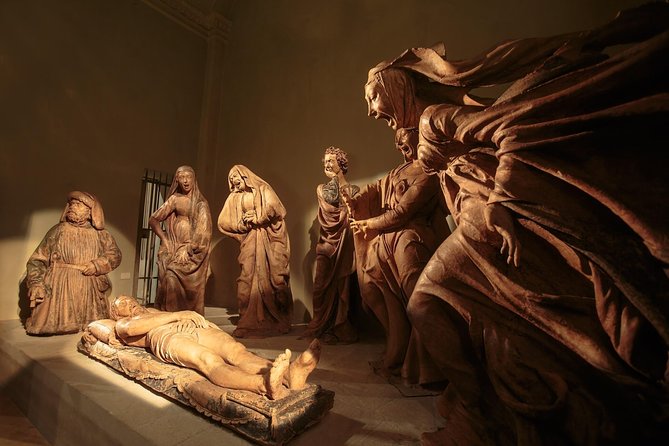
Chiesa di Santa Maria della Vita takes about 20 minutes and contains one of the route’s most striking works: Niccolò dell’Arca’s terracotta sculpture made in 1470.
The piece is praised for its forceful treatment of movement and emotion. That makes it a strong contrast to the formal architecture seen earlier. Here, bodies twist, faces react, and grief becomes physical. Riccardo’s art focus should be particularly useful because the work rewards close attention to gesture and expression.
This is a short stop, so do not expect a long gallery visit. Still, a focused explanation can make 20 minutes count. If you care about Italian sculpture, this may become one of the moments you remember best.
Towers, wooden pillars, and the old water system
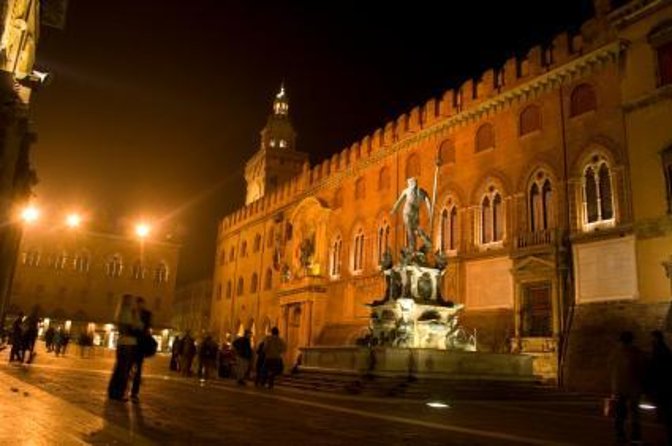
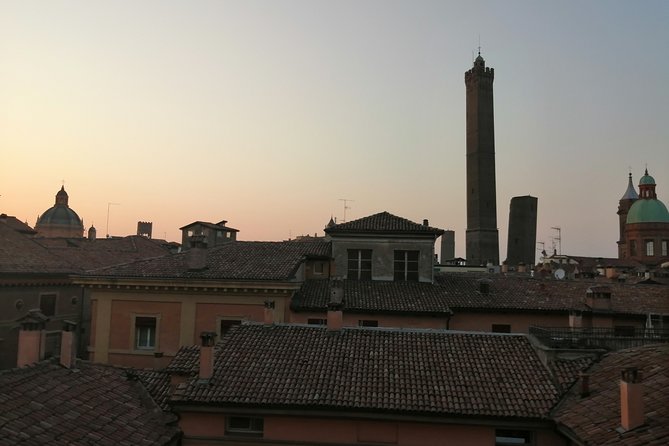
The walk also offers street-level views of Bologna’s famous towers. You will see the 98-meter Asinelli Tower and the leaning Garisenda Tower, two symbols of the city.
The route does not promise a tower climb. Its value here is visual and historical. From the street, Riccardo can explain how these structures fit into the medieval city and why Bologna’s skyline is so closely tied to its towers.
At the Finestrella, the tour turns to water and manufacturing. This small canal window reveals a medieval canal system once used to support silk and hemp textile production. The canal network is recognized as UNESCO heritage, and it gives you a different picture of Bologna, one based on engineering and work rather than palaces and churches.
The itinerary also includes a surviving 13th-century house with original wooden pillars. This is exactly the sort of detail that rewards a local guide. You might walk past it without realizing how unusual it is, while the wooden structure offers a direct glimpse into medieval domestic architecture.
How Riccardo Bacchi shapes the experience
The strongest theme running through the comments is Riccardo Bacchi’s enthusiasm for Bologna. His approach combines art history, politics, architecture, education, commerce, and science. That broad range suits the city, which cannot be understood through food or porticoes alone.
He is also praised for making the tour personal. The supplied experiences describe tailored explanations, extra recommendations, and help planning the following days. One outing included access to sites closed to the general public, but you should not treat that as guaranteed for every departure.
His local connections appear to matter, too. One account describes him being greeted by people around the city and at places on the route. That does not change the formal schedule, but it can make the walk feel less like a rehearsed circuit and more like an introduction to someone’s home city.
The rating is 4.9 from 108 reviews, with 98 percent recommending the experience. Those figures support the strongest pattern: Riccardo is the reason to book this particular walk, especially if you want interpretation rather than a quick orientation.
Is $175.36 per person a fair price?
At $175.36 per person, this is not a budget walking tour. The price makes the most sense if you value a specialist guide, several included admissions, a broad route, and the chance to ask questions along the way.
You are paying for access to a large amount of explanation in a short period. The route covers civic buildings, churches, university rooms, markets, canals, towers, sculpture, painting, and food traditions. A private or small booking may feel especially worthwhile, and group discounts could help reduce the cost for some parties.
Still, the value depends on your interests. If you mainly want a short introduction to Bologna’s famous square and towers, this tour may be more than you need. If you want to understand how art, learning, religion, trade, and city government fit together, the price is easier to justify.
I would book it early if your dates are fixed. It is booked an average of 54 days ahead, which suggests that advance planning matters. Confirmation arrives at booking, and free cancellation is available up to 24 hours before the start time.
Who should take this walking tour?
This experience suits you best if you:
- Enjoy art, architecture, and historical explanation.
- Want more than the usual food-centered introduction to Bologna.
- Prefer a local guide with strong personal enthusiasm for the city.
- Are happy walking at a steady pace for three to four hours.
- Want ideas for what to see after the tour.
- Appreciate lesser-seen details, from guild symbols to medieval building parts.
It may be less suitable if you dislike long guided explanations, need frequent pauses, or want a relaxed food tour with plenty of time to sit and eat. The route covers a lot of ground, and a full group of 25 will not feel as intimate as a private visit.
Should you book it?
Book this tour if you want Bologna to make sense. Riccardo Bacchi’s route does not stop at attractive facades. It shows how the city’s churches, university, markets, canals, civic halls, and artworks grew from connected forces.
I would choose it for a first full day in Bologna, especially if you plan to stay long enough to follow Riccardo’s suggestions afterward. The best reason to book is not simply the number of sights. It is the chance to see familiar landmarks, then notice the overlooked details that give the city its character.
At $175.36, the cost is high, so the decision rests on your appetite for detail. If art and history are central to your trip, this is likely a strong investment. If you want only a quick look around, choose a shorter and less expensive walk.
FAQ
How long does the Bologna historical art walking tour last?
The experience lasts approximately three to four hours.
Where does the tour begin and end?
It begins at Bar Vittorio Emanuele, Piazza Maggiore 1, Bologna. It ends back at the same meeting point.
What language is the tour offered in?
The tour is offered in English.
How large can the group be?
The maximum group size is 25 people. Group discounts are available.
Is admission included for the paid sights?
Admission is included for Basilica di San Petronio, the Archiginnasio di Bologna, and Chiesa di Santa Maria della Vita. Several other stops are listed as free admission.
Can I cancel for a full refund?
Yes. You can cancel at least 24 hours before the local start time for a full refund. Cancellations or changes made less than 24 hours before the start time are not accepted for a refund.
More History Walking Tours in Italy
- Venice: City Center Historical Guided Walking Tour
★ 4.2 · 1,873 reviews - Palermo: Street Food and History Walking Tour
★ 4.9 · 1,486 reviews - Rome Food Tour in the Historic Centre with 8+ Food Tastings
★ 5.0 · 1,000 reviews - Rome: Forbidden History Walking Tour & Pub Crawl with Drinks
★ 4.9 · 688 reviews
More Hidden Gems Walking Tours in Italy
- Rome: Paranormal Night Walking Tour & Secret Backstreets
★ 4.9 · 1,921 reviews - Verona: History and Hidden Gems Guided Walking Tour
★ 5.0 · 1,379 reviews - Rome Walking Tour: Pantheon, Trevi, Navona & Hidden Gems
★ 4.8 · 501 reviews - Florence: Private Walking Tour of Florence’s Hidden Gems
★ 4.6 · 297 reviews
Just added around Italy
- Private Bologna Food & Market Tour with 6 Tastings & Wine★ 5.0 · 102 reviews
- Bologna Walking Tour with Audio and Written Guide★ 4.5 · 132 reviews
- Bergamo: Digital guide made by a local for your walking tour★ 5.0 · 184 reviews
- Full Day Tour by Car and Walking among the Apulian Beauties★ 4.5 · 182 reviews
- The Original Street Food Walking Tour in Bari★ 4.5 · 226 reviews
- Bari Walking City Tour★ 4.5 · 511 reviews
- Bari: Street Food Walking Tour with a Local Guide★ 5.0 · 160 reviews
- Bari Walking Tour with Pasta Experience★ 4.5 · 270 reviews
Food Walking Tours, compared.
Reykjavik Food Walk – Local Foodie Adventure in Iceland
Read our review →
New Orleans Food Walking Tour of the French Quarter with Small-Group Option
Read our review →

Authentic Parisian Gourmet Food Tour with 10 Local Dishes & Wines
Read our review →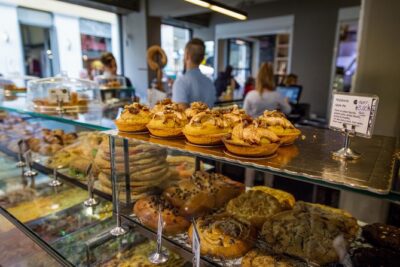
Tapas Walking Tour with Food, Wine, and History
Read our review →
Browse the lists this tour appears in