
Review · HISTORY WALKING TOURS
Verona: History and Hidden Gems Guided Walking Tour
Verona rewards a closer look. This two-hour walk pairs the city’s famous sights with overlooked architectural details, Roman traces, medieval squares, and quiet lanes that are easy to miss on your own. I especially like the small groups of up to 10 and the use of headsets, which make it easier to follow the guide without standing shoulder to shoulder.
The route also gives you a useful first look at the Arena, Piazza delle Erbe, Castelvecchio, Ponte Scaligero, the Scaliger tombs, and Juliet’s house. Fabio Massimo Rapanà, a lifelong Veronese guide, brings strong local knowledge and a clear affection for his city. The main consideration is pace: with more than 30 stops in two hours, many places receive only a short explanation or photo stop.
Key points at a glance
- A local guide with a personal connection: Fabio Massimo Rapanà was born and raised in Verona and leads the walk with warmth, humor, and historical detail.
- A compact route through central Verona: You see the Arena, Piazza Bra, Piazza delle Erbe, Piazza dei Signori, the Scaliger tombs, Romeo’s house, and Juliet’s balcony area.
- Small groups make a difference: With no more than 10 participants, it is easier to ask questions and keep up with the guide.
- Headsets help in noisy streets: You can hear the commentary clearly while walking, even near busy squares.
- Good for history and architecture fans: The walk connects Roman foundations, medieval power, religious buildings, townhouses, and modern city life.
- A strong orientation tour: Take it early in your stay, then return to the places you want to explore at greater length.
Why this Verona walk is more than a greatest-hits tour
Verona can look simple at first. You have the Arena, the famous balcony, a few handsome piazzas, and the Adige River curling around the old center. But the city rewards anyone who slows down and looks up. Roman gates sit beside medieval streets. Market squares preserve traces of older trade routes. Decorative façades reveal changes in wealth, taste, and political power.
That is the useful promise of this walking tour. You are not simply taken from one postcard view to another. The guide explains how the sights fit together and points out small features you might otherwise pass without noticing.
I like this approach because it changes what you do after the tour. A doorway, tower, fountain, or bit of wall can seem ordinary until you understand its age and purpose. Several people who joined Fabio’s tours found themselves returning to places later in the day, now able to notice details they had previously overlooked.
At $41 per person, the price is reasonable for a two-hour guided walk, especially with a licensed local guide, a group capped at 10, and headsets included. It is not the cheapest way to walk around Verona, but the value comes from interpretation. You are paying for the connections between the sights, not just for being led down the street.
More Hidden Gems Walking Tours in Italy:
- Rome: Paranormal Night Walking Tour & Secret Backstreets
★ 4.9 · 1,921 reviews - Rome Walking Tour: Pantheon, Trevi, Navona & Hidden Gems
★ 4.8 · 501 reviews - Florence: Private Walking Tour of Florence’s Hidden Gems
★ 4.6 · 297 reviews
Starting beneath the Italian flag in Piazza Bra
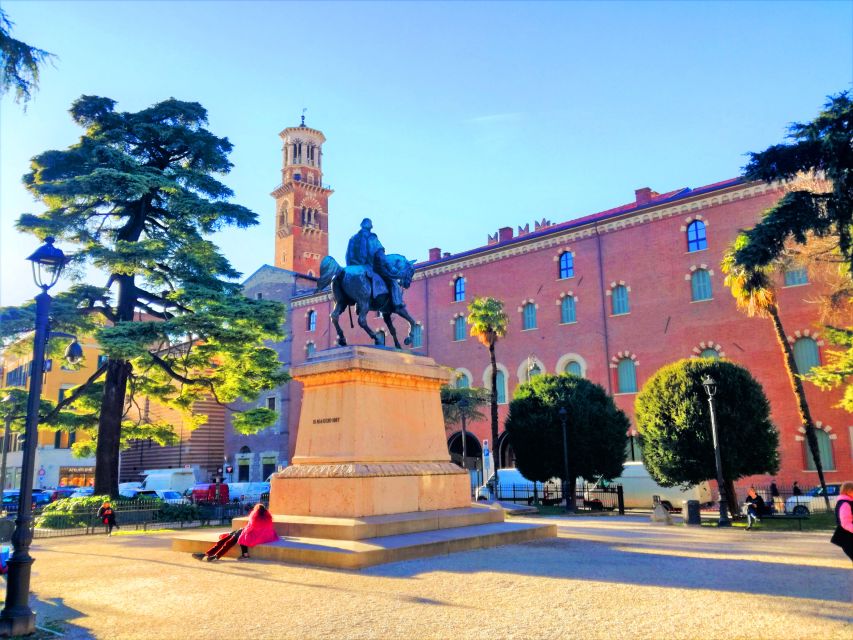
The meeting point is below the Italian flag at Palazzo Barbieri, Verona’s town hall, in Piazza Bra. This is a practical starting place because Piazza Bra is one of the city’s main arrival points and the Arena is immediately nearby.
The opening stop in Piazza Bra gives you a first sense of Verona’s public face. The square has room to pause, orient yourself, and see how the Arena dominates the center. The guide then turns your attention to the amphitheater itself.
The Verona Arena is more than a grand photo background. You learn about the gladiator contests held here and the building’s Roman purpose. The ten-minute stop is enough to understand its scale and place in the city, though it does not include entry. If you want to see the interior, you will need to arrange that separately.
This outside introduction is useful even if you already plan to attend an opera or visit the Arena later. You get the basic context first, then can return with a better idea of what you are looking at.
Roman Verona appears along the Corso
From Piazza Bra, the walk follows the foundations of the early medieval walls toward the Corso, one of the city’s oldest streets. This part of the route begins to shift the mood from major attraction to street-level history.
Porta Borsari, also known as Porta Jovia, is an important Roman-era monument on the route. Its surviving stone façade gives you a direct link to Verona’s ancient defenses and gateways. It is a quick stop, but that is part of the appeal. The gate is not treated as an isolated relic. It helps explain how people entered and moved through the old city.
The itinerary also includes several brief stops described simply as private or lesser-known points of interest. The exact details are not specified in advance, but the structure tells you what kind of walk this is. You will pause often for a doorway, wall, façade, or small architectural feature, then move on before the route becomes repetitive.
This is where the headsets earn their keep. Fabio speaks through a microphone, and participants receive earpieces. You can listen while looking at the building rather than crowding around the guide or trying to catch every word from the edge of a group.
River views from Riva San Lorenzo and Ponte Scaligero
At Riva San Lorenzo, the route opens toward the Adige River. The water views give you a break from the close streets and provide a useful sense of Verona’s geography.
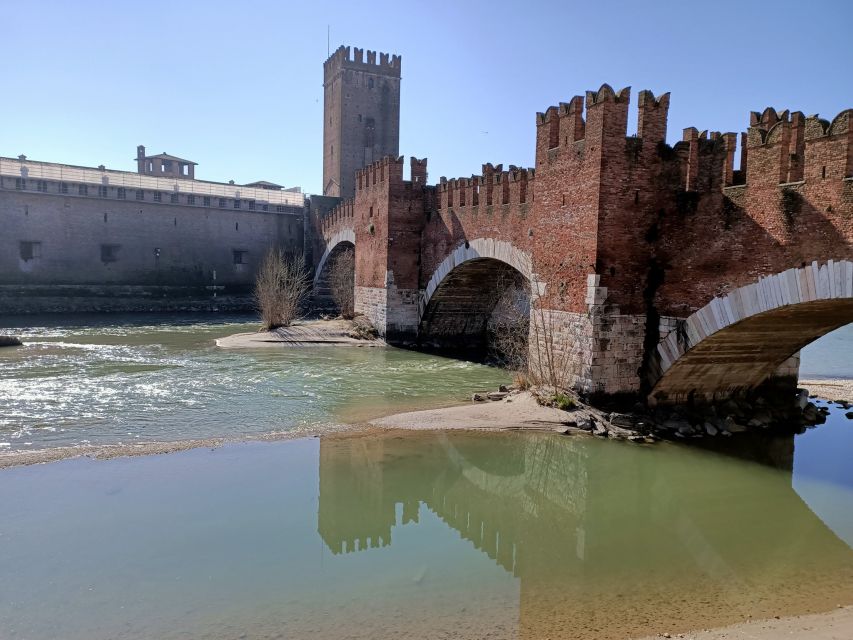
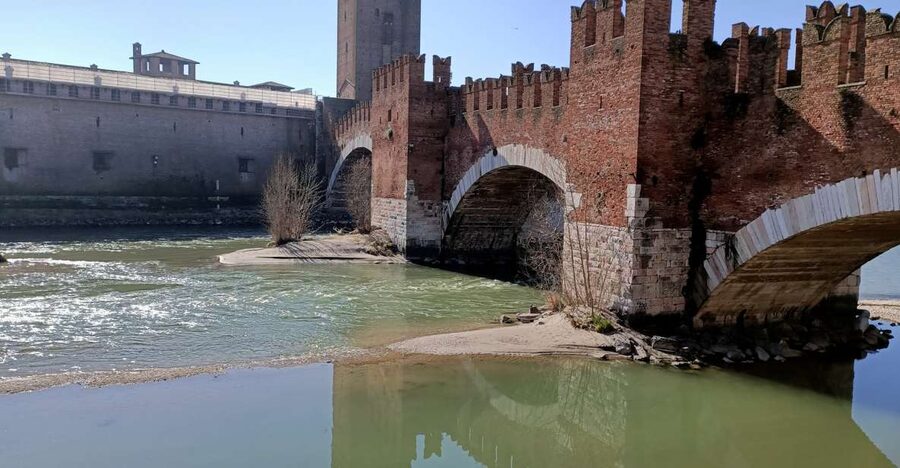
The river is not just scenery. It helped shape the city’s defenses, trade, bridges, and neighborhoods. From this area, you can also admire Castelvecchio and the Ponte Scaligero. The bridge’s strong medieval form contrasts with the softer curves of the river and the surrounding city.
This is one of the better points for photographs, but the guide’s explanation is what gives the view meaning. Instead of seeing a bridge as a pretty structure, you begin to understand its connection to Verona’s ruling Scaliger family and the city’s medieval power.
The route does not include transport, and it does not need to. The central sights are close enough to connect on foot. Still, wear proper shoes. Two hours on old city streets is not a serious hike, but hard pavement and frequent walking can be tiring if you arrive in thin sandals.
More History Walking Tours in Italy:
- Venice: City Center Historical Guided Walking Tour
★ 4.2 · 1,873 reviews - Palermo: Street Food and History Walking Tour
★ 4.9 · 1,486 reviews - Rome Food Tour in the Historic Centre with 8+ Food Tastings
★ 5.0 · 1,000 reviews - Rome: Forbidden History Walking Tour & Pub Crawl with Drinks
★ 4.9 · 688 reviews
Piazza delle Erbe and the city’s oldest market life
Piazza delle Erbe is one of the tour’s main stops and receives about ten minutes. This is the city’s famous market square, surrounded by historic façades and public buildings.
The guide explains the local market and points out the oldest fountain in Verona. That combination is valuable because it links daily life with the city’s past. You are not only looking at painted façades. You are learning how the square functioned as a place for trade, movement, and public life.
Look upward here. The façades are easy to admire as a colorful group, but the tour encourages you to notice their individual details and the layers of time around the square. The commentary also helps you understand why Verona can feel elegant and practical at the same time.
Piazza delle Erbe can be crowded, so this is one place where the small group and headsets matter. You may not have a long, quiet pause in the middle of the square, but you should be able to hear the guide and continue looking around.
Piazza dei Signori and the Scaliger power base
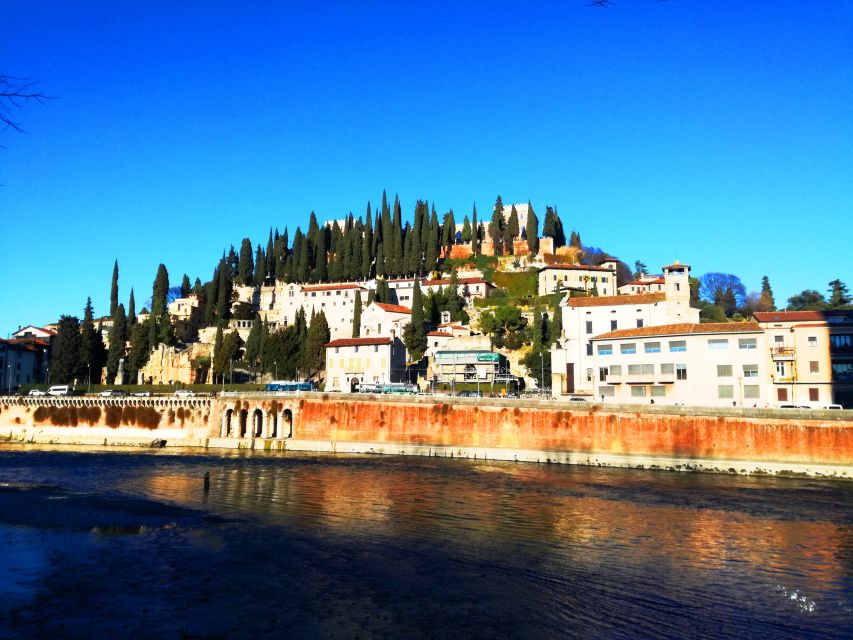
The next major section leads into Piazza dei Signori, a more formal square framed by buildings connected to Verona’s medieval government and ruling families.
You see Palazzo della Ragione, Palazzo della Scala, and Palazzo del Capitano. The guide discusses the medieval period and points out Verona’s tallest tower. This makes the square a strong stop for understanding how political authority was displayed in stone.
I find this part especially useful for anyone interested in architecture. Verona’s story is not told only through churches and arenas. It is also told through civic buildings, towers, courtyards, and the shape of public squares.
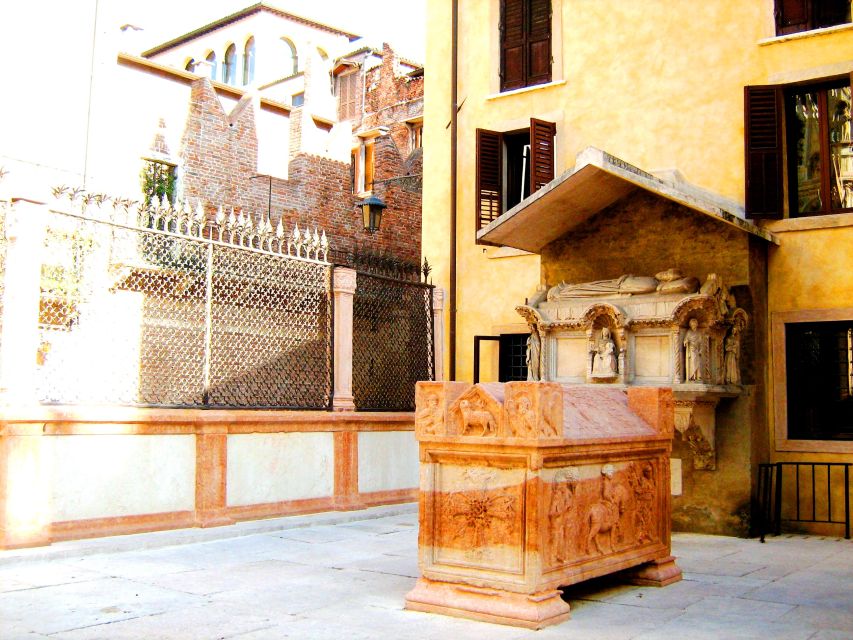
The walk then reaches the Arche Scaligere, the dramatic tombs of the Scaliger family. These ornate mausoleums are among the most striking sights in central Verona. They are viewed from outside as a photo stop, so do not expect an extended visit inside a monument. Their value here is visual and historical: they show how a powerful family used architecture to announce its status.
Churches, courtyards, and overlooked corners
The route includes the Basilica di Santa Anastasia, one of the important religious buildings in central Verona. The stop is brief and focused on viewing rather than a long interior visit.
You also pass Chiesa di San Giovanni in Foro, the Convent of Saint Mary della Scala of the Servants of Mary, the old market courtyard, and several smaller points of interest. Some receive only two or five minutes. That means the tour works best as an introduction rather than a detailed church-by-church examination.
The old market courtyard is a good example of the route’s purpose. A busy square can hide traces of older civic life, and a short explanation can make that space easier to read. The same is true of the smaller lanes and side streets. You get a look at Verona beyond the headline sights without spending half a day on a single building.
This variety also keeps the walk moving. You pass from open squares to narrow streets, from Roman remains to medieval structures, and from public monuments to quieter corners. If you prefer extended time inside museums, this will feel too quick. If you want a broad introduction before exploring alone, the range works well.
Romeo, Juliet, and the reality behind the story
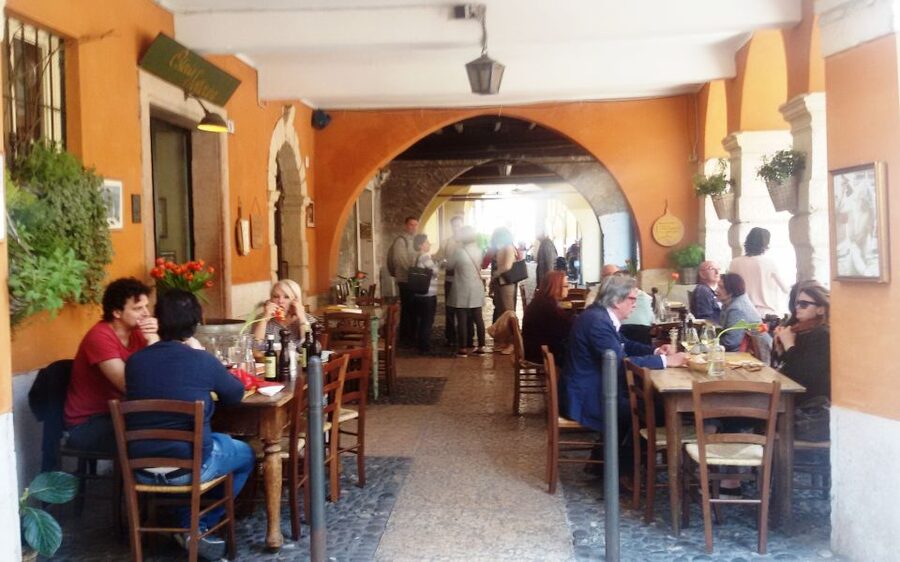
The tour includes Casa di Romeo and Juliet’s House, with a photo stop at each. You also pass through the area around Juliet’s balcony and learn about the historical inspiration behind Shakespeare’s tragedy.
This is a sensible way to handle Verona’s most famous romantic story. The walk does not pretend that the play is a straightforward record of local history. Instead, it places the story beside the city that helped inspire it.
Juliet’s House is one of Verona’s busiest attractions, and a short stop is enough to locate it and understand its place in the city. Entry is not included, so you can decide later if you want to visit the courtyard or balcony area at greater length.
The nearby streets also include Piazza Indipendenza, Via Dietro Anfiteatro, a former convent area, and the synagogue of Verona. These stops widen the picture beyond the Shakespeare connection. Verona is not only a romantic stage set. It is a city shaped by Roman rule, medieval politics, religious institutions, Jewish life, commerce, and modern tourism.
Fabio’s guiding style and the small-group advantage
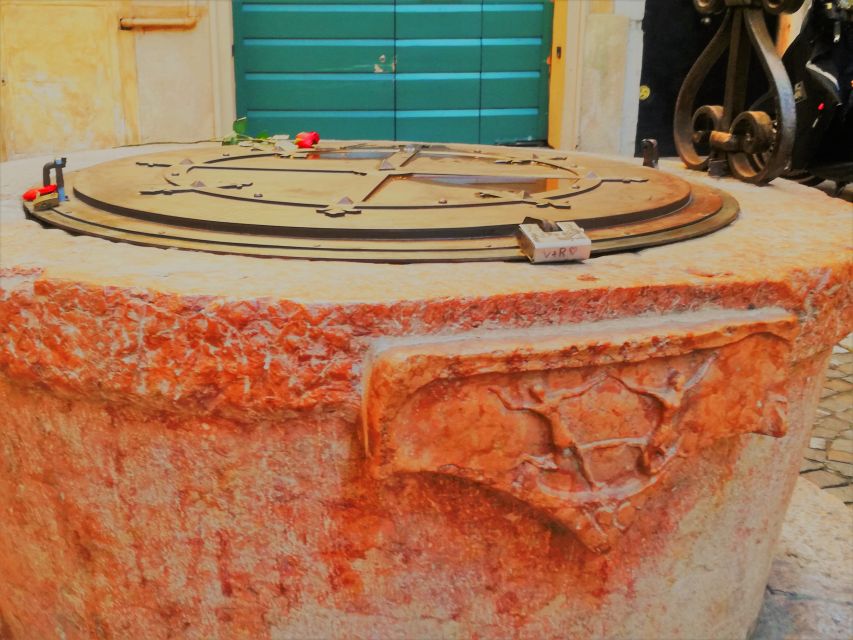
Fabio Massimo Rapanà is the named guide for this experience, and his local background is central to its appeal. He was born and raised in Verona, and his presentation combines history, architecture, anecdotes, and practical suggestions.
The strongest praise concerns his enthusiasm and storytelling. He explains buildings in a way that connects them to wider periods and events, rather than delivering disconnected dates. He also responds carefully to questions and remembers personal details such as participants’ names and home countries.
That personal approach matters in a group tour. A maximum of 10 people is small enough for questions and conversation, but still offers the cost advantage of a shared experience. One useful sign of his commitment is that he has continued with a tour even when only one booking was made.
Families can also consider this walk. A young participant was kept interested through the stories and visual details, while slower walkers were given patient attention. On hot days, Fabio has directed groups toward shade and water refill points when possible. That kind of practical care can make two hours much more pleasant.
The headset system is another real advantage. The guide speaks into a microphone, and you receive an external earpiece. This is especially helpful for anyone with hearing difficulty or for walks passing through noisy streets.
Timing, weather, and who should book
The tour runs for two hours and takes place in all weather, so bring water and comfortable shoes. There are no food or drink inclusions, and no transport is provided. The central route is designed for walking from start to finish, returning to Palazzo Barbieri in Piazza Bra.
I would take this early in a Verona stay. The walk gives you a map in your head and helps you decide which places deserve a second visit. It is particularly well suited to:
- First-time visitors who want historical context before sightseeing alone
- People who enjoy architecture, city history, and old urban details
- Couples interested in the Romeo and Juliet story but not only the romantic angle
- Families wanting a short, structured introduction
- Visitors with limited time in Verona
- Anyone who prefers a small group instead of a large tour following a flag
You should think twice if you want long interior visits, extensive free time at each monument, or a slow photography walk. The route covers a lot of ground and many stops are short. It is a focused overview, not a museum tour.
The tour is wheelchair accessible, and private or small-group options are available. The guide speaks English, German, Italian, and Spanish. You can also cancel up to 24 hours ahead for a full refund, and reserve now while paying later, which helps if your Italian schedule is still shifting.
Should you book this Verona walking tour?
I would book it if you want Verona to make more sense, not just look beautiful. The Arena, Piazza delle Erbe, Ponte Scaligero, Piazza dei Signori, the Scaliger tombs, and Juliet’s House are all easy to find, but the smaller Roman, medieval, religious, and civic details are harder to read without help.
The strongest reasons are Fabio’s local connection, the small group, the clear headsets, and the broad historical story packed into two hours. At $41, it offers good value for a first visit, especially if you use the rest of your day to return to the places that caught your attention.
Skip it only if you prefer to wander without commentary or want to spend most of your time inside major monuments. For everyone else, this is a smart way to begin in Verona and see beyond the obvious sights.
FAQ
Where does the tour meet?
Meet the guide below the Italian flag at Palazzo Barbieri, Verona’s town hall, in Piazza Bra.
How long does the walking tour last?
The tour lasts two hours and returns to Palazzo Barbieri in Piazza Bra.
What sights are included?
The route includes Piazza Bra, the Verona Arena, Porta Borsari, Riva San Lorenzo, the Adige River views, Piazza delle Erbe, Piazza dei Signori, Santa Anastasia, the Arche Scaligere, Romeo’s house, Juliet’s House, the old market courtyard, and several smaller historic points.
Is entry to the Arena or other attractions included?
No. Entry fees are not included. The listed stops are viewed from outside or used as photo stops unless otherwise stated.
How large is the group?
The small-group tour allows up to 10 participants. Private options are also available.
Which languages are offered?
The live guide can lead the tour in English, German, Italian, or Spanish.
What should I bring?
Bring comfortable shoes and water. The tour runs rain or shine, so plan for the weather.
Just added around Italy
- Bergamo: Digital guide made by a local for your walking tour★ 5.0 · 184 reviews
- Full Day Tour by Car and Walking among the Apulian Beauties★ 4.5 · 182 reviews
- The Original Street Food Walking Tour in Bari★ 4.5 · 226 reviews
- Bari Walking City Tour★ 4.5 · 511 reviews
- Bari: Street Food Walking Tour with a Local Guide★ 5.0 · 160 reviews
- Bari Walking Tour with Pasta Experience★ 4.5 · 270 reviews
- Assisi Private Walking Tour including St. Francis Basilica★ 5.0 · 124 reviews
- Private St. Francis Basilica of Assisi and City Walking Tour★ 5.0 · 114 reviews
History Walking Tours, compared.
History and Hauntings of Salem Guided Walking Tour
Read our review →
Freedom Trail History Small Group Walking Tour
Read our review →
Historic Charleston Guided Sightseeing Walking Tour
Read our review →
Tapas Walking Tour with Food, Wine, and History
Read our review →
Savannah History and Haunts Candlelit Ghost Walking Tour
Read our review →
A History of Terror – Belfast City Centre Walking Tour
Read our review →Browse the lists this tour appears in