
Review · SMALL-GROUP WALKING TOURS
The Full Revolutionary Story Epic Small Group Boston Walking Tour
History gets better on foot. This three-hour to three-and-a-half-hour walk links Boston’s famous Freedom Trail sites in the order the Revolution unfolded, then adds burial grounds, gardens, waterfront views, and pieces of modern Boston. I especially like the chronological storytelling and the small-group format, which makes it easier to ask questions and follow the complicated cast of patriots, loyalists, soldiers, and ordinary citizens. The main tradeoff is simple: you walk a lot, and nearly everything happens outdoors.
The tour begins at City Hall Plaza and ends near Lewis Wharf in the North End. Guides such as Tyler, Mike, Chris, and Tom bring academic training and plenty of energy, using maps, cards, character badges, and even Lego soldiers to explain battles. This is not a costumed show or a quick photo stop tour. It is a serious history lesson made lively, with enough humor and local advice to keep it from feeling like school.
Key points to know before you book
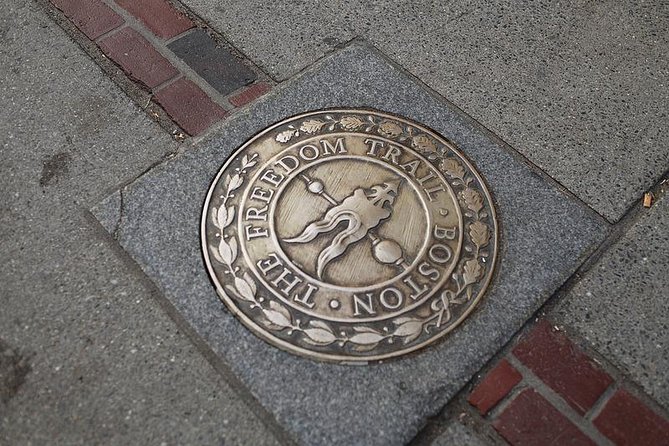
- The Freedom Trail runs in historical order: You do not simply follow the brick line from one end to the other. The route moves around Boston so the story builds from early settlement to revolution.
- Small groups keep the discussion personal: The maximum group size is 15 people, a useful limit for a tour that depends on questions and conversation.
- You see more than the standard trail: The route includes Post Office Square, the Financial District, the Rose Kennedy Greenway, North Square, and the Harborwalk.
- Guides teach with visual aids: Maps, cards, historical characters, and small props help explain events such as Bunker Hill and the Boston Massacre.
- The North End is part of the payoff: You finish among Italian restaurants, pizza shops, seafood places, cannoli counters, and Boston Harbor views.
- Plan for a real walk: Comfortable shoes and weather protection matter. One recent outing included intense wind, and another was rainy and cold, though the guide kept the group involved.
Why the chronological route works so well
Boston’s Freedom Trail is easy to walk but not always easy to understand. The red brick path connects major sites, yet the physical order does not match the order in which events happened. This tour fixes that problem by arranging the stops as a story.
You begin with the people who shaped early Massachusetts Bay, then move through religious conflict, political resistance, the Boston Massacre, the Tea Party, and the fighting that followed. That structure gives each location a reason to appear when it does. Instead of asking you to remember a list of buildings, the guide shows how one argument led to another.
The approach also leaves room for less famous people. You hear about patriots, loyalists, soldiers, printers, merchants, and political leaders, not just Paul Revere and George Washington. That broader view helps explain that revolution was not a clean contest between two tidy sides. Boston was full of competing interests and dangerous disagreements.
Tyler has a master’s degree in American history and previously worked as a curriculum coordinator. Mike is also described as holding advanced history degrees. Chris has a background as a trained and certified historian. The guides may differ in style, but the experience clearly depends on teachers who enjoy explaining the subject, not simply reciting dates.
More Small-Group Walking Tours in the USA
- Boston: Freedom Trail History Small Group Walking Tour
★ 5.0 · 6,450 reviews - Boston: Freedom Trail History Small Group Walking Tour
★ 4.9 · 1,590 reviews - Boston: Full Revolution Story Epic Small Group Walking Tour
★ 4.9 · 132 reviews
Starting at City Hall Plaza with Boston’s modern face
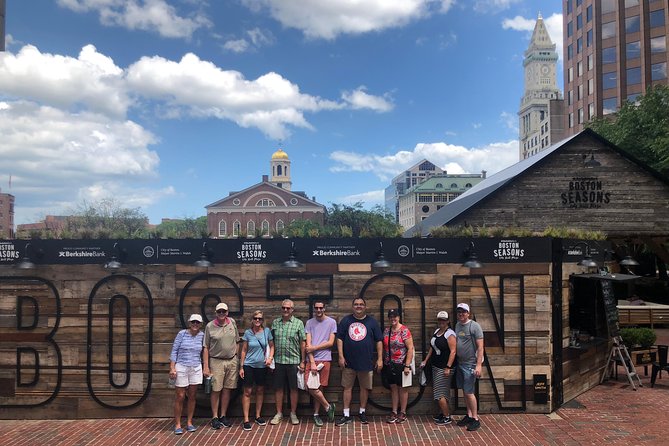
Meet at City Hall Plaza, between Five Iron Golf and City Hall, near the seasonal beer garden and the large BOSTON sign. Faneuil Hall appears behind you, making this a useful starting photograph and an easy place to find your guide.
The opening view gives you an immediate contrast. Boston City Hall is famous, or infamous, for its stark modern architecture, while Faneuil Hall across the way points toward the colonial past. The guide uses that contrast to introduce the city as it is now, not just the city of the 1700s.
This is a good meeting point because the plaza is pedestrian-only and centrally located. Still, arrive ready to begin on time. A group tour cannot easily pause for late arrivals once it moves into the tight streets of downtown.
Early Boston: King’s Chapel and the burial grounds
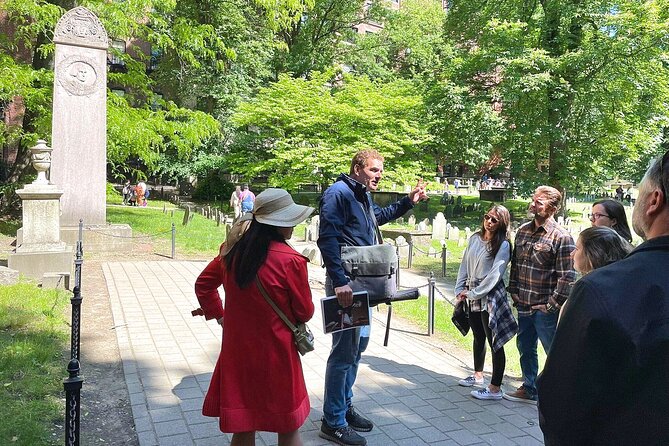
The first historical stop is King’s Chapel Burying Ground. Here, the focus is on the first settlers of Massachusetts Bay and the unusual religious world created by the Puritans. The guide treats the early settlers as real people with strong beliefs, strict rules, and plenty of contradictions.
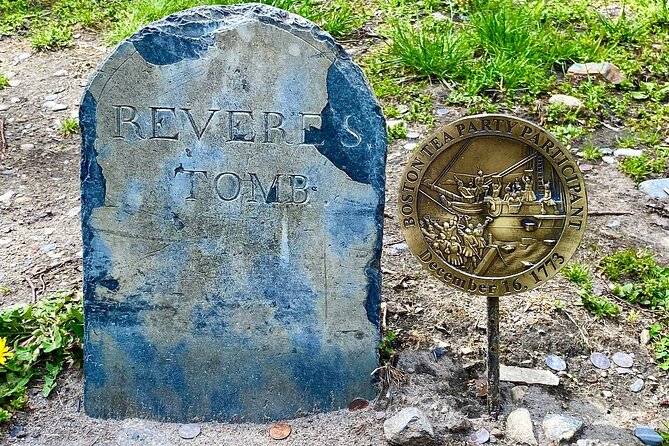
You then pass Boston’s first Anglican church before reaching Granary Burying Ground. This cemetery contains the graves of Paul Revere, John Hancock, and Samuel Adams, and it becomes the setting for a discussion about the Sons of Liberty.
The cemetery stop lasts about 15 minutes, enough time to orient yourself without turning the tour into a long monument visit. You do not need to pay an admission fee at these outdoor locations. The guide’s job here is to connect names on headstones to the political network that drove resistance.
A useful feature is the attention to the religious divide between Puritans and Anglicans. That context helps explain why a church building could carry political weight, not just spiritual meaning.
Old City Hall, Franklin, and the arguments behind independence
At Old City Hall, the architecture provides a backdrop for a discussion about democracy, its obstacles, and its built-in challenges. This is one of the places where the tour moves beyond heroic storytelling. You get a chance to consider who had political power and who did not.
The statue of Benjamin Franklin follows. Nearby, the guide explains America’s first public school and Franklin’s connection to it. Franklin becomes more than a famous face on a dollar bill. His education, ambitions, and public life fit into the larger story of Boston’s growing political culture.
These stops are brief, usually five to ten minutes, but they help vary the pace. You are not standing at one site for an hour. Instead, you move through the city while the guide keeps the main thread in view.
More Small-Group Walking Tours in Boston:
- Amsterdam Anne Frank: Small-Group Walking Tour & Local Guide
★ 4.8 · 12,789 reviews - New Orleans Food Walking Tour of the French Quarter with Small-Group Option
★ 5.0 · 6,118 reviews - Barcelona Tapas and Wine Experience Small-Group Walking Tour
★ 5.0 · 5,804 reviews - Reykjavík Small group Walking Tour – by CityWalk
★ 5.0 · 5,076 reviews
The Old State House and the Boston Massacre
The Old State House is described as the country’s oldest public building and the center of Massachusetts politics during the growing dispute with British authority. Here, you hear about the arguments over rights, taxation, and political control that pushed Boston toward open conflict.
The nearby Boston Massacre site brings those ideas down to street level. Soldiers, citizens, loyalists, and patriot leaders all became caught in the tension. The stop works best when you pay attention to the competing viewpoints. The event was not just a simple scene of innocent colonists facing cruel troops. It was a moment shaped by fear, anger, propaganda, and political pressure.
This is also where the guide’s style matters. Chris is praised for tying people from the Sons of Liberty to the places where they acted. Mike is known for presenting difficult material with humor and enthusiasm. Those qualities make the political arguments easier to follow during a long outdoor walk.
From the Tea Party to Faneuil Hall and Quincy Market
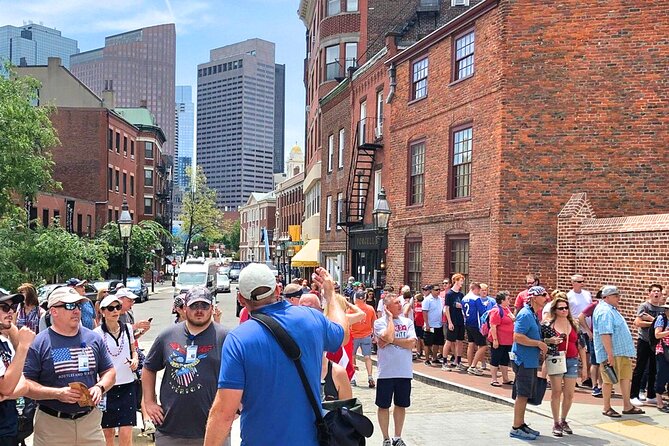
At the Old South Meeting House, the story reaches the Boston Tea Party. The guide treats the meeting house as the place where protest turned into a much more dangerous confrontation. Once the tea was destroyed, compromise became harder.
The route then passes Post Office Square and the Financial District. This section is valuable because it shows how a working, modern city grew around old foundations. The tour does not pretend Boston stopped in 1776. Education, health care, finance, offices, gardens, and traffic all share space with the revolutionary sites.
Faneuil Hall follows, known as the Cradle of Liberty. The guide explains how protest and public debate took root here. You also get a built-in break around Faneuil Hall and Quincy Market.
Quincy Market deserves a practical warning. It is convenient, central, and full of food, but it can also feel touristy and crowded. The guide openly points out the tourist traps, which is useful when you are deciding where to spend your lunch money. The tour itself does not include a meal, so save your appetite and budget for the North End if you want more local restaurant guidance.
The Greenway and the road to Paul Revere’s neighborhood

The Rose Fitzgerald Kennedy Greenway offers a change of pace. This long public garden runs through the center of Boston and gives you a bit of open space after the dense downtown streets.
From there, the route heads toward the North End and the Paul Revere House. The house sits in North Square, one of the city’s oldest and most charming residential squares. The stop is not only about the famous midnight ride. The guide presents Revere as a working man, civic figure, and participant in a larger network of resistance.
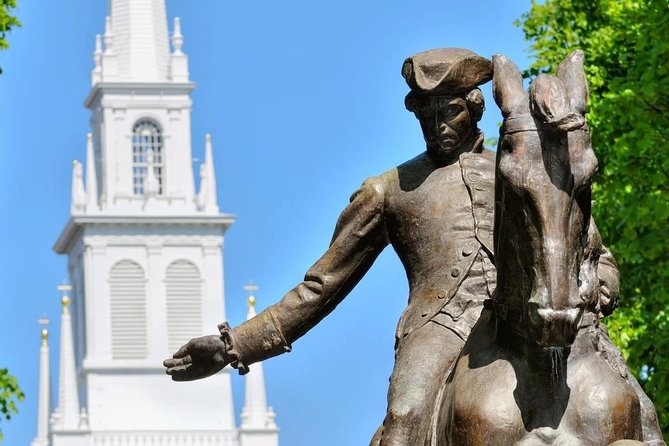
North Square Park helps you picture the neighborhood before it became one of Boston’s best-known food districts. You then reach the Paul Revere statue, a natural photo stop, before looking toward Old North Church.
The route does not promise museum entry to the Paul Revere House or Old North Church. The emphasis is on the streets, views, and story outside. If you want to tour the interiors, you will need to arrange that separately and allow extra time after the walk.
Old North Church, Bunker Hill, and the military story
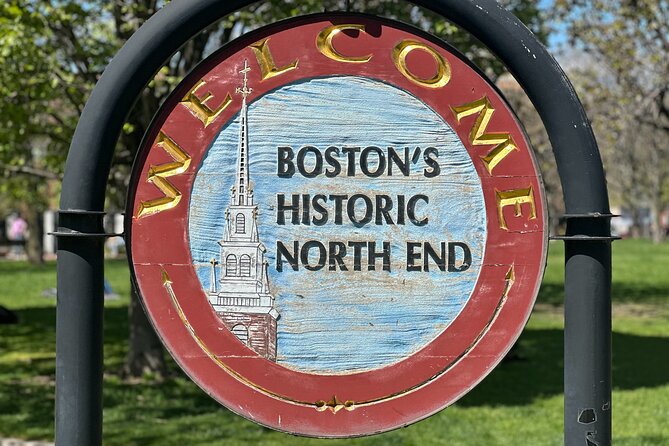
At Old North Church, the guide explains the famous lantern signal and Paul Revere’s midnight ride. The story then builds toward Lexington and Concord and the first major fighting of the Revolution.
The Bunker Hill section is one of the tour’s most interactive moments. The guide recreates the battle with maps and visual aids, and Tyler has used Lego soldiers to show how the forces moved. That kind of simple prop can make a complicated battlefield easier to picture than a long verbal explanation.
You also see the second-oldest burial ground in Boston from outside and get views toward Charlestown and Boston Harbor from the terrace across the street. The tour does not enter every site, so the experience is best for people who value explanation and atmosphere more than collecting interior admissions.
The route includes a view toward USS Constitution, known as Old Ironsides, across Boston Harbor. The guide explains its place in American naval history and offers advice on how to visit it, while also making clear that it was not part of the American Revolution. That distinction is helpful. It keeps later American history from being mixed into the revolutionary story.
Finishing in the North End and on Boston Harbor
The North End is more than the final neighborhood on the route. It brings together the history, culture, and food that make this part of Boston so appealing. You hear about Italian food, seafood, pizza, and cannoli as you walk through one of America’s oldest residential neighborhoods.
The final stretch follows Boston Harbor and the Harborwalk. Piers, wharfs, waterfront parks, and city views give you a physical sense of Boston’s relationship with the water. The ending also provides a satisfying story point, as the British are finally pushed out of Boston.
The tour finishes at Lewis Wharf, close to public restrooms, parking, bicycles, public transportation, and the Aquarium T stop. It is less than a ten-minute walk back to the starting area. Restaurant suggestions are included, which is handy because you will likely be ready for lunch or an early dinner after three and a half hours outside.
Price, group size, and the effort involved
At $55 per person, the value depends on how much historical context you want. You are paying for up to three and a half hours with an expert guide, a small group capped at 15, and a route that covers far more than a basic walk along the brick trail.
You are not paying for museum admissions or transportation. The walking route itself is the product. If you prefer to enter every historic building, this may feel limited. If you want a connected explanation of Boston’s revolutionary story, the price is reasonable, especially compared with a short tour that covers only the most famous photo stops.
The physical demand is moderate, but the distance adds up. Wear walking shoes, bring water, and check the weather closely. The experience runs in rain or cold unless conditions force a cancellation, and all activities take place outdoors apart from any brief access around Faneuil Hall and Quincy Market.
Children are welcome with an adult, but this is not a simplified children’s program. An eighth grader was reportedly engaged by Tyler’s animated delivery, and 10 and 12-year-old boys enjoyed the tour with Chris. That suggests the experience can work well for curious older children, especially those who like stories and participation.
Who should book this Boston walk?
I would choose this tour if you want to understand how events connect, rather than simply photograph the Freedom Trail. It is especially well suited to history fans, families with school-age children, couples, solo visitors, and anyone who wants a strong introduction to Boston during the first days of a trip.
The tour may not suit you if long walks are difficult, if you need frequent indoor breaks, or if you want extensive time inside museums. It is also not ideal if you prefer a quiet, self-guided stroll. The guide talks often, asks the group to participate, and keeps the story moving.
The 99 percent recommendation rate and five-star average reflect a very strong record, but your enjoyment will still depend on weather, walking ability, and interest in American history. Guides can vary, yet Tyler, Mike, Chris, and Tom are all described as warm, energetic teachers. That is a major part of the appeal.
Should you book it?
Book it if you want Boston’s revolutionary story told with structure, personality, and useful local context. The chronological route, small group, visual aids, and North End finish give it more substance than a basic Freedom Trail walk.
Skip it if you want lots of indoor sightseeing or a short, low-effort activity. For most visitors who can handle three hours on foot, this is a strong-value way to connect Boston’s old streets, political arguments, waterfront, and modern city into one memorable lesson.
FAQ
How long does the Boston Revolutionary Story Tour last?
The tour lasts approximately three to three and a half hours.
Where does the tour begin?
It begins at City Hall Plaza, at 1 City Hall Square, near Five Iron Golf, the seasonal beer garden, and the large BOSTON sign.
Where does the tour end?
It ends at Lewis Wharf in Boston’s North End, near public restrooms, parking, public transportation, bicycles, and the Aquarium T stop.
How large is the tour group?
The maximum group size is 15 people.
Is transportation included?
No. This is a walking tour, and transportation is not included.
Are museum admissions included?
Museum entry is not included. The tour includes access around Faneuil Hall and Quincy Market, while other interior admissions must be arranged separately.
Is the tour suitable for children?
Children may join with an adult. The tour is suitable for all ages, but it is not designed as a special children’s version of the history.
What happens if the weather is poor?
If poor weather causes cancellation, you will be offered another date or a full refund. You can also cancel up to 24 hours before the start time for a full refund.
Just added around Boston
- Cambridge, Massachusetts: MIT and Harvard Walking Tour★ 4.7 · 486 reviews
- Boston: Full Revolution Story Epic Small Group Walking Tour★ 4.9 · 132 reviews
- Boston: Freedom Trail Guided Walking Tour in French★ 4.9 · 106 reviews
- Boston: Salem by Boat – Witch Trials & Walking Tour★ 4.3 · 263 reviews
- Boston: 2-Hour Historic Walking Tour★ 4.7 · 88 reviews
- Boston: North End Pizza Walking Tour with 3 Slices & Cannoli★ 4.8 · 162 reviews
- Self Guided Classic Freedom Trail Location Aware (GPS) Walking Audio Tour★ 4.5 · 258 reviews
- Boston History Tour: Scenic Walk Through Time & Landmarks★ 5.0 · 627 reviews
Small-Group Walking Tours, compared.

Amsterdam Anne Frank: Small-Group Walking Tour & Local Guide
Read our review →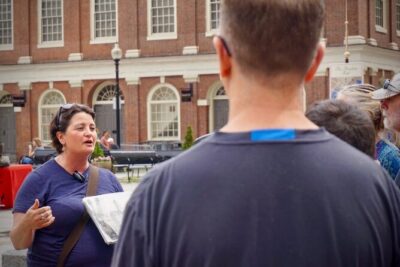
Freedom Trail History Small Group Walking Tour
Read our review →
New Orleans Food Walking Tour of the French Quarter with Small-Group Option
Read our review →
Barcelona Tapas and Wine Experience Small-Group Walking Tour
Read our review →
Reykjavík Small group Walking Tour – by CityWalk
Read our review →
Best of Lisbon Small-Group Guided Walking Tour
Read our review →
Small Group Boat Cruise and Guided Walking Tour
Read our review →
Browse the lists this tour appears in