
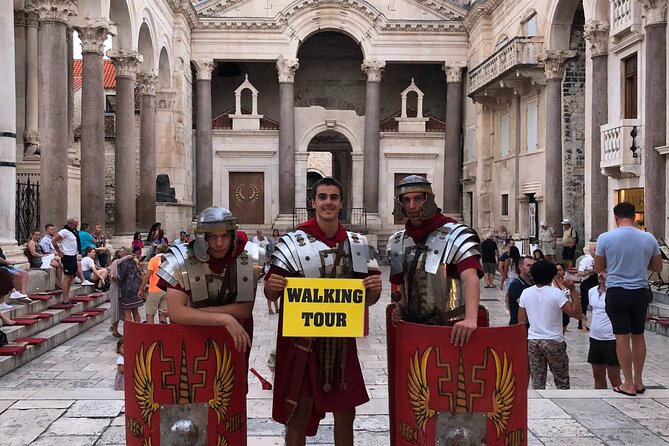
Review · CASTLE AND PALACE WALKING TOURS
Walking Tour of Split and Diocletian’s Palace
Roman walls still shape daily life in Split. This 90-minute walking tour takes you through Diocletian’s Palace, from the grand Peristyle to the Golden Gate, then out toward the Riva waterfront and the old city squares. I like the clear route and the chance to connect Roman, Venetian, Croatian, and Jewish heritage in one compact walk. I also like that guides such as Antonella, Anton, Mario, and Marino have been praised for bringing the city to life with humor and personal insight.
The main caution is sound. Groups can reach 20 people, and several tours may crowd the same spaces at once. Without headsets, it can be hard to hear a soft-spoken guide, especially in the Vestibule or busy palace lanes. The paid sections are not included, so you should treat this as an introduction rather than a complete palace visit.
Key points to know before you book
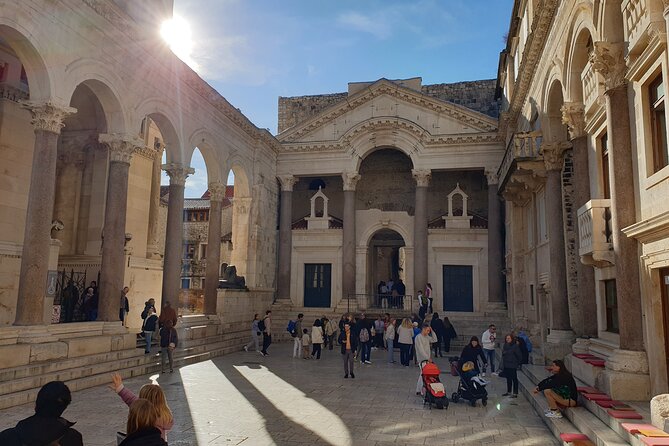
- Diocletian’s Palace is still part of the city: You walk through spaces that also contain shops, homes, cafés, and working streets.
- The tour covers seven distinct areas: The route includes the Peristyle, Vestibule, substructures, Golden Gate, Riva Harbor, Fruit Square, and the Split Synagogue.
- The guide makes the difference: Strong guides such as Antonella, Anton, Mario, and Marino have been praised for clear explanations, humor, and enthusiasm.
- The basic price is $48.37 per person: That is fair for a guided introduction, but you pay extra for any palace areas requiring admission.
- Expect uneven steps: The route includes high and irregular steps, so it may not suit anyone with difficulty managing stairs.
- Hearing the guide can be a challenge: Ask to stay close, particularly if your group is large or another tour is nearby.
Why this short walk works so well in Split
Split can be confusing at first because Diocletian’s Palace is not a single isolated monument. It is the old center of the city, with Roman walls woven into later streets and buildings. You can walk through an ancient gate and soon find a café table, a shop, or a local passing through with groceries.
That makes a guided walk useful. I like having someone explain what is Roman, what came later, and why the palace still matters to Split. In 90 minutes, you get a framework for exploring on your own instead of wandering past important stones without knowing what they mean.
The route also gives you more than imperial architecture. You hear about Croatian language and literature at the statue of Gregory of Nin, Venetian power at Fruit Square, Dalmatian singing in the Vestibule, and the Jewish community at the old synagogue. That range gives the walk a broader purpose than simply admiring columns.
The price of $48.37 is not cheap for an hour and a half, especially since admission tickets are not included. Still, it can be worthwhile if you have only one day in Split, are visiting from a cruise ship, or want a strong introduction before exploring the city alone. The value rests largely on the guide. A gifted storyteller can make this route memorable; a disorganized or hard-to-hear guide can make the same route feel thin.
More Castle and Palace Walks in Split:
- Split: Old Town and Diocletian Palace Walking Tour
★ 4.9 · 4,727 reviews - Split & Diocletian’s Palace Walking Tour
★ 5.0 · 1,125 reviews - Split: Diocletian Palace & Old Town Guided Walking Tour
★ 4.7 · 882 reviews
Starting at the Peristyle
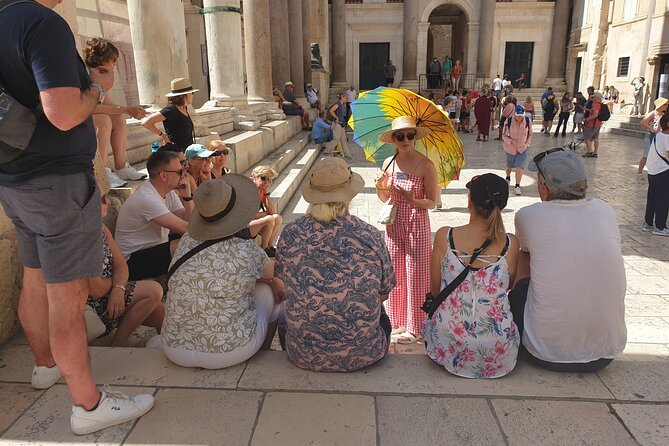
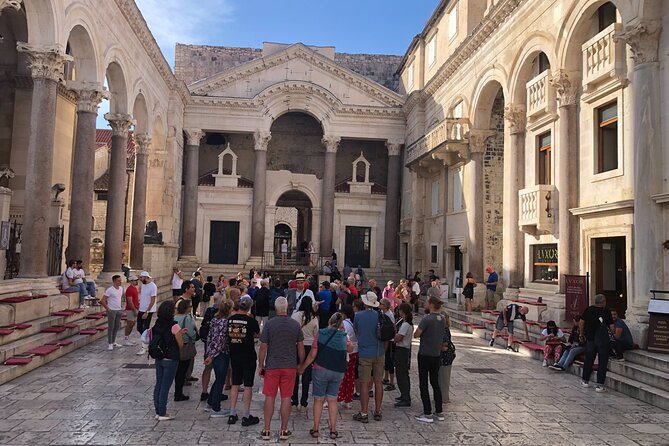
The tour begins at Peristil ulica, beside the Peristyle, the central square of Diocletian’s Palace. This is the right place to start because almost every major section of the palace connects to it.
The Peristyle gives you the clearest sense of the palace as an imperial complex. It is a formal open space, and the surrounding stone, columns, and passageways show how Diocletian planned the heart of his retirement residence. Your guide uses the square to explain the layout before leading you into smaller and less obvious corners.
You should arrive early. The meeting point can be hard to locate, and the central square may be full of groups at different departure times. Once the walk begins, stay close to the guide rather than drifting toward the back. The lack of headsets has been a repeated practical complaint, and the stone setting can make voices harder to follow.
The listed stop lasts about 15 minutes. Admission is free, so this first part costs you nothing beyond the tour fee.
The Vestibule and the sound of Dalmatia
From the Peristyle, the route continues to the Vestibule, the entrance space connected with Emperor Diocletian. It is a short stop of about five minutes, but it can be one of the most atmospheric parts of the walk.
Here you learn how the space served the emperor and how its role changed over time. You may also hear traditional Dalmatian singing, an especially fitting detail in a rounded stone chamber where voices can carry.
This is exactly the kind of moment that separates a guided walk from a quick self-guided circuit. You are not only looking at an old room. You are hearing how the space works and connecting it with local culture. The drawback is that the acoustics can work against the guide as well as the singers. If you are near the rear of the group, move closer before the explanation begins.
What the palace substructures reveal
The substructures are scheduled for about 10 minutes. This section explains how the palace was built and how these lower rooms functioned through different periods.
The substructures are particularly useful because they help you understand the arrangement above them. Once you know that the lower rooms supported and reflected the plan of the imperial apartments, the upper palace becomes easier to read. You begin to see the old residence as a designed complex rather than a random collection of walls.
The tour does not include the museum section of the substructures. You can visit that area afterward, but admission is not covered in the $48.37 price. This is an important distinction. If you want a fuller look at the underground rooms, allow extra time and money after the walking tour.
I would not consider this omission a flaw by itself. A short orientation tour has to leave something out. But you should know that the advertised price pays for the guide, not every palace entrance.
A few more walks around Split worth a look
- Krka Waterfalls tour with Trogir Walking tour and Krka panoramic boat cruise
★ 5.0 · 1,659 reviews - Walking Tour of Split with a ‘Magister’ of History
★ 5.0 · 1,122 reviews - Split Walking Tour with Professor of History
★ 5.0 · 926 reviews - From Split: Krka Waterfalls Cruise & Trogir Walking Tour
★ 4.7 · 681 reviews
The Golden Gate and Gregory of Nin
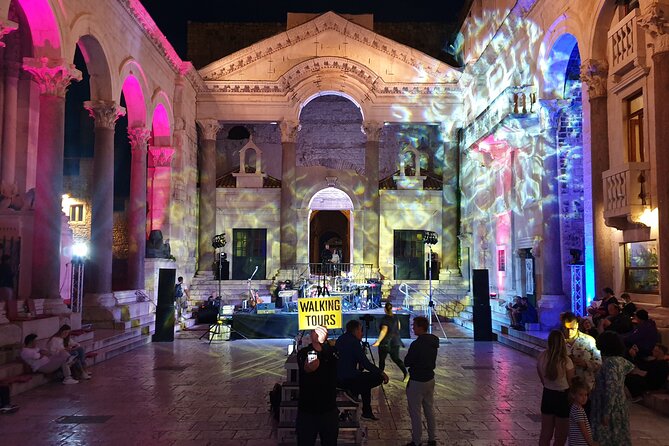
The Golden Gate is the main entrance to Diocletian’s Palace and receives about 10 minutes on the route. Your guide explains the gate’s role and points out the statue of Gregory of Nin nearby.
Gregory of Nin matters because of his connection to Croatian language and national identity. The stop gives the tour a welcome shift from Roman imperial power to the development of Croatian culture. You also get a chance to consider how the palace changed from an imperial residence into the center of a living city.
The Golden Gate is one of the clearest places to understand the palace as a gateway, not merely a ruin. It connected the interior with the wider city, and today it remains a natural crossing point. Expect people moving through the area, so listen closely and keep the group in sight.
Riva Harbor and Split’s waterfront life
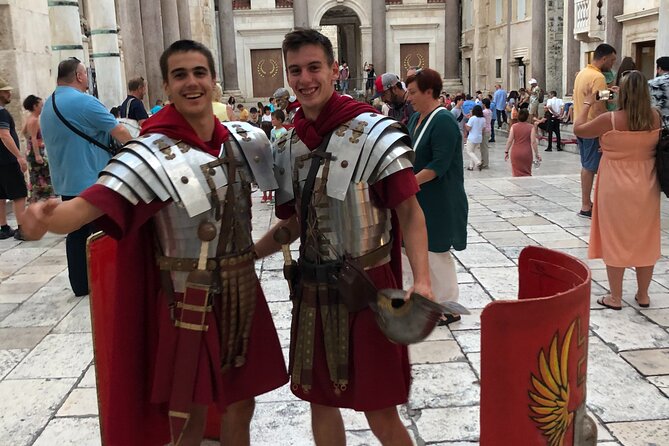
The walk then heads toward Riva Harbor for about 15 minutes. Here you see a bronze model of Diocletian’s Palace and learn about the history of the Riva promenade.
The model is useful because the palace can be difficult to picture from street level. A three-dimensional view helps you understand the relationship between the walls, gates, waterfront, and interior spaces. After walking among close-set buildings, the harbor also gives you a change of scale.
The Riva is not just a viewpoint or a photo stop. It helps explain why Split developed around this location and how the waterfront became part of the city’s daily life. I like this part of the route because it connects the palace to modern Split instead of treating the Roman complex as a sealed archaeological site.
If your tour takes place during a busy period, this may be one of the easier spots to lose the guide. Keep listening for the next meeting point and avoid wandering too far toward the waterfront while the explanation is under way.
Fruit Square and a Venetian chapter
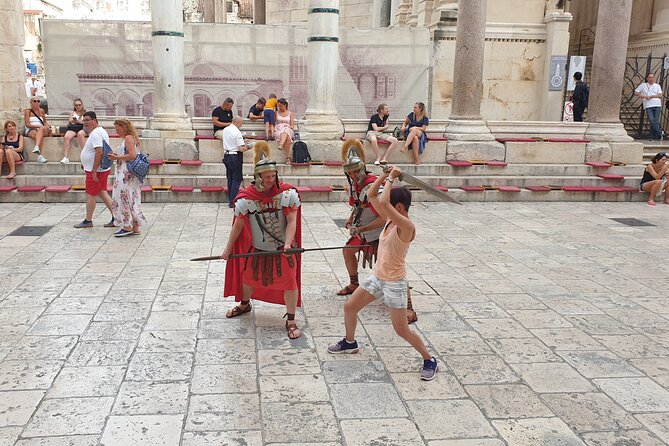
Fruit Square, officially Trg Brace Radic, receives about 10 minutes. The stop includes a 15th-century Venetian citadel and an explanation of Marko Marulić, often called the father of Croatian literature.
This section broadens the story again. Diocletian’s Palace is the main attraction, but Split’s identity was shaped by much more than the Roman emperor. The Venetian fortification shows the city’s later political and architectural changes, while Marko Marulić connects the streets to Croatian writing and language.
I find this kind of context especially useful for a short visit. You may not remember every date, but you will leave with a better sense of the layers beneath Split’s old center. The tour does not present the city as one frozen moment. It shows how different eras reused the same urban space.
The Split Synagogue and a smaller community story

The final listed stop is the Split Synagogue, a 16th-century site covered in about 10 minutes. The guide explains the history of Jewish people in Split.
This is a quieter part of the route, and it adds a human dimension that can be missed if you focus only on emperors, gates, and grand squares. It reminds you that Split’s past includes communities whose presence may be less obvious in the surviving architecture.
Admission is not included here. The route passes by the synagogue, so you should not assume the tour fee covers an interior visit. The key value is the explanation and the placement of the site within the wider story of the city.
Guide quality matters more than the route
The strongest part of this experience is the range of guide personalities. Antonella has been praised for being friendly, well organized, funny, and clear in English. Anton has been described as enthusiastic and engaging, while Mario has been appreciated for answering questions beyond the planned material. Marino, a history teacher, has been singled out for his passion for Split.
Those comments point to an important truth: this tour depends heavily on who leads it. The best guides tell stories rather than recite dates. They explain why a building matters, add local perspective, and leave you with useful ideas for the rest of your visit.
There have also been weaker experiences. One guide was difficult to understand and wandered away from the main subject. Another group had to wait about 20 minutes after a booking problem and a last-minute guide change. A separate cancellation and meeting-point problem caused serious frustration for one party.
These incidents do not erase the strong overall rating of 4.9 from 2,588 ratings or the 99 percent recommendation figure, but they are worth keeping in mind. Confirm your start time, arrive at the exact meeting point, and contact the provider promptly if the guide does not appear.
Group size, sound, and walking conditions
The maximum group size is 20. That is still manageable, but it is not the same as a private tour or a tiny seminar. In narrow palace lanes, a group of this size can spread out quickly.
The most useful tactic is simple: stay near the guide. Several people had difficulty hearing because other tours were taking place nearby, and headsets are not provided. If you have hearing concerns, ask whether you can stand close to the guide at each stop.
The route includes uneven surfaces and high steps. It is not recommended for people who have trouble with high stairs. Most participants can take part, and service animals are allowed, but you should choose sturdy footwear and avoid assuming that every section will be smooth.
The tour is near public transportation, and it ends back at the meeting point. That makes it easy to continue sightseeing afterward, including a return to the paid substructures if you want more time underground.
Who gets the most from this tour?
I would choose this walk if you are visiting Split for the first time, have only a day in the city, or want historical orientation before exploring alone. It is also a sensible choice for a cruise stop, when you need a fixed route and a clear introduction without spending several hours indoors.
It suits adults and families who enjoy stories, dates, and city history. The humor used by some guides can make the material easier to remember, and the mix of Roman, Venetian, Croatian, and Jewish subjects keeps the walk from feeling repetitive.
I would think twice if you want a detailed archaeological tour with every interior included. The substructure museum and other paid areas cost extra, and the 90-minute schedule only allows a quick look at each place. You should also be cautious if high steps, uneven ground, or crowded streets are difficult for you.
Cancellation is free up to 24 hours before the start time for a full refund. Within 24 hours, refunds are not available, and changes are not accepted. The provider may cancel if the minimum number of participants is not met, in which case you are offered another option or a full refund.
Should you book the Split palace walk?
Book it if you want a lively first look at Split, especially early in your time in the city. The route covers the essential landmarks, and a strong guide can help you understand why the palace is still a living part of Split rather than a fenced-off monument.
The $48.37 fee is reasonable for the guide and the overview, but less attractive if you expect every entrance ticket to be included. Go in knowing that sound may be the biggest problem, paid palace sections are extra, and the experience can vary with the guide.
My practical choice would be to book it for your first morning, arrive early at the Peristyle, stay close to the guide, and use the rest of the day to revisit the places that catch your interest. If you want an easy, compact introduction with plenty of local context, this tour is a good starting point.
FAQ
How long is the walking tour?
The tour lasts approximately 1 hour and 30 minutes.
Where does the tour start and end?
It starts at Peristil ulica, Peristil ul., 21000 Split, Croatia, and ends back at the meeting point.
Are admission tickets included?
No. Admission tickets are not included. The museum section of the palace substructures is not part of the tour, and the synagogue stop also does not include admission.
What language is the tour offered in?
The tour is offered in English.
How large can the group be?
The maximum group size is 20 participants.
Can I cancel for a full refund?
Yes, if you cancel at least 24 hours before the experience starts. Cancellations or changes made within 24 hours are not refunded or accepted.
Just added around Split
- Split: Food Tasting Walking Tour★ 4.9 · 102 reviews
- Split: Local History and Culture 90-Minute Walking Tour★ 5.0 · 194 reviews
- Split: 1.5-Hour Walking Tour and Diocletian’s Palace★ 4.7 · 256 reviews
- Split: Diocletian Palace & Old Town Guided Walking Tour★ 4.7 · 882 reviews
- Split: Walking tour of Split with a ‘Magister’ of History★ 5.0 · 110 reviews
- From Split: Krka Waterfalls Cruise & Trogir Walking Tour★ 4.7 · 681 reviews
- Split: History and Heritage Walking Tour★ 4.9 · 650 reviews
- Diocletian’s Palace and Old Town SMALL GROUP Walking Tour★ 5.0 · 502 reviews
Castle and Palace Walking Tours, compared.

Edinburgh Castle: Guided Walking Tour with Entry Ticket
Read our review →
Doge’s Palace and St Mark’s Basilica Walking Tour
Read our review →
3-Hour Walking Tour of Old Town & Prague Castle
Read our review →Edinburgh Castle: Guided Walking Tour with Entry Ticket
Read our review →
Edinburgh Castle Guided Walking Tour in English
Read our review →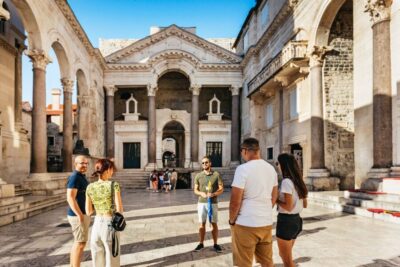
Grand Palace and Wat Phra Kaew Guided Walking Tour
Read our review →Browse the lists this tour appears in