
Review · HISTORY WALKING TOURS
Split Walking Tour with Professor of History
Split’s old town is a Roman palace still used as a city. That is the hook. I like the way this professor-led walk explains ancient stones through Croatian history, and I like the mix of major sights and small local details, from the Temple of Jupiter to the narrow Let Me Pass Street. The modest $24.19 price also gives you a useful first look at central Split.
The main thing to consider is time. The advertised tour lasts about 2 hours 20 minutes, but the guide may run closer to three hours when the conversation is flowing. You will also see the cathedral and Temple of Jupiter from outside, so budget extra if you want to visit their interiors afterward.
Key things to know before you book
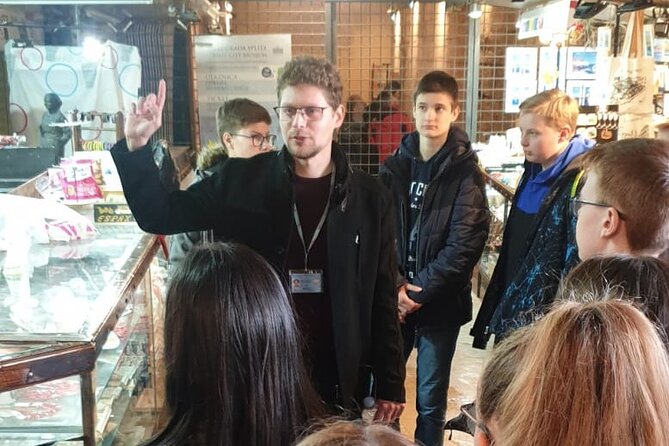
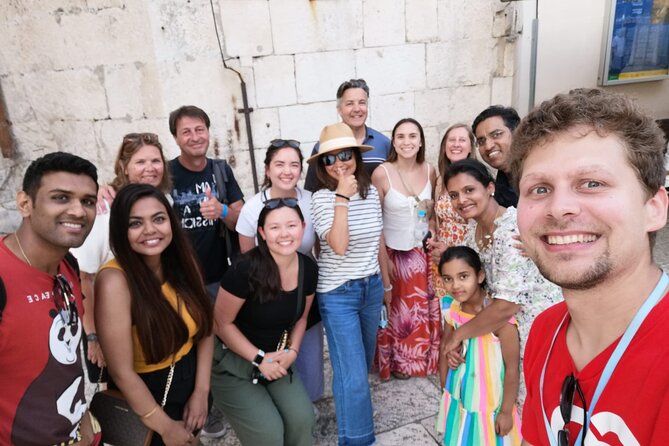
- A history professor leads the walk: Mario receives the strongest praise for clear explanations, humor, local tips, and his ability to make ancient events feel connected to modern Split.
- You walk through a living Roman palace: The route covers the Riva, palace substructures, Peristyle, Vestibule, cathedral, Jupiter’s Temple, and Golden Gate.
- The group is capped at 17 people: That is small enough for questions and personal attention, though it is not a private tour unless you choose the upgrade.
- The tour reaches beyond Diocletian’s Palace: Marmontova Street, Prokurative, and Fruit Square show how Split grew beyond its Roman core.
- The price covers the guided walk, not interior admissions: Cathedral and Temple of Jupiter entry fees are not included, and the cathedral is viewed from outside during the walk.
- Allow extra time after the tour: The guide may suggest restaurants, banks, food spots, and places to visit around Split.
Why this Split walk is worth your time
I see this as a strong first activity in Split, especially if you want the city to make sense before exploring it on your own. The route gives you the basic Roman story, then adds medieval, Venetian, Napoleonic, and modern Croatian layers.
The guide matters here. The best feedback centers on Mario, who combines serious historical study with jokes, questions, and everyday advice. Anita is also praised for her warmth, clear teaching, and care with a group of 14 people. Guide assignments can vary, but the experience clearly depends on someone who can explain rather than simply point.
At $24.19 per person, the value is good. You get roughly two and a half hours of guiding, all listed fees and taxes, and a route covering the main center. You are not paying for entry to every monument, but that keeps the cost down and lets you decide later which interiors deserve your money.
The walk is conducted in English and uses a mobile ticket. It is capped at 17 people, so you should have a better chance of hearing the guide than on a large city tour. A private upgrade is available if you want more control over the pace and questions.
More History Walking Tours in Croatia
- Walking Tour of Split with a ‘Magister’ of History
★ 5.0 · 1,122 reviews - Split: History and Heritage Walking Tour
★ 4.9 · 650 reviews - Split: Local History and Culture 90-Minute Walking Tour
★ 5.0 · 194 reviews
Starting beside the Riva and Brass Gate
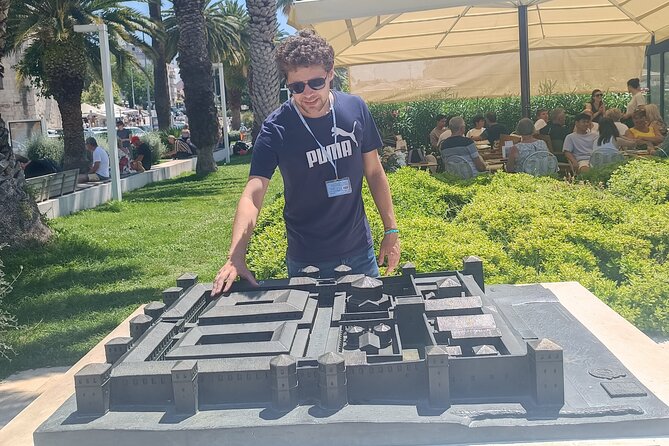
The meeting point is the Brass Gate, also called Porta Aenea, at Obala Hrvatskog narodnog preporoda 22. It sits beside the Riva harbor promenade and the model of Diocletian’s Palace.
This is a sensible place to begin. The Riva is not just a postcard waterfront. It is where people meet for coffee, sit in the sun, and watch daily life pass by. Starting here gives you a quick sense of Split as a working city rather than a museum frozen in Roman time.
The opening stop lasts about 15 minutes. You will hear why the harbor remains central to public life and how the palace relates to the modern waterfront. Bring water and wear shoes suited to uneven old-town paving. Much of the route is outside, and the weather policy requires good conditions.
Seeing the palace from underneath
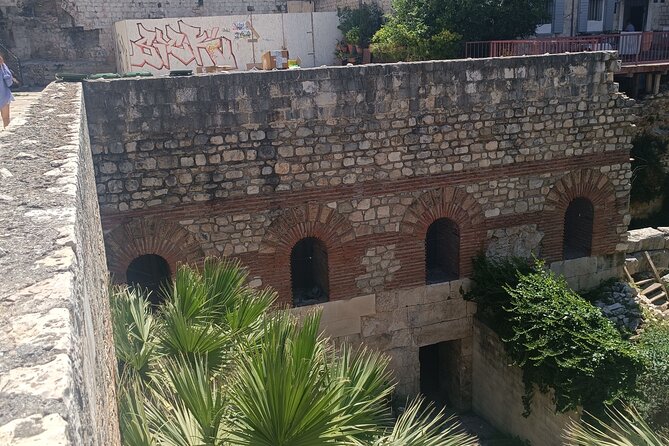
The palace substructures are among the most impressive parts of the route. These basement halls are unusually well preserved, and they help explain why Split’s historic center received UNESCO World Heritage status in 1979.
The important point is practical: the substructures show the original plan of the palace. Above them, homes, shops, restaurants, and lanes have changed over time. Below, the ancient layout remains easier to read.
This stop is scheduled for about 15 minutes. That is enough for an explanation and orientation, but not a long independent visit. Admission is listed as free for the tour, while the cathedral and Temple of Jupiter have no included entrance. If you want more time underground, ask the guide what can be visited after the walk.
Meeting Diocletian in the Peristyle
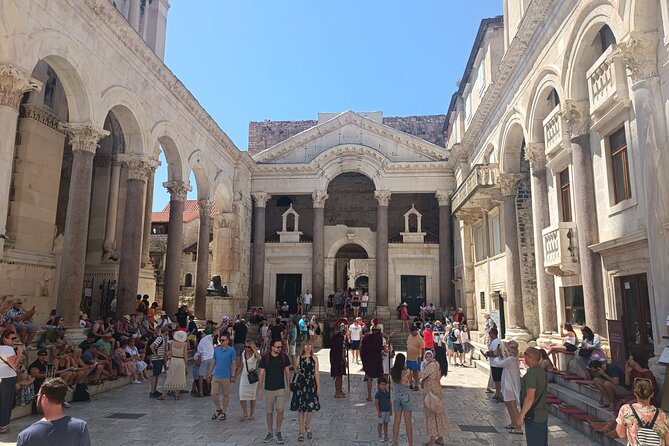
The Peristyle is the palace’s central square and one of the clearest places to understand imperial ceremony. Diocletian was presented here as the living son of Jupiter, and visitors approached him with gestures of submission, including kneeling and kissing the edge of his scarlet cloak.
The guide spends about 10 minutes here. The stop is short, but the setting does much of the work. Columns, stonework, and the surrounding palace walls make the Roman power structure easier to picture.
This is also a spot where a good guide earns the price of admission, even when no ticket is required. The square can look like a pretty old courtyard if you do not know what happened there. With context, it becomes a stage built for imperial theater.
More History Walking Tours in Split:
- Split: Walking tour of Split with a ‘Magister’ of History
★ 5.0 · 110 reviews - History and Hauntings of Salem Guided Walking Tour
★ 5.0 · 14,564 reviews - Lisbon: History, Stories and Lifestyle Walking Tour
★ 4.8 · 10,902 reviews - Boston: Freedom Trail History Small Group Walking Tour
★ 5.0 · 6,450 reviews
Entering the round Vestibule
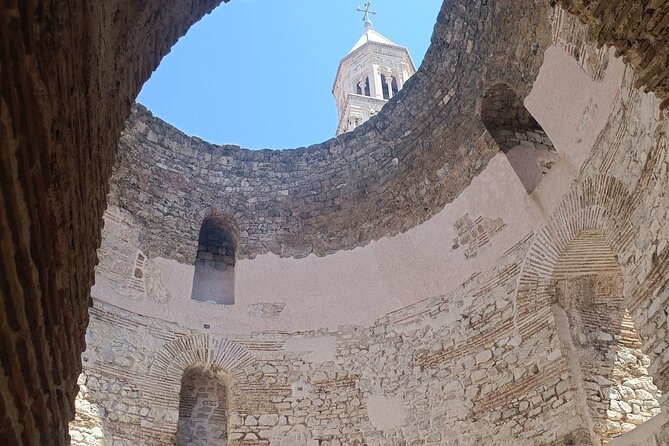
The Vestibule was the formal entrance to the imperial apartments. This circular hall once had a dome and measures about 17 meters high and 12 meters across.
You get roughly 10 minutes here. The guide explains its place in the imperial corridor and why a grand meeting hall would be reserved for selected audiences, including ambassadors.
The Vestibule is a good example of the tour’s teaching style. It does not only identify a building. It asks you to think about movement, access, and status inside the palace. Who could enter? Who had to wait outside? How did architecture make power visible?
Understanding Saint Domnius from the outside
The Cathedral of Saint Domnius has had several lives. It began as a Roman mausoleum and is also connected to the earlier Roman temple complex. Today it functions as a church.
The tour allows about 20 minutes at this stop, but the visit is exterior only. Admission is not included. That distinction matters if you want to climb, enter, or spend quiet time inside. The guide provides detailed information so you can decide later if a paid visit fits your schedule.
This is one of the better places to ask questions. The building’s identity changes depending on the period you are studying, and the guide can connect Roman imperial architecture with later Christian use.
Jupiter’s Temple and the tiny Let Me Pass Street
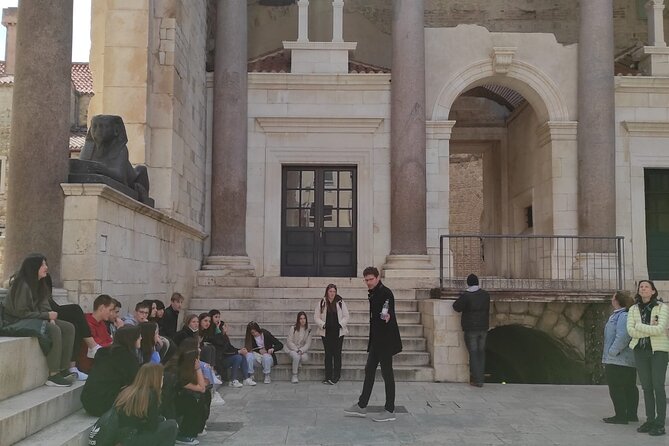
The Temple of Jupiter is another outside stop. Jupiter was the Roman god of the sky and thunder, and the temple was later converted into a baptistery dedicated to Saint John the Baptist.
The tour spends about 10 minutes here, then moves through a very narrow lane known locally as Let Me Pass Street. Local belief gives it the title of the narrowest street in the world. Treat that claim as a playful piece of local character rather than a measurement you need to verify.
This section is useful because it shows how old structures were reused. A Roman religious building became part of a Christian setting, while a tiny medieval passage continues to function as part of everyday city life. It is a compact lesson in how Split kept adapting instead of clearing the past away.
The Golden Gate and Gregory of Nin
The Golden Gate, or Northern Gate, was one of the four main Roman entrances to the palace. It was designed as the emperor’s formal entry and once carried more columns and statuary than you see today.
The gate was sealed during the Middle Ages, then reopened and repaired in modern times. The stop lasts about 15 minutes and gives you a chance to compare the grand imperial entrance with the less formal lanes inside the palace.
Nearby, the 8.5-meter statue of Gregory of Nin adds a Croatian national story to the Roman one. The work by Ivan Meštrović is a popular meeting point, and the shiny toe is impossible to miss. Touching it is said to bring good luck, so you can join the ritual without needing a long explanation.
The statue stop takes about 10 minutes. It is also a reminder that Split’s important figures are not all Roman. Gregory of Nin was a medieval bishop, and his statue helps shift the focus toward Croatian identity and local memory.
Marmontova Street and the Prokurative
Marmontova Ulica provides a change of mood. The street is named for Napoleon’s marshal Marmont, who helped urbanize Dalmatian cities despite arriving as a conqueror.
That tension is worth hearing about. History is rarely a clean list of heroes and villains, and this stop gives the guide room to explain how people can remember an outsider for useful civic changes as well as political control.
The route then reaches Prokurative, or Republic Square. It is an open space surrounded on three sides by elaborate neo-Renaissance buildings. The stop lasts about 10 minutes.
Prokurative helps you see Split outside the palace walls. After several stops focused on Roman and medieval stone, this square shows a later city shaped by grand public architecture and changing political ambitions.
Finishing at Fruit Square
The final stop is Fruit Square, officially Trg Braće Radić. Its name recalls the women who once sold fruit there.
You get about 15 minutes in this small square, with time to hear about the statue of Marko Marulić, often called the father of Croatian literature. The square is also a natural place for stories about Croatian food and local life.
I like ending here because the tour does not finish with one more emperor or fortress. It ends with a neighborhood square, a writer, market history, and practical food talk. Mario in particular is praised for giving restaurant suggestions, advice about where to go next, and even guidance on which banks or ATMs to use.
The activity ends back at the meeting point, so you can return to the Riva or continue walking from the old center.
How the guides shape the experience
The strongest praise goes to Mario. He is described as funny, warm, organized, and able to explain a large amount of material without making the walk feel like a lecture. His style includes questions, trivia, local stories, and myth-busting.
That last point is useful in a city with many repeated legends. A guide who asks you to think about what you are seeing can give you a better tool than a string of dates.
Anita also earns praise for her preparation and kindness. She is described as proud of Croatia and attentive to all members of her group. If your guide is Anita or Mario, expect a strong focus on both history and practical help.
The group limit of 17 is important. You will not have the same freedom as on a private tour, but the size is manageable. The guide can respond to questions and keep the group together without the feel of a large coach excursion.
Timing, comfort, and what to bring
The stated duration is approximately 2 hours 20 minutes. Allow up to three hours if your guide adds stories, answers questions, or offers extra context. One person found the longer format slightly excessive, while many others appreciated getting more information than expected.
Plan the rest of your day with that flexibility in mind. Do not schedule a tight museum booking immediately afterward unless you are comfortable cutting away before the final stop.
The route is a walking tour through the historic center. Some streets and surfaces may be uneven, and you will spend time standing outdoors. Wear comfortable shoes, carry water, and consider sun protection. Guides have made a point of using shade when possible, but Split can be hot and bright.
Service animals are allowed, most people can participate, and the meeting point is near public transportation. The activity is offered in English, with a mobile ticket and confirmation at booking.
What the price does and does not cover
At $24.19, the tour is priced as an accessible introduction to Split. All fees and taxes are included, but alcoholic drinks are not. The cathedral and Temple of Jupiter are viewed from outside, and their admission is not included.
That setup works well for a first visit. You get help identifying what deserves a closer look, then choose your own paid entries afterward. It is less suitable if you want a full interior tour of every monument in one package.
The private upgrade may make sense for families, serious history fans, or anyone with a short list of specific questions. The standard small group should suit most people who want structure without paying private-tour rates.
Cancellation and booking details
You can cancel up to 24 hours before the start time for a full refund. Changes or cancellations inside that 24-hour window are not accepted for a refund.
The activity depends on good weather. If poor weather forces cancellation, you are offered another date or a full refund. Since the tour is booked, on average, about 33 days ahead, reserve early if your Split dates are fixed.
Who should book this walking tour?
I would choose this tour if you are visiting Split for the first time and want the old town explained in a clear order. It is especially good for people who enjoy Roman history, Croatian culture, local stories, and guides who welcome questions.
It also suits cruise passengers or anyone with limited time because the route covers the main historic center without requiring separate planning for each sight. Just remember that the experience may last longer than the stated 2 hours 20 minutes.
I would look elsewhere if you need a fully private pace, want long interior visits, or dislike standing outdoors while listening. For everyone else, the combination of a small group, strong teaching, useful local advice, and a $24.19 price makes this a smart way to begin in Split.
FAQ
How long is the Split walking tour?
The tour lasts approximately 2 hours and 20 minutes. It may run closer to three hours if the guide adds information or spends extra time answering questions.
Where does the tour begin?
It begins at the Brass Gate, also called Porta Aenea, at Obala Hrvatskog narodnog preporoda 22 in Split.
Where does the tour end?
The activity ends back at the meeting point.
Is the tour offered in English?
Yes. The tour is offered in English.
Are entry fees included?
All listed fees and taxes are included, but admission to the Cathedral of Saint Domnius and the Temple of Jupiter is not included. Both are viewed from outside during the walk.
How large is the group?
The standard tour has a maximum of 17 people. A private upgrade is also available.
What happens if the weather is poor?
The tour requires good weather. If it is canceled because of poor weather, you can choose another date or receive a full refund.
Just added around Split
- Split: Food Tasting Walking Tour★ 4.9 · 102 reviews
- Split: Local History and Culture 90-Minute Walking Tour★ 5.0 · 194 reviews
- Split: 1.5-Hour Walking Tour and Diocletian’s Palace★ 4.7 · 256 reviews
- Split: Diocletian Palace & Old Town Guided Walking Tour★ 4.7 · 882 reviews
- Split: Walking tour of Split with a ‘Magister’ of History★ 5.0 · 110 reviews
- From Split: Krka Waterfalls Cruise & Trogir Walking Tour★ 4.7 · 681 reviews
- Split: History and Heritage Walking Tour★ 4.9 · 650 reviews
- Diocletian’s Palace and Old Town SMALL GROUP Walking Tour★ 5.0 · 502 reviews
History Walking Tours, compared.
History and Hauntings of Salem Guided Walking Tour
Read our review →

Freedom Trail History Small Group Walking Tour
Read our review →
Historic Charleston Guided Sightseeing Walking Tour
Read our review →
Tapas Walking Tour with Food, Wine, and History
Read our review →
Savannah History and Haunts Candlelit Ghost Walking Tour
Read our review →
A History of Terror – Belfast City Centre Walking Tour
Read our review →Browse the lists this tour appears in