
Review · CASTLE AND PALACE WALKING TOURS
Venice: Doge’s Palace and St Mark’s Basilica Walking Tour
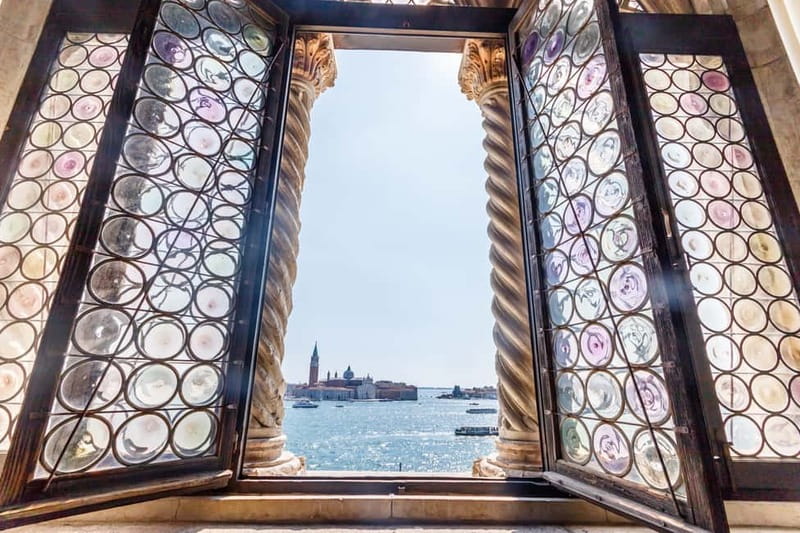
Venice saves its grandest stories for St. Mark’s Square. This 2 to 2.5-hour walking tour brings you into the Doge’s Palace and St. Mark’s Basilica with priority entry, then adds the Bridge of Sighs, palace prisons, golden mosaics, and a terrace view over the square. I like the time saved at both landmarks, and I like the guides’ ability to turn paintings, politics, and old Venetian customs into a story you can follow.
The main drawback is pace. You cover two major monuments in a short time, and the crowds can make the tour feel hurried, especially in summer. At $101 per person, this is not a bargain basement outing, but skip-the-line access and a strong guide can make the cost worthwhile on a busy day.
Key points to know before booking
- Priority entry matters here: You may pass long queues at both major sites, though a short wait can still occur.
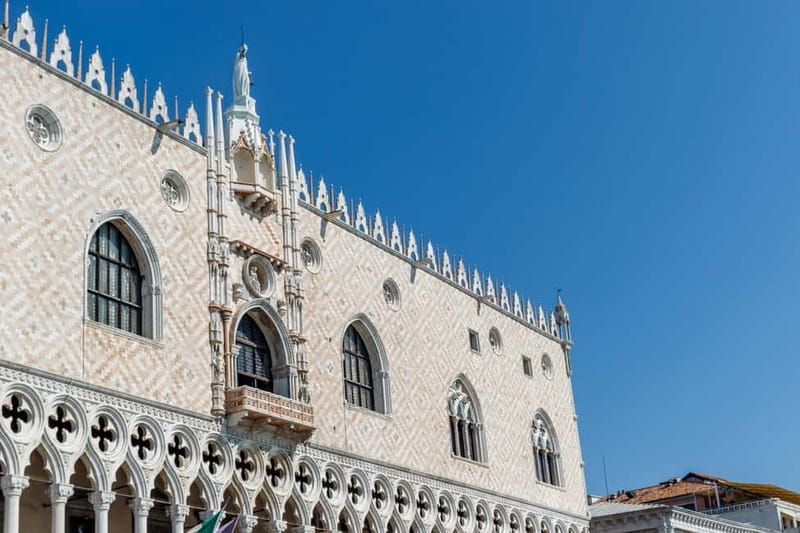
- The Doge’s Palace is the tour’s political heart: Expect grand council rooms, painted ceilings, the medieval gold staircase, the Bridge of Sighs, and the old prison.
- St. Mark’s Basilica is the visual high point: Gold mosaics, marble floor patterns, the treasury, museum, and terrace fill the second part of the visit.
- Guides receive the strongest praise: Denise, Donatella, Marina, Eliza, and others have been singled out for clear explanations, humor, patience, and local insight.
- Dress carefully: Shoulders and knees must be covered, and large backpacks are not allowed inside the basilica.
- Choose extras with care: Museum and terrace access, Pala d’Oro, or a glassblowing demonstration may depend on the option you book.
Starting in St. Mark’s Square
The tour begins in St. Mark’s Square, the natural stage for Venice’s most famous buildings. Meeting details can vary by booking option, so check your confirmation closely and arrive early. A past participant nearly missed the tour because the ticket collection point was not clear, a useful warning in a square crowded with signs, groups, and competing activity.
Your guide leads you first toward the Doge’s Palace, the pale Gothic building beside the basilica. This was not simply a royal home. The doge was the elected head of the Venetian Republic, and the palace housed the institutions that directed Venetian government for centuries.
That political background gives the building purpose. Without it, you may see a string of grand rooms and enormous paintings. With a guide, you can better understand how the council, doge, courts, and prison system worked together inside one complex.
The tour operates in English, German, Spanish, French, or Italian. It may be a shared group or a private group, depending on the option you select. Some departures have used one guide for both buildings, while others have had a different guide for each site.
More Castle and Palace Walks in Italy:
- Venice: Walking tour, Doge Palace, & St. Mark’s Basilica
★ 4.5 · 884 reviews - Florence: Pitti Palace and Boboli Gardens Walking Tour
★ 4.6 · 182 reviews - Florence: Pitti Palace Entry Ticket and Guided Walking Tour
★ 4.5 · 90 reviews
The Doge’s Palace and its enormous council chamber
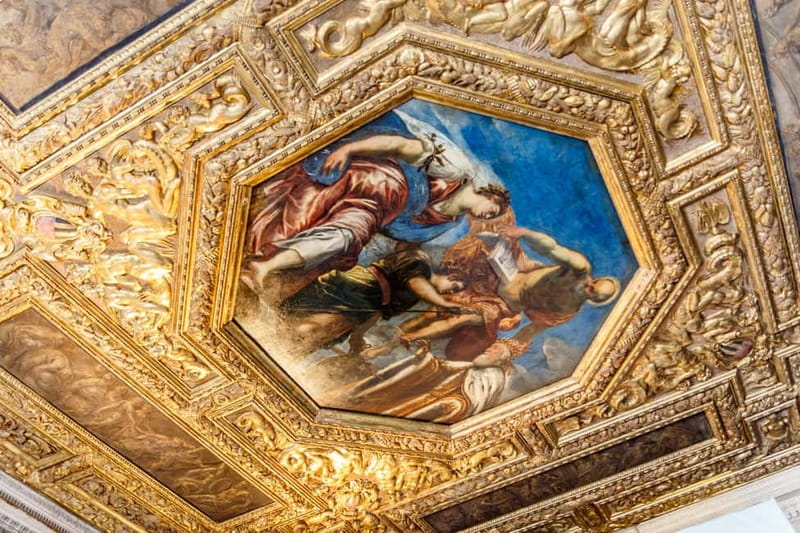
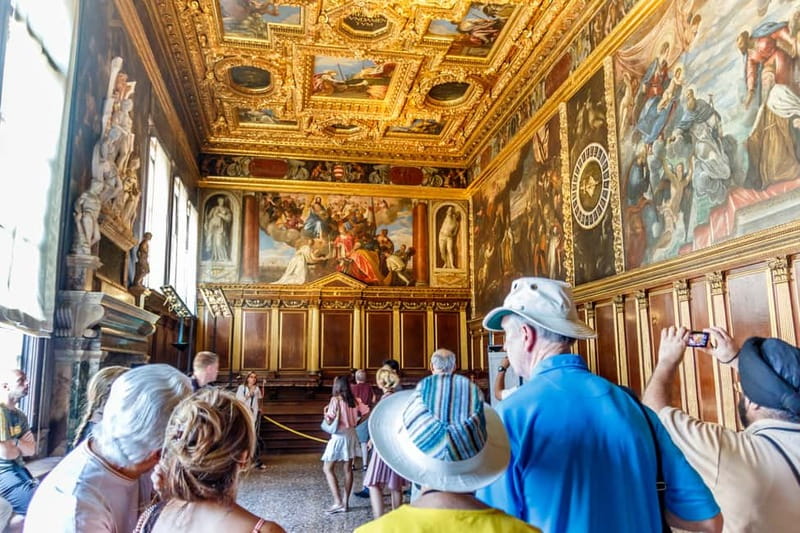
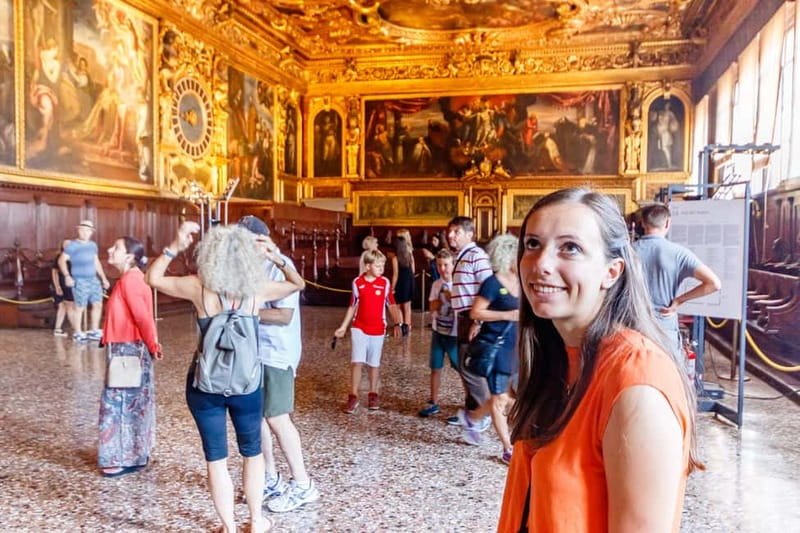
Inside the palace, the scale changes quickly. The rooms are filled with painted ceilings, wall decoration, carved details, and formal spaces built to impress political visitors. The most important stop is the Sala del Maggior Consiglio, or Great Council Hall.
This huge chamber was used by the Great Council, a body that included many members of Venice’s ruling class. Its size helps you understand how public power worked in the republic. Look upward as you move through the room, since the ceiling decoration and large historical paintings are as important as the architecture around you.
The guide’s role is especially valuable here. There is too much to absorb by simply walking through, and the palace does not explain every detail in a way that makes the political story easy to follow. Guides such as Marina, Donatella, and Denise have been praised for combining architecture, art, and Venetian government without turning the visit into a dry lecture.
You will also see the medieval gold staircase, an ornate route into the palace’s ceremonial rooms. It is a small part of the visit in terms of time, but it helps show how Venice used design as a form of authority. Every polished surface and grand entrance had a job: to make the republic appear permanent, wealthy, and in control.
Crossing the Bridge of Sighs
The Bridge of Sighs connects the palace to its former prison. Its enclosed white-stone passage is one of Venice’s most photographed sights, but it becomes more interesting once you understand its function.
Prisoners were taken from the courtrooms and palace offices across the bridge into detention. The bridge’s name refers to the supposed sighs of prisoners catching their last view of Venice through the small stone windows. The story may be romanticized, but the passage still gives you a clear sense of how close justice and imprisonment were inside the palace.
The route often takes you across the bridge more than once, which is a small bonus. You can see its exterior from the surrounding area, then understand its interior as part of the prison route. The passage is narrow and can be crowded, so keep close to your guide.
The old Venetian prison is also linked with Giacomo Casanova, the famous writer and adventurer who escaped from the palace prison in 1756. That episode adds a lively human story to an otherwise severe part of the tour. It is easier to remember a prison when you can connect it with a dramatic escape rather than only a date and a name.
St. Mark’s Basilica and its golden interior
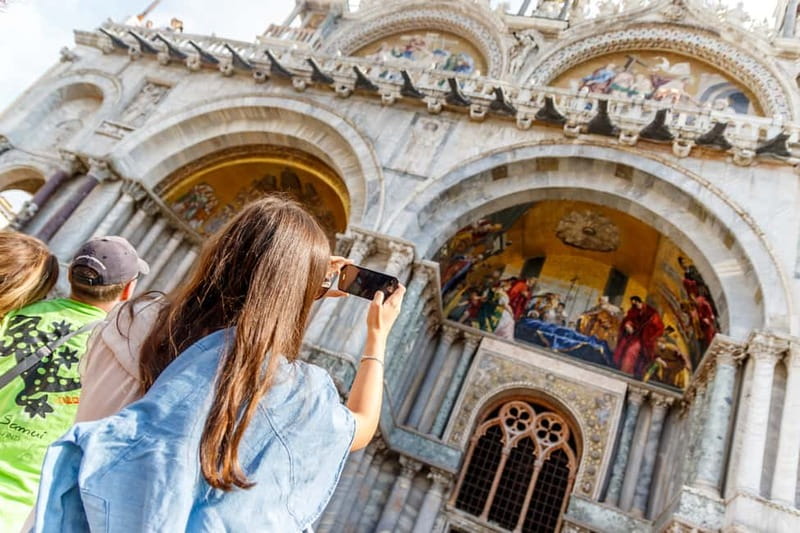
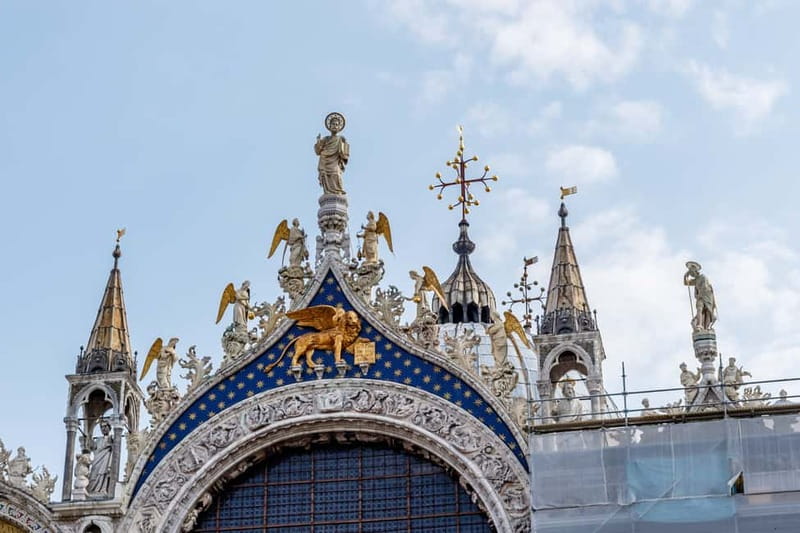
The second major section takes you into St. Mark’s Basilica, a Byzantine masterpiece built to display Venice’s connections with the eastern Mediterranean. The interior is immediately different from the palace. The Doge’s Palace speaks through political ceremony and painted history. The basilica works through light, gold, marble, and religious imagery.
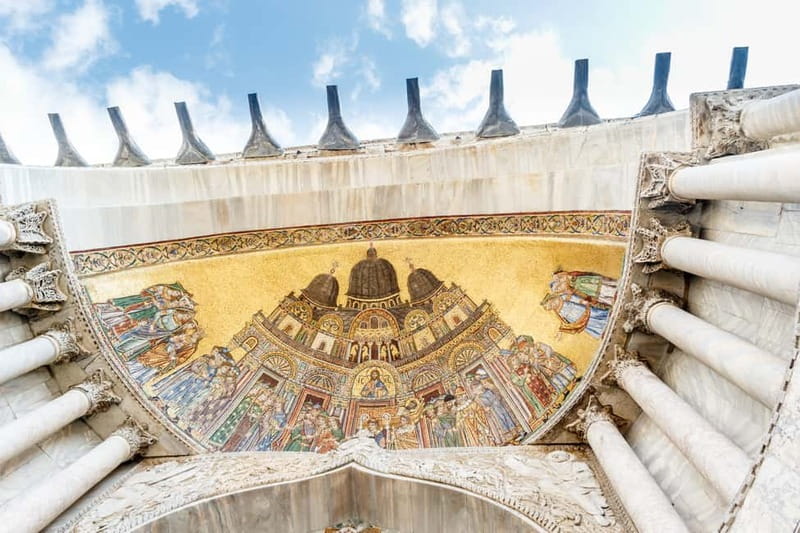
The gold mosaics are the main event. They cover large portions of the interior and catch the light in a way that changes as you move. Your guide points out important images and explains how the decoration reflects the church’s religious purpose and Venice’s long relationship with the Byzantine world.
Look down as well as up. The marble floor inlays are easy to miss when the mosaics pull your eyes toward the ceiling. These patterns add texture and color to the lower half of the basilica, giving the building a more complete visual design than a quick glance from the entrance suggests.
The basilica requires proper clothing because it remains a sacred place. Shorts, skirts above the knee, and sleeveless shirts are not allowed. Your shoulders and knees must be covered, so pack a light covering if your sightseeing clothes are not suitable. Large backpacks are also prohibited inside.
Access rules are strict. From July 1, 2025, all participants must enter with the guide or escort assigned to the visit, and late arrivals may not be admitted. You should treat the meeting time as firm, not flexible.
A few more walks around Italy worth a look
- Milan: Guided Walking Tour & Last Supper Visit with Ticket
★ 4.7 · 5,409 reviews - Naples: Street Food Walking Tour with Local Guide
★ 4.9 · 4,976 reviews - Florence: Highlights Walking Tour with Expert Guide
★ 4.6 · 4,662 reviews - Venice: San Marco to Rialto Walk & Spritz Like a Local
★ 4.2 · 3,651 reviews
Museum and terrace access
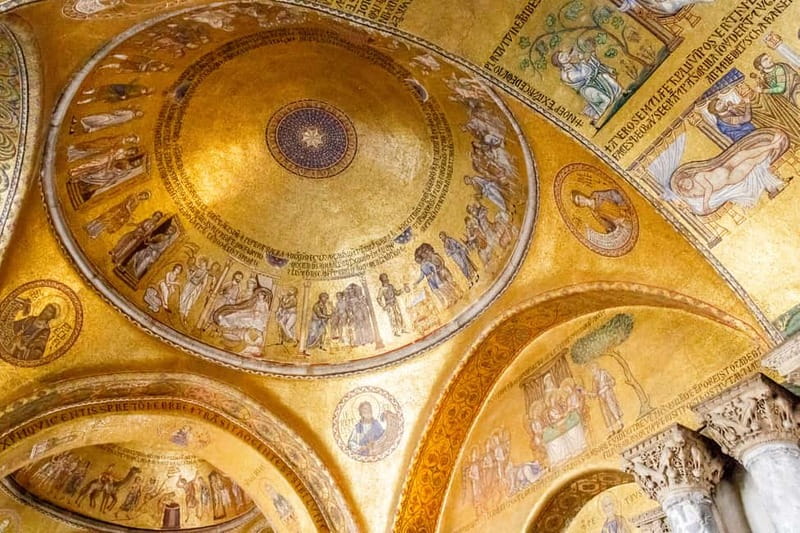
Some booking options include the basilica museum and terrace. Check the exact option before paying, since these extras are not necessarily part of every ticket.
The museum adds another layer to the basilica visit. It gives you a closer look at objects and details that can be difficult to study from the main floor. The terrace provides a view over St. Mark’s Square, a useful chance to look outward after spending much of the tour focused on ceilings, mosaics, and palace rooms.
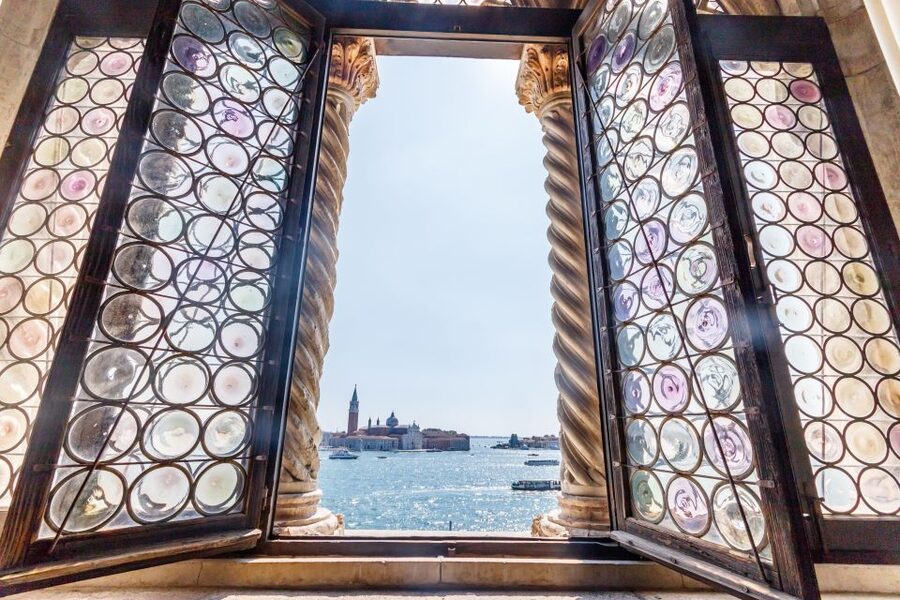
That terrace stop received special praise from one participant who considered the view a major benefit of the booking. It is not a long separate excursion, but it changes your sense of the square. From above, you can better understand the relationship between the basilica, palace, piazza, and surrounding streets.
Depending on the option, access may also include the Pala d’Oro or full interior access. The information provided lists different non-refundable basilica ticket values, from €12 for basic entry to €24 when the museum or Pala d’Oro is included, and €36 for full access inside. The booking price also covers guide services, required audio equipment, and operational arrangements. That helps explain why the $101 price is higher than a simple entrance ticket.
Why the guide makes a difference
A self-guided visit can show you the buildings, but the guide supplies the connections. The best guides on this tour have been praised for clear English, humor, patience, and an ability to answer questions without losing the group.
Denise was singled out for adapting to changes and highlighting the most important parts of the basilica within limited time. Marina received praise for making Venetian history accessible and looking after the group. Donatella was described as excellent at explaining both the basilica and the palace. Eliza, Lise, Ana, and Cinizia were also praised for friendly, engaging visits.
One guide, described as a Venice resident, gave extra context about the city’s origins. That kind of local perspective can add value, especially if this is your first visit and you want more than a quick photo at the square.
The listening equipment helps, but it is not perfect. One person reported static that made the audio painful and hard to understand. Another said you need to stay close to the guide for the earphones to work well. Keep your group in sight, especially around the bridge and crowded entrances.
Timing, heat, and the pace of the visit
The advertised duration is 2 to 2.5 hours. One itinerary lasted about 1 hour and 15 minutes in each major building, which gives you a useful idea of the balance.
That is enough time for an informed overview, not enough for a slow art study. If you want to examine every painting, browse every museum display, or linger in each room, this tour may feel too quick. One participant wished the palace and basilica had been separate visits for exactly that reason.
The pace also changes with crowd levels. Venice can become difficult to cross in high season, and the tour group must keep moving to stay on schedule. In August, the heat inside and outside the monuments can be intense, with little relief around St. Mark’s Square. Wear comfortable shoes, carry water where allowed, and avoid assuming the palace will feel cool.
The advantage of a guided route is that someone else handles the crowd navigation. Several people praised guides for keeping the group together and finding a workable route through packed areas. The tour may still feel busy, but you are less likely to lose time wondering where to go next.
Is $101 per person a fair price?
At $101, this tour is expensive compared with visiting a single church or buying basic admission on your own. You are paying for two major entrances, a live guide, priority access, audio equipment, and the convenience of joining a planned route through Venice’s busiest square.
The price makes the most sense when lines are long. One participant described walking past roughly a hundred people waiting to enter. Another still encountered a small wait despite priority access, but said it was much faster than the standard queue. Skip-the-line access is never a guarantee of instant entry, yet it can protect a large part of your day.
I would be less convinced by the price during a quiet period if you prefer to read at your own pace. I would be more willing to pay it during summer, on a first visit, or when your Venice schedule is tight. The guide adds the most value for visitors who want the art and political story explained rather than simply photographed.
Who should book this Venice tour?
I recommend it for a first visit to Venice, especially if you have limited time and want the two headline monuments handled in one appointment. It also suits anyone who finds grand art and political history hard to decode without help.
Families and mixed-age groups may appreciate the direct route and the guide’s ability to answer questions. Private group options are available if you want a more personal format.
You should think twice if you dislike fixed schedules, dislike walking with a group, or want long stretches of quiet viewing. The tour is not designed for a slow, solitary museum visit.
The accessibility information needs careful checking. The activity details describe wheelchair accessibility in one place, but the same information also says it is not suitable for wheelchair users. Confirm the exact option and current arrangements before booking if mobility access affects your decision.
Should you book it?
Book this tour if your priorities are saving time and understanding the monuments. The Doge’s Palace and St. Mark’s Basilica are too important to rush past, and a good guide can make their art, government, religion, and prison stories stick.
Choose the museum and terrace option if the elevated view and additional basilica areas matter to you. Arrive early, dress for the church rules, keep close to the guide, and accept that the pace will be brisk. For a first Venice visit, the combination is costly but practical, and the strong guide quality makes it a sensible choice when the square is packed.
FAQ
How long does the Doge’s Palace and St. Mark’s Basilica tour last?
The tour lasts approximately 2 to 2.5 hours. The time is generally divided between the palace and basilica, with about 1 hour and 15 minutes at each site on one reported itinerary.
What is included in the tour?
The standard inclusions are a guided tour, entrance to the Doge’s Palace, and entrance to St. Mark’s Basilica. Museum, terrace, Pala d’Oro, full interior access, or a glassblowing demonstration depend on the option booked.
Does the tour really skip the lines?
It includes priority or skip-the-ticket-line entry at the Doge’s Palace and St. Mark’s Basilica. A short wait can still occur, especially during busy periods, but you should avoid the standard ticket queues.
What languages are available?
Live guides are available in English, German, Spanish, French, and Italian.
What should I wear to enter St. Mark’s Basilica?
Your shoulders and knees must be covered. Shorts, skirts above the knee, and sleeveless shirts are not permitted. Large backpacks are also not allowed inside the basilica.
Can I book a private group?
Yes. A private group option is available, depending on the booking choice.
Is the tour wheelchair accessible?
The activity information is mixed. One section lists wheelchair accessibility, while another says the tour is not suitable for wheelchair users. Confirm the exact arrangement before booking.
Can I cancel the tour?
You can cancel up to 24 hours in advance for a full refund. A reserve-now, pay-later option is also available, depending on the booking terms.
Just added around Italy
- Bergamo: Digital guide made by a local for your walking tour★ 5.0 · 184 reviews
- Full Day Tour by Car and Walking among the Apulian Beauties★ 4.5 · 182 reviews
- The Original Street Food Walking Tour in Bari★ 4.5 · 226 reviews
- Bari Walking Tour with Pasta Experience★ 4.5 · 270 reviews
- Bari Walking City Tour★ 4.5 · 511 reviews
- Bari: Street Food Walking Tour with a Local Guide★ 5.0 · 160 reviews
- Assisi Private Walking Tour including St. Francis Basilica★ 5.0 · 124 reviews
- Private St. Francis Basilica of Assisi and City Walking Tour★ 5.0 · 114 reviews
Castle and Palace Walking Tours, compared.

Edinburgh Castle: Guided Walking Tour with Entry Ticket
Read our review →
3-Hour Walking Tour of Old Town & Prague Castle
Read our review →Edinburgh Castle: Guided Walking Tour with Entry Ticket
Read our review →
Edinburgh Castle Guided Walking Tour in English
Read our review →

Walking Tour of Split and Diocletian’s Palace
Read our review →
Grand Palace and Wat Phra Kaew Guided Walking Tour
Read our review →Browse the lists this tour appears in