
Review · CITY HIGHLIGHTS WALKING TOURS
Bucharest Highlights Walking Tour
Bucharest reveals itself one layer at a time. This 2.5-hour walk links old trading inns, grand banks, Orthodox architecture, royal buildings, communist-era sights, and the huge Palace of Parliament. I like the clear city orientation and the way guides such as Ed, Dan, Alex, and Andrei bring Romania’s complicated past down to street level. The main drawback is simple: you spend the whole tour outside, and winter guests found the cold hard to ignore.
At $21.77 per person, the tour is a good-value first look at the capital, especially if your time is short. I also like the route’s finish at Parliament, which gives the walk a strong sense of direction. Just remember that admission fees are not included, some major buildings are viewed from outside, and a group may include up to 25 people.
Key points to know before you book
- A 2.5-hour route with a strong historical arc: You move from Bucharest’s trading roots through monarchy, communism, and modern democracy.
- The tour begins at Manuc’s Inn: This old caravan inn is an excellent starting point for understanding how the city grew.
- The route ends at Parliament: You finish in front of one of Bucharest’s most imposing buildings, rather than circling back to the start.
- Guides make the difference: Ed, Dan, Alex, Andrei, Lucia, and Eduard have been praised for clear stories, humor, patience, and useful local advice.
- Plan for outdoor weather: Cold conditions made the tour uncomfortable for some people, and poor weather can lead to a cancellation or date change.
- Best for first-time visitors: The tour gives you a practical map of central Bucharest before you explore on your own.
Why this Bucharest walk works so well for a first visit
Bucharest can feel confusing at first. Its old center has Ottoman-era trading roots, French-inspired public buildings, Orthodox churches, royal sites, Stalin-era architecture, and enormous communist projects. The pieces do not always fit together at a glance.
This walking tour gives those pieces an order. You begin near the old town, pass through the former financial district, cross into the area around the Royal Palace, walk through Cișmigiu Park, and finish at Parliament. The route is less about entering every building and more about helping you understand how the city changed.
That approach suits you if you have just arrived and want to get your bearings fast. It also works well for a short stay, since the walk covers many of the central sights in one outing. Guides explain both the buildings in front of you and the larger story of Romania, from Vlad the Impaler and Ottoman influence to monarchy, communist rule, and democracy.
The strongest praise goes to the guides’ delivery. Ed is repeatedly described as lively, friendly, and easy to follow. Dan has been praised for answering questions, adding Romanian music to the experience, and allowing extra time for breaks. Alex adapted one tour to a guest’s interests and added an old pharmacy as a bonus stop. Guide assignments can vary, but the pattern is clear: the human element is a major reason to book.
More City Highlights Walking Tours in the world:
- Historic Charleston Guided Sightseeing Walking Tour
★ 5.0 · 6,216 reviews - Dublin Highlights and Hidden Gems Guided Walking Tour
★ 5.0 · 6,020 reviews - Vienna: Guided Walking Tour of City Center Highlights
★ 4.7 · 4,989 reviews
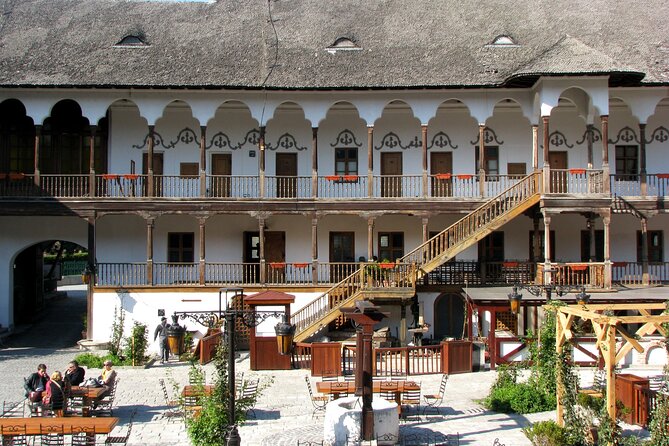
Starting at Manuc’s Inn and Bucharest’s trading roots
The meeting point is at Piața Sfântul Anton 64, near Manuc’s Inn, also called Hanul lui Manuc. This is a fitting place to begin because the story of Bucharest starts here with trade, movement, and travelers passing through.
You spend about 20 minutes learning about the city’s beginnings and seeing some of its oldest surviving buildings. Admission is free, so you can focus on the guide’s explanation rather than rushing through a ticketed interior.
Manuc’s Inn helps explain why the old center looks different from a formal European capital. It was shaped by merchants, carts, inns, and commercial traffic. The setting gives the opening talk a physical anchor. Instead of starting with dates in the abstract, you are standing in a place built for people doing business.
The area around the meeting point is easy to reach by public transportation. Still, arrive with enough time to find Piața Sfântul Anton without stress. The guide may contact you before the walk, as Dan did for one group, which can make the first meeting easier.
Hanul Gabroveni and the last caravan inns
The next stop is Hanul Gabroveni, another reminder that Bucharest was once a trading center. Two centuries ago, about one in four buildings in the old city center served as a caravan-serai, or commercial inn. Only three remain today, and Hanul Gabroveni is one of them.
You spend around 20 minutes here. This is one of the more useful history stops because it changes how you read the old town. The center was not simply a collection of pretty old façades. It was a place where merchants, goods, and news moved between regions.
I find this kind of context more useful than a list of famous buildings. Once you understand the trading role of these inns, the city’s early growth makes more sense. You can also see why Bucharest developed a mixed architectural character rather than one neat, uniform style.
The drawback is that the tour does not promise entry into every site. You should expect an exterior-focused explanation at several points, with the guide doing much of the storytelling.
The National Bank and Bucharest’s former financial district
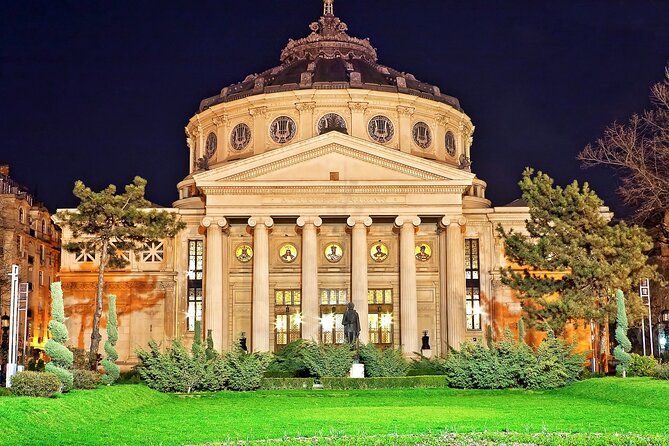
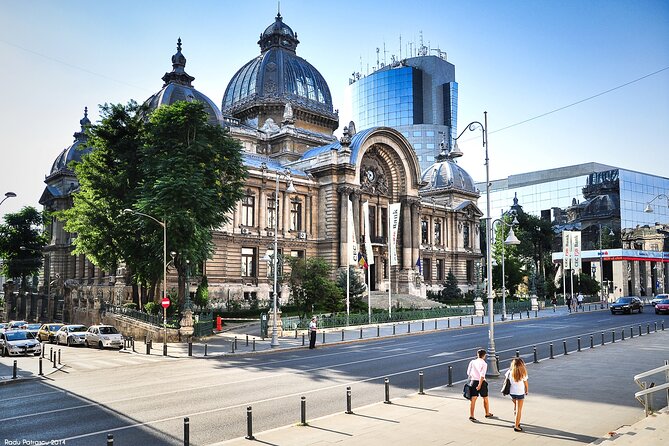
The route then shifts from trade to modern finance. At the BNR Palace, you spend about 10 minutes around the National Bank, the former Stock Exchange, the Palace of Trading and Commerce, and former state and private banks.
This compact section shows how Bucharest changed as its economy grew. The old inns represent an earlier commercial city, while these grand institutions point to a more organized financial center. It is a useful contrast, especially if you are interested in architecture or urban development.
The short stop also keeps the walk moving. You get a concentrated explanation rather than a long pause at one building. Guides have been praised for pointing out architectural details along the route, so listen for the small features that help separate one period from another.
You should not expect a museum visit here. The value is in the setting and the explanation, not in access to bank interiors.
A few more walks around the world worth a look
- Magical London: Harry Potter Guided Walking Tour
★ 4.7 · 22,044 reviews - Reykjavik Food Walk – Local Foodie Adventure in Iceland
★ 5.0 · 18,952 reviews - History and Hauntings of Salem Guided Walking Tour
★ 5.0 · 14,564 reviews - New Orleans Premier Ghost, Voodoo and Vampire Walking Tour
★ 4.5 · 12,856 reviews
Stavropoleos Monastery and Orthodox Bucharest
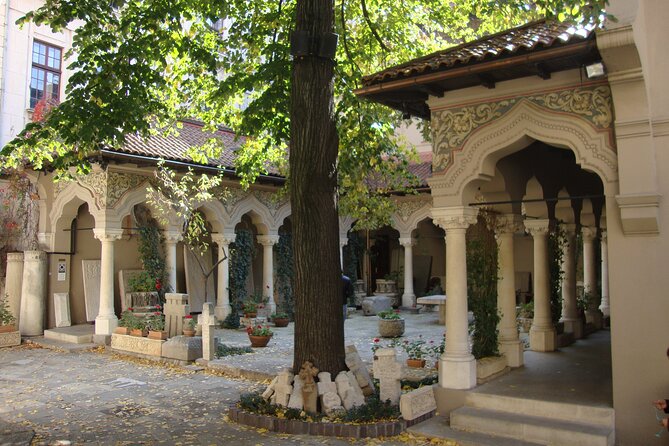
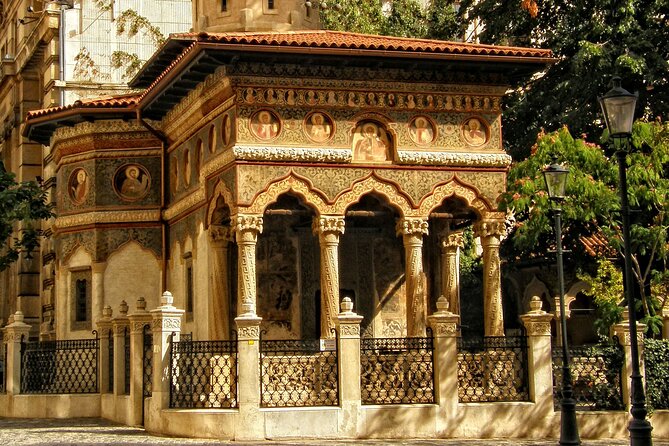
Stavropoleos Monastery is one of the route’s most memorable stops. You spend about 10 minutes at this small Orthodox monument, which offers a sharp change from the grand financial buildings nearby.
Romania is predominantly Christian Orthodox, and the monastery gives you a direct look at that religious tradition through architecture and atmosphere. The stop is brief, but it adds an important cultural layer to the walk. Bucharest is not only banks, palaces, and communist buildings. Its churches remain part of the city’s daily identity.
This is a good point to ask questions. Guides have been praised for welcoming questions throughout the tour, rather than saving all explanations for fixed speeches. That flexibility matters in a group walk, because the subjects can range from religious architecture to Romanian customs and national history.
Admission is listed as free. Still, keep in mind that the tour’s schedule allows only about 10 minutes here, so it is an introduction rather than a detailed church visit.
CEC Palace and Macca-Villacrosse Passage
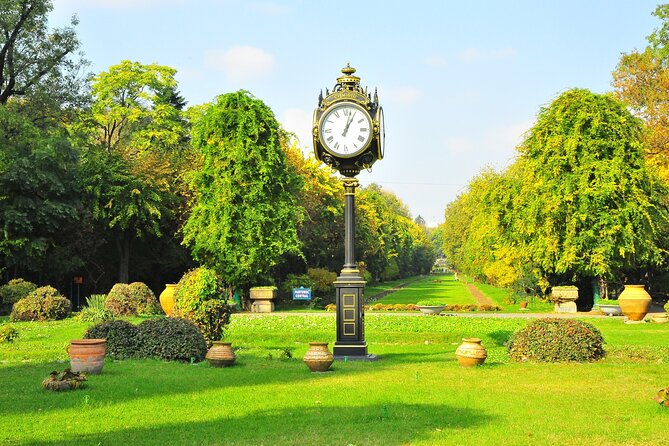
Palatul CEC, or CEC Palace, is presented as one of Bucharest’s finest examples of older architecture. The tour spends around 10 minutes outside, discussing why buildings that look old are often newer than you might expect and how the city was remodeled during its roughly 600-year existence.
This is one of the places where the guide’s commentary adds real value. Bucharest’s history is not a straight line from medieval city to modern capital. Rebuilding, changing tastes, economic growth, and political power all reshaped the center. A good explanation helps you read the façades rather than simply photograph them.
Admission is not included, but the experience does not promise entry. Treat this as an exterior viewing stop unless your guide says otherwise.
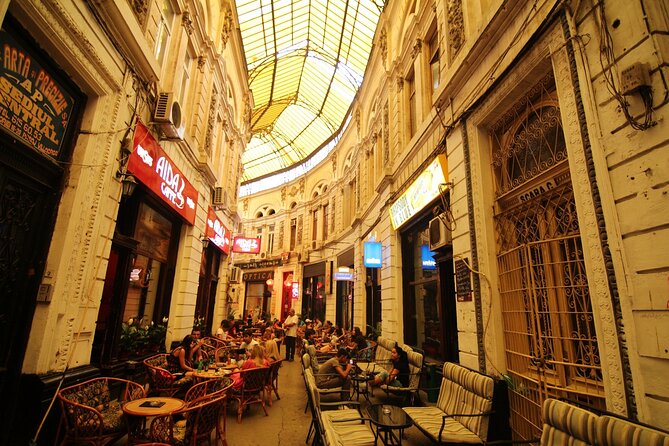
A five-minute walk brings you to Macca-Villacrosse Passage. This covered gallery was linked to the city’s financial district and its spending culture. The idea is easy to grasp: where money gathers, shops, cafés, and leisure spaces follow.
The stop is short, but the passage adds variety to the route. It also helps you see Bucharest as a social city, not just a political one. The narrow gallery contrasts nicely with the monumental buildings outside.
Royal Palace and the shift from monarchy to communism
At the Royal Palace, the tour connects several periods in one place: monarchy, communism, and democracy. You spend about 10 minutes here.
This is a useful stop because Romanian history can feel dense when presented as a string of rulers and dates. The palace gives that story a physical location. Political power changed hands, and the buildings around you carry marks of those shifts.
The tour does not include admission to the palace. The focus is on the exterior setting and the guide’s explanation. That is worth knowing if you want a full museum visit, because you would need to arrange that separately.
The guides’ style is especially important here. Ed has been praised for making historical stories engaging without losing the facts. Lucia has also been praised for combining background information with humor. That tone helps with subjects that might otherwise feel heavy.
Sala Palatului and Stalin-era architecture
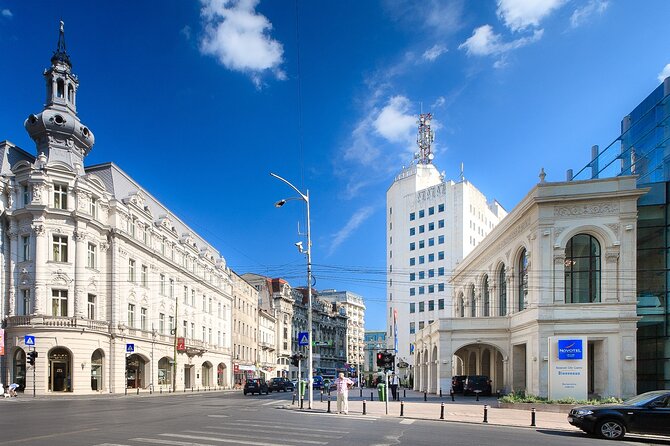
Sala Palatului is a short, 10-minute stop with a very different visual character. The tour uses it to explain Stalin-era architecture.
This part of Bucharest can be easy to miss if you are only looking for ornate old buildings. The city’s communist period left a clear mark, and the architecture reflects the political taste of the time. Seeing it after the Royal Palace makes the change in power more visible.
The stop is free and brief. It works best as part of the larger sequence rather than as a destination on its own. The guide helps you connect the building to the surrounding political story, which is more valuable than simply labeling it communist-era design.
Cișmigiu Park, the oldest park on the route
After the formal buildings, the walk reaches Cișmigiu Park. You spend about 10 minutes in Bucharest’s oldest park.
This is a welcome change of pace. The route has focused on inns, banks, churches, palaces, and political buildings. The park gives you a sense of how residents use the city beyond its monuments.
The stop also creates a natural pause before the final approach to Parliament. You are still walking, but the setting is less crowded with architectural information. In warmer weather, this should be one of the more comfortable sections. In winter, though, you remain outdoors, so do not assume the park stop will function as a warm break.
The tour is not designed as a long park visit. You will get an introduction and continue on, so save extra time if you want to explore Cișmigiu on your own.
The Palace of Parliament as the grand finale
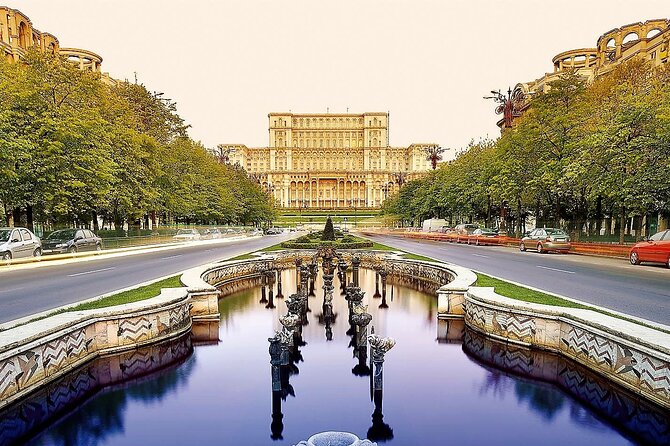
The final stop is the Palace of Parliament, where the tour ends in Piața Constituției, directly in front of the building. You spend about 20 minutes here.
This is the route’s biggest visual payoff. The building is described as the second-largest administrative building in the world after the Pentagon, while also being heavier. Those figures help explain its scale, but the guide’s account of Romania’s communist period gives the building its real meaning.
Parliament is not presented simply as a giant photo stop. It represents the ambition and cost of a political era that reshaped central Bucharest. After seeing the old inns, religious buildings, royal sites, and Stalin-era architecture, the size of Parliament feels like the final chapter of the city’s modern transformation.
Admission is not included, and this tour ends outside. If you want to visit the interior, you will need to make separate arrangements. The end point is useful, though, because you can continue exploring the area or use public transportation rather than retracing the entire route.
Price, group size, and the real value
At $21.77 per person, this is a modest outlay for a 2.5-hour orientation with an English-speaking guide. You are paying mainly for interpretation, route planning, and local context. Those are valuable in Bucharest, where the city’s important sights are spread across several historical periods.
The maximum group size is 25 people. That is not an intimate private walk, but it is still small enough for a guide to keep the group together and answer questions. Eduard, Ed, Dan, and other guides have been praised for checking that everyone was accounted for before moving on.
The tour includes a mobile ticket and the guide. Fees and taxes are not included, and entry to CEC Palace, the Royal Palace, and Parliament is not included. The listed stops are primarily exterior visits, so factor in separate admission costs only if you plan to go inside afterward.
The tour is booked, on average, about 20 days ahead. That does not mean you must reserve exactly that early, but it is a useful warning for a planned Bucharest trip. Free cancellation is available up to 24 hours before the start time. Bad weather or an insufficient number of bookings can lead to a different date, another experience, or a full refund.
Who should book this walk?
I would choose this tour for a first morning or afternoon in Bucharest. It gives you a working map of the center and helps you decide which buildings, museums, churches, and parks deserve a longer visit later.
It suits solo visitors, couples, families, and anyone with only a day or two in the city. It also works for people who enjoy history but do not want a lecture. The strongest guide feedback points to a relaxed style, humor, questions, practical food suggestions, and stories that make the buildings easier to remember.
It may be less suitable if you want extensive interior access, a very small private group, or a leisurely photography walk. The route covers a lot, and the 2.5-hour schedule keeps it moving. One particularly cold-weather tour ran longer because Dan added breaks, hot drinks, and bathroom stops, but you should not count on every outing having extra time.
Wear suitable layers in winter. Several people found the cold difficult, and the weather is the only recurring practical warning attached to an otherwise highly praised experience.
Should you book the Bucharest Highlights Walking Tour?
Book it if you want a well-priced introduction to Bucharest’s old center, political past, architecture, and religious life in one walk. The route has a strong beginning at Manuc’s Inn and a memorable finish at Parliament, while the guides add the detail that turns a sightseeing circuit into a useful history lesson.
Skip it only if you mainly want interior tours or a private, highly customized experience. For most first-time visitors, especially those with limited time, this is a smart way to start. Schedule it early in your stay, bring layers, and keep the rest of the day open for the places that catch your interest.
FAQ
How long is the Bucharest Highlights Walking Tour?
The tour lasts approximately 2 hours and 30 minutes.
What language is the tour offered in?
The tour is offered in English.
How much does the tour cost?
The listed price is $21.77 per person.
Where does the tour start?
It starts at Piața Sfântul Anton 64, Bucharest, near Manuc’s Inn.
Where does the tour end?
It ends at Piața Constituției, in front of the Palace of Parliament.
Is admission to the attractions included?
No. Fees and taxes are not included, and admission to Palatul CEC, the Royal Palace, and the Palace of Parliament is listed as not included.
How many people can join the tour?
The maximum group size is 25 travelers.
Is the tour suitable for most people?
Yes. Most travelers can participate, and the meeting point is near public transportation.
Can I cancel the booking for a full refund?
Yes, if you cancel at least 24 hours before the experience starts. Cancellations or changes made less than 24 hours before the start time are not refunded.
Just added around the world
- Walking Tour of Boston’s Freedom Trail★ 4.5 · 77 reviews
- Downtown Freedom Trail Walking Tour – History & Architecture★ 4.5 · 194 reviews
- Boston Food of the North End Private Walking Tour★ 5.0 · 174 reviews
- Boston Seafood Lovers Food and History Walking Tour★ 5.0 · 208 reviews
- Boston “Death and Dying” Walking Ghost Tour★ 4.5 · 223 reviews
- Boston Movie Mile Walking Tour★ 4.5 · 119 reviews
- 1 If By Land Walking Tours★ 5.0 · 95 reviews
- Boston History and Freedom Trail Private Walking Tour★ 5.0 · 117 reviews
City Highlights Walking Tours, compared.
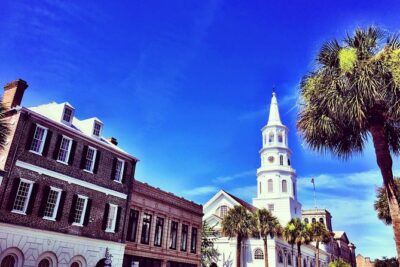
Historic Charleston Guided Sightseeing Walking Tour
Read our review →
Dublin Highlights and Hidden Gems Guided Walking Tour
Read our review →
Guided Walking Tour of City Center Highlights
Read our review →

City Highlights Temple and Market Walking Tour
Read our review →
Montmartre Hidden Gems and Scenic Highlights Walking Tour
Read our review →
Browse the lists this tour appears in