

Review · FLORENCE WALKING TOURS
Florence: Accademia, Uffizi, and City Center Walking Tour
Florence keeps its greatest hits close together. This four-hour guided outing links the Uffizi Gallery, Accademia Gallery, and central Florence in one well-planned route, giving you art, stories, and fast-track entry without spending half the morning in ticket lines. I especially like the early access to the Uffizi and the chance to see Michelangelo’s David with a guide who can explain more than the usual famous-name facts. The main drawback is the pace: two major museums in one morning can leave you wishing for extra time, especially inside the Uffizi.
I also like the walk between the museums. It turns a transfer into part of the experience, with commentary on the sights and stories of Florence along the way. Guides such as Giana, Christiano, Alessandra, and Martina have earned especially warm praise for bringing the art to life without burying you in facts. If you prefer to linger over every gallery room, though, a separate visit to each museum may suit you better.
Key points to know before booking
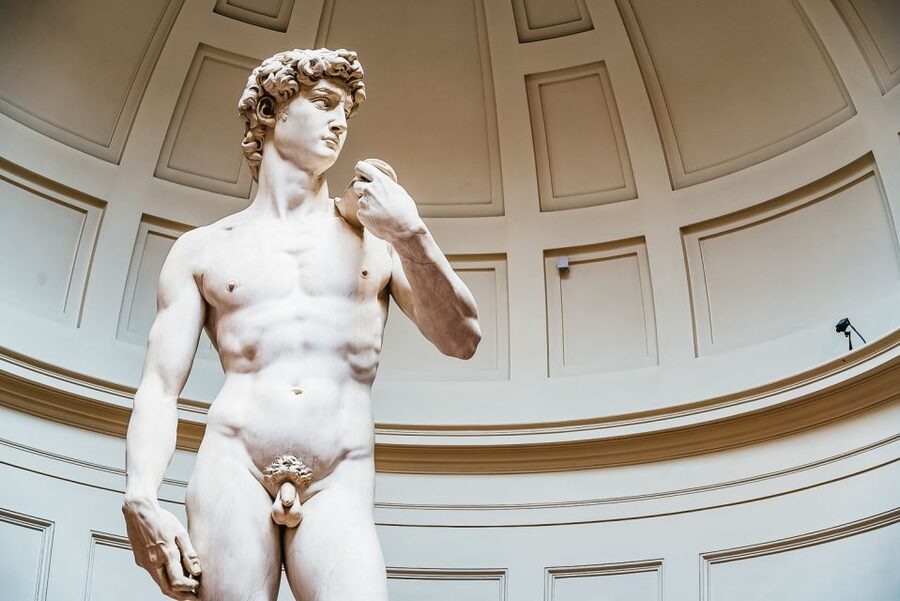
- Early Uffizi entry saves valuable time: Fast-track access matters greatly at Florence’s most sought-after museum.
- Michelangelo’s David is the emotional high point: The guided visit helps you notice the sculpture’s scale, detail, and power.
- The walk between museums adds useful context: You hear stories about Florence instead of simply moving from one entrance to another.
- You see more than the headline artworks: The route can include Botticelli, Leonardo da Vinci, a 1690 Stradivarius, and an early modern piano.
- The schedule is efficient but full: Expect roughly 3.5 to 4 hours, with limited time to explore the Uffizi alone.
- Small groups may be available: A smaller group can make questions and guide commentary easier.
What this Florence tour actually covers
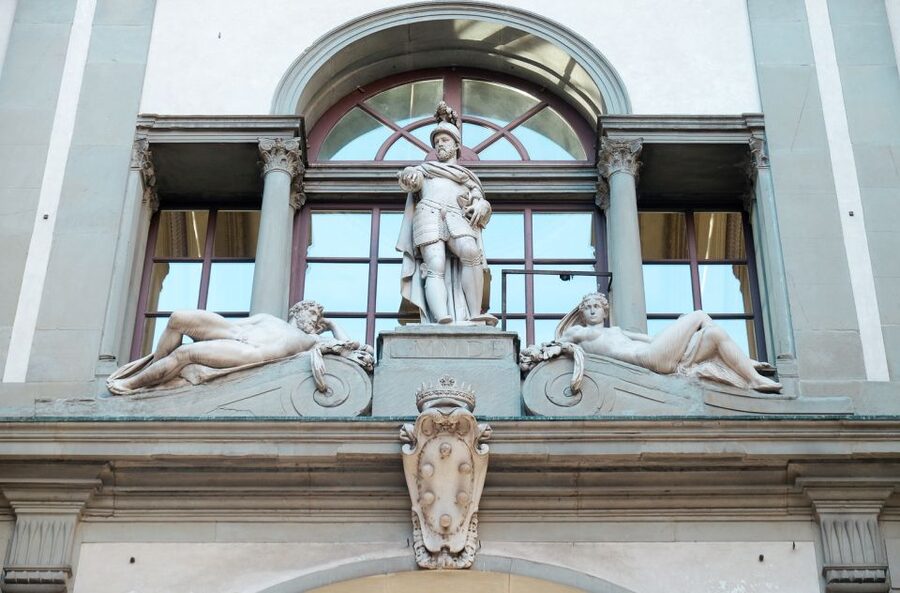
This is a half-day introduction to Florence’s central art and major sights. You visit the Uffizi first, walk through the city with your guide, then continue to the Accademia. The order matters because the Uffizi is often busiest later in the day, while David is best approached with enough time to appreciate the surrounding collection.
Your guide leads the Uffizi portion, pointing out important paintings rather than trying to explain every room. That is the right approach for a museum this large. You will see works associated with Botticelli and Leonardo da Vinci, along with other Renaissance pieces, but the exact route and time spent at each work can vary.
After the Uffizi, the group walks through Florence’s center toward the Accademia. Along the way, your guide provides background on the city and comments on the main sights you pass. The walk is not a separate long city excursion. Think of it as a useful bridge between the two museums, with enough explanation to help you understand Florence beyond the paintings on the walls.
At the Accademia, you receive a guided visit and then some free time. That final independent stretch is useful because you can return to David, look more closely at other works, or visit the collection’s musical instruments. You may see an original Stradivarius from 1690 and the first modern piano, an instrument invented in Florence. Those displays offer a welcome change after several hours of paintings and sculpture.
A few more walks around Florence worth a look
- Florence: Highlights Walking Tour with Expert Guide
★ 4.6 · 4,662 reviews - Uffizi & Accademia Timed Entry: Small Group Duomo Walking Tour
★ 4.5 · 3,630 reviews - Florence: Duomo Complex with Tickets & City Walk Guided Tour
★ 4.7 · 2,057 reviews
Starting at the Uffizi with faster entry
The Uffizi is the more demanding museum in this pairing. Its collection covers generations of Italian art, and a first visit can easily become a march from one famous room to the next. A guide gives the visit a clear shape, helping you focus on works that matter most.
Botticelli’s paintings are likely to receive special attention. They are among the museum’s signature works, and a guide can point out details that are easy to miss when you are jostling for a clear view. Leonardo’s work brings a different kind of interest, with close observation and careful technique that reward a slower look.
The benefit here is not just entry speed. It is also selection. A good guide knows when to keep moving and when a painting deserves a few extra minutes. Alessandra was praised for spending time on the most important pieces without turning the tour into a lecture. That balance is valuable in a museum where information can quickly become too much.
The early start is another strong point. Morning access can help you get inside before the day’s largest crowds build. Start times vary, so check availability for your date rather than assuming every booking begins at the same hour.
You should still keep your expectations realistic. A guided visit to the Uffizi in a combined tour is an introduction, not a complete museum study. If you want to inspect every room, read every label, or return to a favorite painting, you will need another visit or a longer standalone booking.
Walking Florence between the galleries
The route between the Uffizi and Accademia is one of the smartest parts of this experience. You are already in central Florence, so walking saves the need for a separate transfer and lets the guide connect the art to the streets around you.
Your guide comments on the important sights along the way and shares stories about Florentine history. The precise stops are not listed, so you should not expect a fixed parade of named monuments. Instead, think of this section as a moving orientation lesson.
I like this format because it gives the day breathing room. After concentrating on paintings, you step outside, change pace, and see the city itself. The walk also helps you understand why Florence works so well as a walking destination: the major museums are close enough to join with central streets and public spaces.
This is also the part where guide quality matters most. A guide who can tell a short story at the right moment makes the city feel more connected. Christiano received praise for explaining art and history with passion without giving too much information. That is exactly the skill you want during a busy half-day outing.
Wear comfortable shoes. The experience involves museum floors and a city walk, and there is no benefit in sacrificing your feet for fashionable footwear. Bring a passport or ID card, since identification may be required for entry.
Meeting Michelangelo’s David at the Accademia
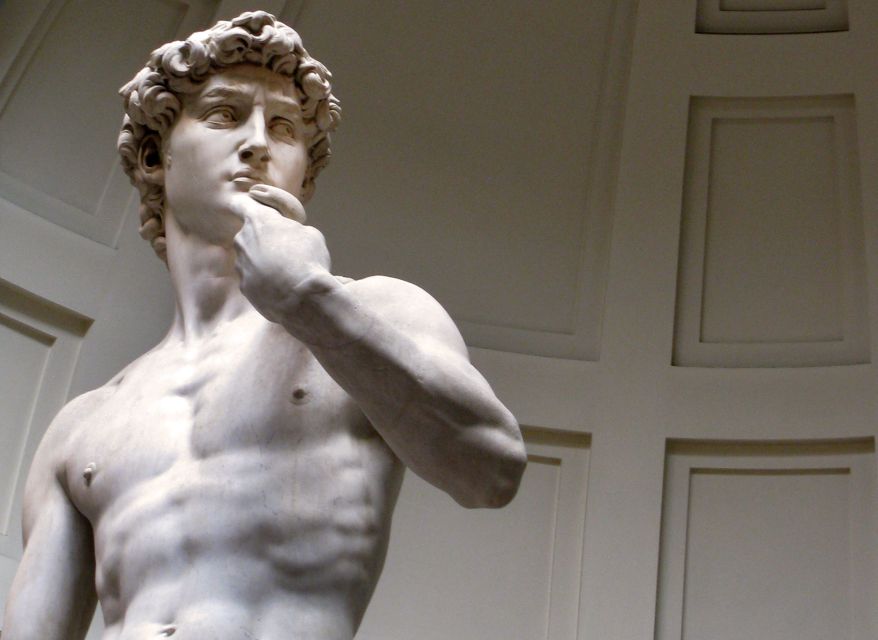
The Accademia is smaller than the Uffizi, but David gives it enormous weight. The sculpture is the clear star, and seeing the original in person is different from seeing photographs or replicas. Its scale, posture, and fine detail become easier to appreciate when you can move around it and look from several angles.
A guide helps you look beyond the famous name. You may hear about Michelangelo’s treatment of the body, the sculpture’s expression, and the way the figure fills the room. Sarah described the encounter as spine tingling, and that reaction makes sense: David is not a small decorative statue tucked into a corner. It dominates the experience.
The guided portion should help you get the essential story and visual details. Afterward, you can stay longer inside the Accademia if you want. That extra time is an important advantage, especially if David leaves you wanting a quiet second look.
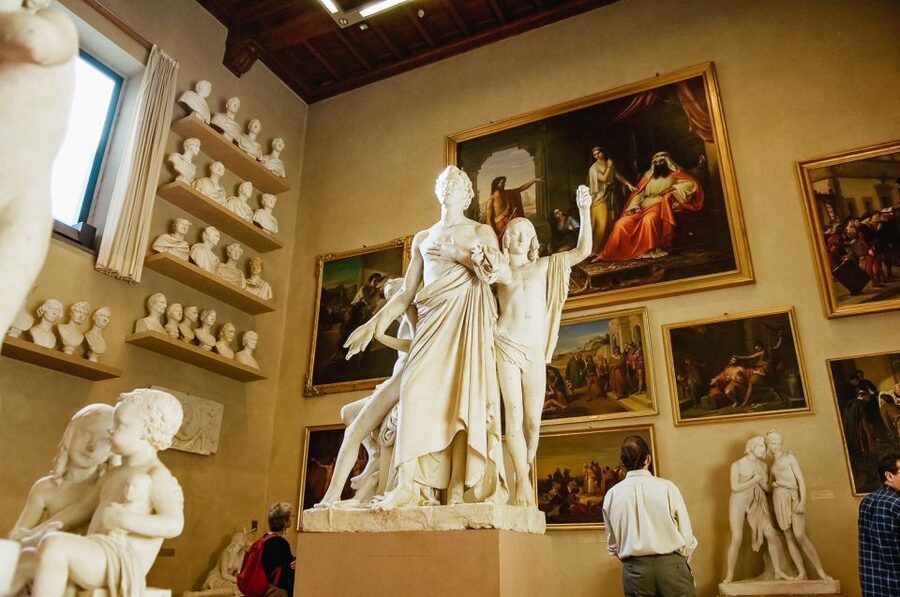
The museum also contains more than the central sculpture. The musical instrument collection includes an original 1690 Stradivarius and the first modern piano, invented in Florence. These displays are easy to overlook when everyone heads straight for David, but they add variety and show that Florence’s creative life was not limited to painting and sculpture.
One practical warning: the combined schedule can feel short. Mila enjoyed the tour but felt there was not enough time to see all the Uffizi’s major works. If you already know you want extensive solo time in both museums, book them separately with a break between visits.
Same streets, a different way to see them:
- Michelangelo’s David, Accademia & Uffizi Small Group Tour
★ 4.5 · 1,986 reviews - David & Accademia Guided Tour with Time Entry Ticket
★ 4.5 · 1,705 reviews - Florence: Guided Walking Tour
★ 4.6 · 1,602 reviews - Florence: Renaissance and Medici Tales Guided Walking Tour
★ 4.8 · 1,549 reviews
The guides make the difference
The strongest feature of this experience is the live guide. The art itself is famous, but famous art does not automatically make a satisfying visit. You need someone who can explain why a work matters, answer questions, and judge when the group has had enough.
The guide names associated with especially strong experiences include Giana, Christiano, Alessandra, and Martina. Giana was praised for passion and clear art knowledge, while Christiano was remembered for making the works feel alive. Alessandra received credit for focusing on the most important pieces, and Martina was described as fun as well as well informed.
Those comments point to the kind of guide you should hope for: engaged, flexible, and alert to the group’s needs. One particularly useful account described a guide arranging a wheelchair for a traveler with walking trouble and making sure the important sights were not missed. That is encouraging, but it should not be treated as a guarantee of a particular accessibility arrangement. Contact the provider in advance if you have mobility needs.
The tour is offered in English and Italian. A small-group option is available, which may be worth choosing if the price difference is reasonable for you. Smaller groups usually make it easier to hear the guide and ask questions, though the available group size depends on the option you book.
Is the four-hour format good value?
No price is provided here, so I cannot judge the exact cost. I can judge what you receive for the time: entry assistance at two major museums, a live guide, a central Florence walking segment, and the chance to remain in the Accademia after the guided portion.
That combination can be good value if this is your first Florence visit and your schedule is tight. You avoid planning two museum reservations, reduce the risk of wasting time in lines, and get a useful explanation of the masterpieces. You also gain a basic sense of the city center without adding a separate walking tour.
The value drops if you already know the Uffizi and Accademia well or prefer to set your own pace. Independent visitors can spend longer with less famous works, take breaks when needed, and choose exactly when to move on. This tour gives you structure, which is a benefit for some people and a restriction for others.
The best comparison is not guided versus unguided. It is focused half-day visit versus two slower museum visits. Choose the first if you want the essentials and a guide’s judgment. Choose the second if art is the main reason you came to Florence.
Who should book this experience?
I would recommend it to a first-time visitor who wants to see Florence’s two best-known art museums in one morning or afternoon. It also suits you if Renaissance art is new to you and you want help knowing what deserves your attention.
Families may appreciate the changing rhythm: paintings, a city walk, sculpture, and musical instruments. The guide can also keep the experience from becoming a long sequence of silent museum rooms, though young children may still find four hours demanding.
This is a practical choice for a short stay. If you have only one or two days in Florence, the tour covers several major priorities without requiring you to build the schedule yourself. It can also work well on a first day, since the city walk helps you get your bearings.
I would hesitate to recommend it to serious museum fans who want every gallery room. The Uffizi alone can fill much of a day, and the combined schedule will not give you unlimited free time. You might prefer separate bookings, with a break between them, as Mila advised.
Bring comfortable shoes, a passport or ID card, and no large luggage. Pets, smoking, and large bags are not allowed. On the first Sunday of each month, museum entry is free, but tickets cannot be reserved ahead of time, so entry is not guaranteed. That is not the best day to rely on this tour for a firm museum schedule.
Final verdict: book it for focus, not endless museum time
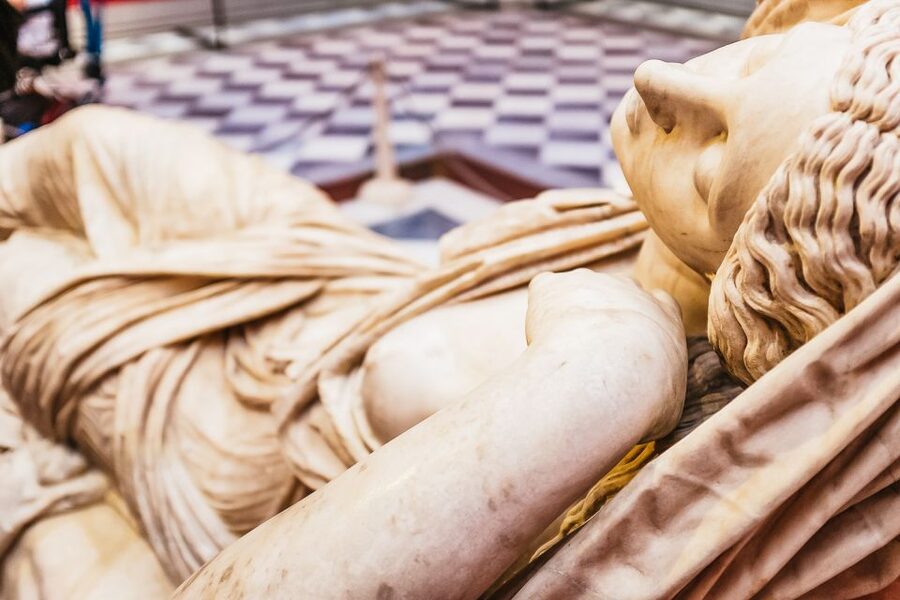
I would book this tour if I wanted a guided introduction to Florence’s art, fast entry, and a clear half-day plan. The combination of Uffizi masterpieces, David, central streets, and the Accademia’s musical instruments gives you a lot without sending you across town.
The most important question is how you like to visit museums. If you want a guide to explain the big works and keep the day moving, this is a strong choice. If you want to linger over every Botticelli, study Leonardo at length, or wander without a timetable, book the galleries separately.
For most first-time visitors with limited time, the tour offers a sensible mix of art and city. Just accept its central tradeoff: you will see the essential Florence, but you will not see every corner of either museum.
FAQ

How long does the Florence art and walking tour last?
The experience lasts approximately 3.5 to 4 hours. Starting times vary, so check availability for your chosen date.
Which museums are included?
The tour includes the Uffizi Gallery and the Accademia Gallery. It also includes a guided walk through Florence’s city center between the museums.
Is fast-track entry included?
Yes. The tour includes tickets with faster access than regular visitors and skip-the-ticket-line entry.
What famous artworks can I expect to see?
The tour includes Michelangelo’s David, works by Botticelli, and masterpieces by Leonardo da Vinci. The exact time spent at each work may vary.
Can I stay inside the Accademia after the guided tour?
Yes. After the guided portion, you can stay longer in the Accademia if you want to see more.
What languages are available?
Live guiding is available in English and Italian.
What should I bring, and what is not allowed?
Bring a passport or ID card and comfortable shoes. Pets, smoking, luggage, and large bags are not allowed.
Just added around Florence
- Florence: Heart of Florence Guided Walking Tour★ 4.0 · 81 reviews
- Florence: The Medici Family Guided Walking Tour★ 4.7 · 129 reviews
- Florence: Tuscan Food and Wine Guided Walking Tour★ 4.8 · 72 reviews
- Florence Walking Tour & Skip-the-Line David at Accademia★ 4.7 · 159 reviews
- Florence: Walking Tour with David, Duomo & Uffizi Gallery★ 4.7 · 414 reviews
- Florence: Pitti Palace and Boboli Gardens Walking Tour★ 4.6 · 182 reviews
- Florence: Small Group Guided Walking Tour★ 4.7 · 176 reviews
- Florence Street Food Walking Tour with Wine in Duomo Area★ 4.9 · 76 reviews
Florence Walking Tours, compared.

Uffizi & Accademia Timed Entry: Small Group Duomo Walking Tour
Read our review →
Duomo Complex with Tickets & City Walk Guided Tour
Read our review →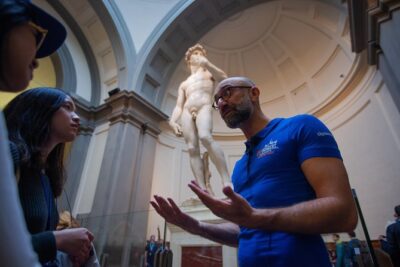
Michelangelo’s David, Accademia & Uffizi Small Group Tour
Read our review →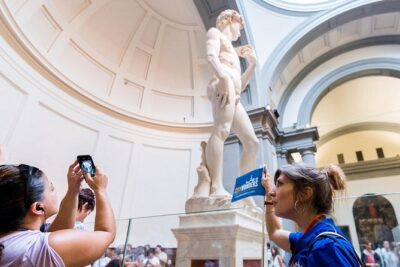
David & Accademia Guided Tour with Time Entry Ticket
Read our review →

Browse the lists this tour appears in