
Review · PRIVATE WALKING TOURS
Frankfurt: Private or Shared Walking Tour
Frankfurt’s old center tells two stories at once. This 1.5-hour walk connects the medieval-looking Römerberg and rebuilt Neue Altstadt with the city’s modern skyline, giving you a quick, useful introduction to Frankfurt’s past and present. I like the route because it covers several major sights without wasting time, and I like that the guide explains why so much of the historic center had to be rebuilt.
The Eiserner Steg and Paulskirche give the walk real variety. You get a bridge with views toward the Main, the city hall complex, and the church where Germany’s first national assembly met. The main consideration is language: the live tour is offered in German, so it is best for German speakers or anyone comfortable following a history-focused walk in German.
The price of about $17 per person is fair for a short city orientation, especially if you want local context rather than only photographs. Private groups are available, and the feedback points to friendly, flexible guiding. One guide named Sanel received particular praise for adjusting a private tour to a shortened schedule and still providing useful historical detail.
Key things to know before booking
- The meeting point is the Justitia-Brunnen on Römerberg, right in Frankfurt’s main historic square.
- The route includes the Eiserner Steg, an iron footbridge built in 1868, before moving through the old town.
- Paulskirche marks the site of Germany’s first national assembly, making this more than a sightseeing stroll.
- The Neue Altstadt is a major focus, showing how Frankfurt rebuilt part of its historic center after wartime destruction.
- The tour lasts 1.5 hours and costs about $17 per person, making it a compact introduction rather than a full-day city tour.
- German is the stated tour language, with private groups available for a more personal pace.
Starting at the Justitia-Brunnen on Römerberg
Your guide meets you at the Justitia-Brunnen, the fountain in the middle of Römerberg. This is a practical starting point because you are already in the heart of Frankfurt’s historic center, surrounded by the city hall, reconstructed town houses, and some of the city’s most important public spaces.
Römerberg is also easy to recognize. If you are arriving with limited time, meeting here helps you avoid a long search through modern streets and office blocks. Arrive with a few minutes to spare, since the square has plenty to look at before the walk begins.
The opening section sets up the main theme of the tour: Frankfurt has an old-looking center, but much of what you see is the result of reconstruction. That distinction matters. The buildings are not simply untouched medieval survivors. They reflect war damage, later planning choices, and a major effort to restore the character of the old town.
This is one reason a guide adds value. Without context, Römerberg can look like a pleasant collection of historic buildings. With context, you begin to see the square as a record of destruction, memory, and urban decision-making.
More Private Walking Tours in Germany
- Berlin Private Complete History All Day Walking Tour
★ 5.0 · 474 reviews - Private Walking Tour Berlin Third Reich Hitler and World War II
★ 5.0 · 360 reviews - Private Berlin: Iconic Sights and Hidden Gems Walking Tour
★ 5.0 · 292 reviews
Crossing the Eiserner Steg, built in 1868
The tour moves to the Eiserner Steg, Frankfurt’s iron footbridge over the Main. Built in 1868, it gives you a change of pace from the tight streets and formal squares of the Altstadt.
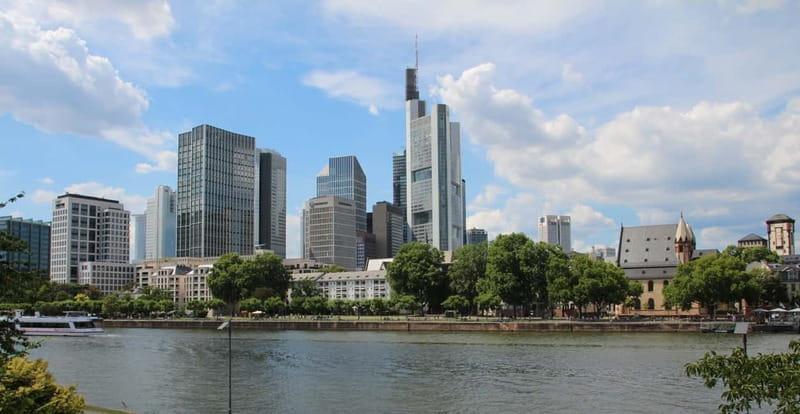
The bridge is useful as a sightseeing stop because it connects history with a broad view of modern Frankfurt. From here, you can compare the older riverfront setting with the city’s famous high-rise skyline. That contrast is central to understanding Frankfurt. It is a major business center, yet its historic core is compact enough to explore on foot.
The Eiserner Steg is also a good place for photographs, though the tour is not presented as a photo-only outing. Your guide uses the stop to explain the city and its development, so you should expect commentary rather than a long pause for personal sightseeing.
The bridge itself may be less comfortable for anyone who dislikes crowds or open crossings, though no group size is specified. Since the whole experience lasts only 90 minutes, the stop is likely brief. If you want extensive time along the Main or a slow photography session, you may need to return later on your own.
Seeing how World War II changed the old center
A key part of the walk is learning how many of Frankfurt’s grand historic buildings were destroyed during World War II. This gives the rest of the route a more serious edge. The old town is attractive, but its appearance cannot be understood without discussing the damage and the choices that followed.
The tour also covers the major renovation of 2008 and 2009. That project helps explain why Frankfurt’s center contains such a striking mix of traditional facades, rebuilt structures, and modern city planning.
I find this historical framing more useful than a simple list of dates. You can look at a building and ask what is original, what was reconstructed, and why the city chose to recreate an older appearance. The experience becomes a lesson in how European cities handle wartime loss and the pressure to modernize.
The subject is handled during a short walk, so do not expect a specialist architectural seminar. Still, the route gives you enough background to make later independent sightseeing more rewarding. You will know what you are looking at instead of treating the old town as a decorative backdrop.
The Römer and Frankfurt’s political center
The Römer is one of the walk’s essential stops. This historic complex is closely tied to Frankfurt’s civic identity and gives the tour a strong visual centerpiece.
Your guide provides information about the building and its role in the city. The value here is not only the facade. Frankfurt’s old center developed around trade, government, and public life, and the Römer helps connect those themes.
Because the tour starts at Römerberg, the Römer is also convenient for first-time visitors. You get your bearings early, then continue to nearby sights rather than spending most of the tour walking between distant neighborhoods.
The limitation is time. A 1.5-hour route can introduce the Römer, but it cannot offer a full interior visit or an extended architectural study. Think of this stop as an orientation. If the building catches your interest, you can return afterward with more time.
Same streets, a different way to see them:
- Discover Berlin Half-Day Walking Tour
★ 5.0 · 9,624 reviews - Berlin City walk Government District and Places of Democracy
★ 4.7 · 8,467 reviews - Berlin: Third Reich & Cold War Guided Walking Tour
★ 4.9 · 8,378 reviews - Munich: Third Reich & WWII Walking Tour
★ 4.6 · 6,181 reviews
Paulskirche and the first German national assembly
Paulskirche gives the tour its strongest political and historical point. It is the location of Germany’s first national assembly, a major event in the country’s constitutional history.
This stop adds substance to the walking tour. You are not only seeing old streets and restored houses. You are also visiting a place connected with the attempt to create a unified German political system.
The guide’s explanation is especially useful here because the importance of Paulskirche is easy to miss if you are focused only on the building’s exterior. The tour puts the church into the broader story of Frankfurt and Germany.
For families and mixed-age groups, this stop can work well because it offers a clear historical subject without requiring a long museum visit. A family group ranging from eight to 87 years old found the walk enjoyable and informative, which suggests the pacing and subject matter can suit several generations. The experience depends on following a German-language explanation, however, so language ability remains important.
Exploring the Neue Altstadt
The Neue Altstadt is the city’s latest major old-town project and one of the most distinctive parts of the route. The name means New Old Town, which sounds like a contradiction until you understand the idea: Frankfurt created a new historic quarter in the center of the city.
This section lets you examine how the city has chosen to represent its past. You will see a blend of reconstructed historic forms and newer construction, rather than an untouched medieval district. That makes the area interesting even if you have visited other German old towns.
I like that the tour does not treat the Neue Altstadt as merely picturesque. The project raises practical questions about restoration, authenticity, and the way cities rebuild an identity after major destruction. A local guide can point out details that you might otherwise walk past.
You should also keep your expectations realistic. The Neue Altstadt is not an untouched old quarter, and the experience is not a substitute for visiting every historic building in Frankfurt. It is a compact urban project that works best when you want to understand how the modern city relates to its past.
A short route with a useful balance of old and new
The strongest feature of this tour is its balance. You move among historic monuments, political sites, rebuilt streets, and views of modern skyscrapers. That gives you a more accurate sense of Frankfurt than a route focused only on one period.
The walk is also manageable. Ninety minutes is long enough to cover the central sights but short enough to fit before another activity, a train connection, or an evening meal. If you are visiting Frankfurt on a brief stop, this is an efficient way to get an introduction without committing half a day.
The compact schedule also creates the main weakness. You will receive useful information about each attraction, but the tour cannot linger for long at every stop. Anyone hoping for extensive time inside buildings, long museum visits, or detailed architectural analysis should plan additional sightseeing.
The route is best viewed as a foundation. Afterward, you can choose whether to spend more time around the Römer, return to the Eiserner Steg, or explore the Neue Altstadt at your own pace.
Shared or private: which option makes sense?
The shared format should suit solo visitors and couples who want a low-cost introduction. At about $17 per person, it is a modest expense for a guide-led walk through several of Frankfurt’s key historic areas.
A private group costs more in total, depending on the option selected, but it can make sense for families, friends, or groups with a particular schedule. The private format appears to offer more flexibility. Sanel, one of the guides praised by name, adjusted a private walk around a shortened schedule and still gave the group a strong introduction, even during a rainy evening.
That flexibility may matter if your train arrives late, your group includes older people, or you want to keep the pace relaxed. It is not a promise that every private booking will receive the same guide or exact adjustment, but it shows why private touring can be useful here.
A larger family group also had a good experience across four generations. The guide was described as empathetic, humorous, and able to make the history interesting for both children and older adults. That is a meaningful strength for families who worry that a history walk might feel dry.
The guide style and language question
The guide is the heart of this experience. The strongest praise centers on clear explanations, humor, warmth, and solid historical detail. Several people found the tour lively rather than dull, which is important during a route filled with dates, buildings, and political history.
The tour is listed in German. This is not a small detail. If you understand German, the language offers a direct connection with a local guide and may make the walk feel more natural. If you do not understand German, you may miss the main value of the experience, since the tour depends on spoken explanation rather than an audio guide or printed translation.
The guide can also make the route work for different ages. Feedback from a group with four generations described the storytelling as interesting from Frankfurt’s beginnings through the present day. Another group praised the tour for being humorous, concise, and professionally led.
You should book this with the right expectations: it is a German-language history walk, not simply a stroll through attractive streets.
Is $17 good value for Frankfurt?
At roughly $17 per person, the tour offers good value if you want a local introduction to central Frankfurt. You receive 90 minutes with a guide and visit several important locations, including the Römer, Paulskirche, Eiserner Steg, and Neue Altstadt.
The price is particularly reasonable for a first visit or a short stay. You can quickly learn how the historic center fits together, then spend your free time on the places that interest you most.
The value is lower if you already know Frankfurt well or prefer exploring independently. The route stays in the central historic area, and the experience is relatively short. It does not include a meal, museum admission, transportation, or a long visit inside a paid attraction.
Free cancellation up to 24 hours before the start and the option to reserve now and pay later also reduce the risk of fitting it into a changing itinerary. Check the available starting times before booking, since the tour duration is fixed at 1.5 hours.
Who should book this walking tour?
I would recommend it most strongly to first-time visitors, short-stay visitors, German speakers, and anyone who wants historical context before exploring Frankfurt alone.
It is also a sensible choice for:
- Families with several age groups
- Couples who want a compact city introduction
- Visitors interested in reconstruction after World War II
- People curious about German political history
- Private groups that need a flexible schedule
- Anyone comparing Frankfurt’s historic center with its modern skyline
I would be more cautious if you need an English-language tour, want a slow photography walk, or expect extensive interior visits. The German-only format and short schedule are the two points most likely to affect your enjoyment.
Should you book the Frankfurt walking tour?
Book it if you want a short, reasonably priced introduction to Frankfurt that explains more than what you can see from a map. The route connects the Eiserner Steg, Römer, Paulskirche, and Neue Altstadt while showing how war and rebuilding shaped the city.
Choose the shared option for value, or consider private touring if your group needs flexibility. The most praised qualities are the guides’ humor, historical detail, and ability to work with different ages and schedules.
I would skip it only if German is not suitable for you or if you already know central Frankfurt well. For everyone else, this is a practical first walk, with enough substance to make the rest of your time in the city easier and more meaningful.
FAQ
Where does the Frankfurt walking tour meet?
The meeting point is the Justitia-Brunnen at Römerberg.
How long does the walking tour last?
The tour lasts 1.5 hours.
What language is the tour offered in?
The live tour guide language is German.
Which major sights are included?
The route includes the Eiserner Steg, the Römer, Paulskirche, and the Neue Altstadt. It also covers Frankfurt’s historic center, wartime destruction, and the major renovation of 2008 and 2009.
What is special about Paulskirche?
Paulskirche is the location where the first German national assembly took place.
Is a private tour option available?
Yes. A private group option is available, alongside the shared walking tour option.
How much does the tour cost?
The listed price is $17 per person. Availability and starting times should be checked before booking.
Just added around Germany
- Berlin Walking Tour★ 4.5 · 378 reviews
- Small Group Walking Tour of East Berlin with a French Guide★ 5.0 · 176 reviews
- Berlin Street Art Walking Tour – Off The Grid★ 5.0 · 270 reviews
- Berlin Highlights Private Guided Walking Tour★ 4.5 · 89 reviews
- Private Walking Tour: World War 2 and Cold War Sites in Berlin★ 5.0 · 230 reviews
- East Meets West: Berlin Food Culture & Street Art★ 5.0 · 157 reviews
- Kreuzberg Berlin: Off the Beaten Track PRIVATE Walking Tour★ 5.0 · 128 reviews
- The History of Berlin: WWII PRIVATE Walking Tour With Locals★ 5.0 · 209 reviews
Private Walking Tours, compared.

Private 3 hrs Venice Tour: St Mark’s, Walking tour & Boat tour
Read our review →
Private Street Food Evening Walking Tour in Ho Chi Minh City
Read our review →
Old Quebec City: Grand Walking Tour with Private Option
Read our review →
Barcelona Helicopter, Sailboat & Old Town Private Walking Tour
Read our review →
Browse the lists this tour appears in