

Review · BERLIN WALKING TOURS
Berlin: Third Reich & Cold War Guided Walking Tour
Berlin’s past is never far beneath your feet. This two-hour walk links the Third Reich and Cold War through major sites such as the Brandenburg Gate, Hitler’s Bunker, the Berlin Wall, and Checkpoint Charlie. I like the efficient route and the way guides turn open squares and ordinary-looking buildings into places with human stories. At $23, it is also a strong introduction to central Berlin. The main drawback is that two hours can only sketch such a difficult subject, and much of the tour takes place outdoors.
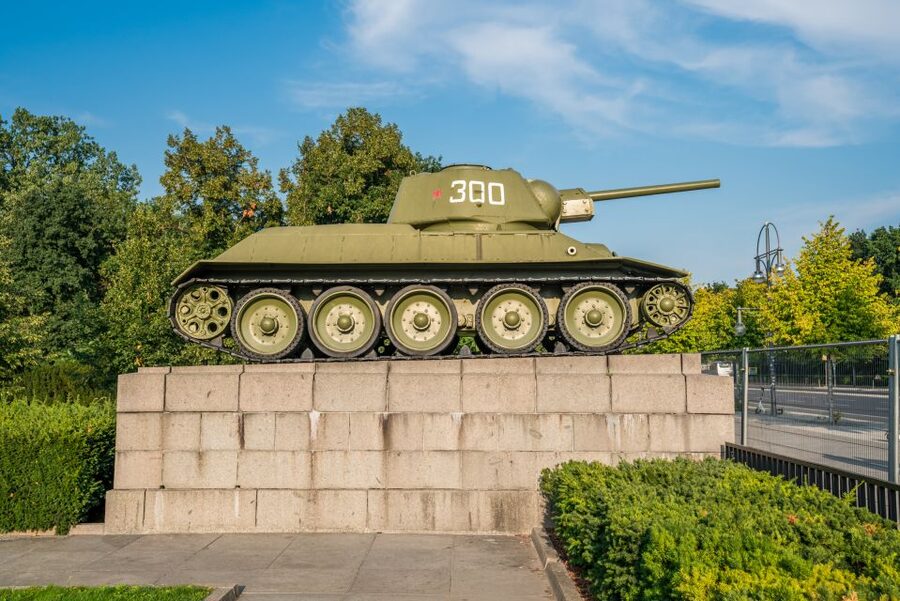
I especially like the preserved Soviet tanks at the Tiergarten war memorial and the 200-meter section of the Berlin Wall, where the city’s division feels less like a textbook topic. Guides such as Rohan, Maggie, Maria, Mikey, and Ciaran have been praised for making complicated events clear without losing their emotional weight. Bring good shoes, though, because you will walk about 2 kilometers and the tour runs in rain, snow, and serious winter cold.
Key points to know before you go
- The route covers about 2 kilometers in two hours, with several stops for stories, questions, and photographs.
- The Brandenburg Gate is both meeting point and historical starting line, linking Nazi parades, Cold War division, and German reunification.
- The tour visits the actual site of Hitler’s Bunker, marked by an unassuming location rather than a preserved underground room.
- A 200-meter Berlin Wall section gives the Cold War story physical weight, especially when paired with escape stories.
- Checkpoint Charlie is the final stop, where American and Soviet forces once faced one another.
- Group and private tours are available, with German and English options depending on the chosen tour type.
Why this compact Berlin history walk works
Berlin can be confusing on a first visit. A grand building may have served several governments, while a vacant plot may mark one of the darkest places in modern European history. This tour helps you connect those fragments in the right order.
The route moves from the Nazi period through the Second World War and into the divided city of East and West Berlin. It then finishes with the Wall’s fall and Germany’s reunification. That sequence matters. You do not simply collect famous photo stops. You see how one era fed into the next.
At $23 per person, the tour offers good value if you want an introduction before exploring museums on your own. You receive a live guide, a walking route, and the benefit of having the major sites explained as you encounter them. The price is modest compared with a private tour, although a private option is available if you want more control over the pace.
The strongest part is the human scale. Guides often explain escape attempts, political decisions, family stories, and the effect of the Wall on ordinary Berliners. One guide, Ben, has been praised for sharing family photographs and personal stories. Another, Maria, reportedly explained the period in a way that connected huge political events with individual lives.
Still, keep your expectations sensible. This is not a museum visit, and there is no time for long indoor stops. The tour gives you a clear framework, but you may want to visit the Topography of Terror, the Documentation Center beneath the Memorial to the Murdered Jews of Europe, or other museums afterward.
More Guided Walks in Berlin:
- Berlin: Hidden Backyards Guided Walking Tour
★ 4.8 · 5,360 reviews - Berlin: City Street Art Guided Walking Tour
★ 4.8 · 1,051 reviews - Berlin: History of the Third Reich Guided Walking Tour
★ 4.7 · 791 reviews
Meeting the guide beneath the Brandenburg Gate
The tour begins in front of the tourist information point at Brandenburg Gate, at Pariser Platz 1. Look for the guide carrying a pink umbrella. That detail is useful because Pariser Platz can be busy, especially around the gate and nearby government buildings.
The closest train stop is Brandenburger Tor, served by S1, S2, S25, S26, and U5. Buses 100 and 245 also stop nearby. I would arrive a little early so you are not searching for the group at the last minute.
Brandenburg Gate is an excellent opening stop because its meaning changed so dramatically over time. It was used for Nazi displays, later sat beside the fortified boundary between East and West Berlin, and became a symbol of unity after the Wall fell in 1989.
Your guide has plenty to work with here: the gate’s role in public ceremony, the political symbolism of its location, and the way a familiar monument can carry different meanings for different generations. It is also a good place to take your first photograph before the walking begins.
Reichstag and the fire that changed Germany
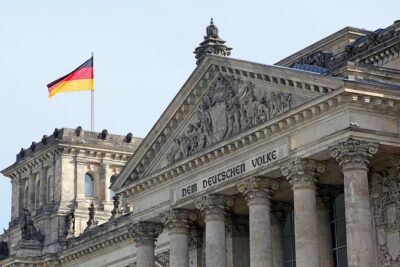
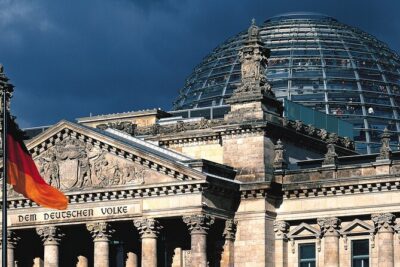
The short walk to the Reichstag brings you to one of Berlin’s most important political buildings. You will hear about the 1933 Reichstag Fire and why it mattered during Hitler’s rise to power.
The key value of this stop is political context. The fire was not just a dramatic event at a famous building. It became part of the process by which civil liberties were restricted and Nazi control tightened. A good guide will explain the event without burying you in dates.
You will view the Reichstag from outside rather than take a tour of the interior. That keeps the walk moving, but it also means you will not see the glass dome or the parliamentary spaces. If you want to visit inside, that requires separate planning.
The building’s later story is just as useful. It survived war, destruction, and decades of division before becoming the home of Germany’s modern parliament. In a short stop, the Reichstag gives you a clear example of how Berlin’s buildings were pulled into the events around them.
Soviet tanks at the Tiergarten war memorial
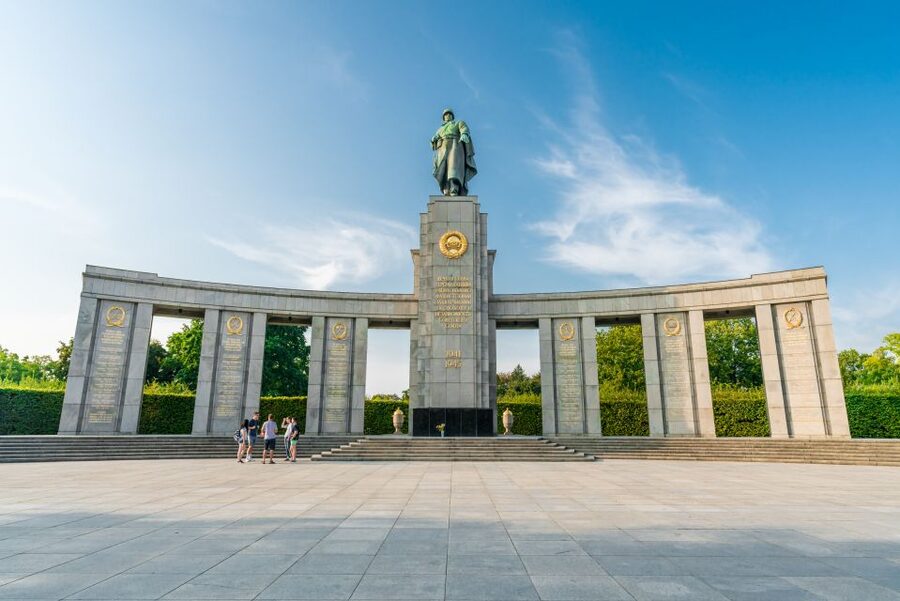
The Soviet War Memorial in Tiergarten is one of the more striking outdoor stops. Preserved Red Army tanks sit beside the memorial, which honors roughly 80,000 Soviet soldiers who died during the Battle of Berlin.
The tanks make this part of the tour particularly tangible. You are not only hearing that Berlin was fought over in 1945. You are looking at military hardware connected to the final battle for the city.
The memorial also adds a layer that is easy to miss if you only focus on German and Western Allied history. Soviet losses were immense, and the site reflects the Soviet role in defeating Nazi Germany. Your guide can place the memorial within the wider Battle of Berlin and explain why it was built in the middle of what later became West Berlin.
This is an outdoor pause, so cold or wet weather matters. The tour operates in all weather, and several people have enjoyed it even at around minus 8 degrees Celsius. I would not rely on enthusiasm alone. Wear a warm coat, gloves, and shoes with good grip if the pavement is icy.
A few more walks around Berlin worth a look
- Discover Berlin Half-Day Walking Tour
★ 5.0 · 9,624 reviews - Berlin City walk Government District and Places of Democracy
★ 4.7 · 8,467 reviews - Berlin: Discover Berlin Walking Tour
★ 4.9 · 5,998 reviews - Berlin’s Best: 2 Hour Walking Tour Third Reich and the Cold War
★ 5.0 · 5,486 reviews
The Holocaust Memorial and a difficult pause
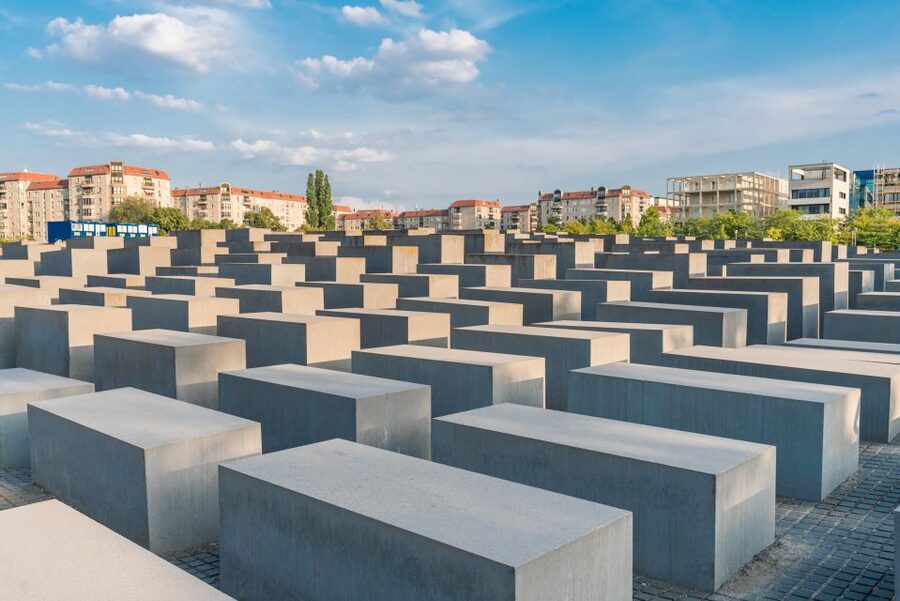
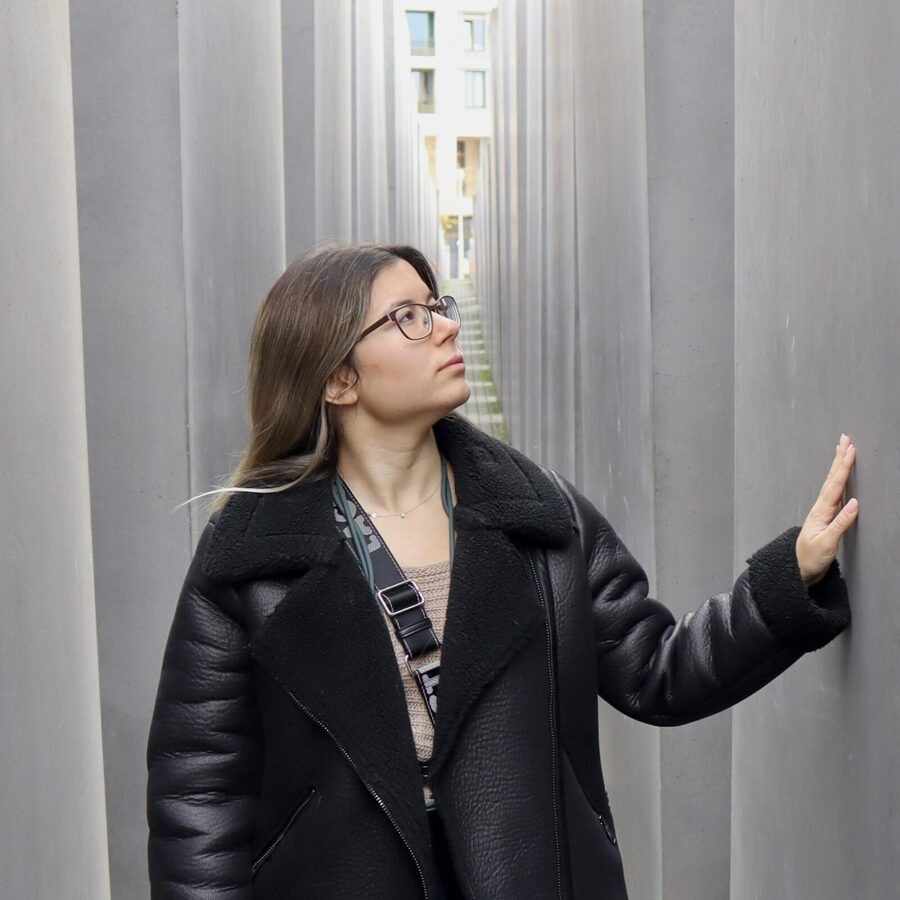
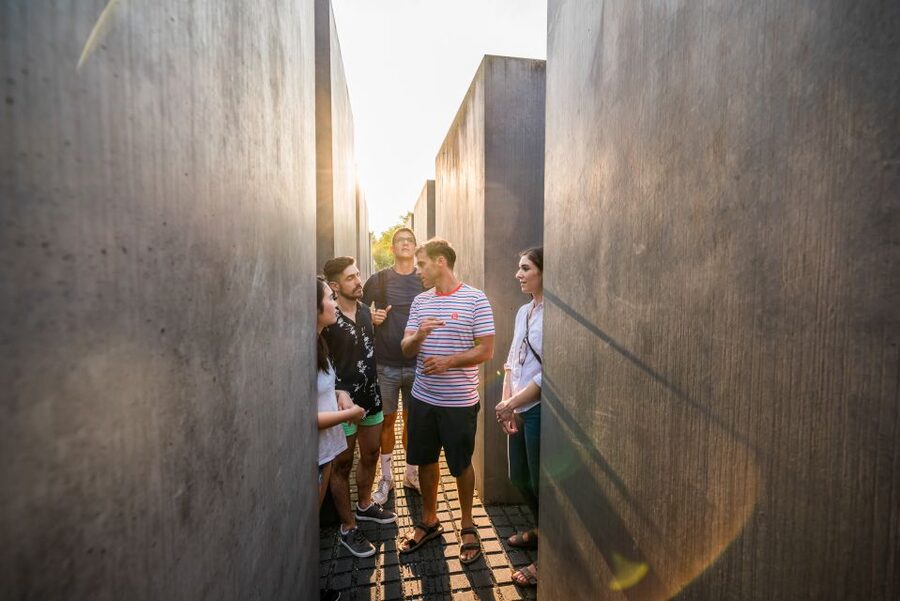
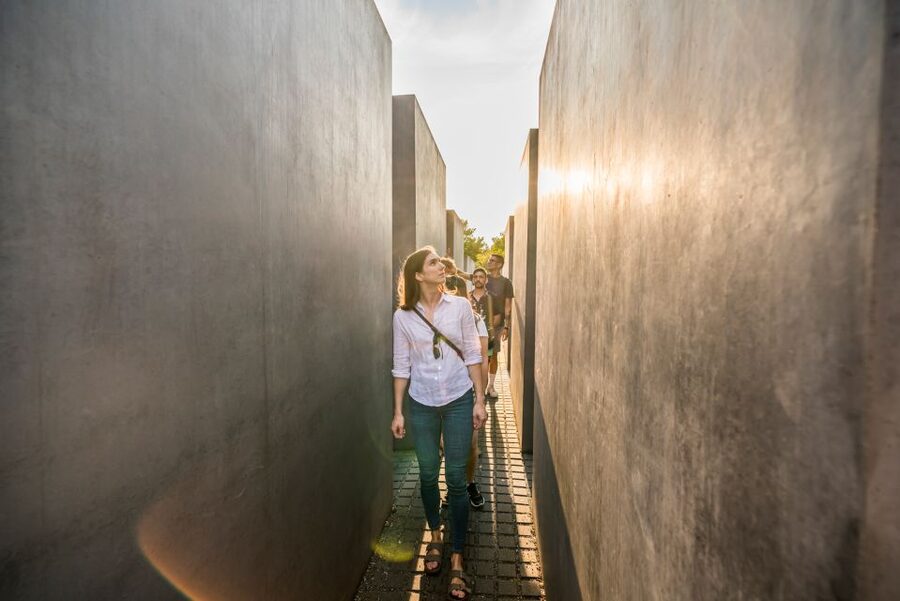
The Memorial to the Murdered Jews of Europe is made up of 2,711 concrete slabs arranged across an open field. The tour pauses here for an explanation of the memorial and the six million Jewish victims of the Holocaust.
This is not a site to rush through for a photograph. You can walk among the blocks, where the changing height and narrow paths create a strong sense of uncertainty. The design does not provide a simple message, and your guide’s explanation helps you approach it with care.
The stop is emotionally heavy, but it belongs in this route. The tour has already shown how power was taken and how war reached Berlin. Here, the focus shifts to the people targeted and murdered by the Nazi regime.
A walking tour cannot replace the memorial’s underground Information Centre, which presents personal stories and family histories. If this subject matters to you, allow extra time to return on your own. The outdoor memorial is free to visit, while the guided tour gives you a short introduction during the route.
Hitler’s Bunker and the danger of a plain-looking place
The former site of Hitler’s Bunker is not a dramatic ruin. There is no preserved bunker interior to explore, and the location can look surprisingly ordinary. That plainness is part of the point.
Here, the guide explains Hitler’s final days and the collapse of the Third Reich. You will learn where he spent the end of the war and how the surrounding area looked as Berlin fell.
For many visitors, this is one of the most useful stops because it corrects a common expectation. The bunker is not presented as a shrine or a spectacle. It is treated as a historical location connected to dictatorship, war, and destruction.
The stop also shows why guided interpretation helps in Berlin. Without an explanation, you could walk past the site without realizing its importance. With one, an unmarked or lightly marked location becomes easier to understand.
Detlev-Rohwedder-Haus and changing political power
The former Ministry of Aviation, now known as Detlev-Rohwedder-Haus, provides another example of Berlin’s layered political past. During the Nazi period, it was linked to Hermann Göring’s Ministry of Aviation. In 1949, it became associated with the birth of East Germany.
That change of use is central to the tour’s structure. The same building moved from Nazi government to the political life of the German Democratic Republic. You see how regimes reused existing offices and symbols rather than wiping the past clean.
This is mainly an exterior stop, with the guide doing the work through explanation. You will not spend a long time inside. Still, the building helps bridge the gap between the Third Reich and the Cold War, which is exactly where many shorter Berlin tours lose their focus.
The Topography of Terror and the machinery of repression
At the Topography of Terror, the route reaches the former headquarters of the SS and Gestapo. The site is closely tied to the planning and administration of Nazi persecution.
The outdoor tour stop gives you the basic setting and explains what happened here. It is a sobering place because the terror was organized through offices, paperwork, orders, and institutions. This was not only a story of battlefield violence. It was also a system run from city buildings.
You may want to return to the site for a longer visit. The Topography of Terror has exhibitions that require more time than the walking tour can provide. The guide’s stop works best as an introduction, helping you understand why the location deserves a later, slower visit.
This part of the route can feel intense. Guides have been praised for treating the subject seriously while still making the timeline understandable. That balance matters, especially for families or anyone encountering the subject for the first time.
Walking along the Berlin Wall
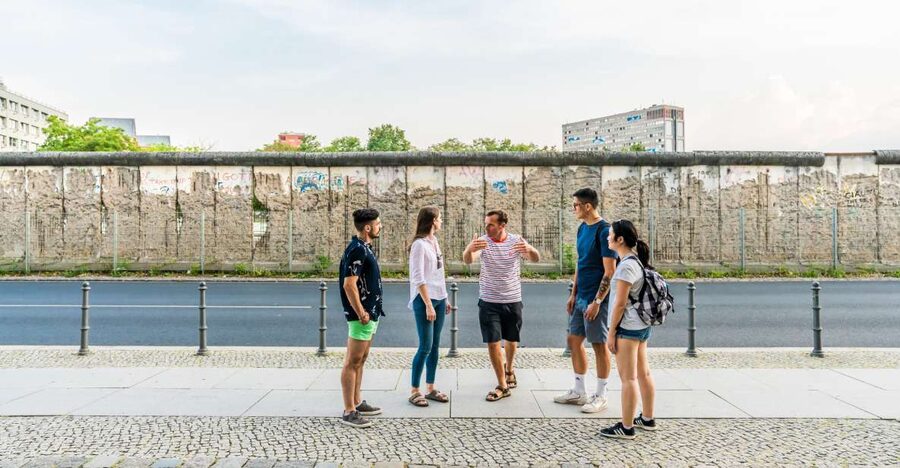
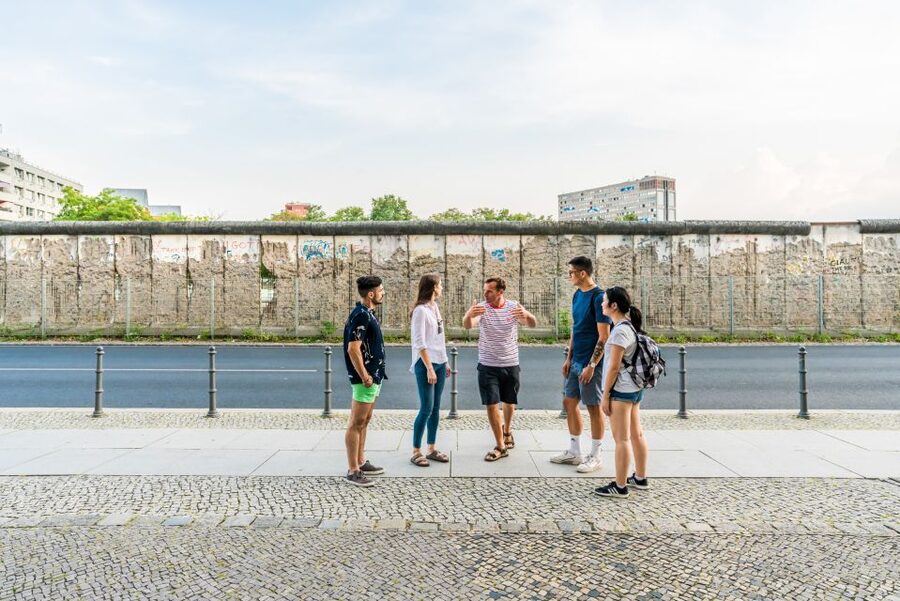
The tour then reaches a 200-meter stretch of the Berlin Wall. This is where the Cold War becomes especially physical.
You will hear about the Wall’s construction, the division between East and West Berlin, and the people who risked their lives to escape. The remaining section is not enormous, but it gives you a real sense of the barrier’s presence and scale.
The most useful part is the personal detail. Statistics about the Wall can feel distant. Stories of escape attempts, families separated by a border, and the long pressure of living in a divided city bring the subject closer.
The route does not visit every major Wall site in Berlin, and two hours is not enough for that. You will not get the full story of the Wall’s watchtowers, death strip, memorials, and neighborhoods. What you do get is a compact explanation that prepares you to explore sites such as the Berlin Wall Memorial or East Side Gallery later.
Checkpoint Charlie and the road to reunification
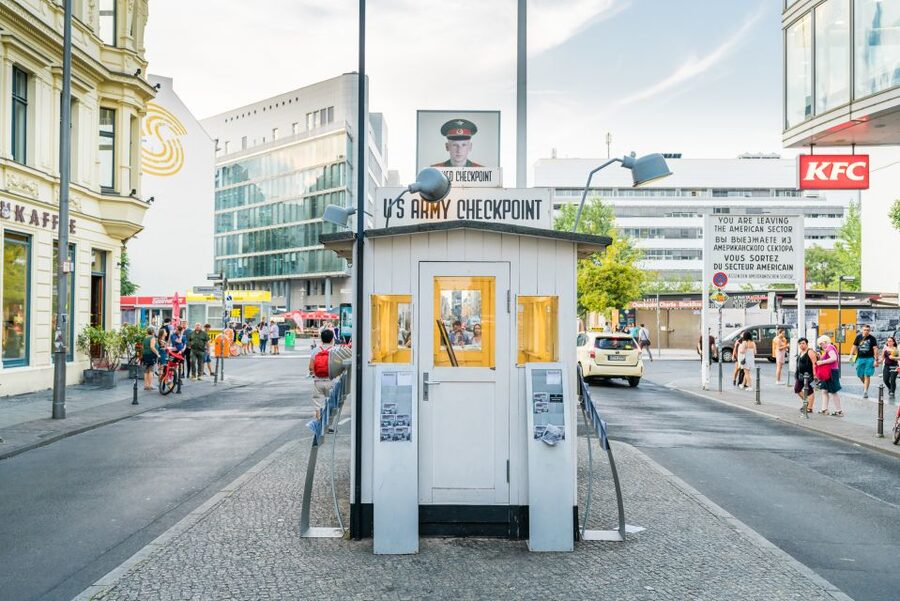
The walk ends at Checkpoint Charlie, once the best-known crossing point between East and West Berlin. American and Soviet tanks faced one another here during a tense Cold War confrontation.
The guide also explains escape attempts and the final period before the Wall came down. This gives the tour a clear ending, moving from dictatorship and war toward political change and reunification.
Checkpoint Charlie is visually less powerful than many first-time visitors expect. The current checkpoint booth and surrounding displays are heavily shaped by tourism, and the area can feel commercial. The historical significance is real, but the modern setting does not always convey the tension of the original standoff.
That is why the guide matters here. Without context, you may see a famous sign and a crowded street. With context, you can picture the danger of crossing the border, the pressure between the United States and Soviet Union, and the sequence of events that led to the Wall’s fall.
The tour finishes here rather than returning to Brandenburg Gate. That is convenient if you want to continue toward the Friedrichstraße area, visit nearby museums, or find lunch in central Berlin.
Guide quality and the pace of the walk
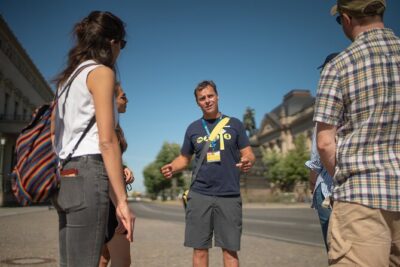
The guide can make or break a history walk, and this experience receives especially strong praise for guide energy, clarity, and storytelling. Names that have received warm feedback include Rohan, Paul, Ben, Maggie, Maria, Mikey, Ciaran, Ariel, Glen, Jimmy, Hannah, and Jasper.
The recurring strength is the ability to explain difficult material in plain language. Guides are also praised for answering questions, adding humor at suitable moments, and offering suggestions for the rest of your time in Berlin. Maggie, for example, has helped people with local recommendations after the walk, including where to find a good German döner.
The pace appears to be manageable for most people. You stop often, walk between locations, and cover about 2 kilometers. Some guides have continued beyond the advertised two hours when the group had questions or the subject needed more time.
That extra time should be viewed as a possibility, not a promise. If you have a strict reservation immediately afterward, leave a buffer. The tour has many stops, and the guide may want to finish an explanation rather than cut it short.
Who should book this tour?
I would choose this tour for a first visit to Berlin, especially if you want to understand the city before visiting its museums. It gives you a useful map of the central landmarks and shows how Nazi and Cold War history overlap.
It suits adults, older children, students, and anyone who prefers stories and place-based explanation to reading plaques alone. Children may ask difficult questions, but the route gives families a way to discuss serious history together. One guide was specifically praised for answering children’s questions with patience.
It is also a good choice if you have only a weekend in Berlin. You see many major sites without spending the entire day on one museum. The two-hour length leaves room for the Reichstag dome, the Holocaust Memorial Information Centre, the Topography of Terror, or another museum afterward.
You may want a different experience if you dislike outdoor tours, need long indoor breaks, or already have a strong understanding of Berlin’s twentieth-century history. A specialist museum visit or a longer private tour would offer more detail.
Practical advice for a better experience
Wear comfortable shoes. The distance is modest, but the route includes pavements, open spaces, and several standing stops.
Dress for the forecast and then add one layer. The tour operates in rain and snow, and winter reports include temperatures around minus 8 degrees Celsius. Bring an umbrella, water, and a camera, but remember that the most important part of the tour is listening.
Check the language before booking. German and English are offered, but shared and private options may not have identical language choices.
The tour is wheelchair accessible, and a private group option is available. Free cancellation is allowed up to 24 hours before the start, and you can reserve now and pay later, which helps if your Berlin schedule is still shifting.
Is the Berlin Third Reich and Cold War tour worth $23?
Yes, for most first-time visitors. At $23, you get a well-planned central route, a live guide, and a clear explanation of places that can otherwise seem disconnected. The value is strongest when you treat it as your historical orientation, not as a complete study of Berlin’s past.
Book it early in your stay if you can. The route gives you bearings, highlights museums worth returning to, and explains why modern Berlin looks the way it does. Choose the private option if you want more control over questions and pace. Otherwise, the shared walk offers a lot for a modest price, provided you are ready to walk outdoors and spend two hours with serious subject matter.
FAQ
How long is the Berlin Third Reich and Cold War walking tour?
The tour lasts two hours. The route covers approximately 2 kilometers on foot.
Where does the tour begin?
It begins in front of the tourist information point at Brandenburg Gate, Pariser Platz 1. Look for a guide with a pink umbrella.
Where does the tour finish?
The tour ends at Checkpoint Charlie.
Which landmarks are included?
The route includes Brandenburg Gate, the Reichstag, the Soviet War Memorial in Tiergarten, the Memorial to the Murdered Jews of Europe, Hitler’s Bunker site, Detlev-Rohwedder-Haus, the Topography of Terror, a 200-meter section of the Berlin Wall, and Checkpoint Charlie.
Is the tour available in English?
Yes. Tours are offered in English and German. Language choices can differ between shared and private options, so check the selected option before booking.
Is the walking tour wheelchair accessible?
Yes, the activity is listed as wheelchair accessible.
What should I bring?
Bring comfortable shoes, an umbrella, a camera, and water. The tour operates in all weather conditions, so dress warmly in winter and prepare for rain when needed.
Just added around Berlin
- Berlin Walking Tour★ 4.5 · 378 reviews
- Small Group Walking Tour of East Berlin with a French Guide★ 5.0 · 176 reviews
- Berlin Street Art Walking Tour – Off The Grid★ 5.0 · 270 reviews
- Berlin Highlights Private Guided Walking Tour★ 4.5 · 89 reviews
- Private Walking Tour: World War 2 and Cold War Sites in Berlin★ 5.0 · 230 reviews
- East Meets West: Berlin Food Culture & Street Art★ 5.0 · 157 reviews
- Kreuzberg Berlin: Off the Beaten Track PRIVATE Walking Tour★ 5.0 · 128 reviews
- The History of Berlin: WWII PRIVATE Walking Tour With Locals★ 5.0 · 209 reviews
Berlin Walking Tours, compared.
Berlin City walk Government District and Places of Democracy
Read our review →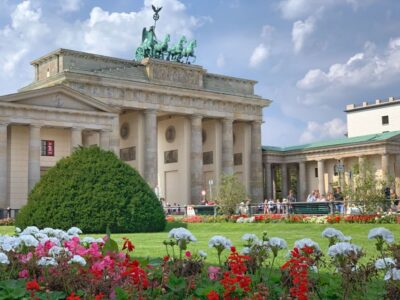
Berlin’s Best: 2 Hour Walking Tour Third Reich and the Cold War
Read our review →
Explore Berlin: See All The Iconic Sights & Some Hidden Gems
Read our review →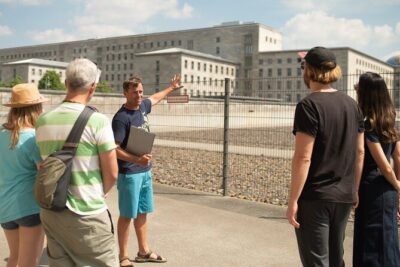
Third Reich Berlin: Hitler and WWII Walking Tour
Read our review →
Browse the lists this tour appears in