
Review · BERLIN WALKING TOURS
Third Reich Berlin: Hitler and WWII Walking Tour
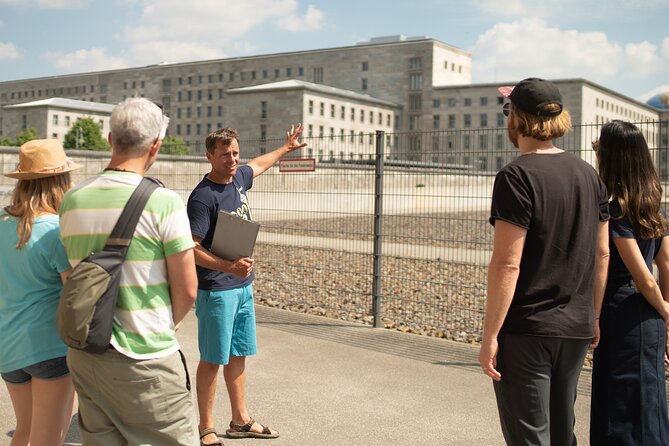
Berlin’s darkest chapter is best read on foot. This three-hour Third Reich tour links Hitler’s bunker, the Reichstag, Goebbels’ propaganda offices, the Soviet War Memorial, and the Topography of Terror in one clear route. I like its strong focus on places, not just dates, and the way it connects Nazi power with ordinary Berlin life under dictatorship.
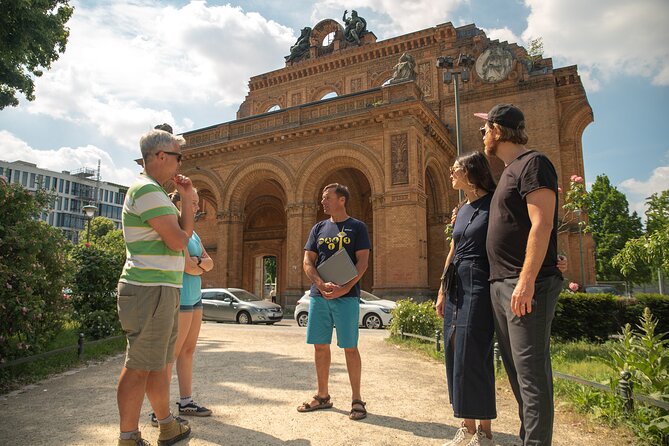
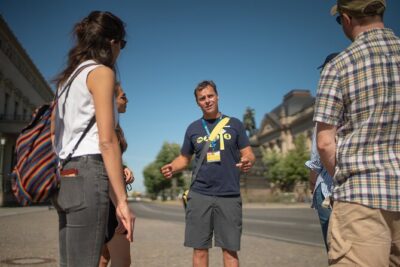
I also like the guides’ lively teaching style. Paul, Ru, Chris, Maria, Tom, Ciarán, and others have been praised for clear explanations, good storytelling, and patient answers. The main drawback is simple: this is an outdoor walk of about 5,000 brisk steps, so winter cold, rain, or tired legs can change the experience quickly.
Key things to know before you book
- Hitler’s bunker is an empty site today: You stand above the location, then learn what happened there during the final days of April 1945.
- The route links power and persecution: Nazi ministries, the Reichstag, resistance figures, deportation memorials, and the Holocaust Memorial all appear in one walk.
- Guides make the difference: Paul, Ru, Chris, Maria, Tom, Ciarán, and other guides are praised for clear history lessons and approachable storytelling.
- Expect a brisk outdoor tour: The walk lasts about three hours and can cover roughly 5,000 steps between stops.
- The group can reach 25 people: That keeps the cost low, though a larger group may make questions and positioning harder.
- The ending is useful for sightseeing: You finish at the Topography of Terror, close to Checkpoint Charlie.
Why this Berlin history walk works
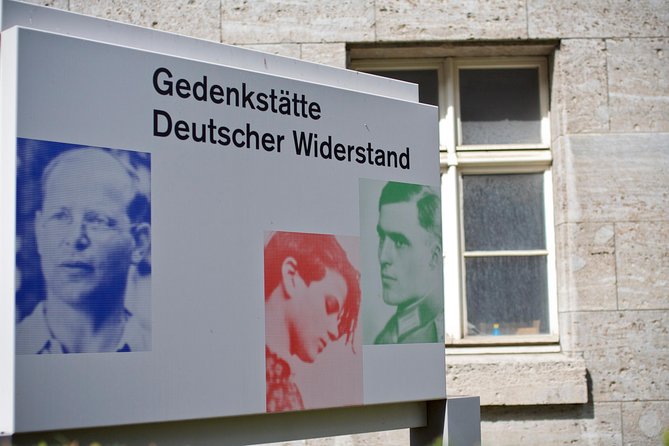
Berlin is full of sites linked to the Third Reich, but many are easy to miss. Some are ordinary-looking government buildings. Others are marked by a small plaque, a memorial, or an open space where a major structure once stood.
That is where this tour earns its price. At about $24.07 per person, you are paying for a guide who connects scattered places into one story. You do not simply look at a building and hear that something important happened there. You learn who worked there, what decisions were made, and how those decisions affected people across Germany and Europe.
The focus is especially strong on the final phase of the war. You follow the route of the last Soviet assault, learn about the Battle of Berlin, and finish with Hitler’s final days and the fall of Nazi Germany. The tour also reaches further back, explaining how Hitler gained power, how democracy was weakened, and how Nazi racial policy helped lead to the Holocaust.
I would not book this as a light sightseeing walk. The subject is persecution, war, dictatorship, and mass murder. The best guides handle that weight with care while still making the facts easy to follow. Paul has been praised for balancing difficult material with accessible storytelling. Ciarán is noted for explaining complex events without flooding the group with detail. That teaching skill matters here.
A few more walks around Berlin worth a look
- Discover Berlin Half-Day Walking Tour
★ 5.0 · 9,624 reviews - Berlin City walk Government District and Places of Democracy
★ 4.7 · 8,467 reviews - Berlin: Third Reich & Cold War Guided Walking Tour
★ 4.9 · 8,378 reviews
Starting near Friedrichstrasse and the River Spree
The walk begins in central Berlin. The supplied meeting information gives Reichstagufer 17 as the start, while the itinerary identifies Berlin Friedrichstrasse Station as the opening point. Because both names appear in the booking details, check the exact meeting instructions on your confirmation and arrive 15 minutes early.
The opening briefing gives you a map in your head. The guide explains the main places ahead: the Reichstag, Wilhelmstrasse, the former Nazi ministries, the bunker site, the Soviet memorial, and the Topography of Terror.
Friedrichstrasse is a practical starting area. It is near public transport, and the central location makes it easy to reach before the tour. From here, the guide begins setting the scene for Berlin under the Nazi regime, including air raids, dictatorship, propaganda, and the daily strain placed on civilians.
This opening is valuable because the tour is not only about Hitler and military commanders. You also hear how ordinary Berliners lived under censorship, fear, bombing, and state control. That wider view keeps the walk from becoming a parade of famous men and government offices.
Trains to Life, Trains to Death
The first major memorial is Trains to Life, Trains to Death. It recalls the deportation of Berlin’s Jewish population to concentration camps during World War II.
The memorial is brief in physical size, but its subject changes the tone of the tour. You move from government buildings and military planning to the personal cost of Nazi policy. The site honors people who were forced from their homes and sent away on trains, many to their deaths.
Expect about ten minutes here. That is enough for an explanation and a moment to take in the memorial, but not enough for an extended museum visit. If you want more time with Holocaust history, plan a separate visit to the Holocaust Memorial information center or another museum after the walk.
The Reichstag and the collapse of democracy
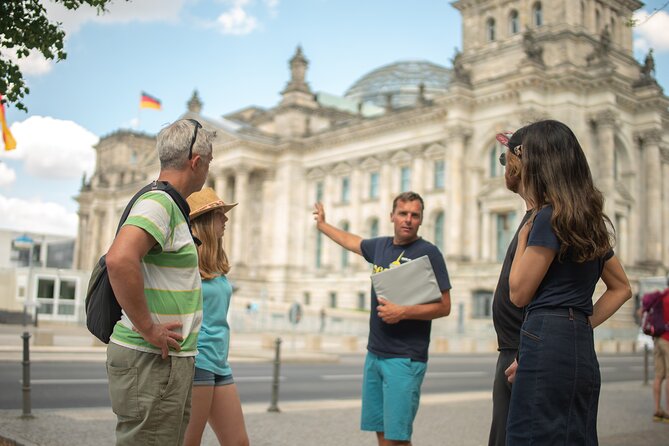
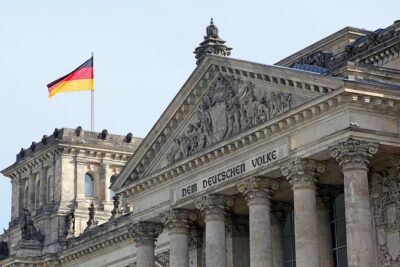
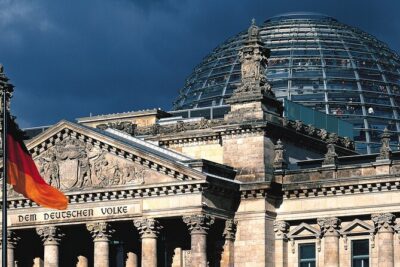
The Reichstag is one of the most useful stops because it connects the Nazi rise to power with a building you can recognize immediately.
The 1933 fire was used by the Nazis as a reason to suspend civil liberties. The guide explains how this helped dismantle democratic safeguards and clear the way for dictatorship. This is one of the tour’s strongest lessons: democracy can be weakened through legal measures and public fear, not only by a dramatic military takeover.
The Reichstag also returns you to 1945. After the Battle of Berlin, Soviet troops raised their flag over the building, creating one of the war’s most famous images. The structure therefore carries two key moments: the destruction of German democracy and the symbolic defeat of Nazi Germany.
The visit is an exterior stop. Entry to the building is not included, and the planned stop lasts about 15 minutes. You will not be taking the glass-dome tour as part of this walk, so book that separately if it interests you.
Same streets, a different way to see them:
- Berlin: Discover Berlin Walking Tour
★ 4.9 · 5,998 reviews - Berlin’s Best: 2 Hour Walking Tour Third Reich and the Cold War
★ 5.0 · 5,486 reviews - Berlin: Hidden Backyards Guided Walking Tour
★ 4.8 · 5,360 reviews - Explore Berlin: See All The Iconic Sights & Some Hidden Gems
★ 5.0 · 4,429 reviews
The Soviet War Memorial in Tiergarten
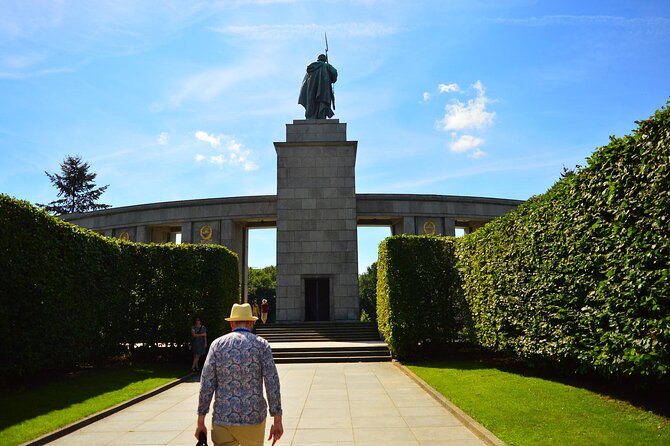
The Soviet War Memorial in Tiergarten is a solemn military cemetery and monument to Red Army soldiers killed in the Battle of Berlin.
The large Soviet soldier sculpture dominates the site. The memorial’s imagery presents the defeat of Nazism through Soviet victory, including the defeated Nazi symbols beneath the soldier. Your guide can place the monument within the final battle for Berlin and explain the enormous human cost behind the city’s capture.
This stop also adds balance to the route. The walk does not tell the end of the war only from the German point of view. You hear about the Soviet role in the final assault and the soldiers who died in the fighting.
Allow about 15 minutes. The memorial is outdoors, so weather matters. In cold conditions, this is one more reason to wear proper layers rather than relying on a fashionable but thin coat.
Brandenburg Gate and the use of public symbols
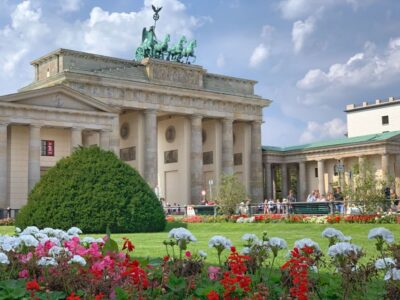
The Brandenburg Gate is now associated with reunification and modern Berlin. During the Nazi period, it was used as a backdrop for propaganda, rallies, and displays of state power.
That contrast is the point. A famous landmark can carry several meanings over time. The Nazis used the gate to project authority and militarism. Today, the same monument is linked with a very different national story.
The stop lasts about ten minutes and is free. It is also a good place to understand how propaganda worked visually. Buildings, flags, ceremonies, and public gatherings were not decoration. They helped turn politics into a daily performance of power.
The Academy of Arts and Albert Speer’s vision
The Akademie der Künste introduces the cultural side of the regime. The discussion centers on Albert Speer, Hitler’s architect and later Minister of Armaments.
Speer promoted monumental, neoclassical designs intended to express the authority and permanence of the Nazi state. The academy itself is now devoted to contemporary arts, but its connection to the era forms part of Berlin’s larger effort to confront institutional involvement and artistic compromise under dictatorship.
This is a shorter stop, around ten minutes. Do not expect a full museum visit. Instead, use it as a chance to think about how architecture and culture can support political power. The tour is strongest when it shows that the Third Reich was not only about battlefields and uniforms. It also relied on buildings, ceremonies, speeches, and carefully designed public images.
The Holocaust Memorial and the human cost
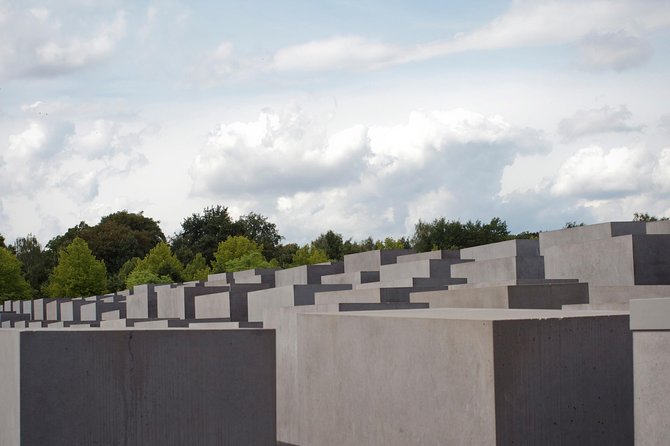
The Memorial to the Murdered Jews of Europe is one of Berlin’s most affecting modern memorials. Its 2,711 concrete slabs vary in height and create narrow, uneven paths.
The design can feel disorienting as you walk through it. That physical sensation encourages reflection, though the memorial does not tell the whole story by itself. The guide provides the historical frame, linking the site to the deportations, racial laws, and mass murder carried out by the Nazi regime.
The planned visit lasts about ten minutes. You should treat it as a respectful stop, not a photo prop. The memorial is open and accessible without an admission charge, but the information center below the field is not part of this tour.
For me, this is where the route’s earlier explanations come together. You have already heard about power, propaganda, offices, and military plans. Here, the scale of the crime becomes harder to keep at a distance.
Hitler’s bunker and the final days
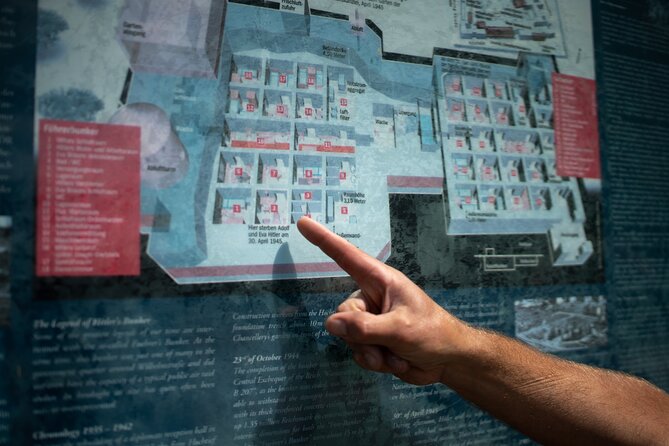
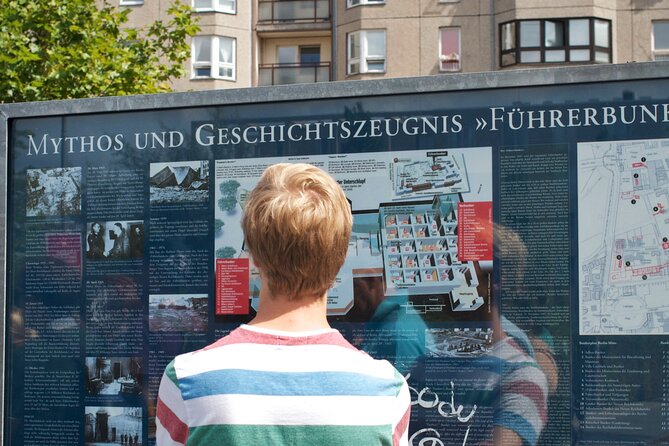
The bunker site is one of the tour’s most anticipated stops, though there is no dramatic entrance to see. The bunker was destroyed, and the area is now an ordinary urban site. A sign marks the location, and the guide explains the layout, Hitler’s final days, and his death in April 1945.
That lack of visible remains is part of the lesson. You are not walking through a preserved shrine. You are standing above a place associated with the final collapse of the Nazi regime, surrounded by modern Berlin.
One guide, Eran, was praised for delaying the reveal until the group reached the sign. That approach can make the location more striking because the site first appears unremarkable. Do not expect underground access. The value comes from the explanation and the historical setting.
The nearby New Reich Chancellery was built under Albert Speer and served as the headquarters of the Nazi government. The guide helps you picture the scale and purpose of the complex even though much of it no longer survives.
Wilhelmstrasse and the machinery of Nazi rule
Wilhelmstrasse was the administrative center of Nazi Berlin. Government offices here included the Reich Chancellery, the Foreign Ministry, and the Ministry of Propaganda.
This is where the tour moves from personalities to systems. Decisions about military expansion, persecution, and the treatment of Jews and other targeted groups passed through offices like these. Joseph Goebbels’ propaganda operation helped shape speeches, public messages, and the regime’s version of events.
The area has changed greatly since the war. Some buildings were destroyed, others reused, and modern development covers much of the old political district. That means you need the guide’s commentary to read the location. Without help, you might walk along Wilhelmstrasse and see little more than offices and traffic.
The stop lasts around 15 minutes. It is one of the best examples of why this walk is more useful than exploring alone.
Göring’s Air Ministry and the final stop
On Niederkirchnerstrasse, you see Hermann Göring’s former Air Ministry, the Reichsluftfahrtministerium. The large building housed the Luftwaffe administration and reflected the regime’s military ambitions.
The guide explains Göring’s position as head of the German air force and one of Hitler’s leading officials. The building also helps connect Berlin to the wider war, including the Luftwaffe’s role in major military operations.
You then reach the Topography of Terror, located at the former SS and Gestapo headquarters. Its exhibitions document repression, persecution, and the Holocaust through photographs, documents, and personal accounts.
The tour ends here, close to Checkpoint Charlie. This is a smart ending because you can continue with a museum visit if you want more detail. The tour itself only allows about ten minutes at the site, so plan extra time if you want to read the outdoor displays or enter the exhibition.
Price, group size, and practical comfort
At $24.07, this is good value for a three-hour guided history walk. You get a local guide and a route that covers far more ground than most independent visitors would find efficiently in one morning or afternoon.
The maximum group size is 25. That is large enough to keep the price low and small enough for a guide to speak to the full group, though you may need to move closer at busy stops. The experience is offered in English and uses a mobile ticket.
You are outside for nearly the entire tour. Wear comfortable shoes, bring water, and check the forecast. Cold-weather advice comes up repeatedly for good reason. At least one group completed the walk in temperatures around minus 7 Celsius, and the advice was to layer up and bring coffee. In icy conditions, the walk can be tiring.
The pace has been described as comfortable by some, but another practical estimate is around 5,000 steps with brisk movement between points. If you have limited walking stamina, ask yourself if three hours outdoors is realistic before booking.
Free cancellation is available until 24 hours before the start time. Changes or cancellations inside that window are not accepted for a refund.
Who should book this tour?
I would book it if you want a clear introduction to Nazi Berlin, especially if you are visiting for only a few days. It suits history enthusiasts, families with older children, and anyone who wants more context than a self-guided walk provides.
It also works well for visitors who do not already know the city. Guides such as Tom, Jimmy, Pete, Ben, Hannah, Jamie, and Callam have been praised for keeping the material understandable, adding humor where appropriate, and answering questions without rushing people.
I would be more cautious if you dislike long outdoor walks, need frequent indoor breaks, or want extensive time inside museums. This is a guided overview, not a museum tour. The Holocaust Memorial, Topography of Terror, and Reichstag all deserve additional time if you want to study their displays.
Should you book the Third Reich Berlin walking tour?
Book it if you want the main Nazi and World War II sites tied together by a strong historical narrative. The excellent 4.9 rating from 3,301 ratings and 99 percent recommendation rate reflect a consistently well-received format, but your experience will still depend on the guide and the weather.
For the money, the route is hard to beat. You see the bunker site, Reichstag, Soviet memorial, Wilhelmstrasse, Nazi ministries, Holocaust memorials, and Topography of Terror in three hours. Wear sensible shoes, dress for the season, confirm the exact starting point, and leave extra time afterward for the museums at the end.
FAQ
How long does the Third Reich Berlin tour last?
The tour lasts approximately three hours.
What language is the tour offered in?
The tour is offered in English.
What is included in the tour?
A local expert guide and the three-hour walking tour are included.
Is hotel pickup included?
No. Hotel pickup and drop-off are not included.
Where does the tour end?
The tour ends at the Topography of Terror on Niederkirchnerstraße 8, close to Checkpoint Charlie.
Is entry to the Reichstag included?
No. Admission to the Reichstag is not included in the walking tour.
How many people can join the tour?
The maximum group size is 25 people.
Can I cancel for a full refund?
Yes. You can cancel at least 24 hours before the experience starts for a full refund. Cancellations or changes made less than 24 hours before the start time are not accepted for a refund.
Just added around Berlin
- Berlin Walking Tour★ 4.5 · 378 reviews
- Small Group Walking Tour of East Berlin with a French Guide★ 5.0 · 176 reviews
- Berlin Street Art Walking Tour – Off The Grid★ 5.0 · 270 reviews
- Berlin Highlights Private Guided Walking Tour★ 4.5 · 89 reviews
- Private Walking Tour: World War 2 and Cold War Sites in Berlin★ 5.0 · 230 reviews
- East Meets West: Berlin Food Culture & Street Art★ 5.0 · 157 reviews
- Kreuzberg Berlin: Off the Beaten Track PRIVATE Walking Tour★ 5.0 · 128 reviews
- The History of Berlin: WWII PRIVATE Walking Tour With Locals★ 5.0 · 209 reviews
Berlin Walking Tours, compared.
Berlin City walk Government District and Places of Democracy
Read our review →
Berlin’s Best: 2 Hour Walking Tour Third Reich and the Cold War
Read our review →
Explore Berlin: See All The Iconic Sights & Some Hidden Gems
Read our review →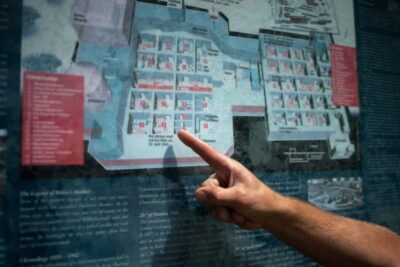
Browse the lists this tour appears in