
Review · FRANCE WALKING TOURS
Marseille: Essential Guided Walking Tour of the City
Marseille reveals itself on foot. This 150-minute walk links the city’s oldest quarters, working harbor, major monuments, and sea views in one well-paced route. I especially like the small group of up to eight and the way local guide Charles combines ancient Greek and Roman history with stories about wartime Marseille, architecture, food, and daily life. The main consideration is the distance: this is a five-kilometer walk with hills and no wheelchair access, so comfortable shoes and decent walking stamina matter.
I also like that the tour finishes near Le Pharo, where you get broad views across the harbor instead of ending in a crowded square. At $41 per person, the price is fair for a personal tour with a bilingual guide, though food, drinks, and entry fees are not included.
Key points at a glance
- Charles sets a personal tone: He speaks French and English, uses photos and maps to explain changes over time, and adjusts his presentation to the group.
- The route covers Marseille’s essential core: La Major, Le Panier, the Church of Accoules, Rue de la République, Vieux Port, Saint-Victor, and Le Pharo all appear in one outing.
- You get both famous sights and quieter corners: Street art, old lanes, the Vieille Charité, Windmill Hill, and harbor forts give the walk variety.
- The tour is strong on orientation: You finish with a clearer sense of how Marseille’s old neighborhoods connect to the port and waterfront.
- The walk has real physical demands: The route covers about five kilometers, includes a hillside district, and is not suitable for wheelchair users.
- The final stop is scenic: Le Pharo provides one of the best places on the route for looking back across Marseille’s harbor.
Why this two-and-a-half-hour walk works
Marseille can feel scattered at first. Its old port, cathedral, hillside lanes, grand nineteenth-century streets, and seaside monuments do not form one obvious sightseeing circuit. This tour solves that problem by creating a clear line through the city.
You begin at La Major Cathedral and gradually move through Le Panier to the waterfront. From there, the route follows the Old Port, passes through the Cours Honoré d’Estienne d’Orves, reaches Saint-Victor, and ends at Le Pharo. That progression gives you a useful picture of Marseille’s development, from its ancient beginnings to its modern maritime identity.
The tour is also a good first activity in the city. You get names, landmarks, neighborhood bearings, and practical suggestions for the rest of your stay. Charles has supplied restaurant, museum, and sightseeing recommendations to people after the walk, so you can use the afternoon as a planning session as well as a history lesson.
The 4.9 rating from 161 reviews reflects a very clear pattern: Charles is repeatedly praised for his humor, warmth, strong English, and ability to explain complicated events in a simple way. He is not merely pointing at buildings. He uses pictures and maps, answers questions, and pays attention to the pace and comfort of the group.
More Guided Walks in France:
- Paris Top Sights Half Day Walking Tour with a Fun Guide
★ 5.0 · 2,893 reviews - Paris: Montmartre Highlights Walking Tour with a Local Guide
★ 4.9 · 2,318 reviews - Paris: Montmartre Cheese, Wine & Pastry Guided Walking Tour
★ 4.8 · 2,255 reviews
Starting beneath La Major Cathedral
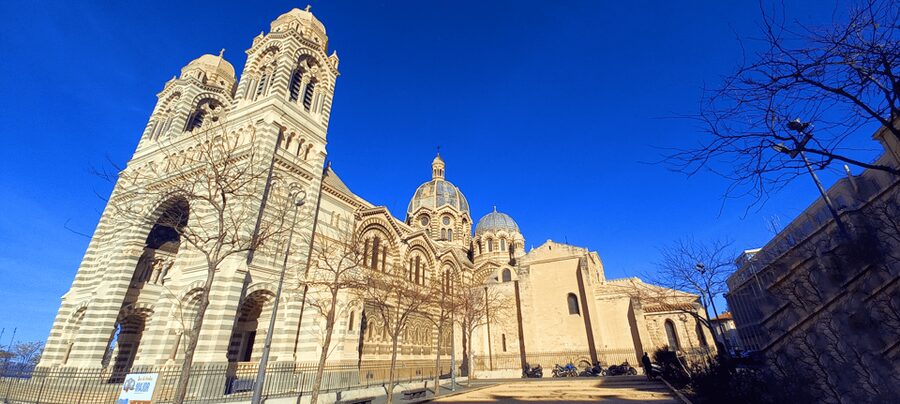
The meeting point is in front of Cathédrale Basilique Sainte-Marie-Majeure, usually called La Major. You will find your guide wearing a white cap.
This is a fitting place to begin. The cathedral’s Neo-Byzantine and Romanesque design is large, ornate, and instantly different from the narrow streets that follow. The opening guided stop lasts about ten minutes, giving Charles a chance to introduce Marseille and its long story before the route turns inland.
La Major also gives you a strong visual marker. If you arrive early, you can orient yourself around the cathedral and the nearby waterfront before the group sets off. Just keep the meeting instruction simple: look for the guide in front of the cathedral and the white cap.
Le Panier: Marseille’s old hillside quarter
From La Major, you enter Le Panier, one of Marseille’s oldest districts. This is where the walk becomes less about grand façades and more about street-level details.
Le Panier sits on a hillside above the Vieux Port, so expect narrow streets, turns, and some uphill walking. The reward is a neighborhood with murals, small lanes, old buildings, and a more residential feel than the main waterfront. Charles points out street art and places that are easy to pass without context.
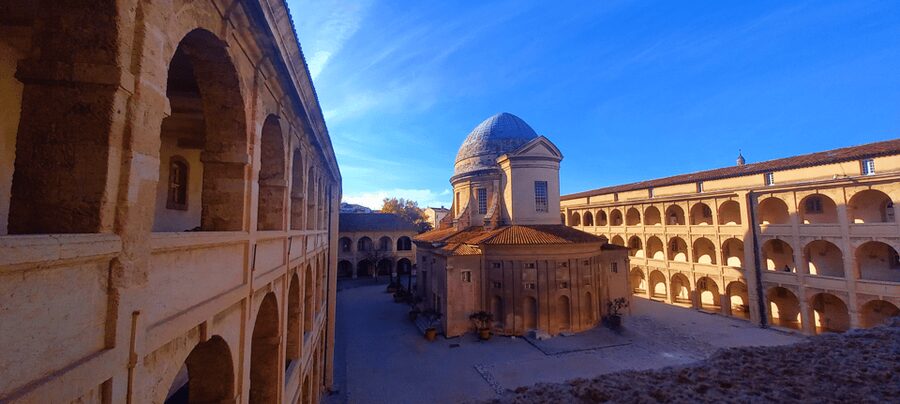
The Vieille Charité is one of the major sights here. It began as a seventeenth-century charitable complex and now serves as one of Marseille’s best-known cultural buildings. The tour does not include food or drinks, and the schedule does not promise interior admission, so think of this as an exterior and neighborhood-focused visit rather than a museum tour.
Windmill Hill adds another layer. The calm name contrasts with Marseille’s busy port, and the stop helps you understand the shape of the old district. I like this part because it gives the city texture. You are not just collecting landmarks. You are seeing how the older quarter rises and folds around the harbor.
The Le Panier section lasts about thirty minutes, making it one of the most substantial parts of the walk. You should be ready to keep moving rather than expect long free time in each lane.
The Church of Accoules and Rue de la République
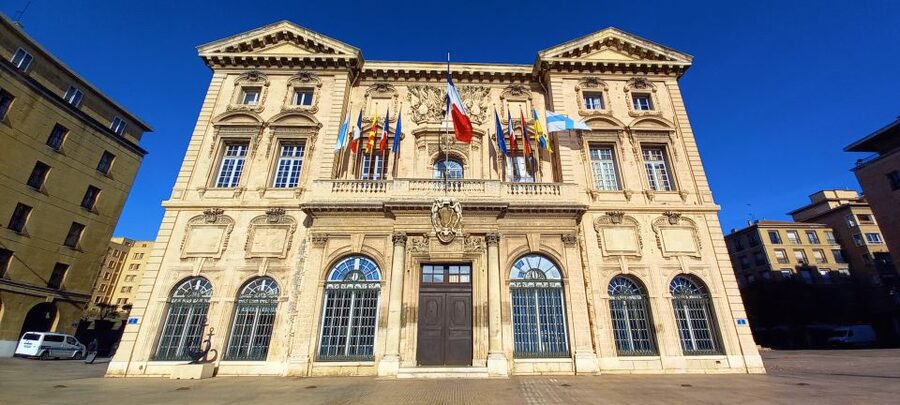
The Church of Accoules provides another short historic stop, lasting around ten minutes. It helps connect Le Panier’s religious buildings with the wider story of Marseille’s old center.
After that, the route reaches Rue de la République. This broad street feels different from Le Panier’s tight lanes. Its scale reflects a later period of urban planning and gives you a useful contrast between old Marseille and the more formal city that developed around it.
The route here includes sightseeing and walking rather than a long indoor visit. That distinction matters. You are buying a guided overview of the city, not a series of admission-based museum stops. Charles supplies the context that makes the streets easier to read, while the buildings and squares provide the physical evidence.
A few more walks around France worth a look
- Montmartre Hidden Gems and Scenic Highlights Walking Tour
★ 5.0 · 2,684 reviews - Montmartre Hill French Gourmet Food and Wine Tasting Walking Tour
★ 5.0 · 2,588 reviews - Paris Île de la Cité and Notre-Dame Walking Tour With Crypt
★ 5.0 · 2,272 reviews - Paris in a Day: Louvre or Orsay, Eiffel Tower, City Walk & Cruise
★ 5.0 · 1,956 reviews
Vieux Port, where Marseille still faces the sea
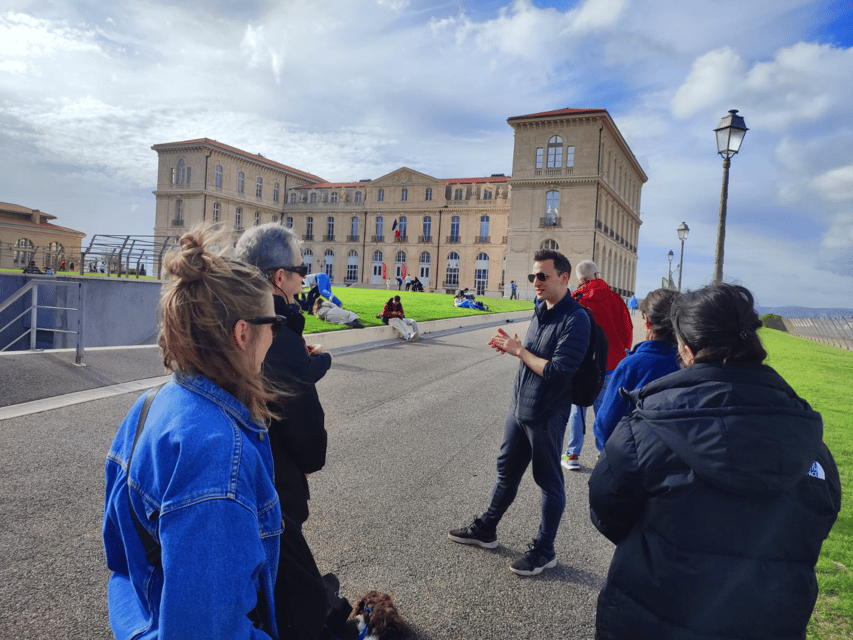
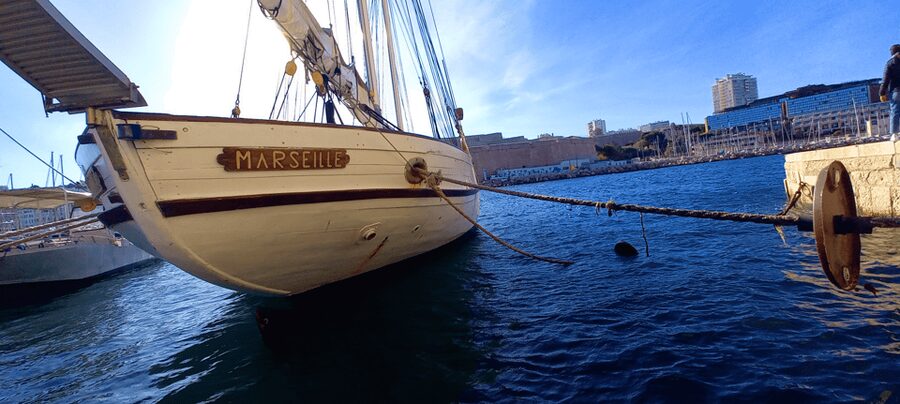
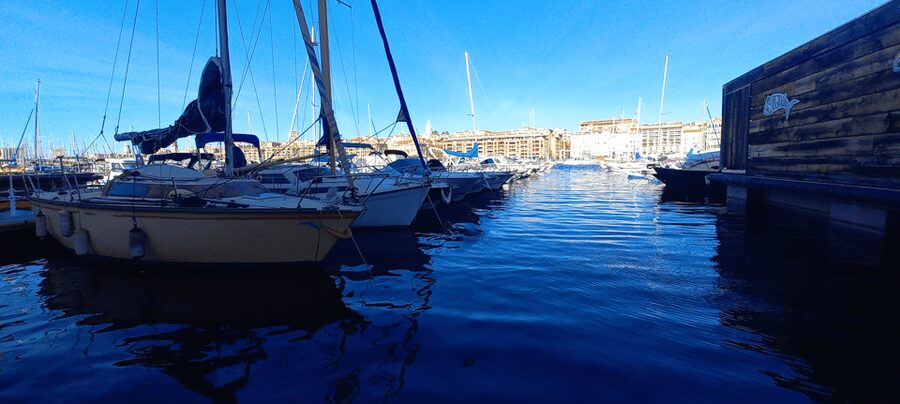
The Old Port is the natural center of the tour. Marseille has depended on this harbor since ancient times, and the waterfront still feels tied to boats, trade, fishing, and public life.
You pass small boats and yachts, with Fort Saint-Jean and Fort Saint-Nicolas guarding the harbor from opposite sides. Their position helps explain the port’s strategic importance. The water, forts, quays, and surrounding streets create one of the most recognizable views in the city.
The Vieux Port stop lasts about fifteen minutes, but you will also encounter the waterfront again later. I like that arrangement because you see it first as a historic port and then understand it better after hearing about Saint-Victor and Le Pharo.
This is also a practical place to learn your bearings. The Old Port is one of the two possible drop-off locations, along with Le Pharo. If you want to continue eating, shopping, or exploring after the tour, ending here keeps you close to many central services.
Cours Honoré d’Estienne d’Orves and Marseille’s public life
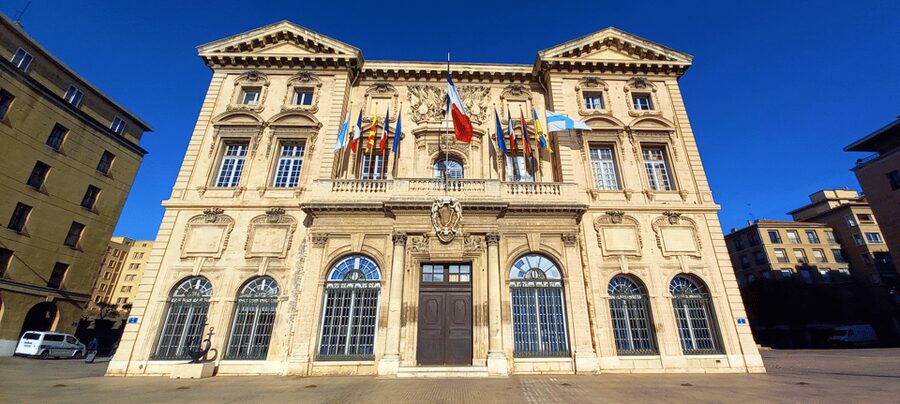
The route continues through Cours Honoré d’Estienne d’Orves, a pedestrian square near the harbor. This portion adds breathing room after the dense lanes of Le Panier.
The stop is brief, about ten minutes, but it helps you see how Marseille’s waterfront shifts from working harbor to social space. It is also a useful transition before the walk heads toward Saint-Victor.
The tour’s changing scenery is one of its strengths. You move from cathedral architecture to hillside streets, from a broad nineteenth-century thoroughfare to harbor quays, and then toward a historic abbey. The walk rarely stays visually repetitive.
Saint-Victor’s Abbey and the twenty-minute pause
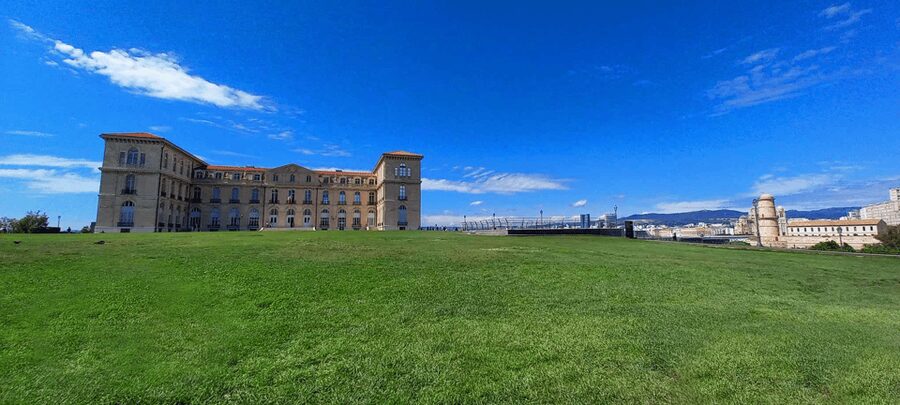
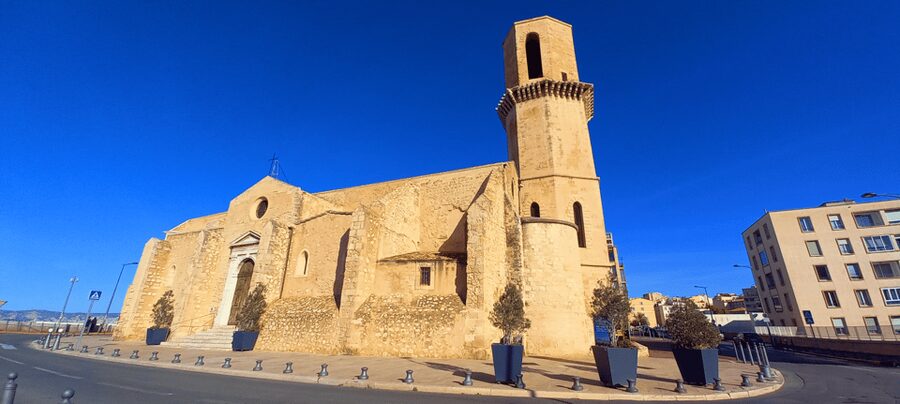
Abbaye Saint-Victor is one of the key religious and historic sites on the route. The abbey connects Marseille to early Christian traditions and gives Charles another place to explain the city’s ancient and medieval layers.
The itinerary allows about fifteen minutes for the guided visit, followed by a twenty-minute break with scenic views along the way. That pause is important. It gives you time to catch your breath, take photographs, and absorb the information before the final section.
Do not treat the break as a guaranteed meal stop. Food and drinks are not included, and you are specifically asked to bring water and snacks if you need them. A small bottle of water is a sensible choice, especially in warm weather.
Saint-Victor also marks the point where the city’s spiritual past meets its coastal setting. You get history, architecture, and views in one stop, rather than seeing the abbey as an isolated church.
Cannebiere, boutiques, cafés, and the city’s everyday character
The walk also includes Cannebiere street, one of Marseille’s best-known central avenues. Here, the atmosphere shifts again toward galleries, workshops, boutiques, cafés, bistros, and restaurants.
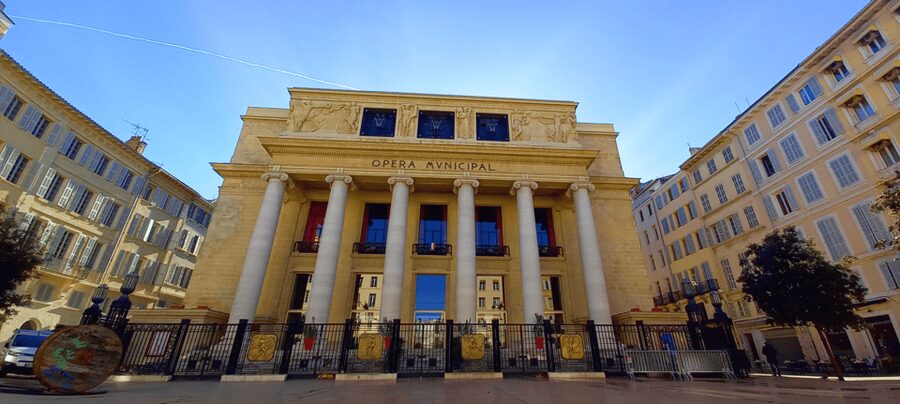
This is a useful part of the tour for understanding the city beyond monuments. Marseille is not simply an old port with a few grand buildings. Its main streets still carry the movement of ordinary city life, commerce, and food culture.
The route description places Cannebiere among the lively streets visited during the walk, while the detailed stop list emphasizes nearby central areas. Exact timing can vary with the group and the guide’s explanations, so do not plan a tight restaurant reservation immediately after the tour.
Charles is especially useful here because his recommendations extend beyond the walk. He has suggested museums, places to eat, and local activities, including advice on bouillabaisse restaurants. That kind of practical follow-up can save you from choosing dinner at random.
Le Pharo and the best views at the finish
The final major stop is Le Pharo, where the route ends after about thirty minutes. The Palais du Pharo was built in the mid-nineteenth century by Emperor Napoleon III for Empress Eugénie. Its grand design and seaside position make it a fitting finale.
You also get views back toward the port and across the Mediterranean. After walking through old streets and dense urban spaces, the open outlook feels like a proper conclusion. It lets you see Marseille as a whole, with the harbor at the center and the historic districts spreading around it.
The palace itself is a sight to admire from the outside during this walking experience. The key value is the setting, the architecture, and the view rather than a promised interior tour.
Finishing at Le Pharo gives you two useful options. You can remain in the area to enjoy the views, or return toward the Old Port, which is the other stated drop-off point. Ask Charles for directions and suggestions before separating, especially if this is your first afternoon in Marseille.
Charles as a guide
The guide can make or break a walking tour, and Charles receives unusually consistent praise for his presentation. I would expect a guide who is warm, energetic, and comfortable in both French and English.
His use of photographs, diagrams, and maps is particularly useful in Marseille. The city has changed greatly over time, and a modern street does not always reveal what stood there before. Visual aids can make ancient, Roman, and wartime stories easier to follow.
Charles also appears to tailor the experience to the people in front of him. He has answered individual questions, adjusted stops for shade during hot weather, and kept solo participants included in the conversation. In a group limited to eight, that personal attention is more realistic than on a large coach excursion.
The humor matters too. Marseille’s history includes war, destruction, political conflict, and tragedy. A guide who can handle serious subjects without making the whole walk heavy gives the experience a better rhythm.
Is $41 a fair price?
At $41 per person, this is not the cheapest way to see Marseille, but the value is solid if you want explanation rather than simple orientation.
You receive a 150-minute guided walk, a small group capped at eight, bilingual service, and a route connecting many of the city’s main historic areas. The guide’s recommendations and visual material add value that is difficult to measure but useful when you have only a short stay.
There are limits. Food, drinks, and admission fees are not included. The activity is also a walking overview, so it will not give you extended time inside La Major, the Vieille Charité, Saint-Victor, or the Palais du Pharo.
I would compare it with the cost of spending an afternoon finding these places alone and then piecing together their stories afterward. If you value local explanation, the fee is reasonable. If you prefer to wander slowly, sit for long periods, or visit interiors at length, you may find the pace less suitable.
Practical advice before you go
Wear comfortable shoes. The route covers about five kilometers and includes Le Panier’s hillside streets, so sandals with little support are a poor choice.
Bring water, sunglasses, and weather-appropriate clothing. You should also carry a snack if you need one, since food and drinks are not included.
The tour is not suitable for wheelchair users. The hillside district, walking distance, and historic streets make this an important consideration when deciding.
I would book it near the beginning of your time in Marseille. That way, Charles’s suggestions for restaurants, museums, and other activities can shape the rest of your visit. The flexible booking terms also allow cancellation up to 24 hours before the start for a full refund, and you can reserve now while paying later.
Who should book this Marseille walk?
I recommend it most to first-time visitors, cruise passengers with a few hours in the city, couples, solo visitors, and small groups who want a personal introduction. It also suits anyone who enjoys history but prefers stories told in streets and squares rather than in a classroom.
It is less suitable if you have limited mobility, dislike walking uphill, or want a tour built around long interior visits. Families and older participants should consider the five-kilometer distance and the weather before booking.
Should you book it?
Yes, if you want a well-rounded first look at Marseille with a guide who brings structure, humor, and local advice. The combination of Le Panier, Vieux Port, Saint-Victor, and Le Pharo gives you a strong sense of the city’s character in one afternoon.
I would book it for the beginning of your stay, wear good shoes, and leave room afterward for a meal or museum visit. At $41, it offers good value for a small-group introduction, especially if Charles’s personal style matches what you want from a city walk.
FAQ
How long does the Marseille walking tour last?
The tour lasts 150 minutes, or two and a half hours.
How far does the tour cover?
The route covers about five kilometers.
Where does the tour begin?
You meet the guide in front of La Major Cathedral, officially called Cathédrale Basilique Sainte-Marie-Majeure.
How will I identify the guide?
The guide will be wearing a white cap.
What languages does the guide speak?
The tour is offered in French and English.
How large is the group?
The group is limited to eight participants.
Is food included?
No. Food and drinks are not included, so bring water and anything you may need during the walk.
Is the tour suitable for wheelchair users?
No. The experience is not suitable for wheelchair users.
Where does the tour finish?
The stated drop-off locations are the Old Port of Marseille and Palais du Pharo.
Just added around France
- Avignon Walking Tour including Pope’s Palace★ 4.5 · 158 reviews
- The Official Emily in Paris Locations Walking Tour★ 4.9 · 383 reviews
- Strasbourg: Historic Center Walking Tour★ 4.7 · 88 reviews
- Strasbourg: Private Walking Tour of the Historical Center★ 4.2 · 107 reviews
- Strasbourg : European District Walking Tour★ 5.0 · 95 reviews
- Strasbourg: Guided Walking Tour★ 4.7 · 127 reviews
- Paris: Montmartre Food Tasting Walking Tour with Secret Dish★ 4.8 · 107 reviews
- Paris: Emily Inspired Walking Tour★ 4.9 · 312 reviews
France Walking Tours, compared.

Authentic Parisian Gourmet Food Tour with 10 Local Dishes & Wines
Read our review →
Paris Top Sights Half Day Walking Tour with a Fun Guide
Read our review →
Montmartre Hidden Gems and Scenic Highlights Walking Tour
Read our review →
Montmartre Hill French Gourmet Food and Wine Tasting Walking Tour
Read our review →
Montmartre Highlights Walking Tour with a Local Guide
Read our review →
Paris Île de la Cité and Notre-Dame Walking Tour With Crypt
Read our review →
Montmartre Cheese, Wine & Pastry Guided Walking Tour
Read our review →
Paris in a Day: Louvre or Orsay, Eiffel Tower, City Walk & Cruise
Read our review →Browse the lists this tour appears in