
Review · ITALY WALKING TOURS
Pompeii: Guided Tour and Skip-the-Line Ticket
Pompeii rewards a guide. This $43 walking tour takes you past the ticket line and into the Roman city buried by Mount Vesuvius in 79 AD. I like the clear route through major sights, and I like that guides such as Anna Rita and Melania have been praised for turning broken walls and old stones into a human story. The main drawback is time: two to two and a half hours gives you the essentials, not all of Pompeii.
I also like the small-group option, which lets you ask questions and sometimes move through the site more easily. Audio headsets are supplied for groups of eight or more, a useful touch when the guide is explaining a scene from several steps away. But Pompeii is hot, exposed, and uneven underfoot, and the tour is not suitable for wheelchair users.
Key points at a glance
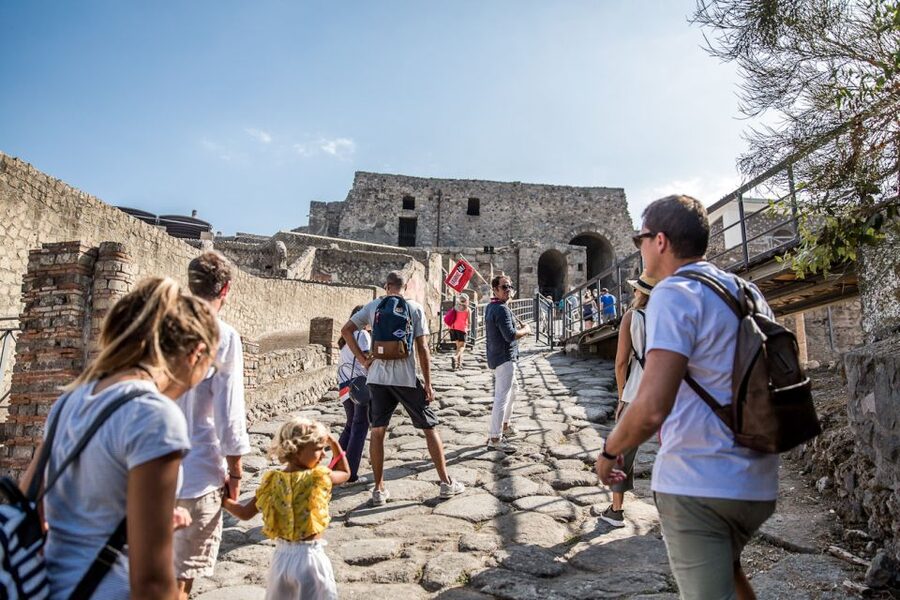
- Porta Marina sets the scene: Begin at one of Pompeii’s original gates before walking toward the city forum.
- The route covers the Roman essentials: See the Civil Forum, Basilica, Large Theater, baths, House of the Faun, Macellum, bakery, food shop, and Lupanare.
- A guide adds real value: Details about politics, religion, business, food, sex, and home life are easy to miss when you walk alone.
- Small groups can be worth the extra cost: A guide may adjust the pace, answer questions, and use time more wisely.
- Priority entry helps, but it is not magic: On the first Sunday of the month, fast access may depend on crowd levels at the ticket office.
- Plan for a long walking session: Wear solid shoes, carry sunscreen, and bring water even though food and drinks are not included.
Why a guided Pompeii visit makes sense
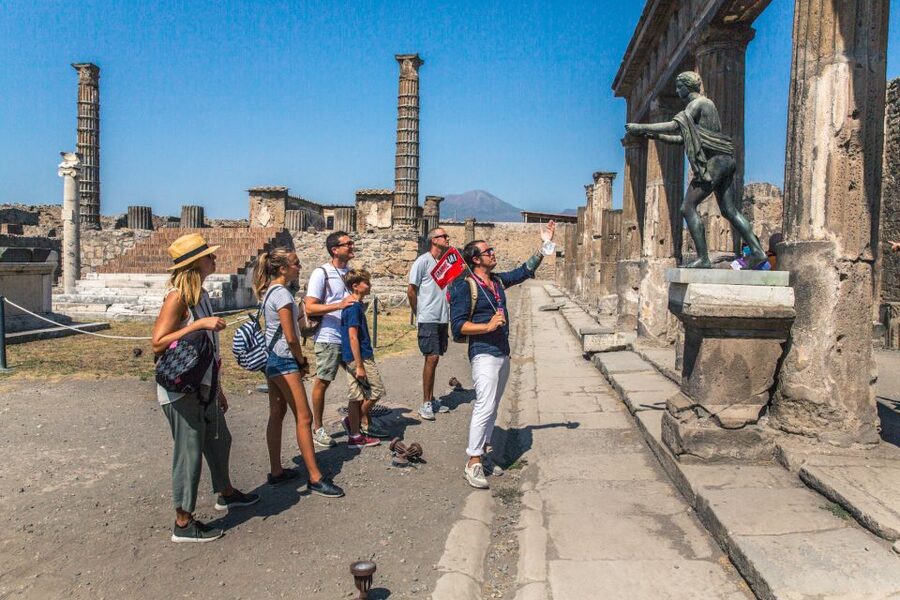
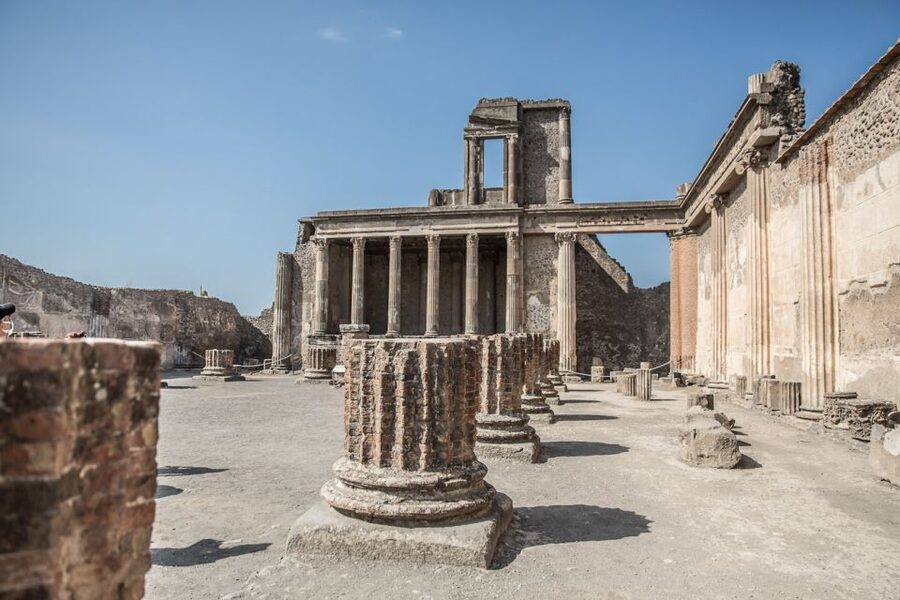
Pompeii is not a single monument with a neat path through it. It is a full Roman town, with streets, houses, shops, temples, baths, theaters, bakeries, and public offices spread across a large archaeological site.
That scale is both the pleasure and the problem. You can wander for hours, but without context, many buildings look like walls and paving stones. A local guide gives the ruins a purpose. The Basilica becomes a place for law and business. A bakery shows how flour was ground and bread was made. A narrow room at the Lupanare tells you something about the city’s sex trade and social customs.
This route is built for first-time visitors who want the main story without spending a full day on site. It is also useful if you have already been to Pompeii and want a more focused look at areas you missed before.
The guide leads in English, Spanish, French, or German. Groups of eight or more receive audio headsets, which should make the commentary easier to follow near busy streets or large buildings. Private and small-group options are available, and that difference matters here. A private party of four, for example, can stop for questions and adjust the pace more easily than a large crowd.
More Skip-the-Line Tickets in Italy:
- Milan: Guided Walking Tour with Last Supper Skip-the-Line
★ 4.7 · 1,143 reviews - Skip-the-Line Florence Highlights and David Walking Tour
★ 5.0 · 1,127 reviews - Siena: Walking Tour and Skip-the-Line Duomo Tickets
★ 4.8 · 1,116 reviews
Starting at Porta Marina and the Civil Forum
The usual route begins at Porta Marina, one of Pompeii’s original entrances. This is a sensible starting point because it gives you an immediate sense of the city’s fortified edge before you move into its public core.
From there, the walk reaches the Civil Forum, Pompeii’s main public square. This was the city’s political, religious, and commercial center. The open space is surrounded by important public buildings, so it gives your guide a natural place to explain how Roman civic life worked.
The Forum is also where the presence of Vesuvius becomes especially powerful. The volcano is not just a distant backdrop. It is the reason the city stopped in time, preserving details that would normally have disappeared through rebuilding, weather, and ordinary use.
You will then see the Basilica, a large building used for legal matters and business dealings. It is easy to mistake such ruins for a temple, so the guide’s explanation is useful. This stop helps connect the monumental stonework to everyday transactions, disputes, and public administration.
Walking Via dell’Abbondanza
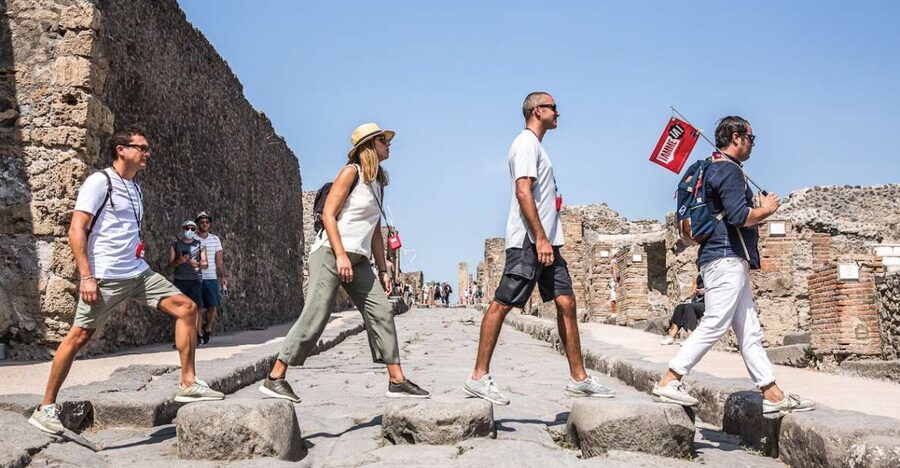
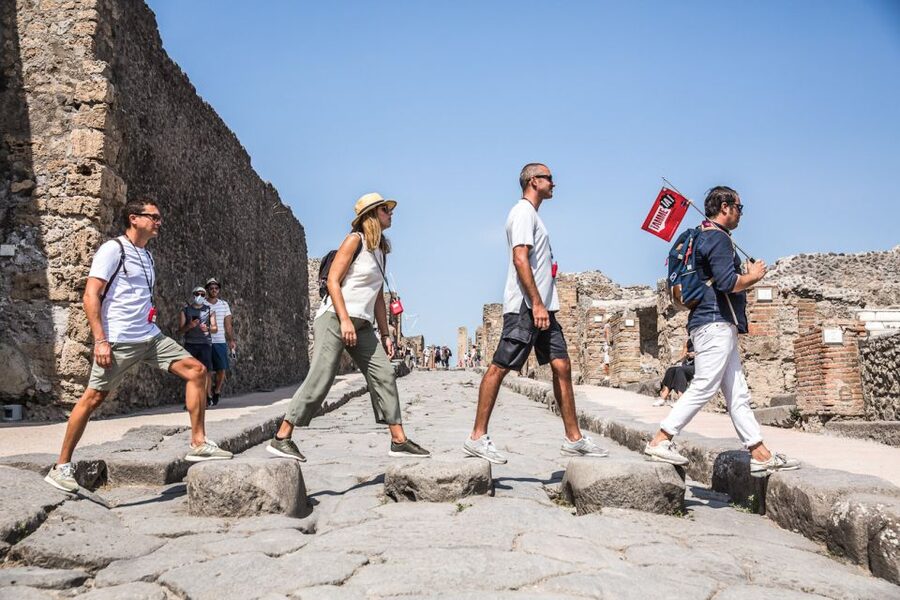
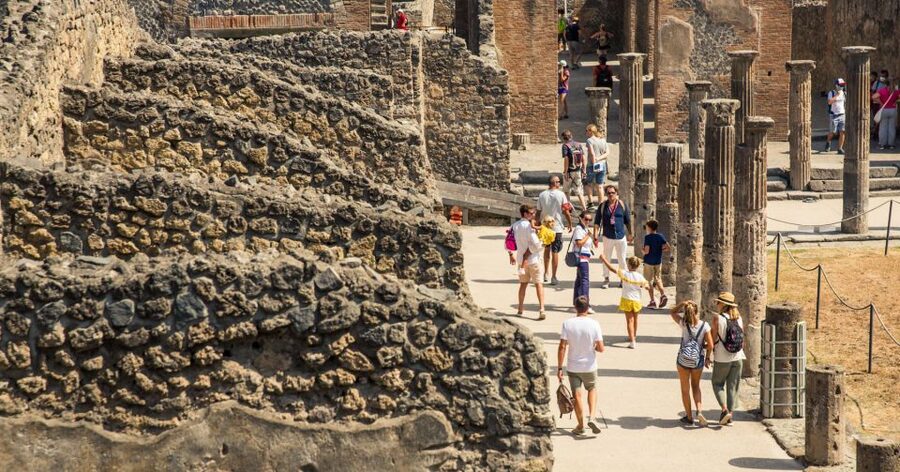
The tour continues along Via dell’Abbondanza, Pompeii’s main street. Shops and homes line the road, and deep grooves cut into the paving stones show where chariot wheels passed.
This is one of the best places to picture ordinary movement through the city. Pompeii was not only a place of temples and grand villas. It was a working town, and the street gives you clues about commerce, transport, and daily errands.
The surface is uneven, so watch your footing while listening. If you focus only on the guide, you can easily catch a toe on an ancient paving stone. Comfortable shoes are not a polite suggestion here. They are part of the ticket price you pay to your own feet.
Theater District and the Forum Baths
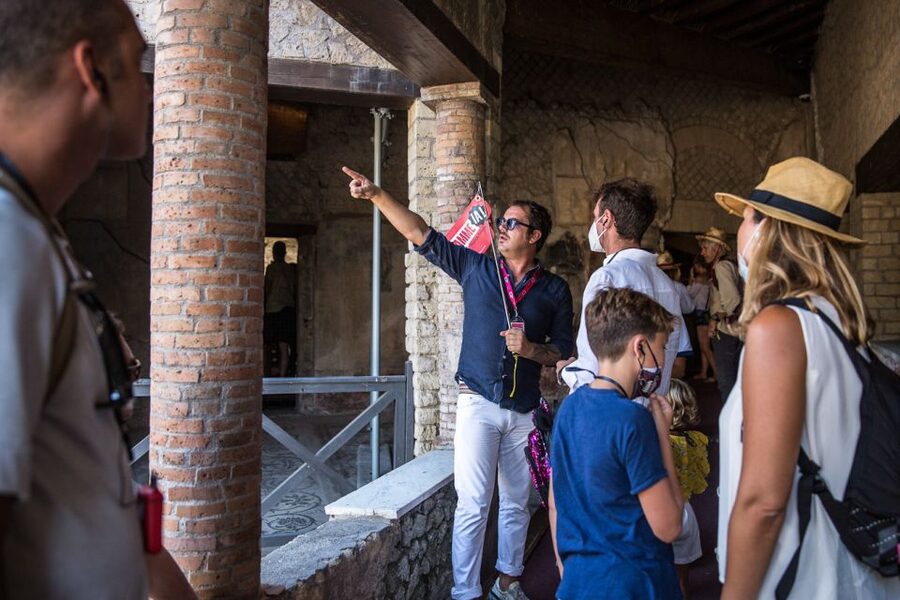
The Large Theater was an open-air venue for comedies, dramas, and musical performances. The curved seating and stage area make the social purpose of the building clear, even when parts of it are worn.
This stop adds balance to the political and commercial sections of the tour. Pompeii was not simply a city of work and worship. People came to watch performances, meet friends, and spend leisure time in public.
Nearby, the route reaches the Forum Baths, a well-preserved bath complex. Roman baths were places for washing, exercise, relaxation, and conversation. The rooms offer a more private look at daily routines than the large public forum does.
The baths are especially useful for visitors who want to understand Roman life beyond the eruption. You can see how much planning went into comfort, heating, and social spaces. Your guide can also help you read the surviving structure instead of simply walking through one room after another.
More Tickets and Entries in Italy:
- Milan: Guided Walking Tour & Last Supper Visit with Ticket
★ 4.7 · 5,409 reviews - Florence: Duomo Complex with Tickets & City Walk Guided Tour
★ 4.7 · 2,057 reviews - David & Accademia Guided Tour with Time Entry Ticket
★ 4.5 · 1,705 reviews - Pompeii: Guided Walking Tour with Entrance Ticket
★ 4.3 · 1,423 reviews
Food shops, bakeries, and the Lupanare
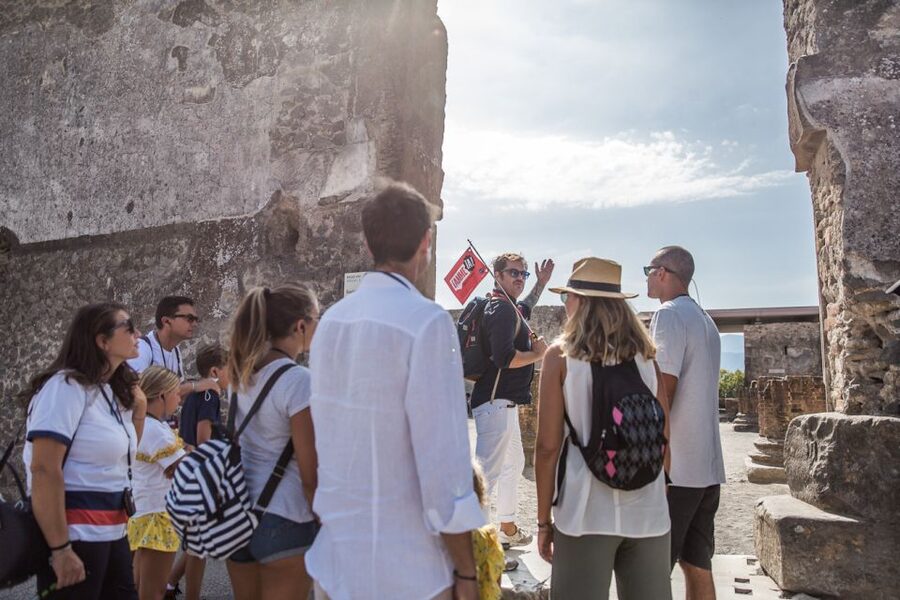
The route then turns toward the practical side of Pompeii. A Thermopolium was an ancient street food shop, where people could buy prepared meals and drinks. Its counter arrangement makes it easier to imagine residents stopping for food rather than cooking every meal at home.
The tour also includes a Pistrinum, or bakery. Millstones, ovens, and serving counters show the work behind the bread that fed the city. These are modest remains, but they often make Pompeii feel more real than the grand villas do. You are looking at the machinery of ordinary life.
The Lupanare, Pompeii’s ancient brothel, is another memorable stop. Its compact stone rooms and vivid frescoes offer a direct, sometimes uncomfortable look at commercial sex in the Roman city.
The route may pass by the Lupanare rather than take you fully inside if the line is long. That is worth knowing before you book. One earlier small-group visit avoided the queue so the guide could spend more time elsewhere. If this building is your top priority, ask about it at the start and understand that site conditions may affect the plan.
Inside the House of the Faun
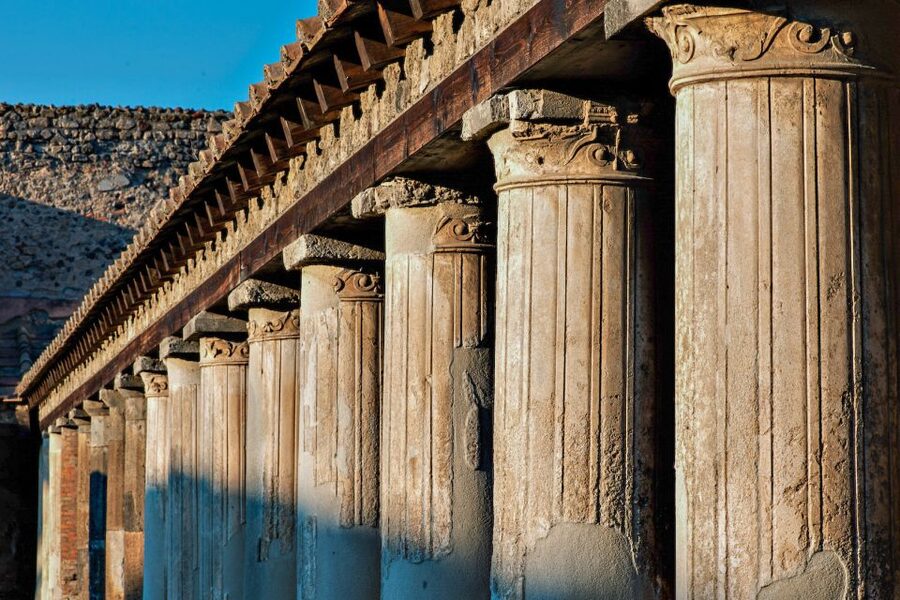
The House of the Faun is one of Pompeii’s grandest private homes. Its size and decoration show the wealth of an elite Roman household.
The major draw is its mosaic work, including the famous Alexander Mosaic, which depicts a dramatic battle scene involving Alexander the Great. This is the point where Pompeii’s domestic architecture turns into high art. The house helps you see how the city’s richest residents used space, decoration, and reception rooms to display status.
I find this stop important because it prevents a common mistake: thinking Pompeii was a uniform town of small homes and shops. It contained sharp differences in wealth. The House of the Faun lets you compare elite life with the bakery, food counter, and ordinary street homes seen earlier.
Allow yourself time to look carefully, but remember that the guide must keep the group moving. A two-hour visit cannot cover every mosaic and room at a leisurely pace.
The Macellum and the plaster casts
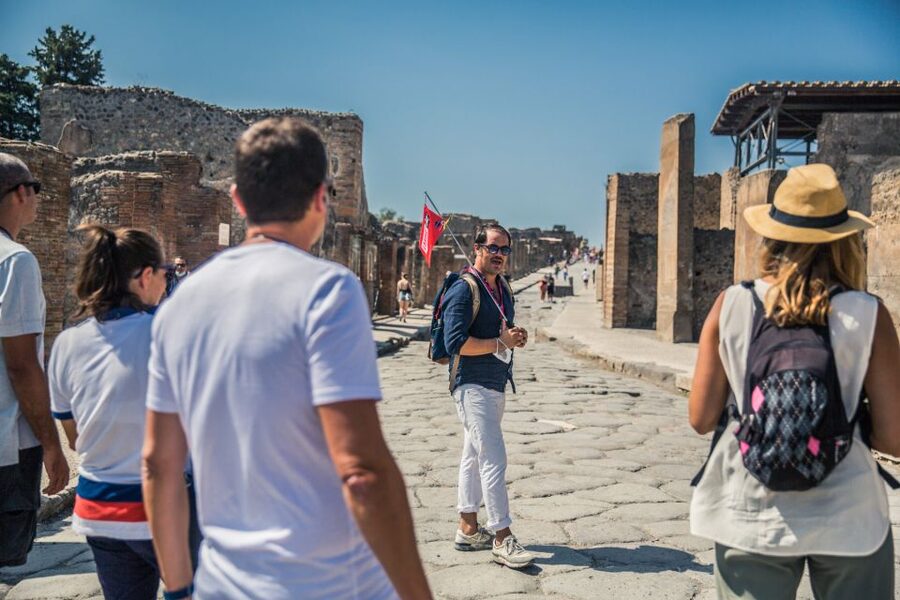
The final major stops include the Macellum, Pompeii’s food market. This was a center of trade, where the city’s daily business took place amid food, sellers, and customers.
The market is a fitting late stop because it brings together many themes from the tour: commerce, food, social life, and the practical needs of an ancient town. After seeing the public forum and the private villa, you return to the daily exchange that kept Pompeii running.
The plaster casts of eruption victims provide the tour’s most difficult moment. These casts preserve the positions of men, women, and children at the end of their lives. They are not simply archaeological objects. They make the disaster personal.
Expect this part to be emotional. The casts can change the way you see the rest of Pompeii. The streets, homes, and shops stop feeling like an ancient puzzle and start looking like places occupied by real people whose routines ended suddenly.
What the two-hour format really gives you
The advertised duration is two to two and a half hours. That is enough for a strong introduction, but it is not enough to see everything at Pompeii.
A former small-group experience found two hours to be the right length for the core sights. Another visitor was reminded that Pompeii is impossible to cover fully in two hours and used the rest of the afternoon to explore alone. That is the best way to think about this tour: it gives you structure and historical context first, then leaves room for independent wandering if your schedule allows.
The route includes many highlights, but some are guided visits while others may be pass-bys. The exact order can change, and access to individual buildings can depend on closures, queues, or site rules.
If you have only a short window, this tour is a practical choice. If you want a slow look at every house, garden, fresco, and inscription, plan extra time at the site after the guided walk.
Price, meeting point, and the transport question
At $43 per person, the tour sits in a reasonable range for a guided visit to a major archaeological site. The price includes priority access, a licensed local guide, live commentary, and headsets for larger groups. For a first visit, the guide is the main value. The ticket gets you inside, but the explanation helps you understand what you are seeing.
The starting options listed are Pompei Parking Zeus and Parking Zeus, with drop-off options at the same locations. Transportation to and from Pompeii is not included, and food and drinks are also excluded. This is important because some promotional wording refers to transfers or hydrofoil tickets, but the included services for this tour do not list transport. Confirm your booked option and plan your own way to the meeting point.
Signs at the meeting area may not always make each group obvious. One useful improvement would be clearer group markers, so arrive with your booking details ready and look for the guide at the agreed entrance point. In one case, a guide waited with a sign bearing the customer’s name, which made the meeting easy.
Free cancellation is available up to 24 hours before the start, and you can reserve now and pay later. That gives you some room to adjust a changing Italy schedule.
Heat, walking, and group size
Pompeii is exposed, and summer heat can be intense. Bring sunscreen, wear comfortable shoes, and carry water. One visitor specifically suggested an umbrella for shade, which may be useful in open sections of the site.
This is not a wheelchair-friendly tour. Uneven ancient paving and the walking route make that restriction important to consider before booking.
Group size can change the feel of the visit. A small party allows more questions and may let the guide adapt the route. In one small group, the guide tailored the commentary to individual needs and made the visit more engaging. A private option can be especially helpful for families or people with strong interests in art, architecture, food, or Roman society.
Large groups are not automatically a problem, since headsets are supplied for eight or more people. Still, a smaller group usually makes it easier to hear, stop, and take photographs without losing contact with the guide.
Who should book this Pompeii tour?
I would recommend it most strongly for first-time visitors, families, and anyone who wants the major sights explained in plain language. Children can follow the story well because the route moves between homes, theaters, food shops, and dramatic human remains rather than focusing only on dates.
The tour also suits people who are nervous about navigating a huge archaeological site. A guide can help you get your bearings and point out details you might walk past alone. Guides including Melania, Anna Rita, Lucia, Natalia, Mary, and Mariella have been praised for clear explanations, patience, and strong local expertise.
English ability can vary slightly by guide. One visitor found an accent difficult at times, though the tour remained understandable. If crisp English delivery matters to you, a private or smaller option may be the safer choice.
Should you book it?
Book this tour if you want a focused introduction to Pompeii, priority entry, and a guide who can explain why each ruin matters. At $43, it offers solid value for the route covered, especially if you have never been to the site.
Skip it if you prefer to wander alone, already know Roman archaeology well, or want to spend a full day examining minor streets and houses at your own pace. If you do book, arrive prepared for sun, stone paving, and a fast-moving two-hour visit. Then keep extra time available if you want Pompeii to reveal more than its headline sights.
FAQ
How long does the Pompeii guided tour last?
The tour lasts about 2 to 2.5 hours. This is enough for the main sights, but not for every part of the large archaeological site.
What language is the tour offered in?
Live guided tours are available in English, Spanish, French, and German. The tour may be conducted in more than one language.
What is included in the ticket price?
The price includes a local guide, live commentary, priority access to Pompeii, and audio headsets for groups of eight or more.
Is transportation to Pompeii included?
Transportation to and from Pompeii is not included. The listed meeting and drop-off options are at Pompei Parking Zeus or Parking Zeus, depending on the booking option.
Where does the tour meet?
The meeting point can vary by the option booked. The listed starting locations are Pompei Parking Zeus and Parking Zeus.
Does the tour include food or drinks?
No. Food and beverages are not included.
Can children join the tour?
Unaccompanied minors are not allowed. Children can join when accompanied by an adult.
Is the tour accessible for wheelchair users?
No. The tour is not suitable for wheelchair users. Comfortable shoes and sunscreen are recommended for all participants.
Just added around Italy
- Bergamo: Digital guide made by a local for your walking tour★ 5.0 · 184 reviews
- Full Day Tour by Car and Walking among the Apulian Beauties★ 4.5 · 182 reviews
- The Original Street Food Walking Tour in Bari★ 4.5 · 226 reviews
- Bari Walking City Tour★ 4.5 · 511 reviews
- Bari: Street Food Walking Tour with a Local Guide★ 5.0 · 160 reviews
- Bari Walking Tour with Pasta Experience★ 4.5 · 270 reviews
- Assisi Private Walking Tour including St. Francis Basilica★ 5.0 · 124 reviews
- Private St. Francis Basilica of Assisi and City Walking Tour★ 5.0 · 114 reviews
Italy Walking Tours, compared.
Doge’s Palace and St Mark’s Basilica Walking Tour
Read our review →
Guided Walking Tour & Last Supper Visit with Ticket
Read our review →
San Marco to Rialto Walk & Spritz Like a Local
Read our review →
Uffizi & Accademia Timed Entry: Small Group Duomo Walking Tour
Read our review →
Browse the lists this tour appears in