
Review · HISTORY WALKING TOURS
Hue Imperial Ancient City Walking Tour
History comes alive behind the gates. Hue’s Imperial City can look like a grand collection of walls, courtyards, and restored halls if you walk through it alone. With a local guide, the site becomes a story about emperors, family life, French rule, war, tradition, and the changing face of Vietnam.
I like the small group size, limited to 10 people, and I especially like the way guides such as Linh use old photographs, humor, and personal observations to explain what you are seeing. The $2 price is remarkable value, but you should remember that this is a tip-based experience and bring cash for the guide, as well as any site entry cost.
The main drawback is that the timing is not perfectly clear: the activity is advertised as 150 minutes, while the itinerary also describes a 3.25-hour guided visit. The pace can also feel less structured during free time, so ask your guide what you will see next.
Key points at a glance
- Linh’s storytelling gives the palace context: He explains the Nguyen emperors, French Indochina, the wars, and modern Vietnam in clear English.
- The route covers Hue’s essential royal sights: Expect the Meridian Gate, Thai Hoa Palace, Dien Tho Palace, and the Forbidden City.
- A $2 booking price offers exceptional value: The experience is tip-based, so plan to carry cash even though the booking price is very low.
- Small groups make questions easy: Groups are capped at 10, and bookings for groups larger than six people are not accepted.
- You get time beyond the guided commentary: The tour includes pauses for photographs, rest, and some independent exploration.
- Come prepared for a walking site: Wear comfortable shoes, carry water and sunscreen, and provide a working WhatsApp or Vietnamese phone number.
Why Hue’s Imperial City needs a guide
The Imperial City is one of Hue’s most important historical places, but its meaning is not always obvious from the buildings alone. A gate is not just a gate here. Its position, decoration, and use tell you something about how the Nguyen court worked.
The Nguyen Dynasty ruled Vietnam from 1802. The imperial complex was designed as a royal center, with formal spaces for ceremonies, private areas for the emperor, residences for senior members of the royal family, and controlled entrances between them.
That arrangement is easier to understand when someone points it out in sequence. You begin to see the city as a working institution rather than a collection of photogenic ruins.
This is where the tour earns its small price. Linh has been praised for making the past relevant to the people standing in front of him. His explanations cover more than dates and names. He connects palace rules with family customs, social pressure, Vietnamese traditions, French colonial control, and the struggle for independence.
That wider setting matters. If you only want a quick walk through attractive buildings, you can explore independently. If you want to understand why the buildings were placed where they were and what life inside them involved, a guide makes the visit far more useful.
More History Walking Tours in Vietnam:
- Hoi An: Ancient Town Guided Walking Tour
★ 4.9 · 766 reviews - Hoi An Ancient Town – Walking Tour with Local Guide
★ 4.9 · 385 reviews - Hanoi: Cho Gioi Vietnam War History Walking Tour
★ 5.0 · 102 reviews
Meeting at the Imperial City ticket office
The meeting point is in front of the Imperial City ticket booth. Tours begin at 9:00 AM and 3:00 PM, and the operator contacts you beforehand to confirm the exact time.
The location is practical because you do not need to arrange transport to a distant starting point. Still, the Imperial City is a large site, so give yourself enough time to arrive at the ticket office without rushing.
The pre-tour WhatsApp messages are another useful touch. Clear communication has helped people find the meeting point and understand the arrangements before arriving. A valid WhatsApp number or Vietnamese phone number is required, mainly to reduce missed meetings and make last-minute contact possible.
Bring water and sunscreen. Hue can be hot, and much of the visit takes place outdoors. Comfortable walking shoes are essential, even though the route is not presented as a strenuous hike.
The tour is wheelchair accessible, but the site contains a mixture of open courtyards, historic structures, and walking areas. If you need specific assistance, confirm the details before booking rather than assuming every part of the route will be equally easy.
Meridian Gate: entering the royal world
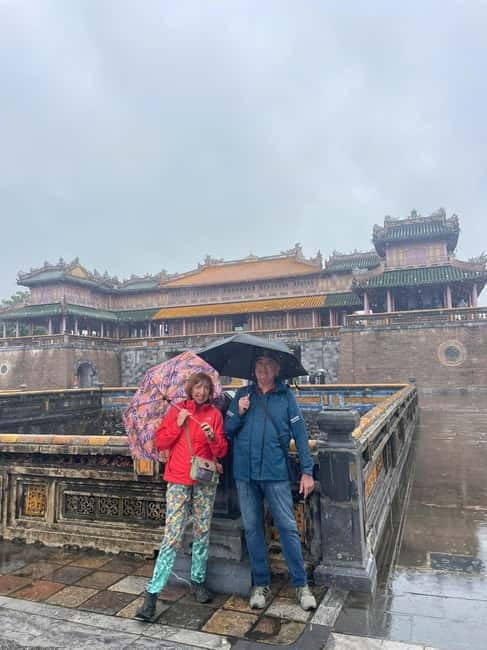
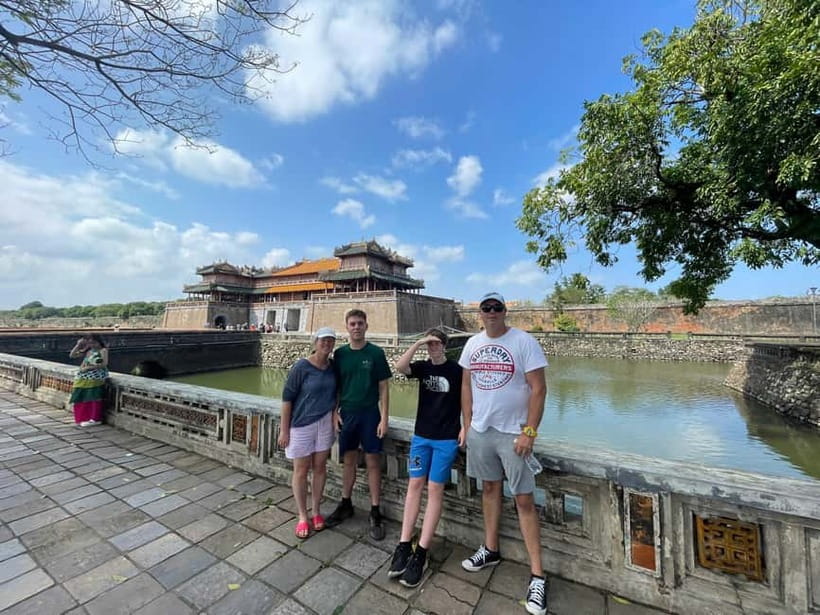
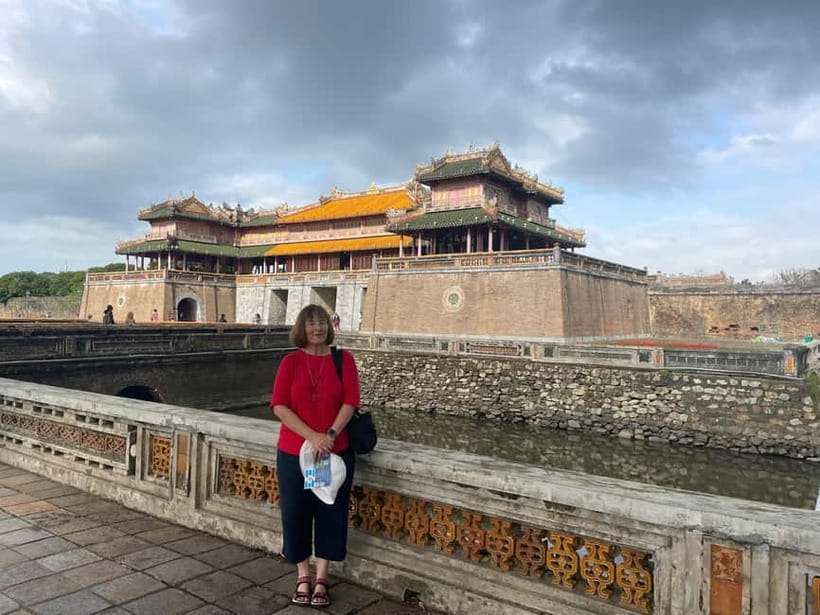
The Meridian Gate, or Ngo Mon Gate, is the natural opening chapter of the visit. It was the main entrance into the Imperial City, and its scale immediately tells you that this was not an ordinary residence.
This is a good place for the guide to explain the layout of the complex. You learn how the outer Citadel, Imperial City, and more private royal areas related to one another. The point is not simply to memorize the names. It is to understand the layers of access and authority.
Expect the guide to pause here for photographs and orientation. It is also a useful moment to ask questions, because the rest of the walk makes more sense once you know where the ceremonial and private zones begin.
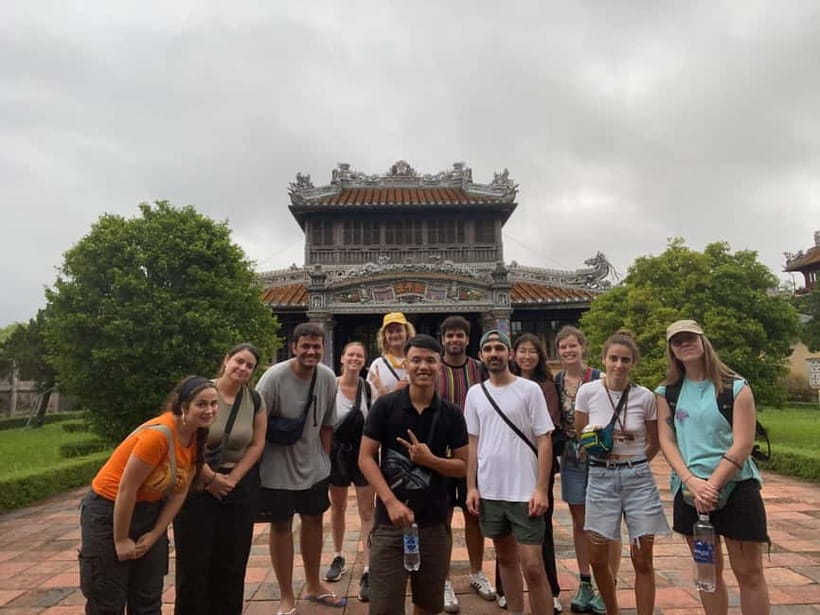
The gate is impressive, but it can also feel crowded or visually busy depending on the time of day. A small group helps. Ten people is still enough for a lively exchange, yet it is far easier to hear one guide than in a large coach group.
Thai Hoa Palace and the rituals of power
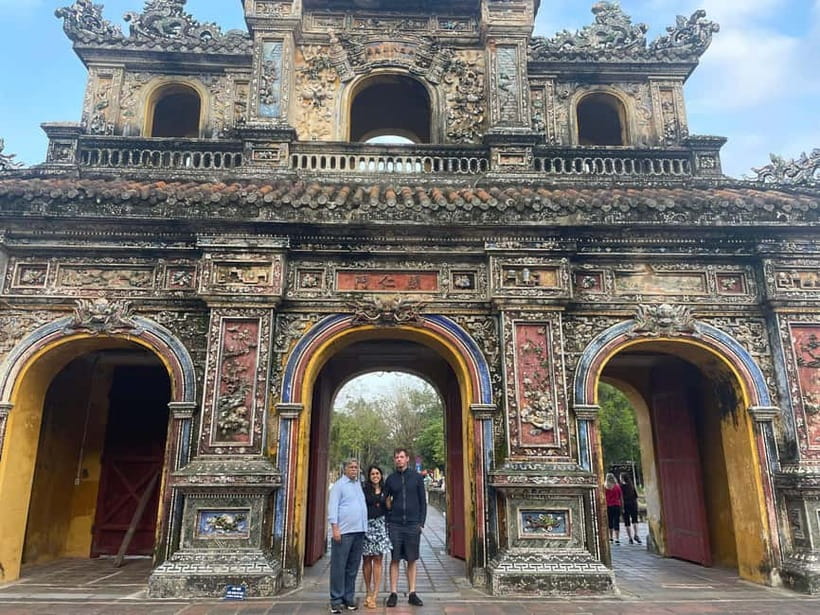
Thai Hoa Palace, the ceremonial main hall, shows how the Nguyen court presented royal authority. This was a place of formal events, not casual family life.
The guide’s explanation helps you imagine the strict order of court ceremonies. Position, movement, clothing, and access all mattered. A palace like this was designed to make hierarchy visible.
The building is also a good reminder that architecture can carry political meaning. The broad ceremonial setting and carefully planned approach were part of the message: the emperor occupied the center of an organized royal system.
The site has suffered damage over time, and restoration is part of what you see. That is not a reason to skip it. In fact, the contrast between surviving structures, repaired areas, and absent buildings helps explain how much the complex has endured.
I appreciate that the guides do not limit the story to the Nguyen period. Linh has also explained French colonial rule and the way it shaped Vietnam’s later fight for independence. That connection gives Thai Hoa Palace a place in a much longer national story.
A few more walks around Vietnam worth a look
- Private Street Food Evening Walking Tour in Ho Chi Minh City
★ 5.0 · 3,175 reviews - [HOT] Hanoi Old Quarter Walking Street Food – Small Group Tour
★ 5.0 · 2,163 reviews - Super Niche Walking Street Food Tour in Ho Chi Minh City
★ 5.0 · 1,636 reviews - Private Walking Tour of Hanoi City
★ 5.0 · 1,251 reviews
Dien Tho Palace and royal family life
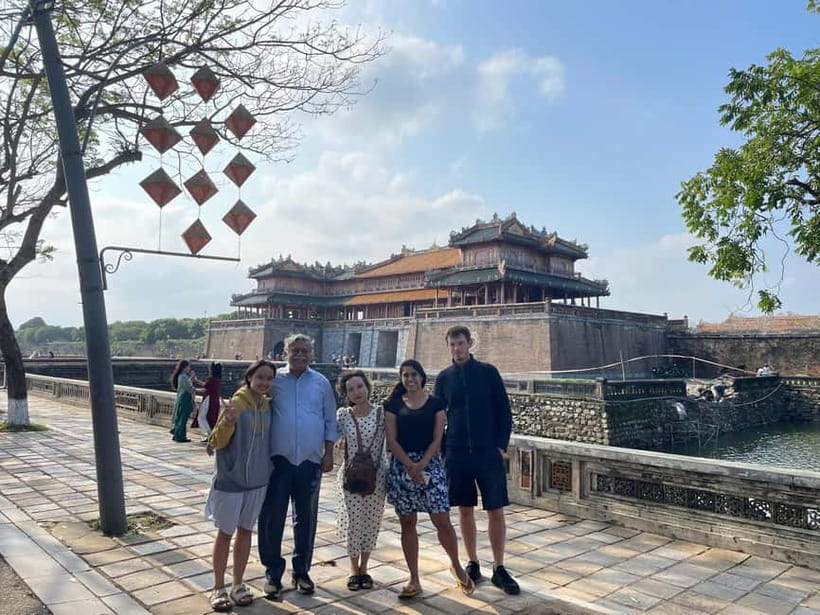
Dien Tho Palace offers a different view of the court. It was the residence of the queen mother, so the emphasis shifts from public ceremony to royal household life.
This stop can help you picture the family structure behind the official image of the dynasty. The imperial court was not only emperors and formal audiences. It was also a network of relatives, obligations, customs, and pressures.
That human detail is one of the tour’s strongest features. The guides explain traditions and family expectations in a way that connects the palace to Vietnamese life beyond the walls. Linh has also shared observations about family pressure and the experience of being a Vietnamese man, giving the historical discussion a personal angle.
You should not expect every room to be open or every detail of daily life to be fully visible. Much of the value comes from interpretation. Without explanation, a residence can look quiet and restrained. With context, it becomes a place linked to rank, family authority, and the private side of the monarchy.
The Forbidden City and the emperor’s private area
The Forbidden City was the most private part of the royal complex. Its name alone suggests how carefully the court controlled access, and the guide explains how this section differed from the public ceremonial areas.
This is often the part of the walk where the story becomes especially vivid. You hear about the emperors, their households, the final ruler, and the people who lived and worked within the court system.
The buildings and grounds have not all survived intact, so you may need to use your imagination. That is where old photographs are helpful. Linh has used images showing how the site looked during different periods, allowing you to compare the present remains with earlier views.
The Forbidden City also brings the modern history of Hue into sharper focus. War damaged parts of the complex, and the condition of the site reflects more than age. A good explanation helps you read the gaps, repaired walls, and empty spaces as part of Vietnam’s recent past.
Allow time to look around after the main commentary. One visitor stayed until sunset after the guided portion, which makes sense if you want photographs or a quieter look at the architecture. The formal tour gives you a framework, but independent time lets you absorb the place at your own speed.
The guides make the difference
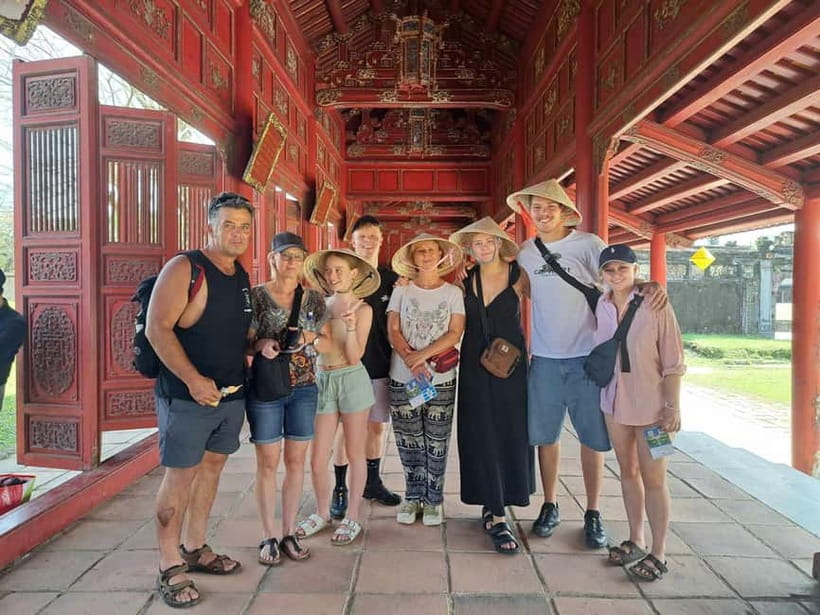
Linh Nguyen is the main name associated with this experience, and the praise for his presentation is consistent. His English is described as strong, his style as funny and engaging, and his historical explanations as detailed without becoming dry.
He uses visual aids and photographs, answers questions, and makes an effort to include people from different countries in the conversation. That matters in a small group. You are not simply following a flag through the site. You can ask about the emperors, the buildings, Vietnamese customs, or the impact of the war.
Other guides, including Thanh, Thang, Kun, and Lin, have also led tours. The feedback points to a friendly and informative approach across the guiding team, though Linh appears most often in the available comments.
The best guides add local perspective without turning the tour into a personal lecture. Linh has recommended Hue specialties such as bun bo Hue, as well as places to eat and royal tombs to visit. Those suggestions are useful because the Imperial City is only one part of a Hue visit.
The style is not perfectly formal. One person found the breaks and free-walking areas a little unclear. I would solve that by asking a simple question before separating from the group: What will we cover next, and which areas should I see now? That small clarification should prevent confusion.
Is two and a half hours enough?
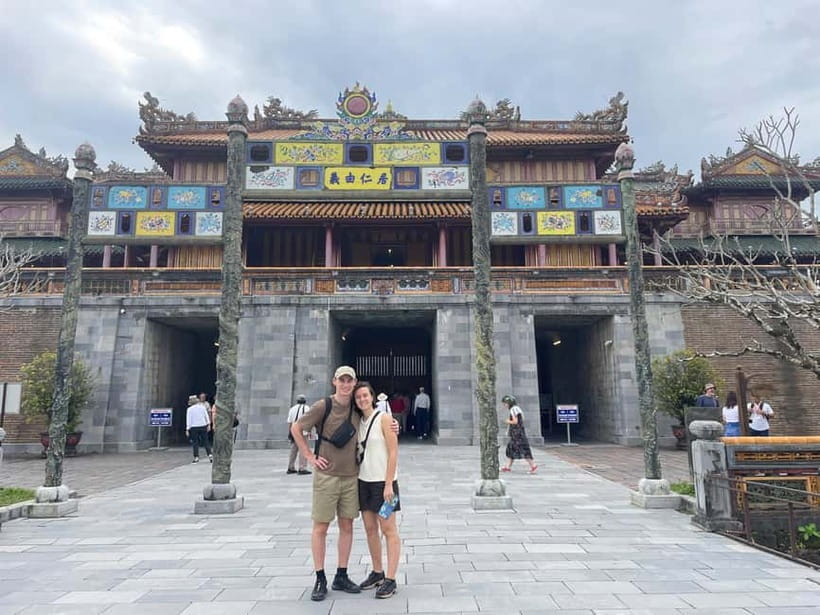
The advertised duration is 150 minutes, or two and a half hours. That is a sensible amount of time for a focused introduction, but the Imperial City is large and has more to see than any short guided walk can cover.
The itinerary also describes a 3.25-hour guided tour, and several experiences have lasted closer to three hours. Because the published timing is not fully consistent, check the confirmed schedule before you arrive and keep some flexibility in your day.
The pace seems designed to balance explanation with rest. You walk between key locations, stop for stories, take photographs, and get some time to explore on your own. That is better than a nonstop march, especially in warm weather.
You should still expect plenty of walking. If you have limited stamina, the morning departure may be more comfortable than the afternoon option, though the best choice depends on the heat and your schedule.
The $2 price and the tip question
At $2 per person, this is exceptional value if you want historical context at a very low booking cost. You are paying almost nothing for a small-group English tour through one of Hue’s major sights.
The important detail is that the experience is tip-based. Tips are at your discretion, but you should carry cash if you feel the guide has made your visit more meaningful. Several people specifically appreciated receiving guidance about the usual tip amount in advance.
Also keep cash available for the Imperial City entry ticket if it is not included in your booking arrangement. The tour price covers the walking tour and local guide, not every possible site cost.
This is not a reason to avoid the experience. It is simply part of budgeting. The advertised price may look like the full cost, but you should confirm admission arrangements and decide in advance what you want to offer the guide.
Free cancellation up to 24 hours before the start and reserve-now, pay-later booking add flexibility. Those terms are useful if your Hue plans may change.
Who will enjoy this walk most?
I would recommend this tour to first-time visitors who want a clear introduction to Hue’s royal past. It is also a good choice for couples, solo visitors, families, and small groups who prefer conversation to a large organized outing.
You will get the most from it if you enjoy history, architecture, local customs, and stories about people rather than just taking photographs. The tour is especially useful if the Nguyen Dynasty, French Indochina, or Vietnam’s modern history is unfamiliar to you.
It may be less suitable if you want complete solitude, a fast visit, or a strictly fixed route with no pauses. The guide allows time for questions and independent looking, which some people value and others may find slightly loose.
Groups larger than six people, including children, are not accepted even if you make separate reservations. Larger parties need to contact the operator about a custom arrangement. The standard group limit is 10 people.
Should you book the Hue Imperial Ancient City Walking Tour?
Yes, if you want the Imperial City to make sense rather than simply look beautiful. The combination of a low price, small group, English commentary, and strong local storytelling makes this one of the easiest ways to add meaning to a Hue visit.
Book it early if you want a specific morning or afternoon time, since only 10 places are available. Send a working WhatsApp or Vietnamese phone number, arrive at the ticket booth with water and sunscreen, and bring cash for the guide and possible admission costs.
I would choose the morning if you prefer cooler walking conditions, then return later for your own photographs and a slower look. If you want the best value from your time in Hue, this tour gives you the historical framework you need before visiting the city’s other royal sites.
FAQ
How long does the Hue Imperial Ancient City Walking Tour last?
The activity is advertised as 150 minutes. The itinerary also describes a 3.25-hour guided visit, so confirm the expected timing when your booking is confirmed.
What time does the tour start?
Tours meet at 9:00 AM or 3:00 PM. The operator contacts you before the tour to confirm the designated time.
Where is the meeting point?
Meet in front of the Imperial City ticket booth, at the Hue Imperial City Ticket Office.
What places are covered?
The experience focuses on Hue Imperial City and includes the Meridian Gate, Thai Hoa Palace, Dien Tho Palace, and the Forbidden City.
Is the tour conducted in English?
Yes. The tour has a live English-speaking guide.
How many people are in each group?
The group is limited to 10 participants. Bookings are not accepted for groups larger than six people, including children, even if separate reservations are made.
What should I bring?
Bring comfortable walking shoes, sunscreen, and water. Carry cash if you plan to tip the guide or need to pay for site entry.
Can I cancel or pay later?
You can cancel up to 24 hours in advance for a full refund. Reserve-now, pay-later booking is also available.
Just added around Vietnam
- Ho Chi Minh City: Super Niche Walking Street Food Tour★ 5.0 · 438 reviews
- Hanoi: Street Food Walking Tour & Water Puppet Show★ 4.8 · 205 reviews
- Saigon: Private Backstreets Walking Food Tour★ 4.9 · 83 reviews
- Ninh Binh Sunset Tour And Visit Hoa Lu Walking Town At Night★ 4.4 · 94 reviews
- Hue Imperial City Walking Tour: Citadel & Forbidden City★ 4.8 · 245 reviews
- Hoi An Ancient Town – Walking Tour with Local Guide★ 4.9 · 385 reviews
- Hoi An: Ancient Town Guided Walking Tour★ 4.9 · 766 reviews
- Hoi An/Da Nang: Private Photoshoot & Guided Walking Tour★ 5.0 · 160 reviews
History Walking Tours, compared.
History and Hauntings of Salem Guided Walking Tour
Read our review →

Freedom Trail History Small Group Walking Tour
Read our review →
Historic Charleston Guided Sightseeing Walking Tour
Read our review →
Tapas Walking Tour with Food, Wine, and History
Read our review →
Savannah History and Haunts Candlelit Ghost Walking Tour
Read our review →
A History of Terror – Belfast City Centre Walking Tour
Read our review →Browse the lists this tour appears in