
Review · GERMANY WALKING TOURS
Augsburg: Walking Tour with Fuggerei
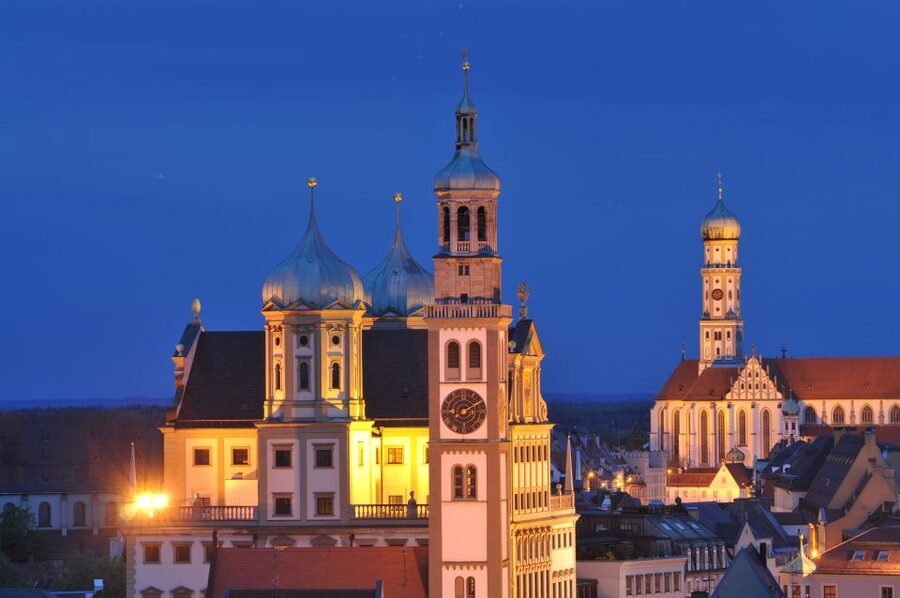
Augsburg tells big stories in small spaces. This two-hour walking tour links the old town’s fountains, canals, and historic buildings with the Fuggerei, the world’s oldest social settlement. I like that it gives you both grand city sights and a close look at everyday life.
I especially like the included Fuggerei entrance and the chance to hear how Augsburg shaped the Fugger banking family, Mozart’s family, and playwright Bertolt Brecht. The main drawback is the fixed pace: two hours is enough for an introduction, but not enough for long visits at every stop.
Choose the 11 AM German tour or the 2 PM German and English tour. From July 19 through the end of September, Thursday through Sunday, an extra English group runs at 2 PM. Bring headphones, your smartphone, and an internet connection if you want to use the optional free elysium® sound system.
Key points to know before booking
- Fuggerei entry is included, giving you access to Augsburg’s most distinctive historic social settlement.
- The 2 PM tour includes Römerlager and Brechthaus, adding Roman and literary history to the city walk.
- Augsburg’s UNESCO-listed water system appears along the route, including old Lech canals and impressive fountains.
- The Augustus Fountain is a memorable stop, with its gentle water sounds and ornate 16th-century design.
- You can follow Mozart and Brecht’s Augsburg connections, not just the better-known Fugger story.
- At $22, the tour offers solid value, especially if you want a guided orientation and two included admissions.
Why Augsburg works so well on foot
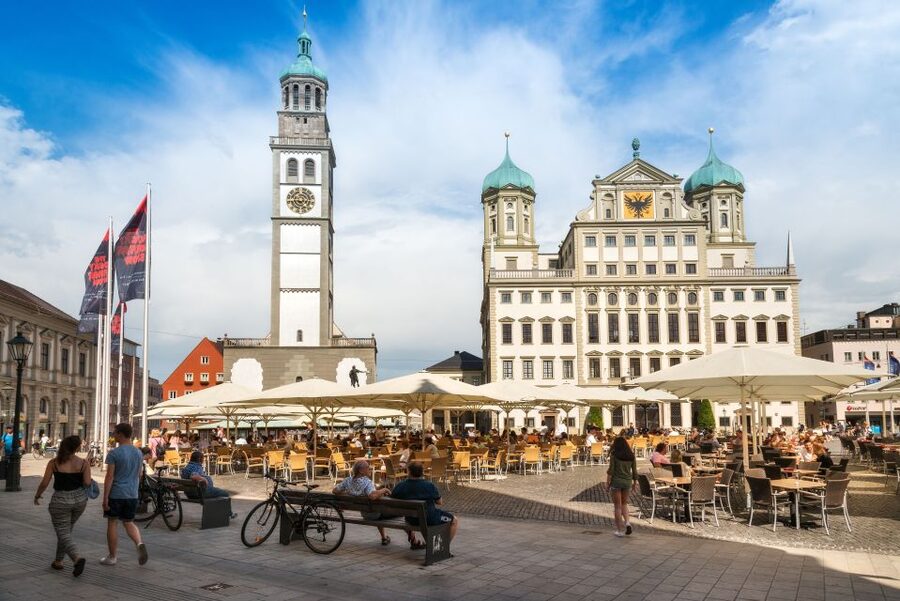
Augsburg is one of those cities where a short walk covers a surprising amount of ground. The old town brings together Roman beginnings, Renaissance wealth, industrial and literary connections, and a working water system recognized by UNESCO.
That mix makes this tour more useful than a simple parade of pretty buildings. You get a framework for understanding why Augsburg mattered, who shaped it, and how its canals and fountains fit into daily city life.
The route begins at the Tourist-Information Augsburg, a sensible meeting point in the center. You do not need a hotel transfer, and the experience stays on foot from there. At two hours, it fits neatly into a morning or afternoon in the city.
I would use this tour early in your Augsburg visit. The guide can point out other sights worth returning to, and one recent participant found the tour useful for learning about additional places to see after the walk. That is one of the best uses of a short city tour: get your bearings, then choose where to spend more time on your own.
A few more walks around Germany worth a look
- Discover Berlin Half-Day Walking Tour
★ 5.0 · 9,624 reviews - Berlin City walk Government District and Places of Democracy
★ 4.7 · 8,467 reviews - Berlin: Third Reich & Cold War Guided Walking Tour
★ 4.9 · 8,378 reviews
The Augustus Fountain and Augsburg’s public face
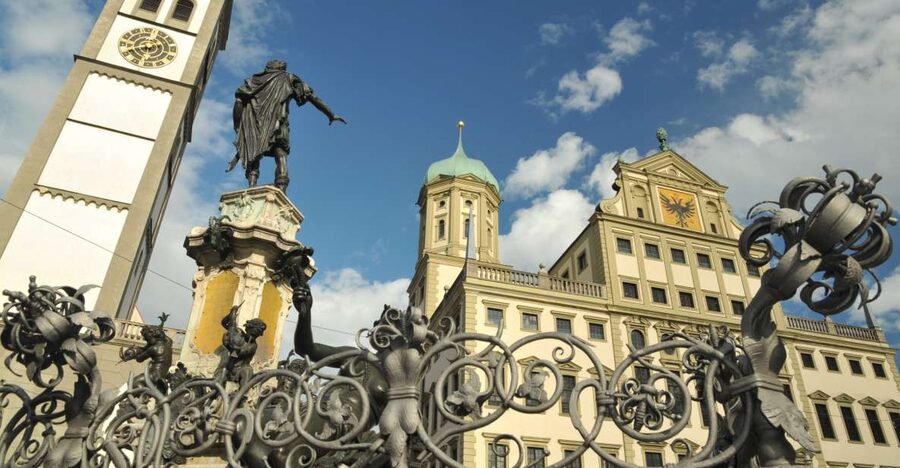
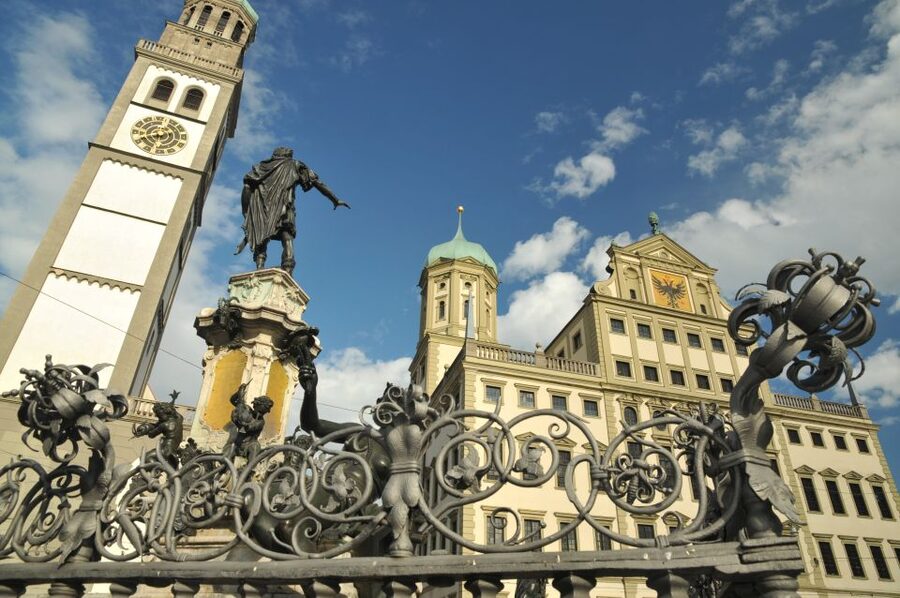
The Augustus Fountain gives the walk a strong visual and sensory opening, or at least one of its most memorable pauses. This ornate fountain dates from the 16th century, a period when Augsburg’s wealth allowed the city to make a very public display of its power.
Listen for the gentle splash of water as you look over the fountain’s detailed design. It is a small pleasure, but it helps you read the city differently. Augsburg’s water features are not random decorations. They connect to the wider water system that helped the city grow and function.
The fountain also shows how Augsburg’s civic pride was put on display. A guide can explain the figures and symbols more clearly than a quick glance from a passing visitor. You will get more from the stop if you pause to look closely instead of treating it as a fast photo break.
The tour also passes other magnificent fountains in the city center. Since the experience is guided, you can ask how these works relate to Augsburg’s wealth, public life, and water management. The exact amount of time at each fountain depends on the group and the guide, so do not expect a long formal lecture at every one.
Following the Lech canals and UNESCO water system
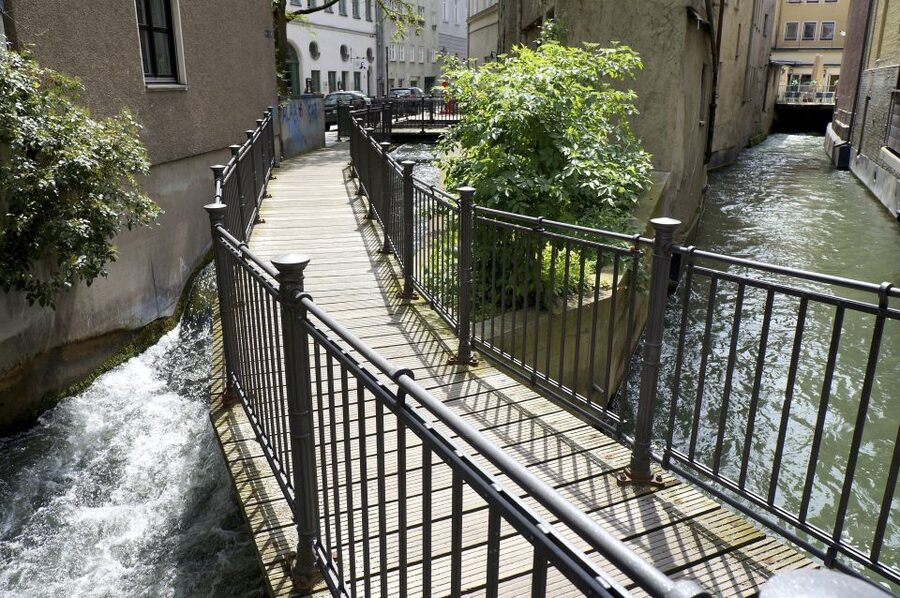
Augsburg’s canals are among the most unusual parts of this city walk. The Lech canals form part of the water system recognized by UNESCO, and they show that Augsburg’s identity was shaped by water as much as by banking and architecture.
You will pass sections of this network while moving through the old town. The canals add sound and movement to the route, while the guide supplies the practical context: why water mattered, how it was used, and why the system deserves international recognition.
This part of the tour is especially helpful if you prefer seeing how a city worked rather than only looking at grand facades. Fountains are the public face of the system, but canals reveal the infrastructure behind it.
Do not expect a separate museum visit focused only on the canals. Their value here comes from seeing them in place and connecting them with other stops. If you enjoy technical or urban history, listen closely during this section and ask questions.
The Fuggerei, Augsburg’s most distinctive stop
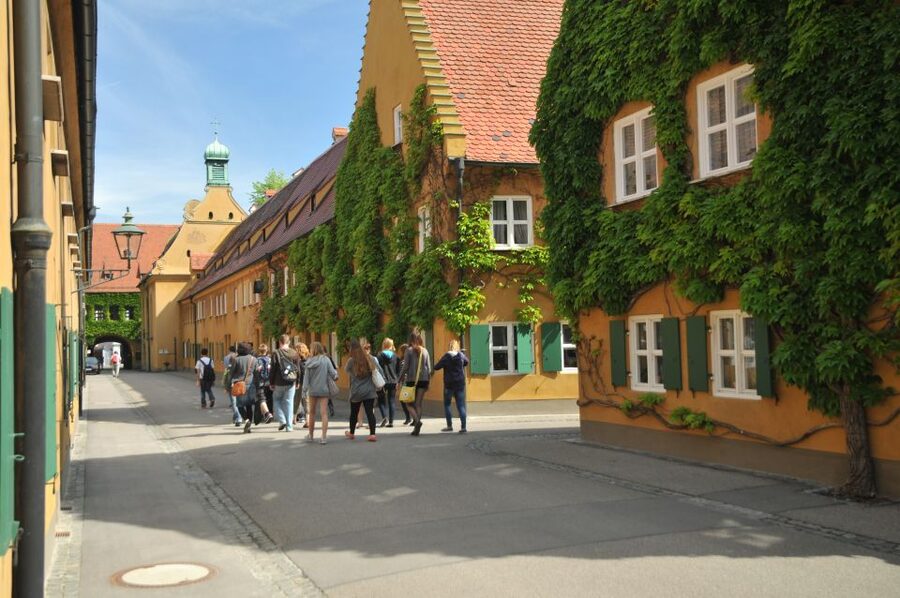
The Fuggerei is the clearest reason to book this experience. Your admission is included, and the tour takes you into the world’s oldest social settlement. It is not simply another old quarter. It reflects an organized attempt to provide housing for people in need, tied to the Fugger family and Augsburg’s powerful banking past.
The Fugger family was a prominent upper bourgeois family of European bankers. Their influence shaped Augsburg, and the Fuggerei gives that story a human scale. Instead of only hearing about money, trade, and status, you see how wealth was directed toward a lasting social project.
Plan to pay attention to the settlement’s purpose, not only its appearance. The visit is most interesting when you consider the connection between private wealth and public responsibility. A recent visitor described the Fuggerei visit as a must and appreciated the useful information and friendly encounters there. That matches the appeal of the place: it feels more personal than a grand palace or church interior.
The Fuggerei is also where the tour may feel most grounded. Augsburg’s fountains and historic buildings show the city’s public wealth. The Fuggerei asks a different question: how did that wealth affect ordinary residents?
Because the full tour lasts only two hours, your time inside the settlement will be limited. I would return independently if you want to inspect every corner or read every sign. Still, having the guide introduce the place first gives you a better starting point than arriving without context.
Same streets, a different way to see them:
- Munich: Third Reich & WWII Walking Tour
★ 4.6 · 6,181 reviews - Berlin: Discover Berlin Walking Tour
★ 4.9 · 5,998 reviews - Berlin’s Best: 2 Hour Walking Tour Third Reich and the Cold War
★ 5.0 · 5,486 reviews - Berlin: Hidden Backyards Guided Walking Tour
★ 4.8 · 5,360 reviews
Roman Augsburg and the Brecht connection
The 2 PM option includes entry to the Römerlager/Brechthaus at 2 PM. This pairing brings together two very different sides of Augsburg: its Roman past and its literary identity.
Römerlager points to the city’s Roman foundations. Even a brief visit helps place Augsburg on a much longer timeline. Before the Fugger family, the fountains, and the modern city, Augsburg was part of the Roman world. The stop adds useful depth to the walk without requiring a separate full-day archaeological visit.
Brechthaus connects the city with Bertolt Brecht, one of Germany’s major playwrights. The tour lets you follow the traces of famous people linked to Augsburg rather than treating the city as only a story of merchants and monuments.
The Brecht connection is a good reminder that cities are shaped by artists as well as bankers. If you know Brecht’s work, you may want extra time here. If you do not, the stop still adds a cultural layer to the tour and gives you a reason to explore more of Augsburg after the guided walk.
Be careful when choosing your start time. The 2 PM option is the one connected with the Römerlager/Brechthaus admission at 2 PM, while the 11 AM tour is in German. If those sites matter to you, check the selected option carefully before paying.
Mozart, the Fugger family, and personal stories
The tour follows traces of several famous figures, including Wolfgang Amadeus Mozart. His father was born in Augsburg, so the connection is not that Mozart lived his entire life here. It is a family link, and that distinction matters.
A good city tour uses details like this to show how people, families, and ideas moved across Europe. Augsburg was not isolated. Its banking family had European reach, and its connection to Mozart adds another thread to the city’s wider cultural network.
The Fugger story is more firmly rooted in Augsburg itself. Their banking success helped shape the city’s buildings, institutions, and social projects. The guide’s job is to connect the impressive architecture with the people who paid for it and the systems that supported it.
I appreciate that the route includes Brecht and Mozart alongside the Fugger family. You get a wider view of Augsburg, with no single famous name swallowing the whole story. The result is a walk about commerce, music, literature, public works, and housing.
What the two-hour format means for you
Two hours is a useful length for a first visit. You can cover major points without giving up an entire day, and you still have time afterward for a meal, museum, or independent wandering.
The trade-off is limited time at each stop. This is an overview, not a slow study tour. You will hear about the old town, see UNESCO-related sights, enter the Fuggerei, and visit the Römerlager/Brechthaus on the relevant option. You will not have unlimited time to read every display or linger at every fountain.
The pace should suit most people who are comfortable walking through a city center. The tour is listed as wheelchair accessible, and it stays within Augsburg’s central sights. Since it is a walking experience, wear shoes you can manage for two hours and allow enough time to reach the Tourist-Information Augsburg before the start.
The optional elysium® sound amplification system may help you follow the guide in a busy street setting. It is free, but you need your smartphone, headphones, and an internet connection. If you do not want to use it, bring your own attention and stay close enough to hear the guide clearly.
German, English, and the best time to go
The 11 AM tour is in German. The 2 PM tour is bilingual in German and English, with an additional English group available from July 19 through the end of September, Thursday through Sunday.
If you need English, do not assume every 2 PM departure has the same format throughout the year. Select the correct English option during booking for that summer period. This is a small detail, but it can determine how much you follow the explanations.
The bilingual tour may take slightly more time to cover the same material because information is presented in two languages. That is not a problem if you value access to English, but it is worth knowing if you want the fastest possible German-only presentation.
The guide is live, and German and English are listed as available languages. A live guide also means you can ask about other Augsburg sights, which is useful since the tour only introduces the city.
Is $22 good value?
At $22 per person, the price is fair for a two-hour guided walk with Fuggerei admission and, on the 2 PM option, Römerlager/Brechthaus entry. You are paying for more than a walk past buildings. The cost includes a local guide, an organized route, and access to places you might otherwise visit without much context.
The value is strongest if you are new to Augsburg or have only a few hours. Paying separately for admissions and then finding the sites on your own may not save much, and you would lose the connections between the water system, Fugger family, Mozart, Brecht, and Roman Augsburg.
The value is weaker if you already know the old town well or prefer to spend an hour at one site. Independent exploration gives you more control, while this tour gives you structure. At this price, I would choose the tour for orientation, then return to the Fuggerei or Brechthaus if one catches your interest.
The activity has a 4.6 rating from 2,245 reviews, which supports the idea that it delivers a dependable introduction. The strongest praise focuses on the informative, interesting presentation and the Fuggerei visit. That is exactly where the tour earns its price.
Who should book this Augsburg walk?
I would recommend it to first-time visitors, couples, families with older children, and anyone who wants Augsburg explained rather than simply photographed. It also suits people arriving for a short stay, since the two-hour route covers several key themes without taking over your day.
History fans will like the range of subjects, from Roman Augsburg to the Fugger family and the UNESCO water system. Literature and music fans get the Brecht and Mozart connections. Architecture lovers will enjoy the fountains and old-town streets, while practical-minded visitors can see how canals supported city life.
You may want to skip it if you dislike guided pacing or want long, quiet visits inside museums. The tour is also less useful if you already have a detailed plan for the Fuggerei and Brechthaus. For most first visits, though, the combination of access, context, and modest cost makes sense.
Book the 2 PM option if the Römerlager/Brechthaus visit matters to you, and check the language choice with care. Canceling is free up to 24 hours in advance, and you can reserve now and pay later, which gives you some room if your schedule is still changing.
Should you book the Fuggerei walking tour?
Yes, if you want a clear first look at Augsburg with the Fuggerei as the main prize. I like the way the tour links grand public works with personal stories and social questions. The Augustus Fountain, Lech canals, Fugger family, Mozart, and Brecht all make more sense when you see them as parts of one city.
Choose the 11 AM German departure for the morning schedule. Choose the 2 PM option for the bilingual tour and the Römerlager/Brechthaus admission. Just remember that two hours gives you a strong introduction, not a full study of Augsburg.
FAQ
Where does the Augsburg walking tour begin?
The meeting point is the Tourist-Information Augsburg.
How long does the tour last?
The guided walking tour lasts two hours.
What languages are available?
Tours are available in German and English. The 11 AM tour is in German, and the 2 PM tour is bilingual in German and English.
Is there an English tour in summer?
From July 19 through the end of September, Thursday through Sunday, an extra English group runs at 2 PM. You should select the option labeled Ticket English July-September during booking.
Is admission to the Fuggerei included?
Yes. The entrance ticket to the Fuggerei is included in the activity.
Is admission to the Römerlager/Brechthaus included?
Yes, for the option connected with the 2 PM visit. The included admission is listed at 2 PM.
Is the tour wheelchair accessible?
Yes, the activity is listed as wheelchair accessible.
What should I bring for the optional sound system?
Bring your smartphone, headphones, and an internet connection if you want to use the free elysium® sound amplification system.
Just added around Germany
- Berlin Walking Tour★ 4.5 · 378 reviews
- Berlin Highlights Private Guided Walking Tour★ 4.5 · 89 reviews
- Small Group Walking Tour of East Berlin with a French Guide★ 5.0 · 176 reviews
- Berlin Street Art Walking Tour – Off The Grid★ 5.0 · 270 reviews
- Private Walking Tour: World War 2 and Cold War Sites in Berlin★ 5.0 · 230 reviews
- East Meets West: Berlin Food Culture & Street Art★ 5.0 · 157 reviews
- Kreuzberg Berlin: Off the Beaten Track PRIVATE Walking Tour★ 5.0 · 128 reviews
- The History of Berlin: WWII PRIVATE Walking Tour With Locals★ 5.0 · 209 reviews
Germany Walking Tours, compared.


Berlin City walk Government District and Places of Democracy
Read our review →

Berlin’s Best: 2 Hour Walking Tour Third Reich and the Cold War
Read our review →

Explore Berlin: See All The Iconic Sights & Some Hidden Gems
Read our review →Browse the lists this tour appears in