
Review · STREET ART WALKING TOURS
Belfast Troubles Murals Street Art and Peace Wall Walking Tour
Belfast tells its story on walls. This three-hour walk moves from modern street art in the Cathedral Quarter to Loyalist and Republican murals, the Peace Wall, and Bobby Sands’ famous portrait. I like the way it connects art with everyday community life, and I like that the small group, capped at eight people, can enter neighborhoods by foot rather than simply viewing them through a vehicle window. The main consideration is pace: you may walk more than 6 kilometers, often briskly, while listening to a large amount of information.
Guide Marty brings strong local knowledge and personal feeling to the subject. His focus is not only the violence of the Troubles, but also the slow work of healing and the hopes of people living in Belfast today. Still, his teaching style can feel direct and lecture-like, and a few people have found his manner awkward when asking questions.
Key points at a glance
- More than six kilometers on foot: Wear proper walking shoes and expect a fast pace over roughly three hours.
- A wide view of Belfast’s murals: You see modern international street art, Loyalist murals, Republican murals, community projects, and political art linked to causes around the world.
- Both sides of the city’s divided past: The route includes Shankill Road, Divis Street, the Peace Wall, and the Bobby Sands Mural.
- A small group capped at eight: This helps the walk feel less like a crowd moving through residential areas.
- An adults-only subject: The tour discusses political violence, trauma, and the Troubles, so it is not suitable for anyone under 18.
- Useful practical value: The $36.11 price includes a local guide, and shopping and restaurant discounts are provided.
What this Belfast walk is really about
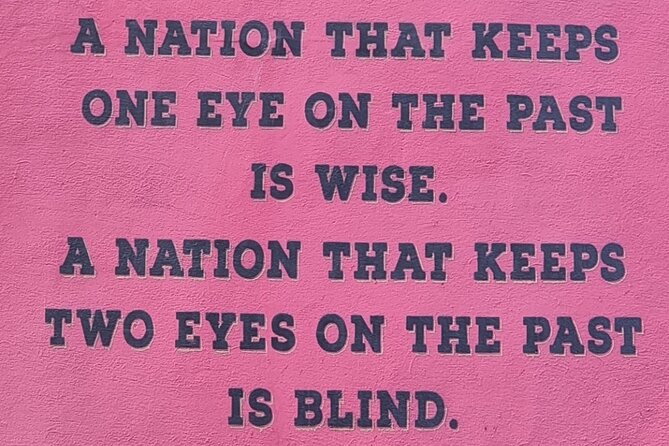
This is not simply a mural-spotting stroll. The artwork gives Marty a way to explain how Belfast became divided, how the Troubles shaped local communities, and how people are trying to live with the past while building something better.
That makes the tour useful for anyone who knows only the broadest outline of Northern Ireland’s conflict. You will hear about the period commonly called the Troubles, but the walk also reaches much further back into the island’s political and religious divisions. Three hours cannot explain every event or viewpoint, and the tour is best treated as an introduction rather than a complete course in Northern Irish history.
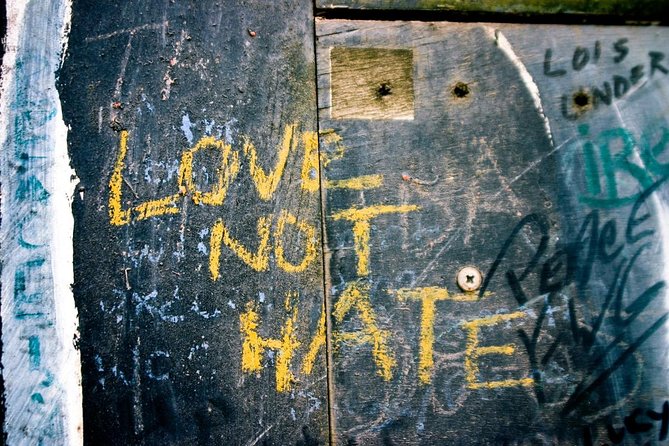
I particularly like the attention given to ordinary people. The walls are not presented as decoration alone. They show identity, loyalty, grief, protest, memory, and changing hopes. The guide also points out community art intended to support local projects and encourage a more peaceful future.
The tone is serious, but the walk is not only about old violence. Marty repeatedly brings the conversation back to healing, future generations, and the idea that trauma can take several generations to work through. That forward-looking emphasis gives the tour more purpose than a simple catalogue of battles, symbols, and dates.
More Street Art Walking Tours in Belfast:
- London: Street Art and Graffiti Guided Walking Tour
★ 4.9 · 1,354 reviews - Berlin: City Street Art Guided Walking Tour
★ 4.8 · 1,051 reviews - Naples Spanish Quarters Walking Tour Street Art, Folklore & Sweet
★ 5.0 · 797 reviews
Starting among modern art in the Cathedral Quarter
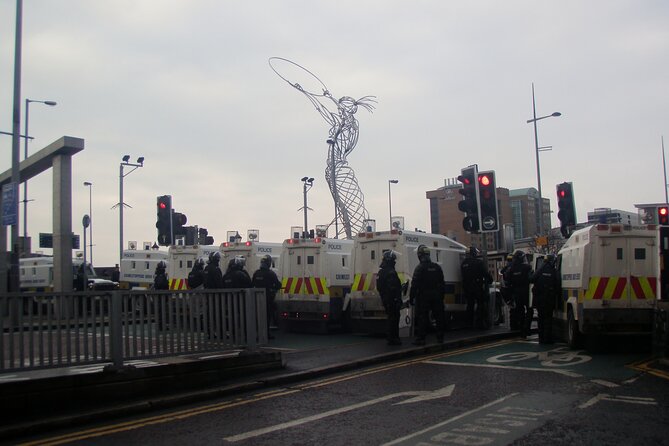
The walk begins on Exchange Street West, close to central Belfast, and first explores the Cathedral Quarter. This opening section lasts about 30 minutes and introduces the modern street art that has helped put Belfast on the international art map.
This is a smart starting point. You begin with accessible, contemporary work before moving into murals carrying more direct political meaning. International artists and local projects appear alongside one another, giving you a sense of how Belfast’s walls have changed.
The route also introduces re-imaging, a community-focused approach that places street art or murals in areas where local people want to share a message with passersby. That detail matters. It shows that murals are not all frozen reminders of conflict. Some are planned as part of a new identity for a neighborhood.
Use this first section to get comfortable with the guide’s approach. Marty often layers dates, political background, and personal interpretation around each piece. If you prefer a relaxed chat with only a few facts, the amount of material may feel heavy. If you want a serious introduction, the opening gives you useful foundations.
Shankill Road and the Loyalist murals
The route then heads toward Shankill Road, where you spend about 15 minutes viewing Loyalist murals and local street art. This is one of the most important parts of the walk because the symbols here can be difficult to understand without context.
A mural can express a community’s identity, mark a political allegiance, honor people who died, or signal a continuing connection to a particular tradition. Marty explains these meanings while placing them within Belfast’s wider story. You should expect the material to be frank and politically charged.
The short listed time does not mean the area is unimportant. The route passes through a section of Belfast that many people would not visit alone, and walking gives you time to notice the setting around the art. You are not being rushed from one photo stop to another, although the overall pace can still be quick.
Pay attention to how the art has changed. Some pieces are closely tied to older political messages, while others reflect local creativity and changing attitudes. That contrast helps you see Belfast as a city in transition rather than a museum of conflict.
Divis Street and the International Mural Wall
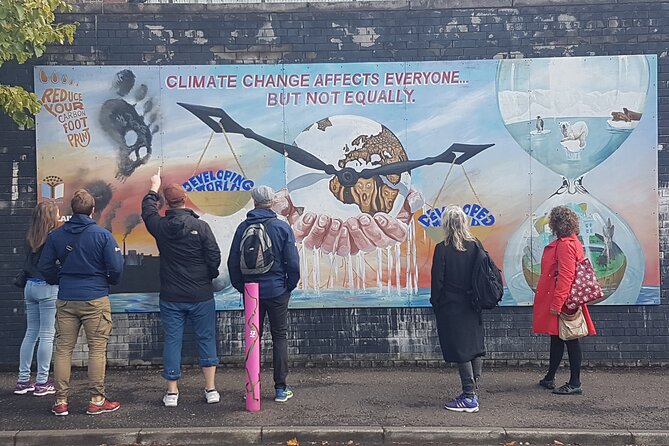
At the International Mural Wall on Divis Street, the focus shifts toward murals supporting causes from around the world. This section lasts about 15 minutes and widens the subject beyond Northern Ireland.
The wall shows how Belfast’s mural tradition can be used to express solidarity with movements and communities far beyond the city. It also gives Marty a chance to compare local political art with international campaigns, making the connection between Belfast’s past and wider struggles easier to grasp.
For me, this is a valuable change of rhythm. After hearing about Loyalist and Republican identities, you see how the same medium can carry messages about global causes. The wall becomes less about one local division and more about how public art can communicate political ideas.
Do not expect every mural to be explained with the same amount of time. The walk covers a lot of ground and several subjects, so some pieces receive a quick explanation while others become a longer discussion.
A few more walks around Belfast worth a look
- A History of Terror – Belfast City Centre Walking Tour
★ 5.0 · 2,883 reviews - Belfast: Political Conflict 3-Hour Walking Tour
★ 4.6 · 2,215 reviews - Belfast: A History of Terror Walking Tour
★ 4.9 · 854 reviews - Belfast: The Troubles Walls & Bridges Guided Walking Tour
★ 4.8 · 583 reviews
The Peace Wall and the city’s unfinished work
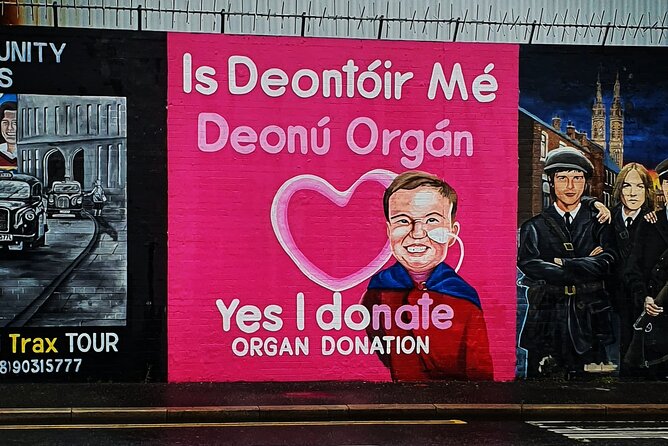
The Peace Wall is a brief stop of about 10 minutes, but it carries enormous weight. The wall separates communities that were once divided by deep hostility, and it remains a physical reminder that peace does not automatically remove fear or mistrust.
This is where the tour’s central theme becomes clearest. Belfast has moved forward, but separation has not simply vanished. The wall represents both progress and unfinished work. It helped reduce violence, yet its continued presence also shows how long it can take for communities to feel secure living together.
The tour information notes that admission is not included at this stop. No separate admission price is given, so check the booking details if this point matters to your budget.
You may find this stop emotionally heavier than the art-focused sections. That is part of its value. The Peace Wall makes the subject physical. Instead of hearing only about division, you are looking directly at a structure built to keep communities apart.
Bobby Sands and the Republican side of West Belfast
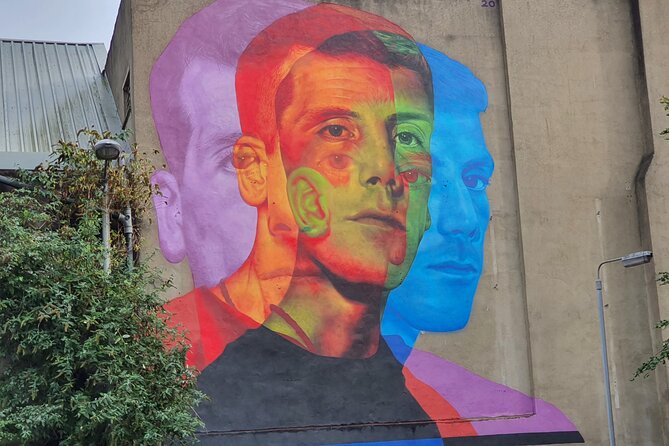
The Bobby Sands Mural is one of the best-known images in Republican West Belfast. The stop itself lasts around five minutes, but the mural gives Marty a clear point from which to explain Republican memory, political imprisonment, and the way certain individuals became symbols.
You will likely recognize this as one of the most photographed murals in the area. The value of seeing it with a local guide is the explanation around the image. Without context, you might take a photograph and move on. With context, you can begin to understand why this wall carries such strong meaning for many people.
The route does not present only one side of Belfast. It brings you through Loyalist and Republican areas, then places both within a wider story of identity, inequality, political power, and peacebuilding. Several people particularly valued the effort to give a balanced account rather than promote one faction.
Balanced does not mean bland. The subject is painful, and the guide has clear opinions about peace and the need to remember the past. You should expect a strong human perspective rather than a detached audio guide.
Finishing near Belfast City Hall
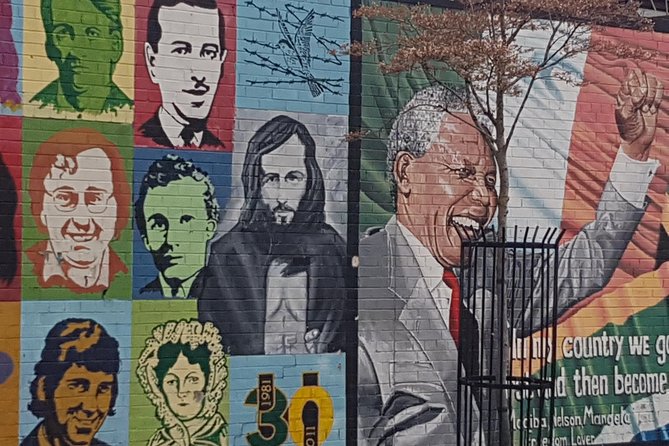
The walk finishes back in the city center at Kelly’s Cellars, with the stated end point at 32 Bank Street. You may also continue a short distance to finish near City Hall at 2 Royal Avenue, in a local community center.
This ending is practical. You finish close to central Belfast rather than in an outlying neighborhood, making it easy to continue with lunch, shopping, or another city-center activity. Shopping and restaurant discounts are also provided, which adds a little extra value after a long walk.
Kelly’s Cellars offers a natural place to pause after three hours of difficult subject matter, though the tour information does not specify what discount applies or where it can be used. Ask for the exact terms when you meet the guide.
The pace, group size, and physical demands
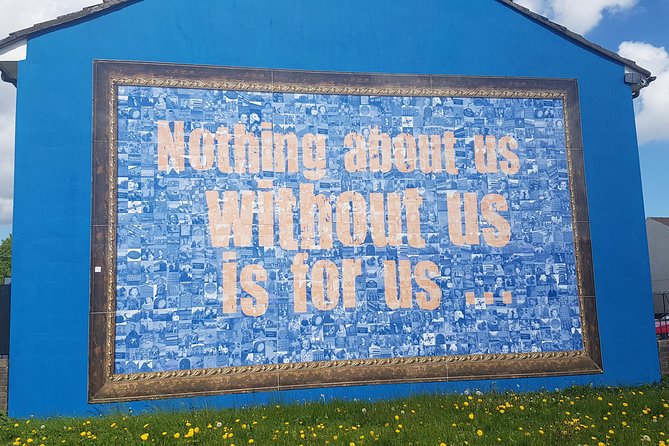
The walk lasts about 2.5 to 3 hours, and one detailed account put the distance at more than 6 kilometers. That is a meaningful amount of walking, especially because the guide may move briskly between stops.
Wear comfortable shoes with good support. This is not a gentle, slow stroll with long breaks. You will spend much of the time standing outdoors, walking through city streets, and keeping close enough to hear the guide.
The group limit of eight is one of the tour’s strongest practical features. A small group is easier to keep together, and it is more respectful when entering residential areas connected to recent conflict. It also gives you a better chance to hear the explanations without a large crowd gathering around a mural.
Marty does not use a microphone. His English accent is described as clear, but you need to stay near him, especially in noisy streets. People who walk at the back or fall behind may miss part of the explanation.
Marty’s teaching style and the amount of information
Marty is praised for his local experience, storytelling, passion for Belfast, and willingness to explain both the past and the present. He has also guided university groups, politicians, and people with personal connections to the conflict, according to information associated with the experience.
His style is intense. He may begin with questions about what you already know, then build a long explanation from there. Some people appreciate being challenged and enjoy the one-person-show quality of the tour. Others find the approach too much like a school lesson, especially when many dates and political details arrive in quick succession.
This is an important point when deciding. The strongest praise centers on Marty’s depth, personal connection, and balanced treatment of both communities. The main criticism concerns his manner, particularly how he handles questions and comments. If you want a polished, scripted tour with a gentle pace, this may not be your ideal choice.
If you are curious, attentive, and comfortable with serious discussion, the same direct style may work very well. Ask questions clearly and stay close to the guide. The tour is built around his explanation, not a printed handout or audio system.
Weather, clothing, and timing
Belfast weather can change quickly, and the walk takes place outside for several hours. Bring layers and rain protection, particularly outside summer. Sun cream and sunglasses may also be useful on brighter days.
The tour has no stated health restrictions, but moderate physical fitness is required. The combination of distance, brisk walking, standing, and uneven weather makes comfortable clothing more important than stylish clothing.
The activity is for adults only. That is not a minor detail. The tour covers political violence, death, community trauma, and personal experience, so it is not designed for anyone under 18.
The experience is often booked about 19 days ahead. That suggests you should reserve before arriving if your Belfast schedule is fixed, especially because the small group has a maximum of eight people.
Is $36.11 a fair price?
At $36.11 per person, the price is reasonable for a three-hour guided walk with a local guide and a small group. You are paying for interpretation rather than entry tickets. Most stops are viewed from public streets, so the value depends on how much context you want around the murals.
I think the cost works best for a first visit to Belfast. You cover several parts of the city and receive an explanation of what you are seeing instead of collecting isolated photographs. The included shopping and restaurant discounts add a small practical benefit, although the exact savings are not stated.
The value is less clear if you already have a strong academic grasp of the Troubles and want a short, highly visual street-art walk. In that case, the historical discussion may feel repetitive or too long. For most people seeking a grounded introduction to Belfast’s past and present, the amount of time and territory covered makes the fee fair.
Free cancellation is available up to 24 hours before the start time. Cancellations within 24 hours are not refunded, and changes inside that window are not accepted.
Who should book this walk?
I would recommend it to adults who want to understand Belfast through its neighborhoods, murals, and living political memory. It suits people who are happy walking several miles and listening closely to a guide for most of the afternoon.
It is especially useful if you want:
- A local view of the Troubles and the peace process
- Both Loyalist and Republican perspectives
- Modern street art alongside political murals
- A small group rather than a large sightseeing crowd
- A guide who connects past events with Belfast’s current healing process
I would hesitate to recommend it to anyone who dislikes long explanations, brisk walks, controversial subjects, or a guide with a forceful presentation style. It is also not suitable for anyone under 18.
Should you book the Belfast murals and Peace Wall walk?
Book it if you want context, not just photographs. The route covers Shankill Road, Divis Street, the Peace Wall, and the Bobby Sands Mural while also showing how contemporary art and community projects are changing Belfast’s public spaces.
Go prepared for more than six kilometers of walking, unpredictable weather, and a dense amount of information from Marty. His approach is not perfect for every personality, but the combination of local insight, small-group access, and attention to peace makes this a worthwhile introduction to Belfast’s complicated present.
FAQ
How long does the Belfast murals and Peace Wall tour last?
The walk lasts approximately three hours, with the full route described as about 2.5 to 3 hours.
How much does the tour cost?
The listed price is $36.11 per person.
How many people can join the tour?
The tour has a maximum group size of eight people.
Is the tour offered in English?
Yes. The experience is offered in English.
Where does the tour start?
The starting point is Exchange Street West, Exchange St W, Belfast BT1, United Kingdom.
Where does the tour finish?
The stated end point is 32 Bank Street, Belfast BT1 1DA. The walk finishes at Kelly’s Cellars, or you can continue a short distance toward City Hall and 2 Royal Avenue.
Is the tour suitable for children?
No. It is an adults-only activity and is not suitable for anyone under 18.
How much walking is involved?
You should expect a moderate physical effort. One detailed account describes walking more than 6 kilometers in three hours, and the pace can be brisk.
Can I cancel for a full refund?
Yes, if you cancel at least 24 hours before the experience start time. Cancellations made less than 24 hours before the start time are not refunded.
Just added around Belfast
- Belfast Political Tour-Conflicting Stories Walking Tour★ 4.5 · 459 reviews
- Belfast Eclectic Walking City Center Experience, The Marti Way★ 5.0 · 348 reviews
- The Real Eclectic Belfast City Walking Tour/Experience.★ 5.0 · 152 reviews
- The Real Story of Belfast walking tour with a local guide★ 5.0 · 144 reviews
- Best of Belfast Walking Tour★ 5.0 · 399 reviews
- Belfast Centre Food Tour of 12+ Local Irish Dishes & Drinks★ 5.0 · 266 reviews
- Belfast: Best of Belfast History, Culture & Art Walking Tour★ 4.9 · 158 reviews
- Belfast Walking Tour with a Local – History & Craic★ 4.9 · 130 reviews
Street Art Walking Tours, compared.


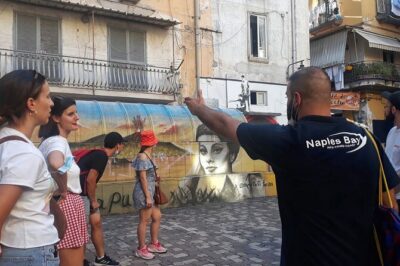
Naples Spanish Quarters Walking Tour Street Art, Folklore & Sweet
Read our review →
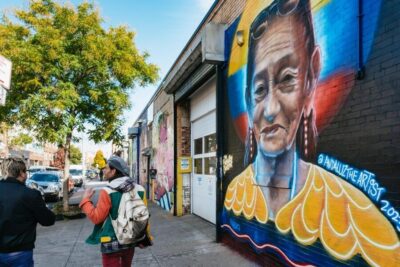
NYC: Brooklyn Graffiti & Street Art Walking Tour in Bushwick
Read our review →
Browse the lists this tour appears in