
Review · HISTORY WALKING TOURS
Walk the Historic Freedom Trail with Costumed Guide
Boston’s past gets a proper introduction here. This 90-minute walk links Boston Common to Faneuil Hall, using a costumed guide to turn churches, burial grounds, and political landmarks into a connected story. I like the short route and the way it covers 11 of the Freedom Trail’s 16 sights without taking half a day.
I also like the guides’ mix of facts and humor. Guides such as James Otis, Thomas, Jeff, Steven, Samuel Gray, and Adri have been praised for making the walk lively and easy to follow. The main drawback is practical: street noise and a group of up to 45 people can make hearing difficult at times, especially near busy roads.
What makes this Boston walk worth considering
- A focused 90-minute route: You see major downtown sites without committing to the full Freedom Trail.
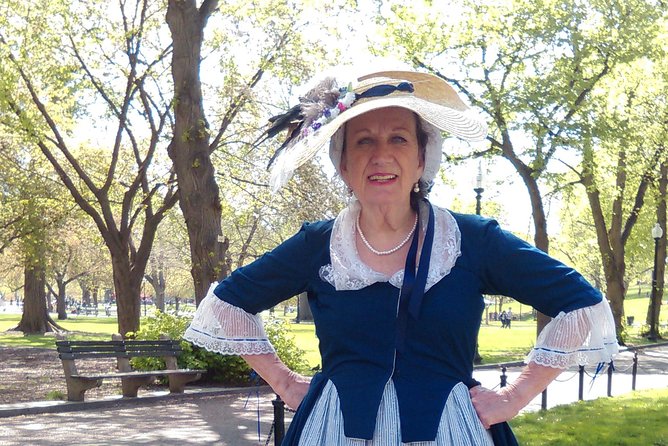
- Costumed storytelling: The period dress gives the tour a theatrical touch without turning it into a show.
- A gentle, mostly level walk: The route covers less than a mile, but you will spend plenty of time standing.
- Strong guide-led experience: James Otis, Thomas, Jeff, Steven, Samuel Gray, and Adri are among the guides praised for humor and clear explanations.
- Useful timing: Morning and afternoon departures leave room for museums, lunch, the North End, or an airport departure.
- Good first look at Boston: You finish at Faneuil Hall, well placed for further exploring.
Boston’s past in 90 minutes
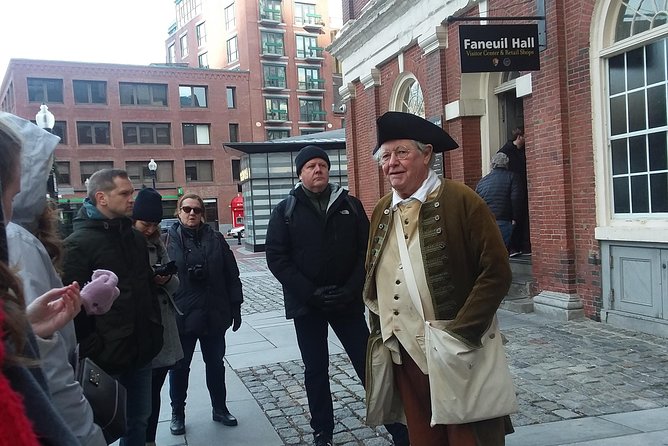
The Freedom Trail is easy to follow on your own, but the red line painted through Boston does not explain itself. This tour gives you a person to listen to, a historical character to watch, and a steady sequence of places to connect.
The route is short. It covers less than a mile and takes about an hour and a half, yet it includes many of the best-known stops in central Boston. That makes it a useful choice if you want an introduction rather than an all-day historical project.
I would expect the experience to feel more like a guided story walk than a series of formal building visits. The stops are brief, usually five to 15 minutes, and the value comes from the explanation given at each one. The tour is offered in English, with a mobile ticket, and the price is $30 per person.
At 90 minutes, the price seems reasonable if you want context and a human voice. You can walk the route for free, but you will miss the personal interpretation, period character, and chance to ask questions. If you already know Boston’s colonial and revolutionary story well, the value depends heavily on the guide you get.
More History Walking Tours in Boston
- Boston: Freedom Trail History Small Group Walking Tour
★ 5.0 · 6,450 reviews - Boston: Freedom Trail History Small Group Walking Tour
★ 4.9 · 1,590 reviews - Boston Pizza Lovers Food and History Walking Food Tour
★ 4.5 · 1,082 reviews
Starting at Park Street Church and Boston Common
The meeting point is at 139 Tremont Street, close to the southern edge of Boston Common. The first stop is Park Street Church, where the guide introduces the religious and political changes that shaped early Boston.
The description of this stop connects the church with the shift from early Puritan ideas toward Protestant abolitionism. That gives you a quick look at how faith and reform became part of Boston’s public life. You spend about five minutes here, so do not expect a full church tour.
Boston Common receives more time, about ten minutes. This is where the guide sets up the city’s early story and helps you understand why this open space matters. The Common is not just a pleasant park. It is the broad civic starting point for the walk, and it gives the group room to gather before the route moves into narrower streets.
This opening section is especially useful for first-time visitors. You get your bearings fast, and the guide begins laying out the ideas that return later: religion, public authority, protest, and the rights of ordinary people.
The State House and Granary Burying Ground
The Massachusetts State House appears next, with a short five-minute stop. Built in 1795, it represents the idea that government needs the consent of the people. That theme fits neatly with the political story that follows along the trail.
The stop is brief, so you will mainly hear about the building’s meaning rather than explore its interior. If you want to see the State House inside, you will need to make separate plans.
Granary Burying Ground is the longest stop at 15 minutes. This is one of the more important pauses on the route, because the graveyard brings names and personal stories into a walk that could otherwise feel like a parade of buildings.
The burial ground is more than 350 years old. The guide points out its connection to major figures from the founding period, and the tour description presents it as a place with more signers of the U.S. Constitution than anywhere else in America. Expect the group to spend time hearing about people connected to the country’s early political story.
One caution: a cemetery stop requires standing still on a compact route, and some people may find 15 minutes here longer than expected. One disappointed participant felt too much time was spent in the graveyard. If you prefer architecture and movement, this may be the slowest part of the walk. If you enjoy personal stories and the human side of history, it may be one of the best.
King’s Chapel and Boston Latin School
King’s Chapel follows, with about ten minutes devoted to the church. It began as a Church of England congregation and was originally built around 1688. That detail helps show the religious divisions present in Boston before independence.
This is a good place to hear how British authority, local custom, and changing religious beliefs overlapped. The church’s age also gives the walk a physical sense of time. You are not only hearing about the colonial period. You are looking at buildings and sites that have been part of Boston for centuries.
The Boston Latin School receives five minutes. Founded in 1635, it is recognized as the oldest public school in the United States. The stop is short, but the idea is significant: education was treated as a public concern very early in Boston’s development.
You might find this section more interesting if you pay attention to the links between the stops. The churches, school, burial ground, and government building are not random points. Together, they show how religion, education, civic authority, and public memory shaped the city.
More History Walking Tours in the USA
- Boston History Tour: Scenic Walk Through Time & Landmarks
★ 5.0 · 627 reviews - Boston’s North End Food and History Walking Tour
★ 5.0 · 459 reviews - Boston Seafood Lovers Food and History Walking Tour
★ 5.0 · 208 reviews - Downtown Freedom Trail Walking Tour – History & Architecture
★ 4.5 · 194 reviews
The meeting houses and the road to rebellion
Old South Meeting House gets about ten minutes. This is one of the strongest political stops on the walk because major meetings took place here, including the gathering held just before the Boston Tea Party in 1773.
The building represents protest as a public act. People gathered, argued, and made decisions together. The guide’s commentary helps you picture the tension before the tea was dumped into Boston Harbor.
From there, the route continues to the Old State House. Built in 1713, it first served British authority and was later taken over by the Americans in 1775. The building gives the tour a clear before-and-after moment. The same civic space changed hands as Boston moved from colonial rule toward revolution.
These stops are where a costumed guide can add real value. The clothing is not a substitute for facts, but it gives the story a human face. Guides have been praised for using humor, dramatic timing, and small details to keep the political material from becoming dry.
Thomas, in particular, has been singled out for a witty style and useful advice about places to eat and explore after the walk. That kind of informal local guidance can make the tour feel more useful than a simple recitation of dates.
The Boston Massacre Site and Paul Revere’s image
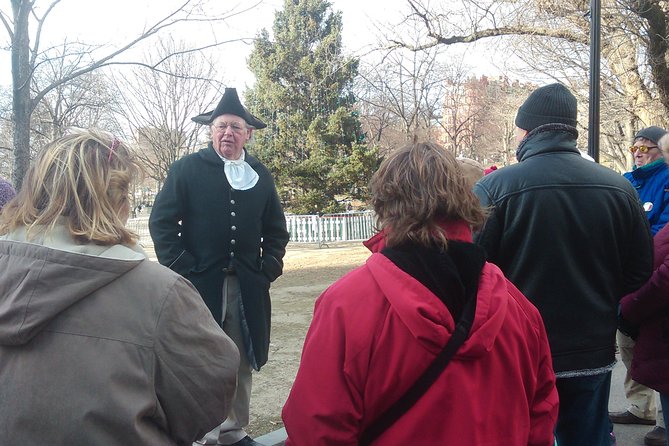
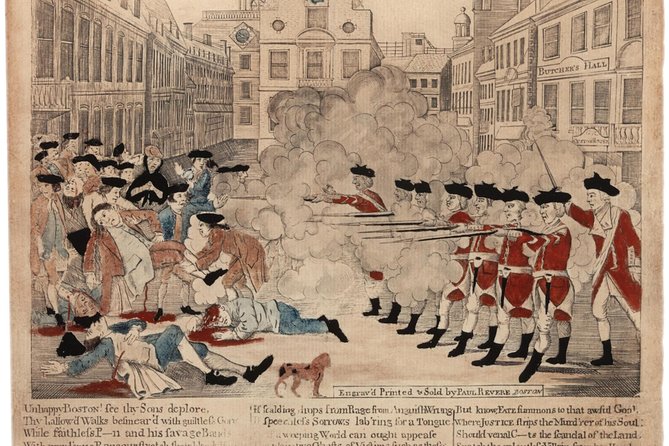
The Boston Massacre Site receives ten minutes. In 1770, British soldiers killed five Americans here, and the event became a powerful symbol for the revolutionary cause.
Paul Revere produced a famous engraving of the incident. The guide can explain how images and printed stories helped shape public opinion. This is an important reminder that revolutions are fought with ideas and information as well as weapons.
The site is in a busy part of downtown, so do not expect a quiet memorial setting. Street traffic, construction, and surrounding city noise can interfere with the commentary. Some people have found it hard to hear at times, even when the guide used a microphone.
If you have hearing concerns, stay close to the guide. The tour operator encourages people with impaired hearing to remain near the speaker. This is sensible advice, since the group may be spread around a sidewalk rather than gathered in a silent room.
Finishing at Faneuil Hall Marketplace
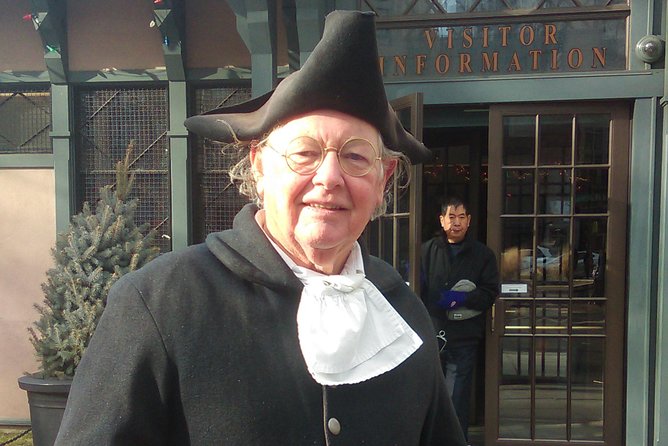
The walk ends at Faneuil Hall Marketplace after about five minutes at the final stop. Faneuil Hall is closely tied to Boston’s tradition of public debate, and the statue of Samuel Adams provides a fitting final image.
Ending here is convenient. You can continue toward the North End, find food, shop, or simply use the marketplace as a central point for the rest of your day. One participant who had limited time before a flight found the morning departure useful, and that is one of this tour’s strengths: it leaves much of the day open.
The endpoint also makes the tour easy to pair with lunch. Guides may offer suggestions, including advice about lobster rolls and places in the North End, though you should treat those tips as extras rather than part of the paid experience.
What the guide can change
The guide is the heart of this tour. The strongest praise has gone to people who combine solid facts with humor and a friendly manner.
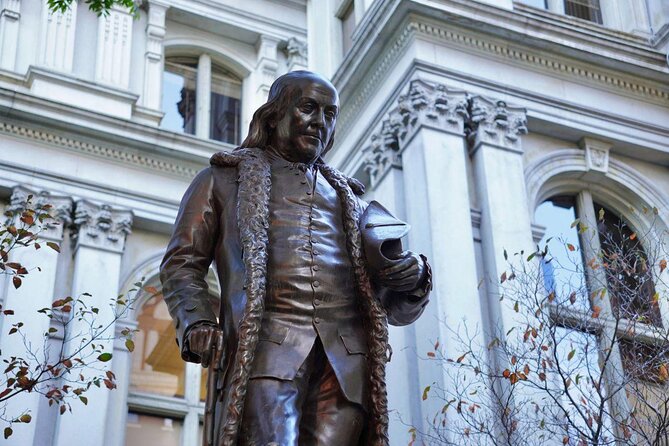
James Otis, also called the Handsome Man, has been guiding on the Freedom Trail for 20 years. His long experience shows in the way he can present the past as a sequence of people and conflicts instead of a list of dates.
Thomas has been praised for a witty, energetic style. Jeff has received strong praise for his command of the material, including his explanations of Benjamin Franklin. Steven has been noted for answering questions and keeping a comfortable pace. Samuel Gray has been described as an engaging storyteller, while Adri has been praised for his detailed commentary.
You may not receive one of these specific guides, so it is best to see the names as examples of the tone the company aims for, not a guarantee. The guide’s personality will shape your experience more than the route itself.
Walking comfort, group size, and sound
The route is described as a gentle 90-minute stroll, and one person called it easy, with no hills. It covers less than a mile, so it is not a strenuous athletic walk.
Still, you should wear comfortable shoes. The challenge is not distance. It is the repeated cycle of walking, stopping, and standing while listening. Dress for the weather, since much of the experience takes place outdoors.
The listed maximum is 45 people, though company responses have also referred to caps of 30 or 35. Group size may therefore vary by departure or operating conditions. A larger group can make it harder to hear, especially on busy streets, and can require the guide to move people aside for passing pedestrians.
This is not a private, quiet tour. If you want close access to the guide or have hearing difficulties, position yourself near the front. A private tour is available according to the provider, but it is a different option and is not covered by the $30 price.
Service animals are allowed, and most people can take part. The activity is near public transportation, but no specific route or parking details are provided, so you should check your own arrival plan before setting out.
Timing, cancellations, and who will enjoy it
Morning and afternoon departures make this a flexible choice. A morning walk can help you understand downtown before exploring on your own. An afternoon departure works well after other sightseeing or for anyone with limited time before an evening plan.
The tour is generally booked 17 days ahead, so reserving early is sensible if your schedule is fixed. Confirmation comes when you book, and the mobile ticket keeps the arrival process simple.
You can cancel for a full refund up to 24 hours before the start time. Changes or cancellations inside 24 hours are not refunded. The experience requires good weather and a minimum number of participants. If poor weather or low participation cancels the tour, you are offered another date or experience, or a full refund.
This walk suits history buffs, first-time Boston visitors, couples, families, and adults who want a lively introduction. Teens can get a lot from it, especially if they respond well to stories and humor. It may also work for a family with a high-functioning autistic child, as one family found the length and style manageable.
It is less suited to anyone seeking a full exploration of all 16 Freedom Trail sites, extensive indoor access, or a small private group. The complete route takes much longer, while this experience focuses on a compact selection of major stops.
Should you book the Freedom Trail walk?
I would book this tour if you want a fast, guided introduction to Boston’s revolutionary story and prefer people, stories, and humor to reading plaques on your own. The route is short, the endpoint is useful, and $30 is fair for a lively 90-minute orientation.
I would skip it if you already know the Freedom Trail well or want to explore every site at your own pace. Also think twice if street noise, outdoor standing, or a potentially large group will frustrate you.
For most first-time visitors, this is a sensible way to get started. Come ready for weather, wear good shoes, stay close to the guide, and keep the rest of your day free for the places that catch your interest.
FAQ
How long is the Freedom Trail walking tour?
The tour lasts approximately 90 minutes.
How much does the tour cost?
The price is $30 per person.
Where does the tour begin?
It begins at 139 Tremont Street, Boston, Massachusetts 02111.
Where does the tour end?
The tour ends at Faneuil Hall Marketplace in Boston.
How many Freedom Trail sites does the tour cover?
The route covers 11 of the 16 sites on the Freedom Trail.
Is the tour offered in English?
Yes. The experience is offered in English.
Is the walk difficult?
It is described as a gentle stroll of less than one mile, with no notable hills mentioned. You should still expect a lot of walking and standing.
What should I wear?
Dress for the weather and wear comfortable shoes.
Are service animals allowed?
Yes, service animals are allowed.
What happens if bad weather cancels the tour?
You will be offered a different date or experience, or a full refund.
Can I cancel for a full refund?
Yes. You must cancel at least 24 hours before the experience start time for a full refund. Cancellations within 24 hours are not refunded.
Just added around Boston
- Boston’s North End Food and History Walking Tour★ 5.0 · 459 reviews
- Freedom Trail Guided Walking Tour (SMALL GROUP)★ 4.5 · 98 reviews
- Boston Private Food Tour of 6+ Tastings, Cannoli, Lobster Roll★ 5.0 · 165 reviews
- Beacon Hill Boston History + Photo Walking Tour (SMALL Group)★ 5.0 · 163 reviews
- Boston’s Architecture, History + Photo Walking Tour (SMALL Group)★ 5.0 · 91 reviews
- 2 Hour North End ‘Little Italy’ Walking Tour★ 4.5 · 125 reviews
- Haunted Boston Booze and Boos Ghost Walking Tour★ 4.5 · 155 reviews
- Haunted Boston’s Historic Streets Walking Guided Tour★ 4.5 · 184 reviews
History Walking Tours, compared.
History and Hauntings of Salem Guided Walking Tour
Read our review →
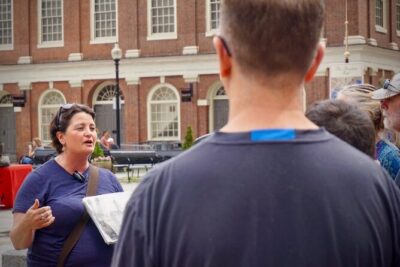
Freedom Trail History Small Group Walking Tour
Read our review →
Historic Charleston Guided Sightseeing Walking Tour
Read our review →
Tapas Walking Tour with Food, Wine, and History
Read our review →
Savannah History and Haunts Candlelit Ghost Walking Tour
Read our review →
A History of Terror – Belfast City Centre Walking Tour
Read our review →Browse the lists this tour appears in