
Review · MUMBAI WALKING TOURS
Group Guided Walking Tour in Fort and Colaba
Mumbai’s grand story begins on foot. This Fort and Colaba walk links grand colonial buildings, old religious sites, cricket grounds, and the Gateway of India in one clear route through the city’s historic core. I like the small maximum group of 12, which gives you a better chance to hear the guide and ask questions. I also like the way the tour connects famous sights with lesser-noticed details, such as old memorials and traces of Mumbai’s Jewish community.
The main drawback is the brisk 2-hour-30-minute format. You will see many places, but most stops last only 15 or 20 minutes. That makes this an excellent introduction to South Mumbai, though not a slow architectural study. A complimentary coffee break may be included, as it was during one outing with guide Palak, but you should not treat that as the central feature.
Key points at a glance

- Nine historic stops: The route runs from the Asiatic Society and Town Hall to the Gateway of India.
- A compact group: The tour accepts no more than 12 people, allowing for a more personal guide-led walk.
- Five centuries of change: You follow Mumbai’s growth from fishing and farming settlement to modern metropolis.
- Free-entry sightseeing: The listed stops do not require an admission ticket during the walk.
- A strong photo finish: The tour ends beside the Gateway of India and the Taj Mahal Palace Hotel.
- Useful local advice: Your guide can suggest places to eat, visit, or explore after the walk.
Why this Fort and Colaba walk works
Mumbai can feel like several cities layered on top of one another. The Fort district brings together colonial administration, churches, universities, public gardens, cricket, art, and commerce. Colaba adds a different mood, with the waterfront and the city’s best-known monument.
This walk gives you a useful framework for understanding those layers. Instead of seeing the Gateway of India as an isolated photo stop, you learn how it fits into the city’s wider story. The route also gives you a better chance of noticing buildings you might otherwise pass without a second glance.
I especially like the small-group limit. A group of 12 is still large enough to have company, but it should not feel like a crowd gathered around a guide with a flag. You can ask about a carving, a memorial, or a building that catches your eye. The guide can also adjust the conversation to your interests and offer local tips.
The tour price is $16.73 per person. For 2 hours and 30 minutes of guided sightseeing, that is a reasonable price, particularly because the route covers nine major points and the listed stops have no admission fees. The value comes from interpretation, not paid entry. You are paying someone to connect the streets, buildings, and events into a story you can follow.
More Guided Walks in India:
- Private Guided Walking Tour in Fort & Colaba
★ 5.0 · 895 reviews - Private Guided Walking Tour in Bandra Queen of Suburbs
★ 5.0 · 383 reviews - Private Guided Spiritual Walk in Banganga Hindu Temples
★ 5.0 · 271 reviews
Starting at Town Hall and the Asiatic Society
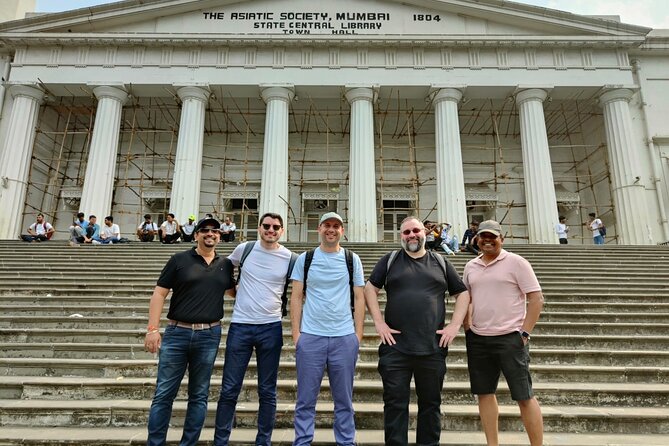
The walk begins at the Asiatic Society in Town Hall, on Shahid Bhagat Singh Road in Fort. This is a fitting starting point because the tour opens with the origins of Mumbai and the effects of Portuguese and British colonization.
The building gives your guide a place to explain how the city changed from a settlement tied to fishing and farming into a major urban center. That broad opening matters. Without it, the grand facades of Fort can seem like a collection of unrelated European-style buildings. With it, you have a reason to look at the district as part of a long political and commercial transformation.
You spend about 20 minutes here, with no admission ticket required for this stop. The beginning also gives you time to settle into the group and understand the route before the walk gathers pace.
Horniman Circle Garden and the city around it
The next stop is Horniman Circle Garden, where you spend about 15 minutes. The garden is described as Mumbai’s oldest, and it is surrounded by Victorian buildings. Your guide explains the activities that once took place around this part of the city.
This is a good stop for readers who enjoy urban history rather than only famous monuments. A public garden can tell you plenty about how a city was organized, who used its central spaces, and how civic life developed around large buildings.
Do not expect a long break here. The stop is brief, so listen closely and look around while the guide is speaking. The surrounding architecture is part of the lesson. The garden itself provides a change from the hard stone and busy streets of the Fort district.
St. Thomas Cathedral’s memorials and altar
St. Thomas Cathedral is Mumbai’s oldest Anglican church, and the tour allows around 15 minutes inside. The focus is on its memorials and grand altar.
This stop adds a quieter note to the walk. After hearing about colonial power and civic buildings, you get a chance to see how that period is remembered inside a place of worship. The memorials offer small human details that large public buildings often lack.
The short visit works best if you are interested in inscriptions, church interiors, and the way different communities shaped Mumbai. If religious architecture is not your main interest, this may feel less essential than the Gateway of India or Oval Maidan. Still, it helps show that Mumbai’s history is not only found in government buildings and monuments.
A few more walks around India worth a look
- Fontainhas Heritage Walk by Make It Happen
★ 5.0 · 2,834 reviews - The Great Indian Food Tour: Old Delhi Food and Heritage Walk
★ 5.0 · 1,698 reviews - Old Goa Heritage Walk by Make It Happen
★ 5.0 · 797 reviews - Old Delhi Food, Heritage&Cultural Walk with Rickshaw ride to Masterji Kee Haveli
★ 5.0 · 742 reviews
Flora Fountain and the city’s main square
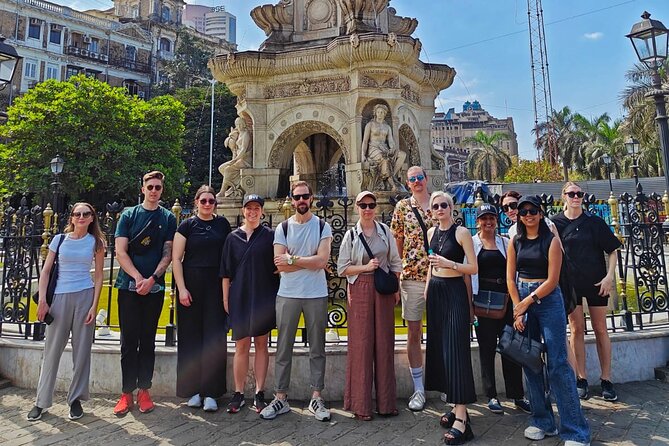
Flora Fountain is presented as Mumbai’s answer to Piccadilly Circus, along with the Martyrs’ Memorial in the city’s main town square. You spend about 15 minutes here.
This is one of the route’s useful orientation points. It brings together traffic, public space, commemorative history, and the grand architecture of the central city. The comparison with Piccadilly Circus gives you a quick sense of its civic importance, while the Martyrs’ Memorial adds a direct connection to India’s political past.
The stop is mainly about seeing and listening rather than entering a building. Have your camera ready, but pay attention to the guide’s explanation too. The fountain and surrounding buildings can be easy to treat as background when you are focused on getting from one sight to another.
Oval Maidan and the birthplace of Indian cricket
At Oval Maidan, the tour pauses for around 20 minutes. You see the grand buildings around the open ground, described as the birthplace of Indian cricket and part of a UNESCO World Heritage site.
This is one of the stronger sections for understanding the relationship between open space and architecture. The maidan gives you a broad view of the buildings around it, allowing their scale and variety to register in a way that is difficult on a narrow street.
It is also a welcome change of pace. Much of Fort is experienced at close range, with facades and details directly overhead. Oval Maidan gives you room to look across the area and compare the buildings as a group.
The cricket connection adds a social side to the story. You are not only looking at colonial-era architecture. You are also seeing a place linked with one of India’s most important sports traditions.
Rajabai Clock Tower and the University of Mumbai
The Rajabai Clock Tower gets another 15-minute stop. It is described as Mumbai’s answer to Big Ben, and your guide explains the evolution of the University of Mumbai.
The comparison helps you recognize the tower’s role as a city landmark, but the university story is the more useful part. It places education alongside administration, religion, commerce, and sport in the wider development of Mumbai.
You will likely want a photo here, but the value of the stop is not limited to the clock tower itself. Listen for the explanation of how the university grew and how the city’s institutions developed around it. Since the time is limited, this is another point where a question to the guide can help you focus on what interests you most.
Kala Ghoda’s art district and unusual buildings
Kala Ghoda is the longest-feeling cultural shift on the route, even though the stop lasts about 15 minutes. You see diverse architecture in Mumbai’s premier art district and hear the secrets held by its buildings.
This section should appeal to you if you like neighborhoods with several layers of character. The focus is not just on a single monument. It is on the mix of buildings and the details that explain how the district became important.
The wording about building secrets is broad, so the exact stories will depend on your guide. That is part of the appeal of a guided walk, but it also means you should not expect a fixed museum-style presentation. Guide Palak, for example, was praised for explaining how Mumbai developed from its origins into the city it is today, including details that are easy to miss when walking alone.
Keneseth Eliyahoo Synagogue and Mumbai’s Jewish past
The stop at Keneseth Eliyahoo Synagogue takes about 15 minutes and introduces Mumbai’s Jewish enclave. You learn about Jewish life in the city, now almost extinct there.
This is one of the route’s most distinctive subjects. The synagogue adds a community story that is not always included in a first look at Mumbai. It shows how the city was shaped by groups whose presence may be less visible today.
The stop is also a reminder that historic buildings can carry more than one kind of story. The architecture matters, but so does the question of who used the building and what happened to that community over time.
Because the visit is short, expect an introduction rather than a full study of Mumbai’s Jewish history. If this subject matters greatly to you, note the key details and ask the guide for local recommendations or further places to explore.
Ending at the Gateway of India and Taj Mahal Palace
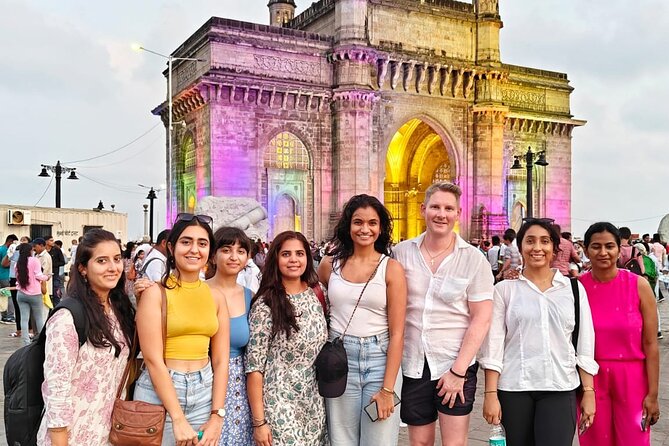
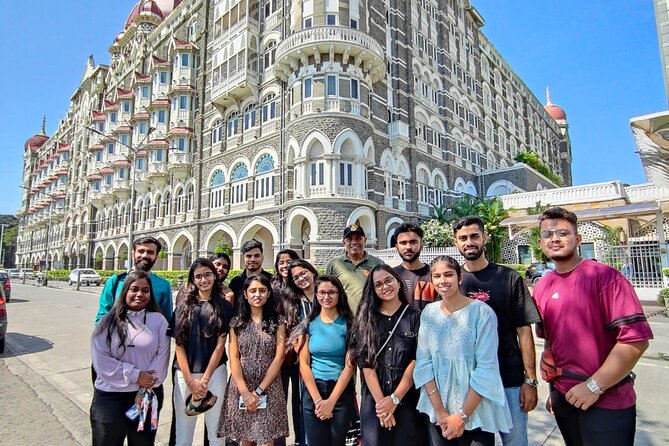
The tour ends at the Gateway of India and the Taj Mahal Palace Hotel, two of Mumbai’s best-known symbols. You have about 20 minutes here, making this the clearest photo opportunity of the walk.
The ending works well because it brings together the route’s main themes: imperial ambition, travel, architecture, and the city’s modern identity. By this point, the Gateway is more than a postcard image. You have spent the walk seeing how Mumbai grew into the city represented by this waterfront landmark.
The Taj Mahal Palace adds another famous architectural point beside the arch. Together, the two sites make a strong finish, though the area may feel more crowded and visually busy than the earlier stops. Your guide can also offer suggestions for what to do next in Colaba.
Since the route ends here rather than returning to Town Hall, plan your afternoon around the Gateway of India. The end point is Apollo Bandar, Colaba, while the meeting point is at Town Hall in Fort.
Timing, group size, and practical comfort
The complete walk lasts approximately 2 hours and 30 minutes. Each stop receives 15 or 20 minutes, so the experience is designed to cover ground and build a broad picture rather than linger at one site.
You should be prepared for sustained walking and outdoor time. Comfortable footwear and protection from the weather make sense, though the provided details do not specify the exact walking distance or facilities along the route. The experience requires good weather, and poor conditions can lead to a different date or a full refund.
The tour is near public transportation, and most people can participate. Confirmation is provided at booking, and the ticket is mobile, which keeps the arrival process simple.
The group limit of 12 is important. If you dislike large organized groups, this format should feel more manageable. If you want a private tour with a completely flexible schedule, this is not that. You will still follow a set route and timed stops.
Who will get the most from this tour?
I would choose this walk for a first visit to Mumbai, especially if you want a quick introduction before exploring Fort and Colaba on your own. It gives you names, dates, buildings, and connections that make later sightseeing easier.
It also suits anyone who enjoys architecture, city history, public spaces, religious buildings, and local community stories. The route has enough variety to keep the 2.5 hours moving.
You may want something else if your priority is shopping, food, or a long visit inside individual monuments. The experience is focused on outdoor city sightseeing, with short visits rather than extended admissions. It is also not ideal if you want to avoid walking or if you prefer an entirely private guide.
A useful approach is to treat the tour as your orientation. Afterward, use the guide’s local recommendations to decide which part of Fort, Kala Ghoda, or Colaba deserves more of your time.
Should you book the Fort and Colaba walk?
At $16.73 per person, I think this is a good-value introduction to Mumbai’s historic center. The strongest reasons to book are the small group, the clear route through nine important sites, and the chance to hear how separate buildings fit into 500 years of city development.
Book it if you want context, architecture, and a well-organized first look at South Mumbai. Skip it if you need a slow pace, private attention, or extended time inside each stop.
The 5/5 rating from 1,073 ratings and 100 percent recommendation indicate very strong satisfaction, and the praise centers on the tour’s clear history and personable guiding. The most useful detail is simple: a guide such as Palak can point out stories you might never notice while walking alone. Just remember that you are buying a compact overview, not a full-day exploration.
FAQ
How long does the walking tour last?
The tour lasts approximately 2 hours and 30 minutes.
How much does the tour cost?
The price is $16.73 per person.
How many people can join the tour?
The maximum group size is 12 people.
Where does the tour begin?
The tour begins at the Asiatic Society in Mumbai Town Hall, on Shahid Bhagat Singh Road in Fort.
Where does the tour end?
The walk ends at the Gateway of India and the Taj Mahal Palace Hotel in Apollo Bandar, Colaba.
Are admission tickets included at the stops?
The listed stops have no admission ticket charge during the tour.
Can I cancel for a full refund?
Yes. You can cancel at least 24 hours before the start time for a full refund. Cancellations or changes made less than 24 hours before the start time are not refunded or accepted. If poor weather cancels the experience, you will be offered another date or a full refund.
Just added around India
- Tipu Palace + Koté Vishnu + Fort + KR Market + Jain Temple = Bengaluru Pété Walk★ 5.0 · 150 reviews
- Street Food walking tour in Bangalore with a food evangelist★ 5.0 · 83 reviews
- Bengaluru Pete City Market Half-Day Walking Tour★ 5.0 · 163 reviews
- Amritsar Heritage Walking Tour★ 5.0 · 112 reviews
- Agra Walking Tour★ 5.0 · 109 reviews
- The Great Indian Food Tour: Old Delhi Food and Heritage Walk★ 5.0 · 106 reviews
- Spiritual Walk Tour Trivandrum (Guided Walking Experience)★ 4.6 · 87 reviews
- Spiritual Walking tour with Puja Ceremony -The Pushkar Route★ 5.0 · 101 reviews
Mumbai Walking Tours, compared.
Private Guided Walking Tour in Bandra Queen of Suburbs
Read our review →
Private Guided Spiritual Walk in Banganga Hindu Temples
Read our review →
Dharavi Slum Walking Tour by First Female Tour Guide
Read our review →
Mumbai Street Food Tour with Evening Bazaar Walk
Read our review →Browse the lists this tour appears in