

Review · CITY HIGHLIGHTS WALKING TOURS
Verona Highlights Walking Tour in Small-group
Verona rewards a good first walk. This two-hour small-group tour gives you a clear route through the old center, from Castelvecchio and its rebuilt bridge to Piazza delle Erbe, Juliet’s House, and the Roman Arena. I like that the pace is relaxed enough for questions, yet the route covers a lot of ground in a short time.
I also like the guides’ strong storytelling. Frank, Isabella, Priscilla, and Maria are repeatedly praised for making Verona’s long past easy to follow, with humor, local knowledge, and useful food suggestions. The main drawback is that the tour is an overview rather than a deep visit inside every monument. Most stops are viewed from outside, and admission to the Arena and Juliet’s House is not included.
Key points to know before booking
- Two hours, six major sights, and several extra landmarks: You cover the Arena, Juliet’s House, Piazza Bra, the Scaliger Tombs, Piazza delle Erbe, and Piazza dei Signori, with Castelvecchio and the Gavi Arch also part of the route.
- A maximum of 16 people: The group is small enough for questions and personal attention, though the experience can still feel busy in crowded squares.
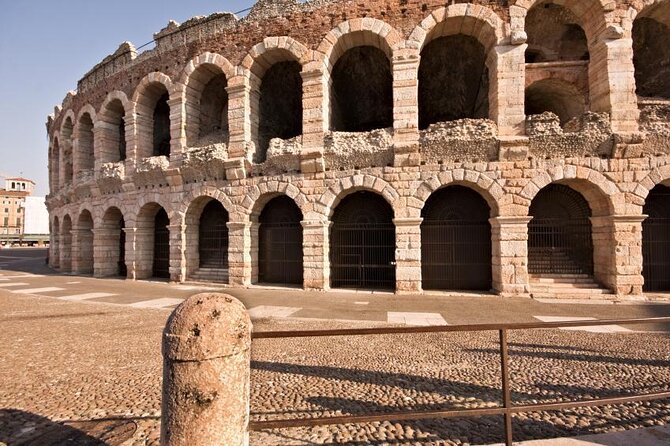
- The Roman Arena is the main event: You learn about its construction in the first century AD, its former capacity of up to 30,000 people, and its continuing opera and concert use.
- Admission is not included: The walking tour visits the Arena and Juliet’s House, but entering either attraction requires a separate ticket or add-on arrangement.
- A good first-day tour: The route helps you understand Verona’s layout and gives you a useful list of places to revisit at your own pace.
- Rain or shine: Wear comfortable shoes and bring protection from the weather. Some parts of the route may be difficult for people with reduced mobility.
Why this walk works well as your Verona introduction
Verona can feel confusing at first. Roman remains, medieval towers, Renaissance façades, Shakespeare’s fictional romance, and modern cafés all share the same compact center. A walking tour helps you see how these layers fit together instead of treating each monument as a separate photo stop.
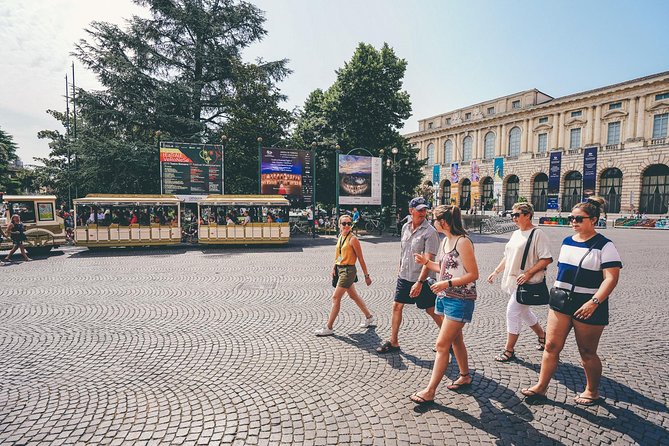
The tour begins and ends in Piazza Bra, the broad square beside the Arena. That makes the meeting point easy to find and keeps the route simple for anyone arriving by train, bus, or on foot. You do not need hotel transport, and the tour stays within the historic center.
The group size matters here. With no more than 16 people, you have a fair chance of hearing the guide and asking questions. The best guides, especially Frank and Isabella, seem to use the smaller format well. Their style is friendly and conversational, with facts mixed into stories rather than delivered as a long lecture.
You should still expect a fairly active walk. One direct account described the pace as manageable but somewhat quick, and another noted that the route includes plenty of walking. If you need frequent rests, tell the guide early. The tour runs in bad weather, so Verona’s famous polished stones can be less pleasant in rain.
More City Highlights Walking Tours in Italy
- Florence: Highlights Walking Tour with Expert Guide
★ 4.6 · 4,662 reviews - Skip-the-Line Florence Highlights and David Walking Tour
★ 5.0 · 1,127 reviews - Venice: Walking Guided Tour of the City Must-See Sites
★ 4.7 · 1,095 reviews
Castelvecchio and the bridge rebuilt after war
From Piazza Bra, the route moves toward Castelvecchio, Verona’s late-medieval castle. You see the fortress and the striking Scaligero Bridge, which crosses the Adige River and connects the castle to the opposite bank.
The bridge was almost destroyed during bombing and later rebuilt to match the original design. That detail gives the stop more weight than a quick castle photo. You are looking not only at medieval military architecture, but also at the effort made to restore an important piece of the city.
The walking tour does not include a full visit inside Castelvecchio Museum. If you have time, return later for a closer look. The route’s purpose is to explain how the castle fits into Verona’s wider story, not to replace a museum visit.
Nearby, you may also see the Gavi Arch, a first-century Roman monument linked to the Gavia family. Napoleon demolished it in 1805, and it was reconstructed in its current location in the twentieth century. It is a useful reminder that Verona’s Roman remains have not simply sat untouched for two thousand years. They have been moved, damaged, rebuilt, and reinterpreted.
Roman Verona at the Gavi Arch and Porta Borsari
The old center still follows parts of the Roman street plan. As you walk, the guide points out evidence of the original city, including Roman walls and the remains of Porta Borsari, once a major city gate.
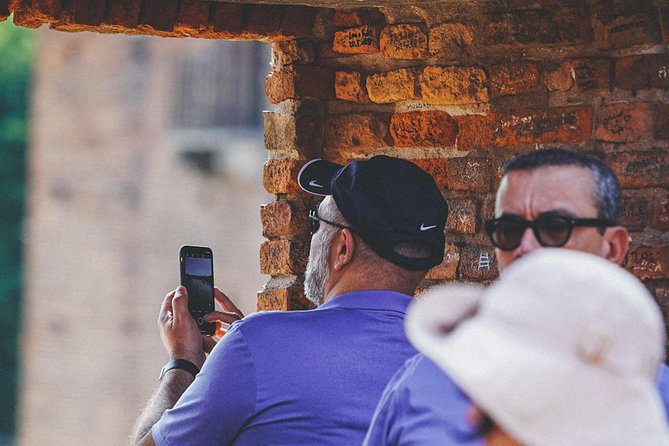
One especially interesting detail is the contrast between the gate’s surviving marble front and the less complete structure behind it. In places, Roman Verona appears in fragments rather than as one grand ruin. That makes a guide useful. Without explanation, you could easily walk past an ancient wall or piece of a Roman house without noticing it.
The route may also reveal Roman remains incorporated into modern shops. One memorable example is a section of Roman wall and part of a home visible inside a Benetton store. This is the sort of detail that gives the walk value. You are not only seeing the obvious monuments. You are learning where the old city remains part of daily Verona.
The Arena: Verona’s Roman centerpiece
The Arena di Verona gets a short stop of about 10 minutes, with admission not included. Built in the first century AD during the Augustan period, it predates Rome’s Colosseum by several decades.
The Arena was built to hold large public spectacles and could once accommodate up to 30,000 people. Its outer ring is no longer complete, but the remaining inner sections still make a powerful impression. The structure is unusually well preserved for a building roughly 2,000 years old.
The guide explains how the monument survived and how it is used today. Verona’s opera season takes place here during the summer, and the Arena also hosts concerts by major international performers. The modern use is important. This is not only an archaeological site behind a barrier. It remains a working performance venue.
The walking tour gives you historical context and time for photographs, but it does not give you an interior visit as part of the basic price. I strongly suggest checking the option that combines the walking tour with an Arena visit if you want to see the seating, arches, and performance space from inside. One participant specifically found the Arena interior to be the highlight of the longer two-part arrangement.
If you are interested in opera, check the festival schedule separately. The walking tour explains the setting, but it does not include a performance ticket.
Same streets, a different way to see them:
- Venice: Doge’s Palace and St Mark’s Basilica Walking Tour
★ 4.4 · 6,291 reviews - Milan: Guided Walking Tour & Last Supper Visit with Ticket
★ 4.7 · 5,409 reviews - Naples: Street Food Walking Tour with Local Guide
★ 4.9 · 4,976 reviews - Venice: San Marco to Rialto Walk & Spritz Like a Local
★ 4.2 · 3,651 reviews
Juliet’s House and the limits of the Shakespeare connection
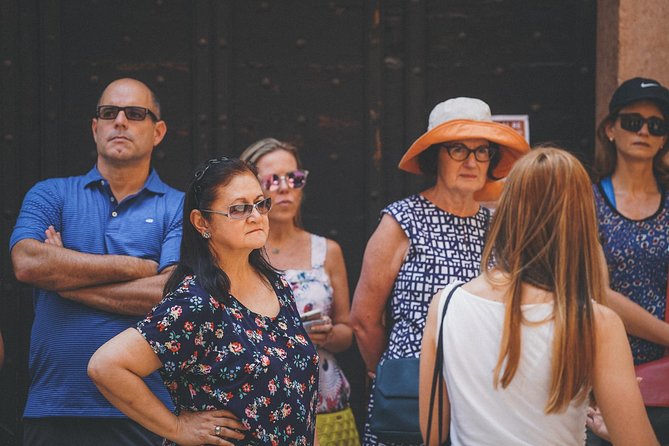
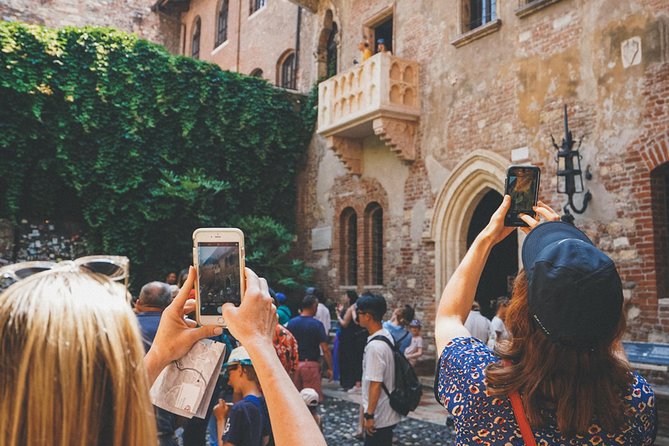
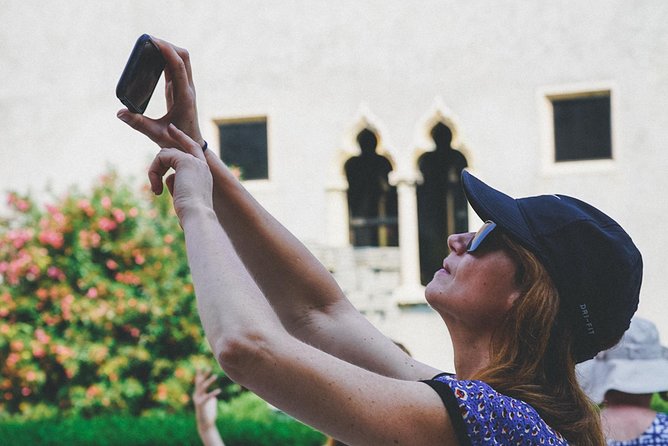
The next major stop is Casa di Giulietta, or Juliet’s House. You visit the courtyard associated with the Capuleti family and the famous balcony linked to Shakespeare’s Romeo and Juliet.
This is one of Verona’s most popular stops, but it needs a little context. The connection between the building and Juliet is a later tourism creation rather than proof that Shakespeare’s characters lived there. The courtyard, balcony, and romantic symbolism are effective, but the story belongs more to literature and modern presentation than to confirmed medieval biography.
That does not make the stop worthless. If you enjoy the play, the setting is fun, and the guide can explain how Verona turned the tale into one of its best-known attractions. If you prefer documented history, you will appreciate a clear distinction between legend and fact.
The standard walking tour does not include admission to Juliet’s House. At certain times, the courtyard may be accessible while the balcony requires a separate ticket. From December 6, 2025, through January 6, 2026, balcony access requires a ticket purchased through the city because of high visitor numbers. The tour provider does not buy that ticket for you.
The stop is brief, listed at about five minutes. That is enough for an introduction and a look around, but not enough for a leisurely visit if the courtyard is crowded.
Romeo’s house, the Scaliger Tombs, and medieval power
The route also passes the medieval palace traditionally associated with Romeo’s family, the Montecchi. The building is privately occupied, so you can only see it from outside. This is another place where the guide helps separate literary tradition from what can actually be visited.
The Arche Scaligere, or Scaliger Tombs, offer a more solid historical stop. These Gothic outdoor monuments mark the cemetery of Verona’s ruling Scaliger family. The elaborate arches and sarcophagi honor figures including Cangrande I, Mastino II, and Cansignorio.
The tombs are easy to miss if you are focused on cafés and shopping streets. Their detail also contrasts sharply with the Roman Arena. Within a short walk, Verona moves from imperial public architecture to the private power of a medieval dynasty.
Admission is not included here either. The tour’s value is in showing you the monuments and explaining their place in the city. If Gothic funerary art interests you, return later for a slower look.
Piazza delle Erbe and Piazza dei Signori
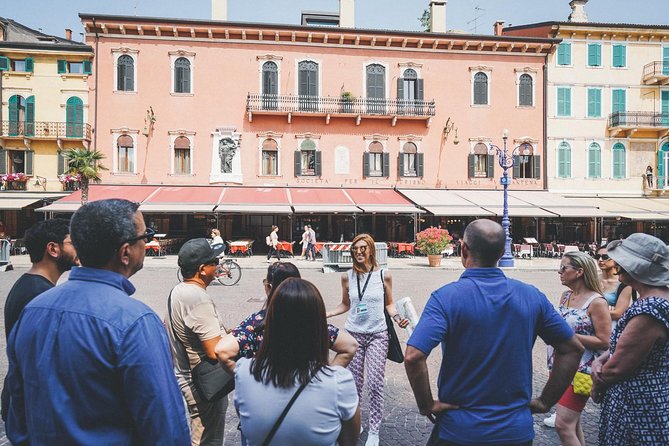
Piazza delle Erbe occupies the site of Verona’s Roman Forum, once the center of public life. Today, it is surrounded by historic buildings, cafés, market activity, and architectural details from different periods.
The fountain in the middle dates from the Scaliger period and is one of the square’s key symbols. Look upward as well as across the piazza. Some façades carry old frescoes, and one account of the walk called attention to fifteenth-century painted decoration on the surrounding buildings.
The guide helps turn the square from a pleasant open space into a readable page of Verona’s history. Roman government, medieval rule, and later Venetian influence all appear around the same few streets.
Piazza dei Signori is quieter and more formal. Once the city’s political center, it is dominated by a statue of Dante Alighieri, added in 1865. The square is also framed by elegant palaces, including Venetian-style architecture, and provides access to the Torre dei Lamberti viewpoint.
The tour does not include the tower visit. If you want a high view over Verona, plan a separate visit and check opening details for your date.
What the guides add to the experience
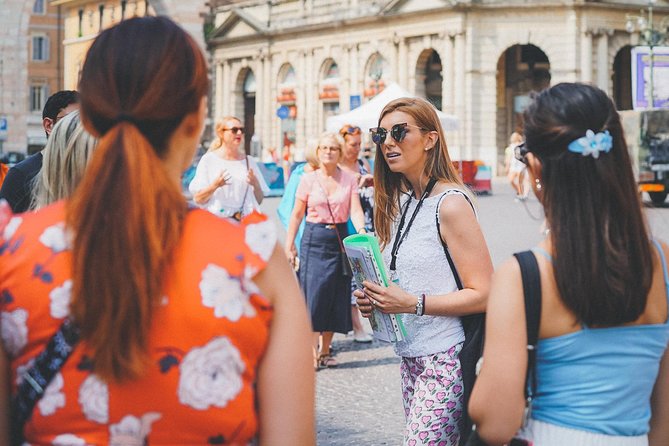
The strongest part of this tour is the human guide. Frank is repeatedly described as funny, friendly, and good at mixing serious history with memorable facts. He also offers recommendations for food and places to see after the walk.
Isabella is praised for explaining Verona’s architecture and culture with energy and humor. Priscilla brings a particularly local perspective and has fluent English, along with patience for older participants. Maria is also described as engaging in rainy conditions.
These details matter because a two-hour city walk can easily become a list of dates and names. The best guides make you notice the city. They explain why a bridge was rebuilt, why a Roman gate looks incomplete, or how a medieval ruler shaped the streets around you.
The experience is offered in English. Since the route passes through busy public spaces, stay close to the guide, especially around Piazza delle Erbe and Juliet’s House. One account even described a guide going back to find a separated participant, which is exactly the sort of care you want in a city center with narrow streets and crowds.
Price, timing, and who gets the best value
At $42.33 per person, the tour is reasonably priced for a two-hour small-group experience, especially if you are new to Verona and want a useful orientation before exploring alone. You are paying for a local guide, not admission tickets or transport.
The value is highest if you plan to use the tour as a starting point. You can mark the Arena, Castelvecchio Museum, Torre dei Lamberti, and Juliet’s House for later visits. The route also helps you avoid wasting time trying to locate less obvious remains such as the Roman gate and wall fragments.
The price is less attractive if you want long interior visits. The basic experience only gives brief stops at several monuments, and admission is not included. In that case, compare it with an option that combines the walk with entry to the Arena and Casa di Giulietta.
The tour is booked an average of 28 days ahead, so reserve early if your Verona dates are fixed. It runs with a minimum of two participants and has a maximum of 16. Free cancellation is available up to 24 hours before the start time. Late cancellations and changes are not refunded or accepted, and unusual weather or sudden closures may be handled case by case.
Should you book this Verona walking tour?
I would book it if you have limited time, want a clear introduction, or prefer learning a city through stories rather than an audio guide. It is especially useful on your first day, when you can use the route to decide which monuments deserve a longer visit.
I would also choose it for the guide-led access to Verona’s less obvious details. The Arena and Juliet’s House are easy to find. Roman wall fragments, the Gavi Arch, the medieval power centers, and the story of the rebuilt bridge are easier to appreciate with context.
Skip it if you want a slow museum tour, a full Arena visit, or extensive time at each stop. For most first-time visitors, though, this is a friendly and efficient way to get your bearings, learn Verona’s major stories, and leave with a better plan for the rest of your stay.
FAQ
How long does the Verona Highlights Walking Tour last?
The tour lasts approximately two hours.
Where does the tour start and end?
It starts and ends at Piazza Bra in Verona.
What language is the tour offered in?
The tour is offered in English.
What is included in the price?
A local tour guide is included.
Are entrance tickets to the Arena and Juliet’s House included?
No. Admission tickets to the Arena and Casa di Giulietta are not included in the standard walking tour.
Does the tour include hotel pickup and drop-off?
No. Hotel pickup and drop-off are not included.
How many people can join the tour?
The maximum group size is 16 people.
Does the tour operate in bad weather?
Yes. The tour runs rain or shine, except that unusual or severe conditions may affect the experience.
Can children join the tour?
Yes, but minors must be accompanied by an adult.
More Small-Group Walking Tours in Italy
- Uffizi & Accademia Timed Entry: Small Group Duomo Walking Tour
★ 4.5 · 3,630 reviews - Eat Like a Local: Venice 3-Hour Small-Group Food Tasting Tour
★ 5.0 · 3,137 reviews - Michelangelo’s David, Accademia & Uffizi Small Group Tour
★ 4.5 · 1,986 reviews - Florence: Uffizi & Accademia Small Group Walking Tour
★ 4.7 · 1,380 reviews
Just added around Italy
- Bergamo: Digital guide made by a local for your walking tour★ 5.0 · 184 reviews
- Full Day Tour by Car and Walking among the Apulian Beauties★ 4.5 · 182 reviews
- The Original Street Food Walking Tour in Bari★ 4.5 · 226 reviews
- Bari Walking City Tour★ 4.5 · 511 reviews
- Bari: Street Food Walking Tour with a Local Guide★ 5.0 · 160 reviews
- Bari Walking Tour with Pasta Experience★ 4.5 · 270 reviews
- Assisi Private Walking Tour including St. Francis Basilica★ 5.0 · 124 reviews
- Private St. Francis Basilica of Assisi and City Walking Tour★ 5.0 · 114 reviews
City Highlights Walking Tours, compared.

Historic Charleston Guided Sightseeing Walking Tour
Read our review →
Dublin Highlights and Hidden Gems Guided Walking Tour
Read our review →
Guided Walking Tour of City Center Highlights
Read our review →

City Highlights Temple and Market Walking Tour
Read our review →
Montmartre Hidden Gems and Scenic Highlights Walking Tour
Read our review →
Browse the lists this tour appears in