
Review · OLD TOWN WALKING TOURS
Dresden Old Town – Guided Walking Tour in English
Dresden’s past is written in stone. This 2.5-hour English walking tour links the city’s Slavic beginnings, Saxon royal splendor, wartime destruction, and careful rebuilding into one clear story. I especially like the way it connects famous sights to wider European history, and I like that guides such as Nicolo, Nicolas, Nikolai, Dominica, and James are praised for humor and strong storytelling. The main drawback is the length: with no planned toilet stop, you should take care of that before meeting the group.
The route begins beside the Martin Luther statue at Neumarkt and finishes near the Elbe, passing Dresden’s major Old Town sights along the way. At $35 per person, it offers solid value if you want orientation and historical context before exploring museums and interiors on your own. Just remember that the booking fee covers your place and the guide’s payment, despite the tour also being described as pay what you wish.
Key points to know before booking
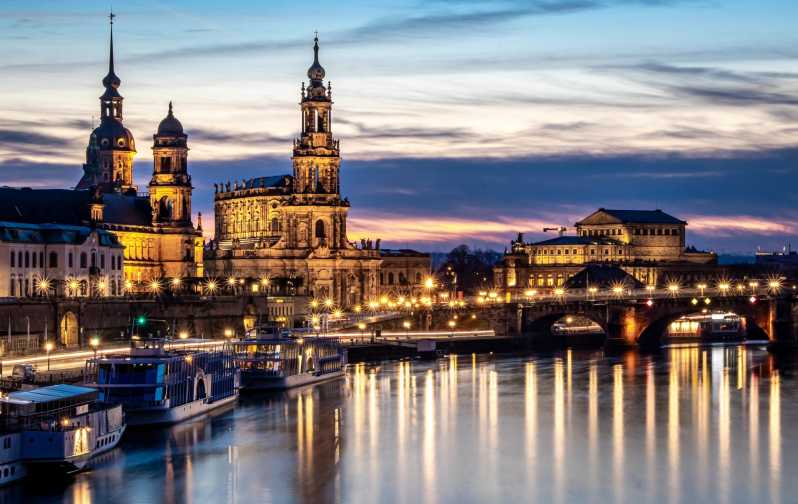
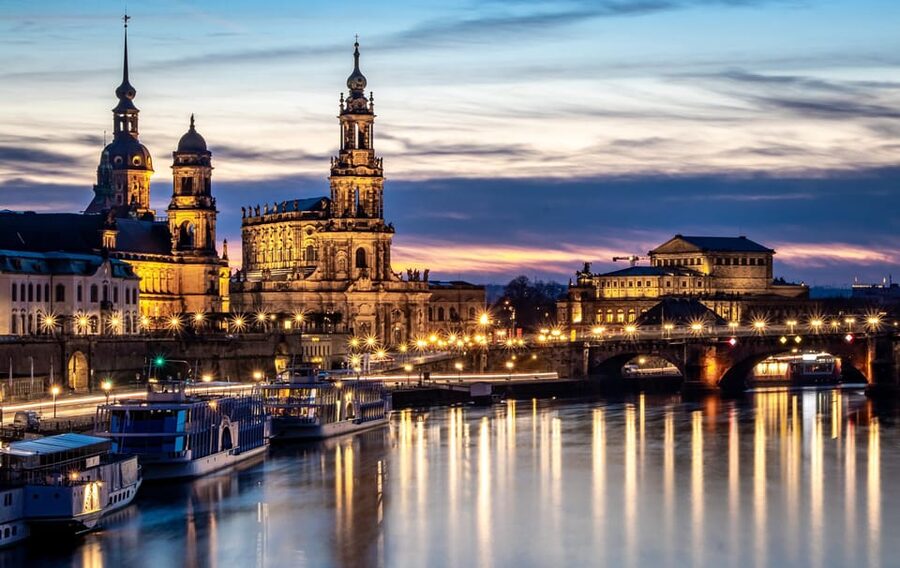
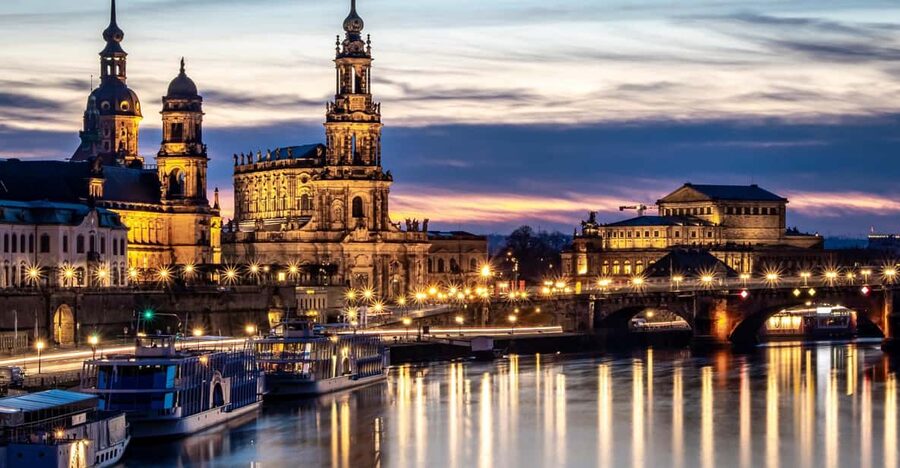
- The tour covers Dresden’s essential Old Town sights, including Frauenkirche, Dresden Castle, Fürstenzug, Brühlsche Terrasse, Hofkirche, Semperoper, and Zwinger Palace.
- The historical story reaches from a small Slavic settlement to modern Dresden, with useful attention to the Wettin dynasty, Polish and Lithuanian connections, World War II, and reconstruction.
- Guides are the strongest part of the experience, with repeated praise for clear English, humor, passion, and the ability to keep history moving.
- The walk usually runs longer than two hours, so wear comfortable shoes and use a toilet before arriving.
- You meet at Neumarkt by the Martin Luther statue, looking for the yellow umbrella.
- The tour is wheelchair accessible, but the route is entirely on foot and includes cobbled streets.
Starting at Neumarkt beside Frauenkirche
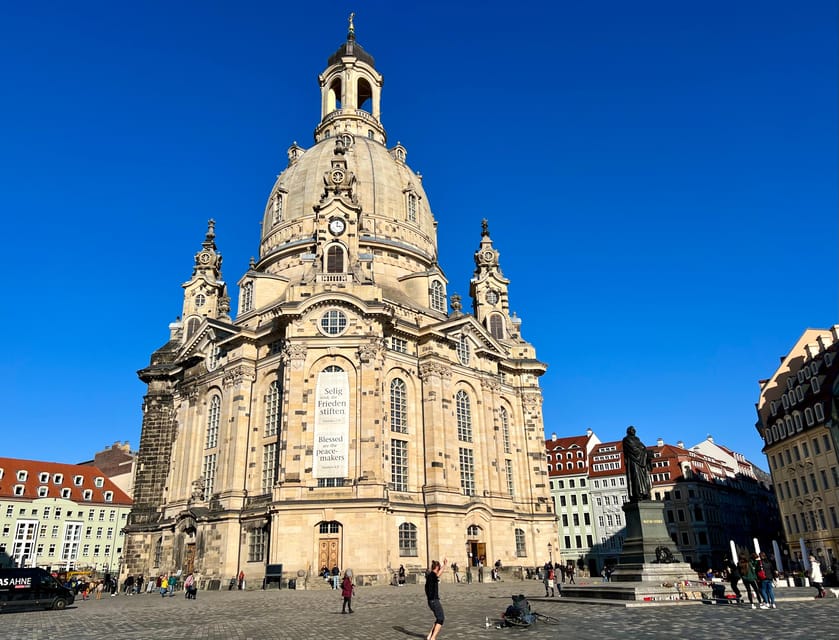
Your meeting point is easy to identify: find the Martin Luther statue at Neumarkt, beside Frauenkirche, and look for the guide with the yellow umbrella. Arrive 10 minutes early. Neumarkt is the right place to begin because it gives you Dresden in one glance: a broad square, a grand church, ornate façades, and a city center rebuilt after almost total destruction.
Frauenkirche is the visual anchor. Its enormous stone dome and pale Baroque form make it one of Dresden’s most recognizable buildings. The tour uses the church as a way into the city’s religious, political, and architectural story. You should not expect an interior visit to be part of the walk, so if you want to see inside, plan that separately. One family specifically wished they had arranged a Frauenkirche visit, which is useful advice for first-time visitors.
The opening section also introduces Dresden’s unusual cultural position. The Elbe is often treated as a dividing line between Germanic and Slavic worlds, but Dresden’s story is more mixed than that. The city began as a small Slavic settlement, and its name still sounds familiar to speakers of Czech, Slovak, Polish, and Sorbian. That context gives the city a more interesting identity than the usual simple label of German Baroque capital.
More Old Town Walking Tours in Germany
- Nuremberg: Old Town Guided Walking Tour
★ 4.6 · 2,416 reviews - Munich: Old Town & Viktualienmarkt City Walk in German
★ 4.7 · 2,304 reviews - Heidelberg: Walking Tour of the Old Town
★ 4.6 · 1,742 reviews
From Slavic settlement to Saxon power
Dresden grew around a castle in the 13th century and became an important regional trading center by the end of the Middle Ages. Nearby silver and lead mines in the Rudavy mountains helped fuel its prosperity. You will hear how mining money, trade, dynastic ambition, and court life gradually changed a modest settlement into a capital built for display.
The city became the seat of Saxony’s prince-electors at the end of the 15th century. The real transformation came in the early 1700s, when Saxon rulers from the Wettin dynasty were chosen as Kings of Poland and Grand Dukes of Lithuania. Dresden then needed to look the part. Palaces, churches, ceremonial spaces, and galleries were built to project authority far beyond Saxony.
This is where a good guide matters. Dates alone can make a city feel like a list. The strongest guides on this tour explain how Dresden’s political ambitions shaped what you see around you. Petr, who already knew the city from an earlier visit, found that Nicolo added useful European context. That is exactly the kind of extra value you want from a walking tour.
Fürstenzug and the long royal procession
One of the route’s most memorable stops is Fürstenzug, the long mural showing the rulers of Saxony. It is more than a decorative wall. It gives you a visual timeline of the dynasty and a direct link between Dresden’s political history and its public art.
The mural is made from porcelain tiles, a fitting choice in a city famous for porcelain production. Your guide can help you read the procession rather than simply admire its length. Look at the sequence of rulers, the clothing, the horses, and the way the artwork turns a side of a building into a statement of legitimacy.
This is also a good point to notice how Dresden’s Old Town works as a collection of connected spaces. You are not just moving from one attraction to another. The squares, palace walls, churches, and arcades explain how the royal city functioned. The guide’s job is to make those links visible.
Dresden Castle and the royal center
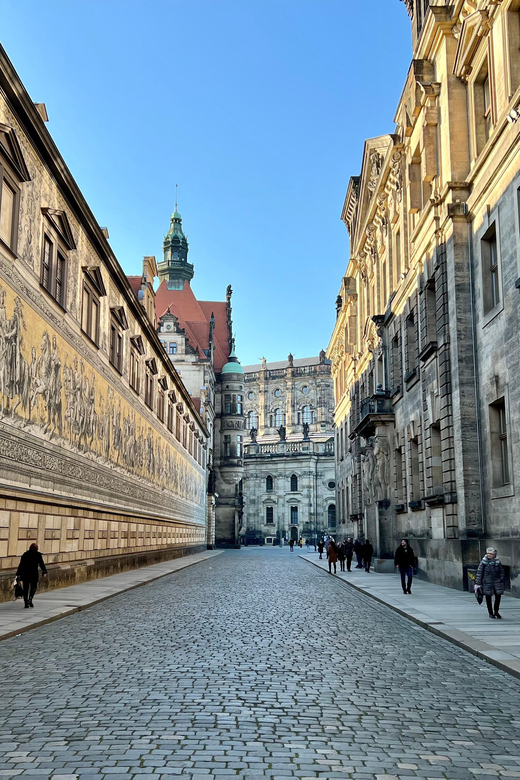
Dresden Castle brings the royal story closer. The complex changed over centuries, and its position near Fürstenzug helps you understand how political power, art, and ceremony were concentrated in this part of town.
The tour focuses on the exterior setting and historical meaning rather than promising entry to the castle’s museums. That distinction matters. Dresden Castle holds major collections, but an outdoor walking tour cannot replace a museum visit. I would use this stop to decide which interior deserves your time later, especially if you have a full day in the city.
The guides are repeatedly praised for making complex material easy to follow. Nicolo is described as lively and full of useful facts, while Nicolas is praised for explaining Dresden in detail without losing his sense of humor. Those qualities matter here, since royal succession and court politics can become dry if they are delivered as a string of names.
Same streets, a different way to see them:
- Discover Berlin Half-Day Walking Tour
★ 5.0 · 9,624 reviews - Berlin City walk Government District and Places of Democracy
★ 4.7 · 8,467 reviews - Berlin: Third Reich & Cold War Guided Walking Tour
★ 4.9 · 8,378 reviews - Munich: Third Reich & WWII Walking Tour
★ 4.6 · 6,181 reviews
Altmarkt, Kreuzkirche, and the modern city
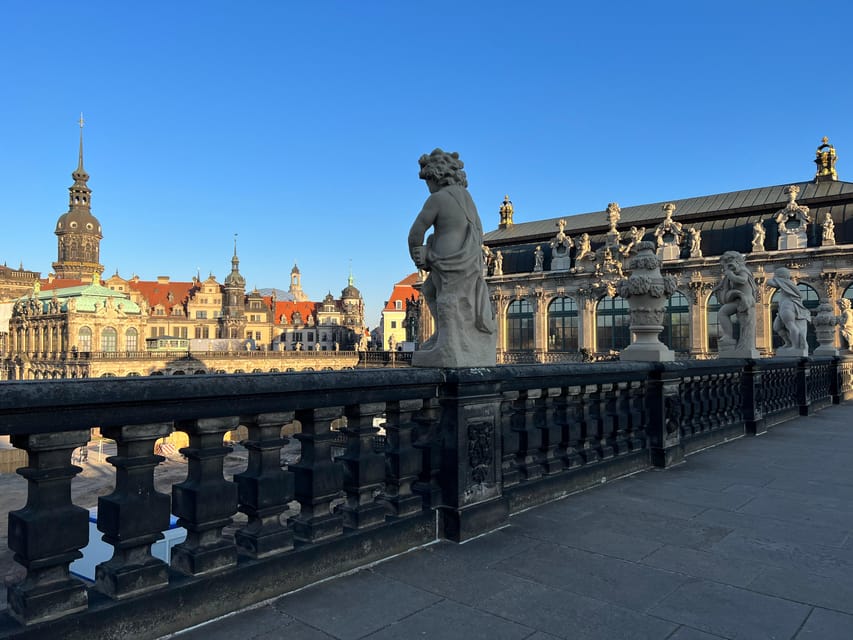
The route continues through Altmarkt, one of Dresden’s main public squares, and past Kreuzkirche and the Palace of Culture. This section helps you see that Dresden is not only a restored Baroque showpiece.
Kreuzkirche connects the city to its Protestant tradition, while the Palace of Culture points to the modern period and the socialist era after World War II. Moving between these buildings gives the tour a wider range than a standard palace walk. You see the city as a working capital, not just a row of grand façades.
The contrast is important. Dresden’s center is famous for historic reconstruction, but present-day life continues around those reconstructed buildings. The guide brings the current city into the story instead of stopping in the 18th century.
Brühlsche Terrasse above the Elbe
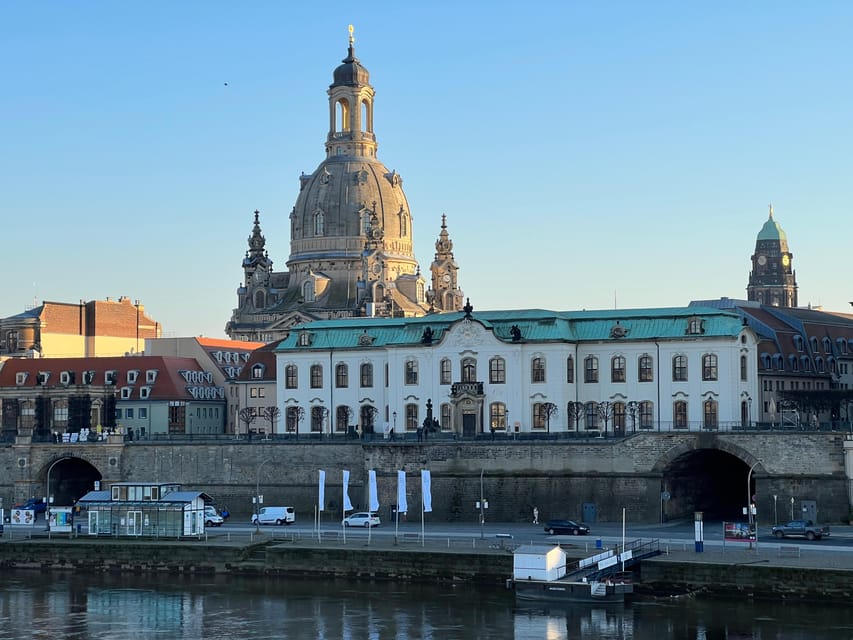
Brühlsche Terrasse is one of the best places to pause. The promenade runs along the Elbe and is often called the Balcony of Europe. From here, you can connect Dresden’s river trade, courtly ambitions, and urban design.
The Elbe is not merely a scenic backdrop. It helped Dresden grow as a trading center and remains central to the city’s layout. The tour’s larger point is that the river connected cultures and regions as much as it separated them. That idea gives the walk a useful Central European frame.
You may find this stop especially enjoyable if you like views and city planning. It also provides a change from close-set streets and monumental buildings. Since the tour is on foot and may last close to three hours, this open stretch offers a welcome breathing space.
Hofkirche and Semperoper
Hofkirche, the former Catholic court church, tells an important story about Dresden’s rulers. In a strongly Protestant region, a Catholic royal church says something about dynastic politics and the Wettin family’s wider ambitions.
The church’s setting also shows how Dresden’s major monuments were placed together to create a ceremonial center. Nearby Semperoper adds another layer, linking the city to opera, court culture, and architecture. These buildings are not random highlights. Together, they show how Dresden used art and design to announce its importance.
A guide can make this part particularly rewarding by explaining how religion, royal image, and music worked together. The best feedback about the tour repeatedly points to this mix of architecture and historical explanation. You are not just told what a building is called. You learn why it was built there and what it was meant to communicate.
Zwinger Palace and Baroque ambition
Zwinger Palace is the grand finale for many people. Its courtyards, pavilions, sculpture, and formal design capture the theatrical side of Dresden’s Baroque period.
The palace was built for court life and celebration, not quiet practicality. That is why the setting feels almost oversized compared with the medieval city that came before it. The guide explains how Dresden’s rulers used architecture to compete with other European courts.
Zwinger is also near the Elbe bridge and sits naturally at the end of a route through the historic center. You can finish the walk with a clear sense of how the city’s main pieces fit together: the church at Neumarkt, the royal buildings around the castle, the river promenade, the opera, and the palace complex.
If you want to visit the museums inside Zwinger, allow extra time after the walking tour. The 2.5-hour route gives you the outside story and orientation, but it does not include museum entry.
Dresden’s destruction and careful rebuilding
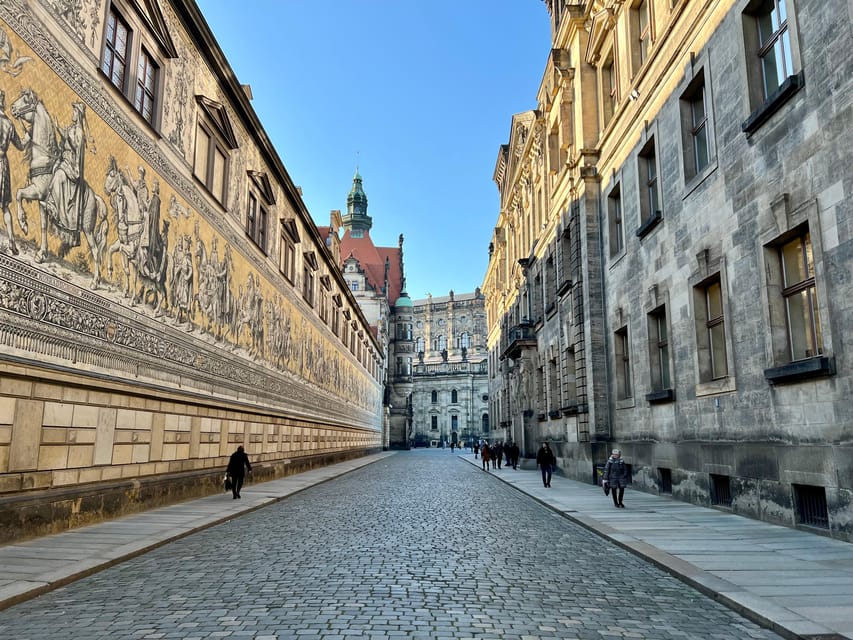
The most important part of the tour is its treatment of the 20th century. Nazi rule and World War II left Dresden’s center devastated. The destruction was so severe that the historic core was reduced far beyond recognition.
What you see today is therefore not simply an untouched old town. Much of the center was rebuilt using historic plans, old techniques, and traditional design elements. Dresden’s reconstruction is often compared with Warsaw’s as one of Europe’s most striking efforts to restore a historic center after wartime destruction.
That fact changes the way you look at every building on the route. The Baroque façades are beautiful, but they also carry a modern story about memory, restoration, and choices made after the war. Several guides are praised for including the 20th century rather than treating Dresden as a frozen royal capital. I consider that essential.
The rebuilt city can look so convincing that you may not realize how much of it is new. A strong guide helps you separate original fabric from reconstruction without turning the walk into a technical lecture. You leave with a better understanding of both the beauty and the difficult history of the Old Town.
The guides make or break the walk
The guide quality is the clearest strength. Nicolo receives especially warm praise for his humor, wide historical frame, and ability to keep a long tour interesting. Nicolas and Nikolai are also praised for clear English and strong command of Dresden’s story. Dominica is described as a gifted storyteller, while James is praised for giving visitors a useful orientation.
That range of names suggests that the experience depends partly on who leads your group. The common thread is positive: guides are described as engaging, funny, passionate, and able to explain history in an approachable way.
English ability is generally strong, but one comment notes that a Spanish guide spoke quickly, requiring a few minutes to adjust. If you sometimes struggle with fast English, stand near the guide and ask for repetition when needed. That is better than quietly losing the thread during the more detailed sections.
How long, how much, and who should book
The stated duration is 2.5 hours, but some walks have lasted around three hours or more. That is good news if you want a thorough introduction, but it requires planning. Use a toilet before the start, bring water, and wear shoes that can handle cobblestones. There is no transportation included, so the full route is on foot.
At $35 per person, the value is good for a first visit if you want a serious orientation rather than a quick photo stop at each monument. You are paying for a live English guide who connects architecture, politics, religion, war, and reconstruction. The price is less attractive if you already know Dresden well or plan to spend your time only inside museums.
The pay-what-you-wish wording needs careful reading. Your booking amount covers the reservation fee and the guide’s payment, so this is not a free walk where you are expected to decide the entire fee at the end. Cancellation is free up to 24 hours before the start, and you can reserve now and pay later.
This tour suits first-time visitors, history fans, families with older children, and anyone who wants to understand Dresden before exploring alone. It is also useful for repeat visitors. One returning visitor still learned much more about the city through the guide’s broader European context.
Should you book the Dresden Old Town walk?
Book it if you want Dresden’s major sights tied into one readable story. The strongest reasons are the route, the treatment of wartime destruction and reconstruction, and the guides’ repeated success with humor and clear explanation.
Skip it if you want extensive interior visits, a short stroll, or a tour with guaranteed toilet breaks. You will need to explore Frauenkirche, Dresden Castle, Zwinger, and other interiors separately.
For most first-time visitors, I would book this early in a Dresden stay. It gives you a map in your head, points out the buildings worth returning to, and explains why this beautiful Old Town is also a carefully rebuilt one.
FAQ
Where does the Dresden Old Town walking tour meet?
Meet beside the Martin Luther statue at Neumarkt, next to Frauenkirche. Look for the guide carrying a yellow umbrella.
How long does the tour last?
The stated duration is 2.5 hours. Some tours have lasted longer, close to three hours, so plan extra time.
What language is the tour in?
The tour is conducted in English by a live English-speaking guide.
Is transportation included?
No. This is a walking tour, and transportation is not included.
Is the tour wheelchair accessible?
Yes, the activity is listed as wheelchair accessible.
What sights are included?
The route includes Neumarkt and Frauenkirche, the Martin Luther statue, Fürstenzug, Dresden Castle, Altmarkt, Kreuzkirche, the Palace of Culture, Brühlsche Terrasse, Hofkirche, Semperoper, and Zwinger Palace near the Elbe bridge.
What happens if I need to cancel?
You can cancel up to 24 hours before the activity for a full refund. You can also reserve your place and pay later.
Just added around Germany
- Berlin Walking Tour★ 4.5 · 378 reviews
- Small Group Walking Tour of East Berlin with a French Guide★ 5.0 · 176 reviews
- Berlin Street Art Walking Tour – Off The Grid★ 5.0 · 270 reviews
- Berlin Highlights Private Guided Walking Tour★ 4.5 · 89 reviews
- East Meets West: Berlin Food Culture & Street Art★ 5.0 · 157 reviews
- Private Walking Tour: World War 2 and Cold War Sites in Berlin★ 5.0 · 230 reviews
- Kreuzberg Berlin: Off the Beaten Track PRIVATE Walking Tour★ 5.0 · 128 reviews
- The History of Berlin: WWII PRIVATE Walking Tour With Locals★ 5.0 · 209 reviews
Old Town Walking Tours, compared.
Underground Vaults Walking Tour in Edinburgh Old Town
Read our review →
3-Hour Walking Tour of Old Town & Prague Castle
Read our review →

Old Town and Jewish Quarter Guided Walking Tour
Read our review →
Cartagena: Historic Center and Getsemaní Shared Walking Tour
Read our review →Browse the lists this tour appears in