
Review · CITY HIGHLIGHTS WALKING TOURS
Ferrara: City Highlights Walking Tour with Local Guide
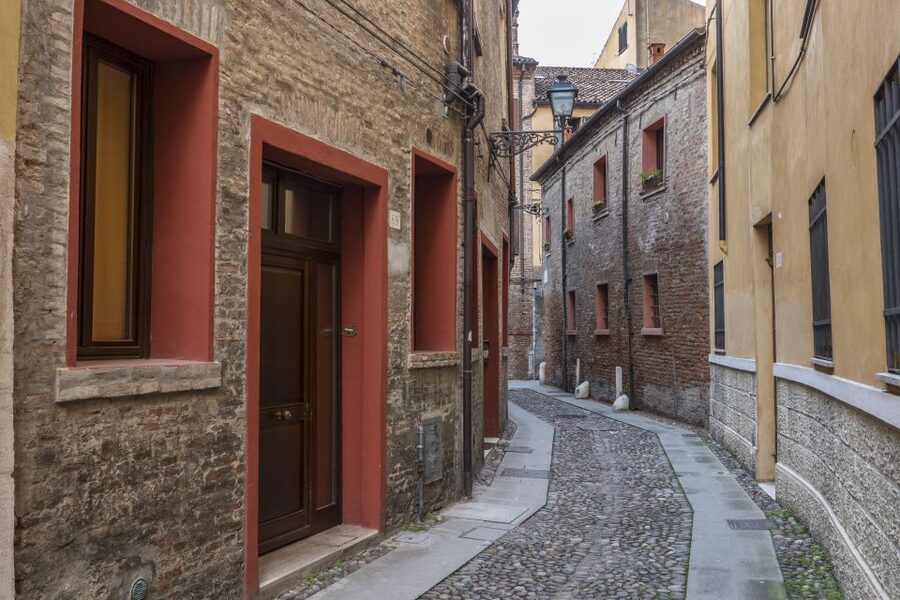
Ferrara rewards slow footsteps. This $17 walking tour links the Este Castle, Renaissance avenues, Palazzo dei Diamanti, and quiet historic squares in two well-planned hours. I like the way it shows both the grand courtly city and the smaller, calmer Ferrara of gardens, arcades, and old churches. I also like that the route includes an internal visit to San Cristoforo alla Certosa, not just quick looks from the pavement. The main limitation is that the tour is conducted in Italian, with an Italian audio guide, so it is not the right choice if you need an English-speaking guide.
The route is especially appealing if you want a useful introduction before exploring Ferrara on your own. Guides are praised for being warm, punctual, and well prepared, and Maria Chiara receives special mention for her work. Bring an umbrella: Ferrara’s streets and open squares are far less pleasant in rain, and the tour continues outdoors.
Key points at a glance
- Two hours, $17 per person: A low-cost introduction to Ferrara’s main Renaissance sights and urban story.
- Starts at Estense Castle: Meet in the castle courtyard near the loggia, a simple central location for beginning the walk.
- Follows Corso Ercole I d’Este: See the grand road planned during the Renaissance Addition and connect the castle with the northern walls.
- Includes San Cristoforo alla Certosa: The church receives an internal visit, adding a quieter religious and artistic stop to the route.
- Italian guide and audio guide: The live commentary is in Italian, with an Italian audio guide included.
- Wheelchair accessible: The activity is listed as accessible, though you should still confirm any personal mobility needs before booking.
Beginning at Estense Castle in Ferrara
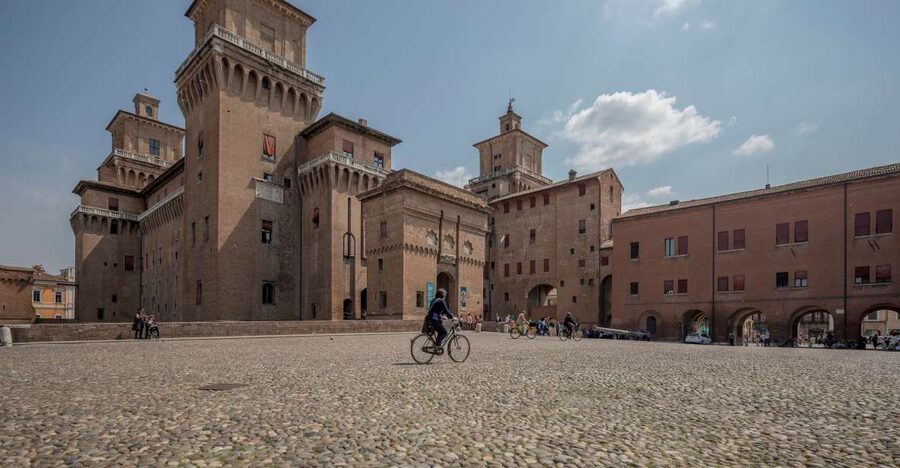
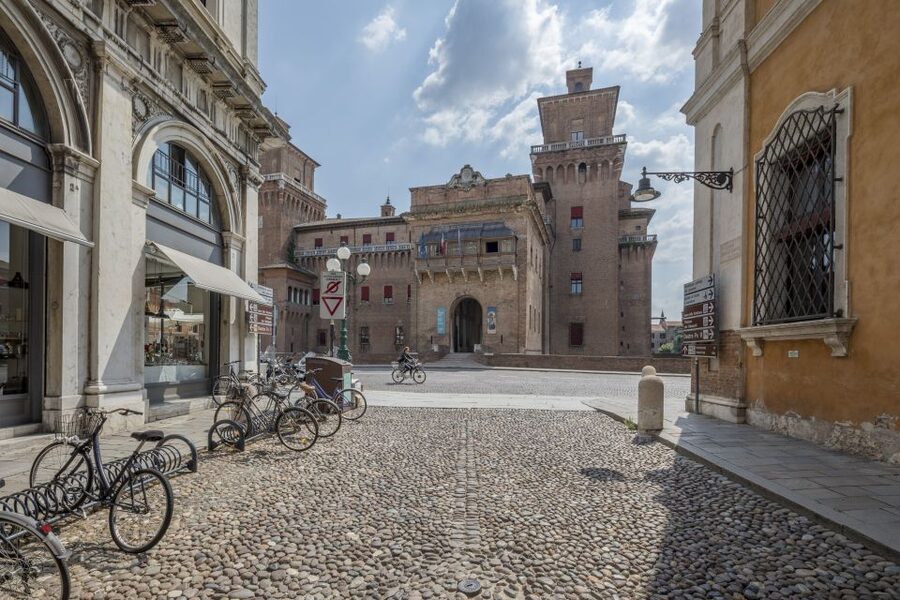
The tour begins in the courtyard of Estense Castle, near the loggia. This is an excellent meeting point because the castle is the clearest symbol of Ferrara and gives you an instant sense of the city’s political past.
The Este family ruled Ferrara for centuries, and the castle was their fortified home, political headquarters, and public emblem. From here, the guide introduces the family’s stories, secrets, and legends before leading you into the city they shaped. You are not simply looking at an attractive brick building. You are starting with the power center that directed Ferrara’s growth from the Middle Ages into the Renaissance.
I like this opening because it gives the rest of the walk a clear purpose. As you move through the streets, the palaces and churches make more sense when you understand that Ferrara was carefully reshaped by the Este court.
The meeting point is practical, but give yourself enough time to find the courtyard. The information provided does not specify a precise sign, guide uniform, or group size, so arriving a little early is sensible. The castle courtyard near the loggia is the place to look for the guide.
More City Highlights Walking Tours in Italy
- Florence: Highlights Walking Tour with Expert Guide
★ 4.6 · 4,662 reviews - Skip-the-Line Florence Highlights and David Walking Tour
★ 5.0 · 1,127 reviews - Venice: Walking Guided Tour of the City Must-See Sites
★ 4.7 · 1,095 reviews
Walking along Corso Ercole I d’Este
From the castle, the route looks toward Corso Ercole I d’Este, the long road that runs north toward the city walls. This is one of the most important parts of the walk because it reveals how Ferrara became a planned Renaissance city rather than a collection of unrelated old streets.
The avenue was part of the Addizione Erculea, or Herculean Addition, ordered by Duke Ercole I d’Este near the end of the 15th century. The Ferrarese architect Biagio Rossetti created the plan, which expanded the city and gave its northern section a more ordered shape.
You will pass Renaissance palaces and churches as the guide explains the relationship between architecture and power. This is where Ferrara’s character becomes clear: the city feels human-sized, but its urban plan was ambitious. A duke was not merely adding houses. He was making a statement about control, refinement, and the future of his court.
The route is valuable for visitors who might otherwise see Corso Ercole I d’Este as simply a handsome street. With context, the road becomes a piece of city planning you can read with your feet. You see how one major avenue connects the castle, the palace district, the gardens, and the northern edge of Ferrara.
There is also a practical benefit to walking this section with a guide. The route can otherwise seem spread out, with each building competing for attention. A good Italian-speaking guide can point out the connections between them and keep the story moving.
Palazzo dei Diamanti and the Renaissance Addition
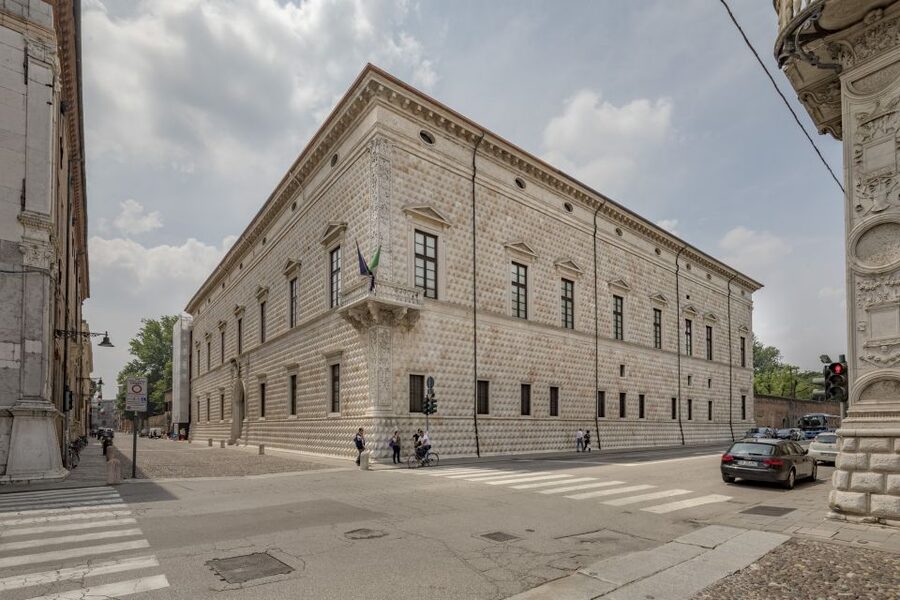
The walk continues toward Palazzo dei Diamanti, the best-known building in Ferrara’s Renaissance Addition. Its exterior is famous for thousands of diamond-shaped stone points covering the façade. Those angular blocks catch light and shadow in constantly changing ways, giving the palace an appearance unlike the smoother Renaissance buildings elsewhere in Italy.
The palace is reached through what is described as the historic crossroads, a significant meeting point within the expanded city. Here, the guide can explain how roads, palaces, churches, and open areas were placed together as part of Rossetti’s plan.
You should not expect a long museum visit inside Palazzo dei Diamanti as part of this activity. Entrance tickets are not included, and the tour is built around an outdoor walking route rather than a full palace exhibition. That is not necessarily a weakness. At $17, the experience gives you the city framework first, leaving you free to decide later if you want to pay for additional interiors.
This is also one of the strongest photo stops. The palace façade rewards a closer look, especially if you examine how its pointed blocks change from flat decoration into a textured surface. The guide’s explanation adds something a camera cannot: the reason the building belongs to a much larger urban project.
A calmer pause in Massari Park
After the formal streets and palaces, the route shifts toward Massari Park. The change in mood is welcome. The park is marked by old cedars of Lebanon and thick planting, with the University Botanical Garden nearby.
This part of the walk gives you a break from façades and historical dates. You can see how Ferrara’s public and institutional spaces fit together, with greenery softening the Renaissance plan. The botanical garden also helps explain why this section feels different from the denser streets around the castle.
The park is useful for understanding Ferrara as a livable city, not only a collection of monuments. The tour description presents the city as magical but human-sized, and Massari Park is where that claim feels most convincing. You are still close to major sights, yet the setting becomes quieter and more open.
Keep in mind that the tour lasts only two hours. The park is part of the route, not a long stop for sitting or independent exploration. If you want time to study the plants or relax under the cedars, plan to return after the guided walk.
Same streets, a different way to see them:
- Venice: Doge’s Palace and St Mark’s Basilica Walking Tour
★ 4.4 · 6,291 reviews - Milan: Guided Walking Tour & Last Supper Visit with Ticket
★ 4.7 · 5,409 reviews - Naples: Street Food Walking Tour with Local Guide
★ 4.9 · 4,976 reviews - Venice: San Marco to Rialto Walk & Spritz Like a Local
★ 4.2 · 3,651 reviews
San Cristoforo alla Certosa and its quiet arcades
One of the most worthwhile stops is the monumental complex of San Cristoforo alla Certosa. The complex began as a church connected with Carthusian monks, who were brought to Ferrara by Duke Borso d’Este in the mid-15th century. Over time, the site became a Monumental Cemetery.
The approach opens into a square framed by elegant arcades. The effect is more restrained than the castle or Palazzo dei Diamanti. Instead of grand courtly display, you get a place shaped by prayer, memory, and quiet reflection.
The internal visit to the Renaissance church is an important part of the tour. Many city walks remain outside religious buildings, so this stop adds depth to the itinerary. You can see the church as an actual historic interior rather than only another façade on a street corner.
The change in use also gives the guide a useful story to tell. San Cristoforo alla Certosa is not frozen in one period. Its religious beginnings and later role as a monumental cemetery show how historic places can change purpose while keeping their visual and emotional force.
This may be the most atmospheric stop for you if you prefer churches, arcades, and quieter spaces to grand palaces. It is also a good reason to choose this route over a basic central-city stroll. You receive a broader picture of Ferrara’s religious and civic life.
The tour information does not specify whether any separate church ticket is required, so do not assume that every interior or monument along the way is covered by the $17 price. Entrance tickets are listed as not included. The church visit is part of the planned route, but ask the provider if you need exact ticket details.
Piazza Ariostea and the end of the walk
The final stop is Piazza Ariostea, named for the poet Ludovico Ariosto. His statue rises above the central column, giving the square a clear focal point and linking the city’s Renaissance setting with its literary culture.
The square provides a natural ending. After the castle, the planned avenue, palace architecture, park, and church, you finish in a green public space beneath the loggia along the edge. It is less about one spectacular monument and more about seeing how Ferrara’s streets open into places where people can pause.
I like this ending because it avoids finishing in a crowded commercial zone. Piazza Ariostea lets the story settle. You can think back over the city’s different layers: medieval power, Este ambition, Renaissance planning, religious life, and poetry.
The square is also useful for continuing your own visit. The tour ends here rather than returning you to the castle, so check the rest of your day’s plans before booking. The information provided does not state how far Piazza Ariostea is from your hotel or railway station. Ferrara is compact enough for further walking, but you should allow time for your next connection.
What the two-hour timing really gives you
Two hours is enough for a strong first look, but not enough for a detailed examination of every building. That is the right balance if you want orientation, context, and a few carefully chosen interiors without giving up half a day.
The route covers a lot of ground, moving from the castle to the northern Renaissance district, then through the park, Certosa, and Piazza Ariostea. You should expect steady walking outdoors, with time for explanations at each major stop. Comfortable shoes make sense, and an umbrella is worth carrying because rain can affect the open portions of the route.
The short format also makes this a useful first activity in Ferrara. You can use the guide’s route to decide where you want to return. Palazzo dei Diamanti may deserve more time, while the church and Certosa may encourage you to explore other religious buildings.
The trade-off is depth. You will hear the main story and see a varied set of places, but this is not a specialist architectural seminar or a full museum program. At $17, the price fits that purpose well. You are paying for a structured introduction and local commentary rather than an all-inclusive sightseeing package.
Guide quality and language
The live guide speaks Italian, and an Italian audio guide is included. If you understand Italian, this is a useful way to get more than a silent walk through the city. The strongest praise centers on guides who are passionate, precise, courteous, and empathetic.
Maria Chiara is specifically praised by name, while other feedback describes the guiding as well prepared and professional. That suggests the human side of the experience is one of its main strengths, though individual guide assignments can vary.
If you do not speak Italian, take the language limitation seriously. The audio guide is also in Italian, so it does not solve the problem for English speakers. You might still appreciate the architecture and route, but you would miss much of the history, legends, and explanation that make the tour worthwhile.
The activity is listed as wheelchair accessible. Since the route includes streets, a park, a monumental complex, and a church, confirm any specific mobility requirements with the provider before booking. The general accessibility listing is helpful, but it cannot address every personal need.
Is $17 a fair price?
Yes, if you want a guided orientation rather than a series of paid interiors. The price is modest for two hours with a live local guide, an audio guide, and a route that reaches several parts of Ferrara instead of staying around the castle.
The value comes from the connections. You see the Este family’s castle, understand the planning behind Corso Ercole I d’Este, visit the exterior of Palazzo dei Diamanti, pass through Massari Park, enter San Cristoforo alla Certosa, and finish at Piazza Ariostea. Doing all of that independently is possible, but you would need to research the sequence and historical links yourself.
The cost does not cover entrance tickets. If you plan to visit paid museums or interiors afterward, add those expenses to your budget. Still, the basic walk gives you enough background to choose those extras with more confidence.
The 4.6 rating from 219 ratings supports the idea that this is a dependable introduction, especially for visitors who value guide quality. The repeated praise for preparation, punctuality, courtesy, and professional presentation is more useful than the number alone.
Who should book this Ferrara walk?
I would recommend it to first-time visitors who want to understand Ferrara’s layout quickly. It is also a good fit if you enjoy architecture, Renaissance city planning, church interiors, and stories about ruling families.
You will get the most from it if you speak Italian and want direct conversation with a local guide. The route is also suitable for visitors who prefer a manageable two-hour activity instead of a full-day excursion.
You might skip it if you want an English-language tour, a museum-heavy experience, or a slow visit with long stops at each monument. You might also prefer independent sightseeing if you already know Ferrara well and have researched the Este family and the Addizione Erculea.
Book with weather in mind. Much of the experience takes place outside, and an umbrella is specifically advised. Flexible booking helps here, since cancellation is allowed up to 24 hours before the start for a full refund, and you can reserve now and pay later.
Should you book the Estense Castle walking tour?
Book it if you want a low-cost, well-structured introduction to Ferrara’s medieval and Renaissance character, especially if Italian is comfortable for you. The route has real variety, and the internal church visit gives it more substance than a basic monument walk.
The best reason to choose it is the balance of famous and quieter places. Estense Castle and Palazzo dei Diamanti provide the headline sights, while Massari Park, San Cristoforo alla Certosa, and Piazza Ariostea show the calmer side of the city.
Skip it if you need English commentary or plan to spend your time inside museums. For everyone else, $17 buys a sensible first look at Ferrara, with enough historical context to make the rest of your visit more rewarding.
FAQ
Where does the Ferrara walking tour begin?
The meeting point is in the courtyard of Estense Castle, near the loggia.
How long does the tour last?
The walking tour lasts two hours.
How much does the experience cost?
The listed price is $17 per person.
What language is the live tour guide?
The live tour guide speaks Italian.
Is an audio guide included?
Yes. An Italian audio guide is included.
What sights are included in the route?
The route includes Estense Castle, Corso Ercole I d’Este, Palazzo dei Diamanti, Massari Park, San Cristoforo alla Certosa, and Piazza Ariostea.
Does the tour include an interior visit?
Yes. The route includes an internal visit to the Renaissance church of San Cristoforo alla Certosa.
Are entrance tickets included?
No. Entrance tickets are not included in the activity price.
Is the tour wheelchair accessible?
Yes. The activity is listed as wheelchair accessible.
What should I bring?
An umbrella is advisable in case of rain.
Just added around Italy
- Bergamo: Digital guide made by a local for your walking tour★ 5.0 · 184 reviews
- Full Day Tour by Car and Walking among the Apulian Beauties★ 4.5 · 182 reviews
- The Original Street Food Walking Tour in Bari★ 4.5 · 226 reviews
- Bari Walking City Tour★ 4.5 · 511 reviews
- Bari: Street Food Walking Tour with a Local Guide★ 5.0 · 160 reviews
- Bari Walking Tour with Pasta Experience★ 4.5 · 270 reviews
- Assisi Private Walking Tour including St. Francis Basilica★ 5.0 · 124 reviews
- Private St. Francis Basilica of Assisi and City Walking Tour★ 5.0 · 114 reviews
City Highlights Walking Tours, compared.
Historic Charleston Guided Sightseeing Walking Tour
Read our review →
Dublin Highlights and Hidden Gems Guided Walking Tour
Read our review →
Guided Walking Tour of City Center Highlights
Read our review →
City Highlights Temple and Market Walking Tour
Read our review →
Montmartre Hidden Gems and Scenic Highlights Walking Tour
Read our review →
Browse the lists this tour appears in