
Review · NIGHT WALKING TOURS
Munich: Night Watchman Walking Tour
Munich gets more intriguing after dark. This 1.5-hour walk turns the old town into a stage for medieval gossip, churchyard tales, and old city rules. I like the costumed night watchman, who does more than point at buildings, and I like the route through small lanes that are easy to miss in daylight. The main drawback is the fixed price of $530, which makes the tour much better value for a larger private group than for only two or three people.
I also like the mix of fact and theatrical storytelling. The guide can be stern, funny, suspicious of modern habits, and ready with an answer about Munich needing so many beer taps. Recent guides including Elsbeth have been praised for being authentic, funny, and informative, while Susann specifically enjoyed the wit and charm.
The timing shapes the experience. You are walking late in the evening, so some families and younger children may find the darker stories too grim. The route is wheelchair accessible, but the exact meeting point can change according to the option you book.
Key points to know before you book
- A 1.5-hour evening route: The walk covers many central Munich landmarks without taking up an entire night.
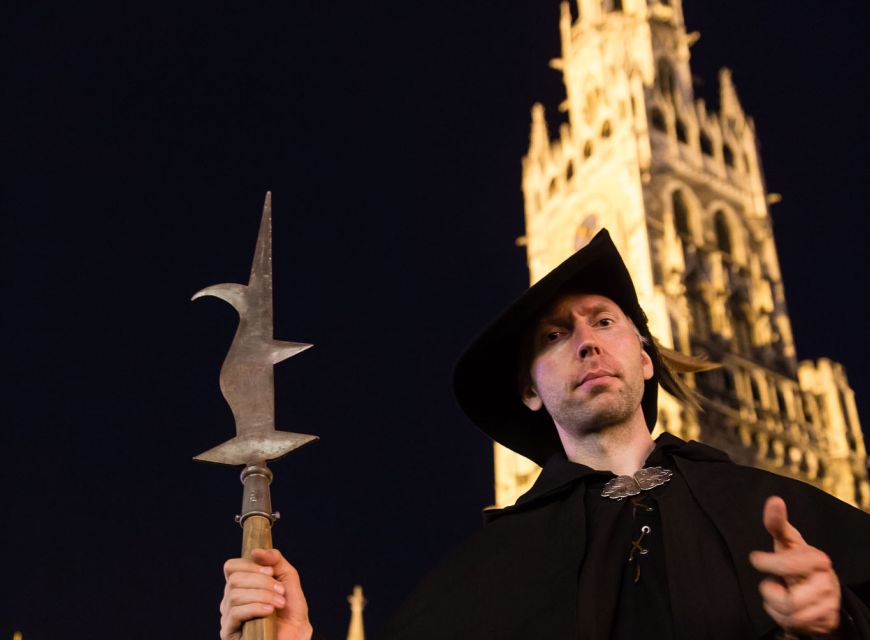
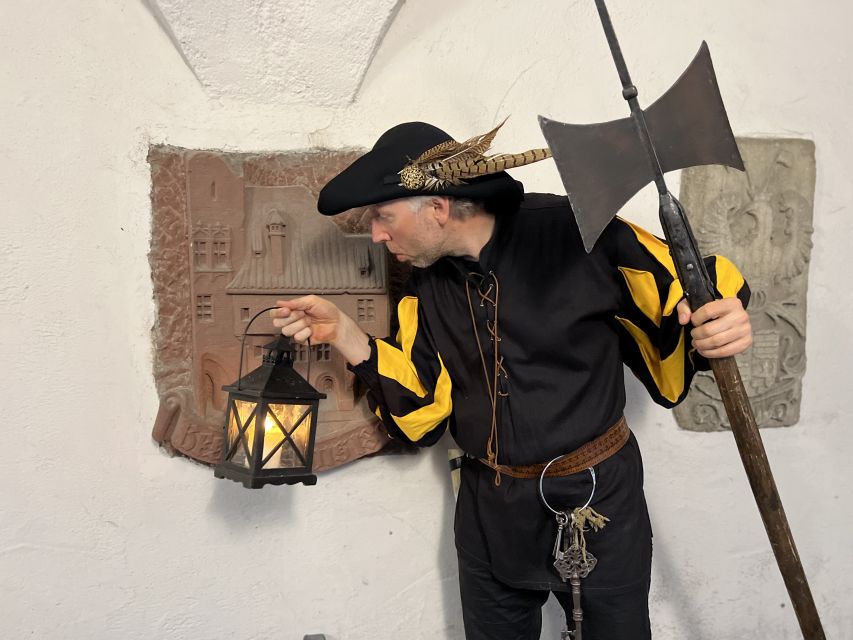
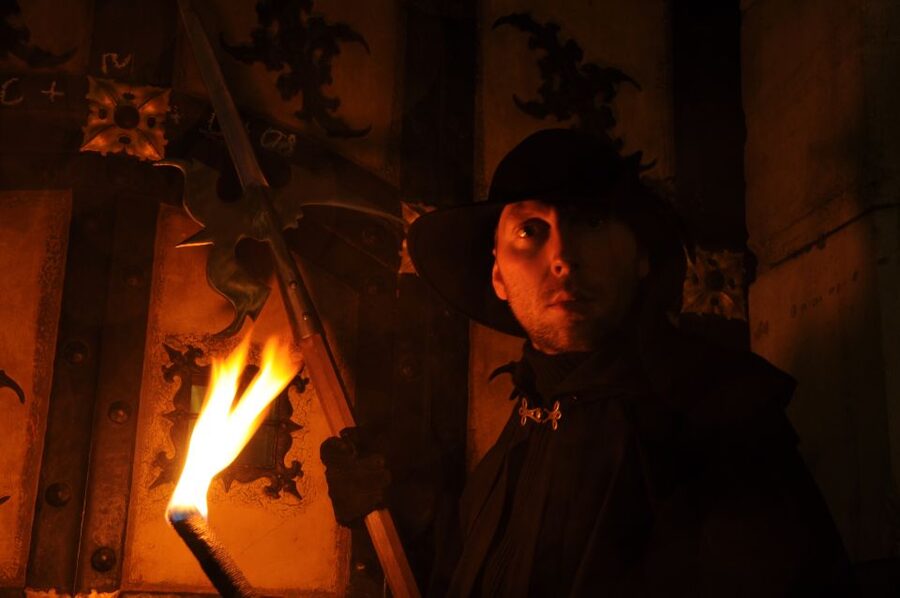
- A character-led guide: Your night watchman carries a lantern, wears medieval clothing, and speaks as a city official from another age.
- Small lanes and old courtyards: The route includes Gruftgasse, Schäfflergasse, the Alter Hof, and other corners that daytime sightseeing can skim over.
- Dark stories with comic relief: Expect tales of graves, torture, sudden death, secret societies, unlucky falls, and plenty of beer humor.
- Best value for a group: The $530 rate covers up to 30 people, so the cost makes more sense for a family, club, or private party.
- English or German guiding: You can choose between the two listed languages, and private groups are available.
Why Munich works so well after sunset
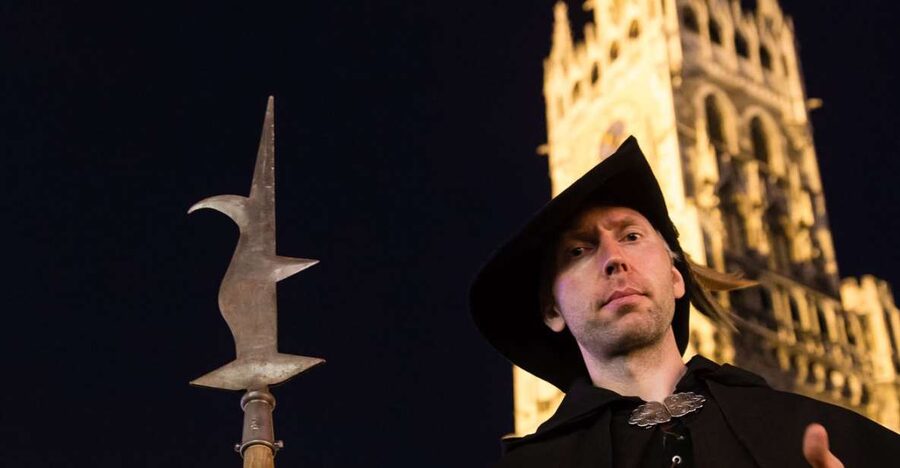
Munich’s old town changes character when the shops close and the streets quiet down. The night watchman format gives you a reason to look upward at church towers, into narrow passages, and toward old gates that can seem ordinary during the day.
This is not a standard architectural walk. The guide speaks in character and treats the city as a place still governed by medieval habits. Law-abiding citizens, in his view, should already be asleep, while the lively crowd gathering after 21:00 deserves a raised eyebrow.
That role-playing adds fun, but it also carries useful information. You hear about patron saints, funeral customs, dynastic politics, city walls, old prisons, and the role of wine in medieval Munich. The stories are easier to remember because they arrive with a personality attached.
The route is also tightly focused. You stay in the inner city rather than spending time on transport between districts. That makes the walk practical after dinner, though you should plan your own route to and from the meeting point because transport is not included.
More Night Walking Tours in Munich:
- Munich Ghosts and Spirits Evening Walking Tour
★ 5.0 · 1,900 reviews - Private Street Food Evening Walking Tour in Ho Chi Minh City
★ 5.0 · 3,175 reviews - Granada: Albaicín and Sacromonte Guided Sunset Walking Tour
★ 4.9 · 2,962 reviews
Marktplatz and the night watchman’s duties
The walk begins at Marktplatz, where the night watchman gathers his flock for the evening round. The language of a flock is intentional. You are not simply following a guide, you are being shepherded through a city that the character claims to police.
I like this opening because it establishes the tone quickly. The night watchman is responsible for peace in dark corners and alleyways, and he knows the city’s maze better than the sleeping residents. He also carries old suspicions about modern life, which gives the early part of the walk a comic edge.
His attitude toward Munich’s nightlife is part of the show. He considers respectable people to be in bed after 21:00, so a lively evening crowd becomes something close to a civic nuisance. The joke works best if you enjoy a guide who gently scolds the group while still explaining the city clearly.
The beer-tap gag is another example of the style. When asked why Munich needs so many taps, the answer is simply for the beer. It is a small joke, but it signals that this walk will not treat every subject with solemn ceremony.
St. Peter’s Church and the crooked towers
At St. Peter’s Church, the route turns your attention to the tops of the towers. The night watchman explains why they stand askew, giving you a reason to study the skyline instead of merely passing the church at street level.
The south side brings a sharper change in mood. You see the old churchyard and hear about gravestones, funeral customs, decomposing bodies, and missing church pews. These details show how closely religious life, burial practice, and daily city routines once overlapped.
This section will appeal to you if you enjoy macabre local stories rather than polished sightseeing. It may be less comfortable for young children or anyone who prefers a light historical walk. The subject matter is not just spooky decoration, though. It helps explain how people understood death and public space in earlier centuries.
The churchyard stories also suit the nighttime setting. Lantern light, old stone, and a guide speaking as a watchman create a stronger mood than the same facts would have in a bright afternoon lecture.
The Altes Rathaus and Munich’s old gate
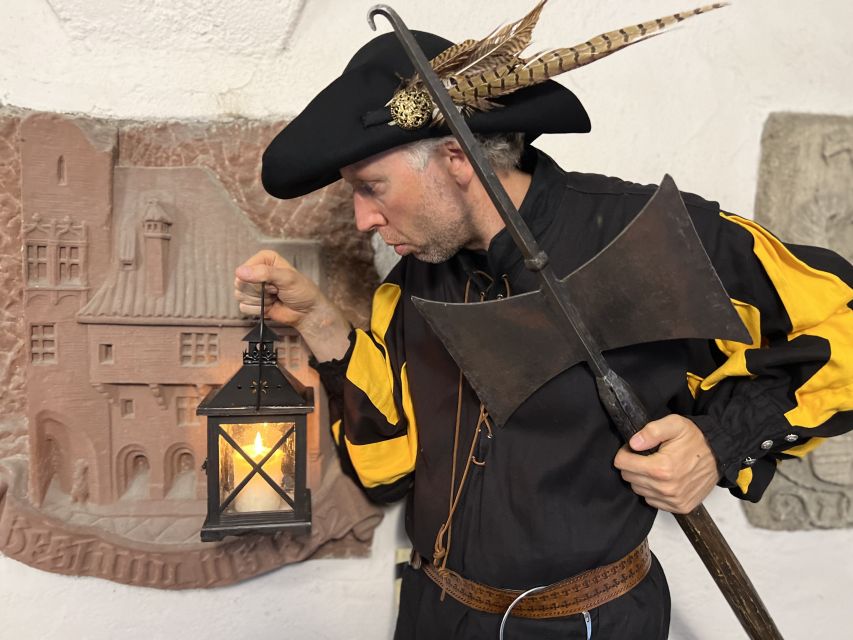
At the Altes Rathaus, the walk reaches historic Salzstraße and the old Stadttor. Here, the gate becomes a character of its own, complaining about its rebuilding in the 1970s. That unusual point of view turns a construction detail into a small piece of civic drama.
The watchman also tests the group’s piety. Patron saints Onuphrius and Henry the Lion enter the story, along with their supposed protection from sudden death. You get a lesson in the city’s religious figures, but the delivery remains playful and slightly suspicious.
I find this style useful because it brings abstract names back into the physical city. Instead of memorizing another saint or ruler, you connect the figure with a gate, a tower, and a question posed directly to the group.
The exact balance between acting and explanation may depend on the guide. Elsbeth has been praised for an authentic, experience-focused performance that still provided plenty of information. That combination matters here. A guide who only performs could leave you entertained but uninformed, while a guide who only lectures would lose the point of the night watchman character.
A few more walks around Munich worth a look
- Munich: Third Reich & WWII Walking Tour
★ 4.6 · 6,181 reviews - Third Reich Walking Tour Munich
★ 4.5 · 4,291 reviews - Munich: Old Town & Viktualienmarkt City Walk in German
★ 4.7 · 2,304 reviews - Munich Old Town Walking Tour
★ 4.5 · 1,287 reviews
Torture, prison, and the Alter Hof
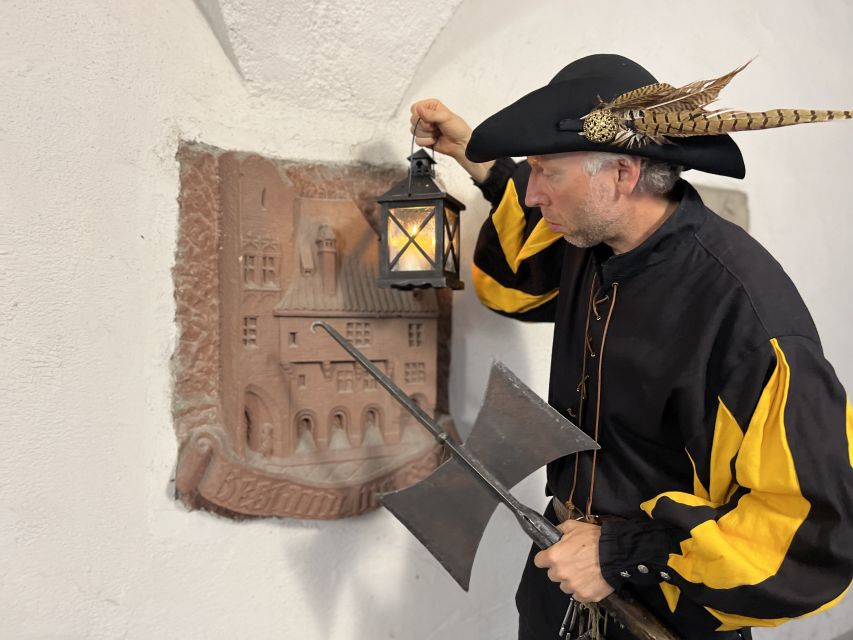
The route continues past the torture chamber and prison before reaching the Alter Hof, built by Louis II. The sequence is effective because it moves from punishment and confinement into royal power.
You hear why this ruler was considered harsh, how the Wittelsbach family came to Munich, and where the name Zwingerstock came from. These are compact historical threads, but together they show how authority worked in the old city.
The Alter Hof section is a good example of the tour’s wider approach. Rather than stopping only at the most famous façade, the guide uses the surrounding places to tell stories about rulers, law, and fear. The setting gives the information a physical anchor.
Do not expect a full political history of Bavaria in 90 minutes. The material is selective and story-driven. You will get memorable episodes and names, not an exhaustive timeline. For most visitors, that is a sensible trade-off on an evening walk.
City walls, Gruftgasse, and the Waller tale
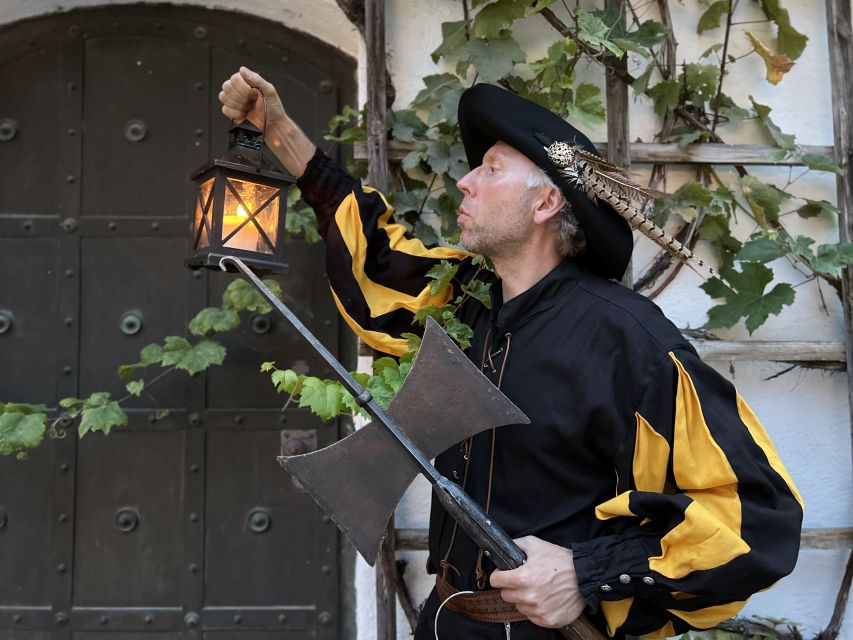
From Wasserburg, the route follows the 12th-century city walls and heads west. This part helps you picture Munich as a fortified medieval settlement rather than the broad modern city around it.
At Gruftgasse, Alois tells the spooky tale of Waller in Walchensee, a young woman, and a golden ring. The provided information identifies Alois as the storyteller for this episode, while recent praise also singles out Elsbeth and other guides for their personal delivery. Guide assignments can vary, so you should not assume a particular person will lead your departure.
The story gives the walk a folklore break from its church and royal subjects. It is the kind of tale that benefits from a dark lane and a guide who knows when to slow the pace.
You should also keep your expectations clear. This is a guided story, not a theatrical production with elaborate staging. The power comes from the route, the costume, the voice, and the old tale itself.
Schäfflergasse and why wine came before beer
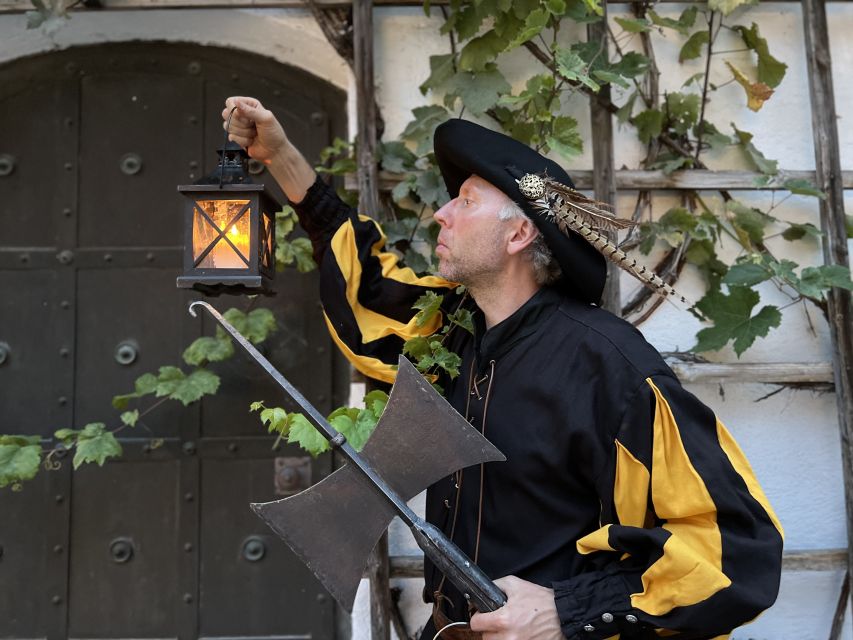
At Schäfflergasse, the night watchman explains why wine, rather than beer, was the preferred drink in the Middle Ages. That detail may surprise you, especially in a city now closely linked with beer halls and beer gardens.
I like this stop because it challenges the easy modern image of Munich. Cities change their habits. A place famous for one drink today may have preferred another centuries ago, and the explanation gives you a sharper sense of everyday life in the old town.
This is also where the tour’s humor and historical detail work together. The watchman can joke about Munich’s beer culture while explaining that the medieval city did not always match the modern stereotype.
Food and drinks are not included, so you will not stop for a tasting. Think of the beverage stories as part of the narration, not as a culinary activity. If you want a beer afterward, plan that separately.
The Frauenkirche and stories above the street
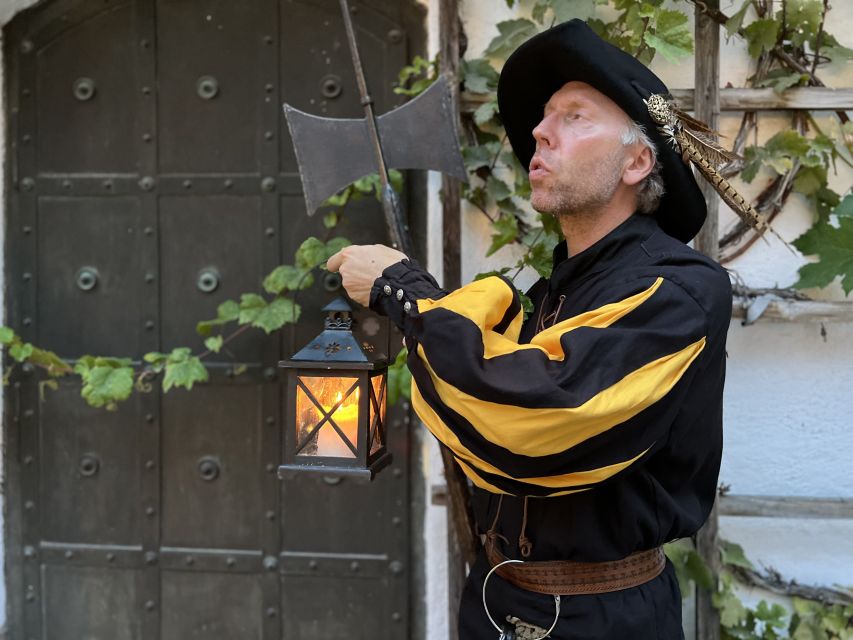
At the cathedral, the guide directs your attention to Munich’s two-towered symbol. The route then adds more personal and unsettling stories, including the epitaph of a wealthy widow and Fanny von Ickstatt’s unlucky fall from the north tower of the Frauenkirche.
These accounts bring individual lives into a large landmark. The cathedral is not treated only as a postcard view. Its towers, inscriptions, and stories become evidence of the people who lived, died, worshiped, and suffered around it.
The tower story is especially suited to the night watchman’s darker voice. It is memorable, but it may not be the right material for someone looking for a gentle family stroll. The tour repeatedly moves between comedy and death, so you should be comfortable with that range.
The cathedral section also rewards looking up. Much of the walk’s value comes from seeing familiar places differently, and the guide keeps directing your eyes toward towers and upper details you might otherwise miss.
Promenadeplatz, palaces, and a royal love story
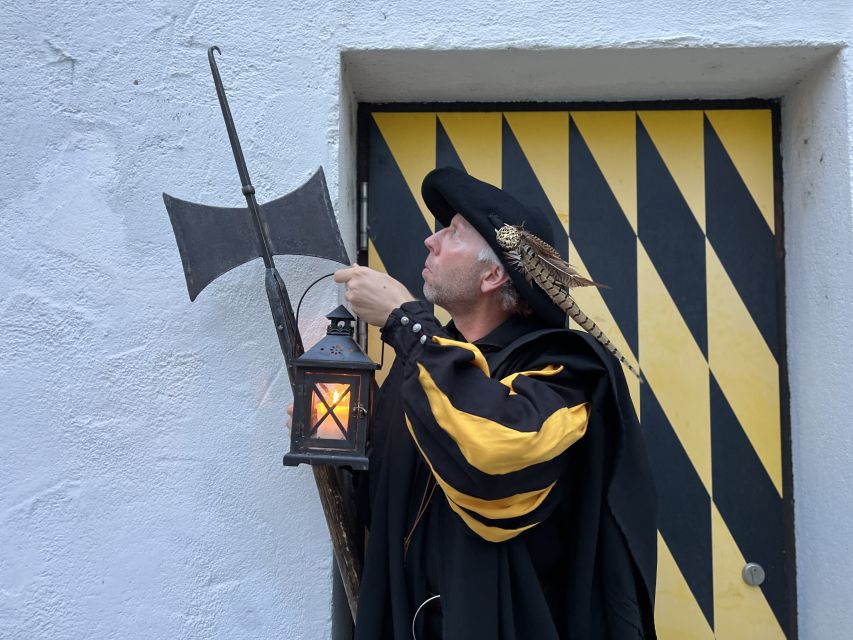
The inner-city route continues to Promenadeplatz and the old Salzstadel. You then pass Palais Porcia and Palais Holstein while hearing about sovereign lord Karl Albrecht and the palaces built for his mistress.
This section shifts the mood from grim churchyard tales to courtly ambition and romance. The palaces show how private relationships could shape public architecture when rulers had the money and power to build.
The old Salzstadel also connects the walk to trade and storage. Even in a short tour, the guide keeps moving between rulers, religion, commerce, and ordinary city life. That range prevents the route from becoming a string of unrelated ghost stories.
You may find the palace section more satisfying if you enjoy social history. The buildings matter, but the story about who ordered them and why gives them a human motive.
Salvatorkirche and the Theatine Church
Near Salvatorkirche, the night watchman tells the story of a major host desecration. The subject is serious and religiously charged, so the guide’s treatment matters. In this format, the event becomes part of a wider account of belief, accusation, and public reaction in Munich.
The walk then turns to Henriette Adelaide, consort of electoral prince Ferdinand Maria, and the Theatinerkreuzgang. After ten years of waiting, the long-desired heir to the throne was born, and the Theatine Church was built.
This is one of the route’s clearest examples of personal events shaping the city. A royal family’s hopes and anxiety become a church that still forms part of Munich’s architectural identity.
The final section brings together several themes from the walk: faith, dynastic succession, public monuments, and the way private concerns can leave a permanent mark on a city. The night watchman then releases his flock into the night and returns to his rounds.
Price, group size, and practical value
The listed price is $530 for a group of up to 30 people. That is a serious total for a 90-minute walk, but the calculation changes if you are traveling with a large family group, company, school group, or private association.
At the maximum group size, the cost works out to roughly $18 per person. For two people, it is $265 each, which is difficult to justify unless you place a high value on a private, character-led experience. Check the exact option before booking because the meeting point may vary.
The private group option is a major advantage for people who want to keep their own pace and share the jokes with friends or family. A large group can also make the fixed price reasonable, though the experience may feel less intimate when all 30 places are filled.
The tour includes the medieval-clothed night watchman and live guiding in German or English. Food, drinks, and transport are not included. Cancellation is free up to 24 hours before the start, and reserve-now-pay-later availability can help if your evening plans are still moving around.
The walk is listed as wheelchair accessible. Because the route passes through old lanes, church areas, and historic parts of the inner city, confirm the meeting details for your chosen option before you go.
Who will enjoy this Munich night walk
I would choose this tour for you if you enjoy local legends, old religious customs, royal gossip, and guides who perform a role rather than deliver a neutral lecture. It works particularly well for a first evening in Munich because the route introduces many central sights without requiring a full day.
It is also a good fit for repeat visitors. You may already have seen St. Peter’s Church, the Frauenkirche, the Altes Rathaus, and the Alter Hof, but the night watchman gives each place a new angle.
Families can enjoy the humor, though I would judge the children carefully. Stories about decomposition, torture, sudden death, and an unlucky fall are part of the experience. Adults who want gentle sightseeing may prefer a daytime city walk.
The strongest praised qualities are the guides’ humor, charm, authenticity, and ability to keep the information flowing. Susann highlighted those qualities, while another recent booking described the experience as both funny and informative. Those comments match what this format needs most: a guide who can keep the character alive without letting the history disappear.
Should you book it?
Book this walk if you want Munich’s old town presented as a living medieval storybook, with jokes, eerie legends, saints, rulers, prisons, and crooked towers. The experience earns its price best when you fill the private group or care strongly about a distinctive guide-led evening.
Skip it if you want a quiet architectural tour, a food experience, or a low-cost activity for one or two people. For everyone else, the mix of old lanes, strong character acting, and useful local history makes this a memorable way to see central Munich after dark.
FAQ
How long does the Munich Night Watchman Walking Tour last?
The tour lasts 1.5 hours.
How much does the tour cost?
The listed price is $530 per group of up to 30 people.
Is the tour private?
A private group option is available. The price applies to a group of up to 30 people.
Which languages are available?
Live guiding is available in German and English.
Is the tour wheelchair accessible?
Yes, the activity is listed as wheelchair accessible.
What does the tour include?
The tour includes guidance from a night watchman dressed in medieval clothing.
Are food and drinks included?
No. Food and drinks are not included in the tour price.
Is transport included?
No. Transport is not included.
Can I cancel for a full refund?
Yes. You can cancel up to 24 hours in advance for a full refund.
Just added around Munich
- Munich: Walking Tour Old Town and Viktualienmarkt★ 4.7 · 839 reviews
- Munich: Raven Black Witches and Executioners Walking Tour★ 4.7 · 294 reviews
- Munich : Private Walking Tour with A Guide (Private tour)★ 4.5 · 85 reviews
- Munich Old Town – Guided Walking Tour in English★ 4.7 · 153 reviews
- Munich: Guided Food Walking Tour with Beer Tasting★ 4.7 · 183 reviews
- Munich: Old Town Guided Walking Tour★ 4.6 · 479 reviews
- Munich: Old Town Walking Tour★ 4.7 · 589 reviews
- Munich: Birthplace of the Third Reich Guided Walking Tour★ 4.6 · 771 reviews
Night Walking Tours, compared.

Private Street Food Evening Walking Tour in Ho Chi Minh City
Read our review →
Albaicín and Sacromonte Guided Sunset Walking Tour
Read our review →
Bremen: Walking Tour in German with Night Guard
Read our review →
Ghosts of Charleston Night-Time Walking Tour with Unitarian Church Graveyard
Read our review →
Savannah’s Ghost City “Dead of Night” Walking Night Tour
Read our review →
Gion Magical Night Walking Tour with Geisha Trivia
Read our review →

Browse the lists this tour appears in