
Review · HIDDEN GEMS WALKING TOURS
Rome Walking Tour: Pantheon, Trevi, Navona & Hidden Gems
Rome rewards curious walkers. This two-hour tour links Piazza Venezia, Trevi Fountain, the Pantheon, and Piazza Navona with quieter streets and overlooked details that are easy to miss on your own. I like the clear route through central Rome, and I like that the guide finishes with practical advice on restaurants, bars, and places to see next. The main tradeoff is that the Pantheon is passed from outside rather than visited inside, and the busy route can feel brisk at popular monuments.
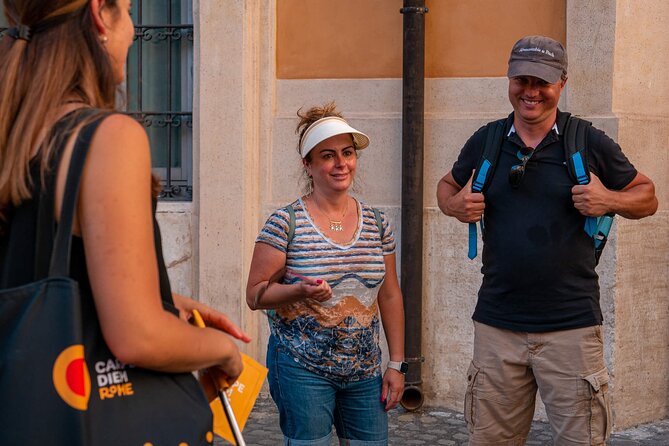
The price is $23 per person, which is good value if you want a useful introduction before exploring Rome independently. The guides receive especially strong praise for storytelling and personal attention. Dan, Domenica, Sharon, Yousef, Polina, Kasia, and several others are described as friendly, engaging, and easy to understand. If you are lucky enough to have a small group, you can ask plenty of questions and adjust the pace more easily.
At a Glance
- Two hours through central Rome: A compact walk covers major piazzas, monuments, and atmospheric side streets.
- Trevi Fountain gets the most time: Expect about 30 minutes around Rome’s famous fountain.
- Not just the headline sights: Galleria Sciarra and Sant’Ignazio di Loyola add art, architecture, and quieter moments.
- Outside views rather than interior visits: The Pantheon is passed by, so book a separate entry if seeing the inside matters to you.
- English and Spanish guiding: Private and small-group formats are available.
- Useful end-of-tour advice: Guides can suggest places to eat and things to do after finishing near Piazza Navona.
Why This Two-Hour Walk Works Well
Rome’s center can feel like a history book dropped into a modern city. One minute you are beside an imperial column, and the next you are crossing a busy street toward a Baroque fountain. A guide helps connect those pieces, especially when you have only a few days in town.
I like the length. Two hours is enough to get your bearings without using up an entire morning or afternoon. It also leaves time to return to the Pantheon, sit in a piazza, or visit a museum afterward.
The tour covers a lot of ground, so you should expect steady walking rather than long stops at every monument. The listed timings add up to more than two hours if taken literally, which suggests they describe approximate attention at each place rather than fixed, separate sessions. Plan for a continuous city walk with commentary along the way.
The strongest part is the guide’s role. Dan is praised for turning history into an approachable story, while Sharon is described as funny, passionate, and good at using Rome’s back streets. Yousef receives praise for including everyone in the group, and Domenica is noted for adapting to the pace of a private party. These details matter because a walking tour succeeds or fails on communication, not just on the route.
More Hidden Gems Walking Tours in Rome:
- Rome: Paranormal Night Walking Tour & Secret Backstreets
★ 4.9 · 1,921 reviews - Rome Highlights & Hidden Gems Guided Walking Tour
★ 4.8 · 280 reviews - Alternative Walking Tour of Rome’s City Center & Hidden Gems
★ 4.8 · 244 reviews
Starting Near Piazza d’Aracoeli or Piazza Pasquino
The tour can begin at Piazza d’Aracoeli or Piazza di Pasquino, depending on the option you book. Check your meeting point carefully, since the start location can vary.
Piazza d’Aracoeli puts you close to the Capitoline area and Piazza Venezia, a useful starting point for the city’s political and imperial story. Piazza di Pasquino places you near Navona and the historic center. Both locations can work well, but they give the walk a different opening rhythm.
Because meeting points can be lively and crowded, arrive with your confirmation details ready. Comfortable shoes are essential. Rome’s center is best handled on foot, and a pair of shoes that feels fine for a short stroll may feel less friendly after two hours on hard streets.
Piazza Venezia and Trajan’s Column

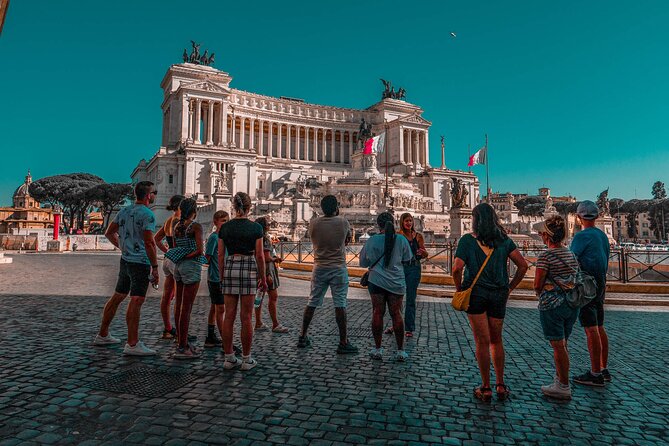
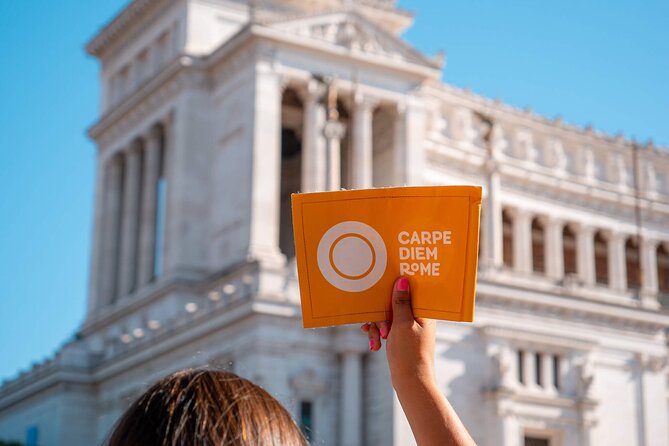
Piazza Venezia is one of Rome’s great orientation points. It is broad, busy, and visually dominated by the monumental white Victor Emmanuel II complex. The tour uses this area to explain Rome’s later political story while connecting it to the older imperial city nearby.
From here, the route reaches Trajan’s Column. This is one of the best places on the walk for a guide’s storytelling because the column is more than a tall stone monument. Its carved spiral records military scenes from Trajan’s campaigns, and the scale can be hard to appreciate without someone pointing out what to look for.
You will spend roughly 20 minutes with guided commentary in this area. That is enough for a focused explanation, but not enough for a leisurely archaeological study. I see this as an introduction rather than a full ancient Rome visit. If Roman military history is your main interest, plan extra time elsewhere.
The advantage is context. The guide can explain how imperial Rome, later Rome, and modern traffic all occupy the same space. That connection is one reason a walking tour is useful here: the city’s layers become easier to read when you move between them on foot.
Trevi Fountain at the Crowded Center of the Route
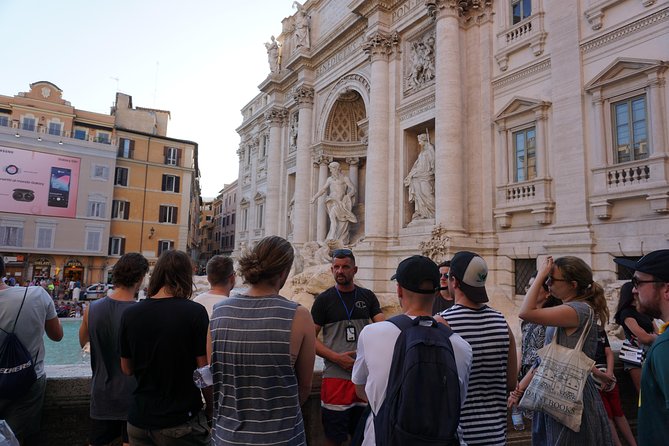
Trevi Fountain gets the longest listed stop, about 30 minutes. That makes sense. It is one of Rome’s most famous sights, and a quick glance rarely feels like enough.
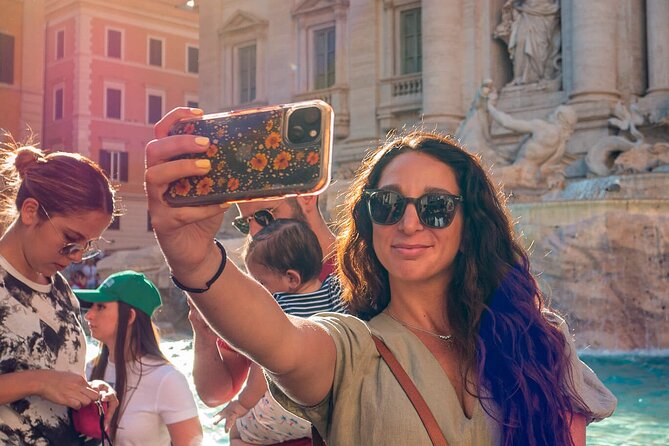
Expect crowds, noise, and people trying to reach the front edge of the fountain. The experience is not quiet, but the drama of the setting is part of its appeal. A guide can help you focus on the design, the figures, and the stories attached to the fountain instead of spending the whole stop searching for a clear photograph.
The tour’s format is useful here because you can hear the background without having to prepare in advance. At the same time, you should keep your expectations realistic. This is a guided look at Trevi Fountain, not a private visit or a slow photography session.
Some guides are especially good at steering groups toward less crowded angles or using nearby streets when possible. Sharon is praised for taking back roads, while Yousef is credited with avoiding packed areas and adding local tips. That approach can make a busy part of Rome feel more manageable.
If you want to toss a coin into the fountain, you can treat that as your own extra moment, but do not count on the group stopping for a long personal ritual. The schedule needs to keep moving.
A few more walks around Rome worth a look
- Rome: Guided Food Walking Tour with Wine in Trastevere
★ 4.9 · 3,105 reviews - Rome: Trastevere & Campo de Fiori Street Food Walking Tour
★ 4.9 · 2,768 reviews - Rome: Trastevere Street Food Walking Tour with Local Expert
★ 4.8 · 1,784 reviews - Rome: Small-Group Guided Day or Night Walking Tour
★ 4.8 · 1,009 reviews
Galleria Sciarra, a Quieter Architectural Pause
Galleria Sciarra is one of the tour’s most appealing lesser-known stops. It is an enclosed passage decorated with ornate paintings and architectural detail, giving you a change of pace after the open streets and crowds around Trevi.
This is exactly the sort of place that can slip past you if you are focused only on Rome’s famous names. The guide’s value here is practical: you learn where to look, why the building matters, and how it fits into the city’s changing architectural style.
The stop is listed at about 20 minutes. That should give you time to look up, take photographs, and hear the explanation without turning the visit into a formal museum tour. I would pay attention to the decorative program rather than rushing through for a quick picture. Places like this reward a slower glance.
Sant’Ignazio di Loyola and Rome’s Painted Illusions
The Church of Sant’Ignazio di Loyola brings another kind of visual surprise. Its interior is known for grand painted effects, and the guide can help you understand how the artwork changes your sense of space.
This stop adds variety to the route. You have seen an imperial column and a huge outdoor fountain, but here the story moves into church art, architecture, and the way artists used perspective to create the impression of a larger building.
The schedule allows about 20 minutes. That is a sensible amount of time for an introduction, especially if the church is busy or the group needs to keep to its route. You may want to return on your own if you find the ceiling paintings especially interesting.
A good guide makes this kind of stop memorable by showing you exactly where to stand and what to notice. Several guides, including Polina and Kasia, receive praise for explaining details clearly and answering questions. That personal explanation can turn a quick church visit into one of the most surprising parts of the walk.
Passing the Pantheon, Not Touring It
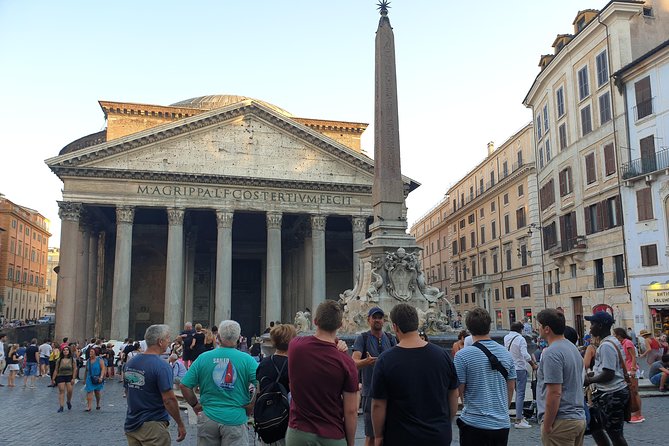
The Pantheon is included as a pass-by stop, with about 20 minutes connected to the area. This distinction matters. You will see one of Rome’s most important ancient buildings from the outside, but entry into the monument is not included in the tour.
I like having the Pantheon on the route because it links naturally with the surrounding streets and piazzas. Still, if the Pantheon is high on your list, plan a separate visit. The walk gives you orientation and historical background, but it does not replace time inside.
That may be the biggest limitation for first-time visitors. The tour covers many major sights, yet most are treated from an outdoor viewpoint. You get breadth rather than a deep visit to one monument.
Finishing at Piazza Navona
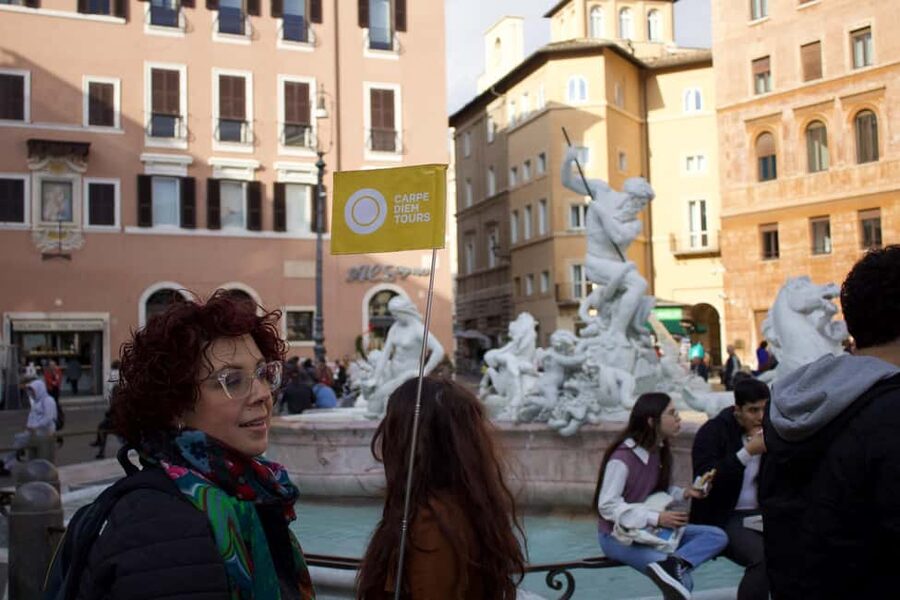
The walk ends in or around Piazza Navona, an excellent place to continue your day. The square has fountains, churches, cafés, restaurants, bars, and rooftop terraces nearby. It is also a practical place to pause after two hours of walking.
The guides are encouraged to offer food and sightseeing suggestions at the end, and this is one of the most useful features of the experience. Dan provided a follow-up guide to one group, while other guides offered recommendations for restaurants, markets, cafés, neighborhoods, and later activities.
Do ask specific questions. Instead of simply asking where to eat, tell your guide what you want: a quick lunch, a quiet café, a market, a rooftop drink, or a place near your hotel. The more precise you are, the more useful the advice is likely to be.
The listed drop-off choices also include the Colosseum area. That gives you flexibility if you want to continue toward ancient Rome, though the exact ending point depends on the option selected.
Group Size, Pace, and Guide Quality
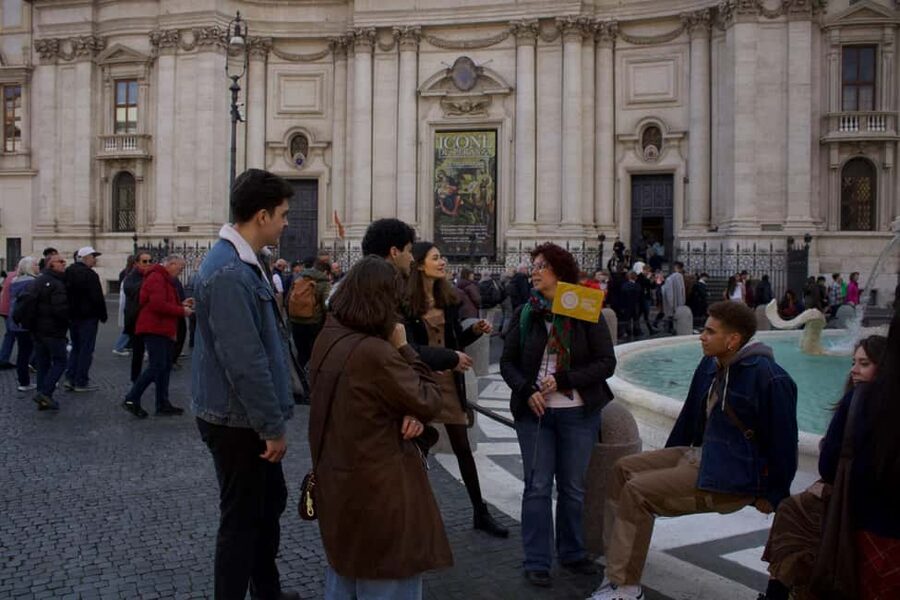
Private and small-group formats are available. This is important because a two-hour city walk feels very different with four people than with a large crowd.
A small group makes it easier to hear, ask questions, and stay close to the guide. One group of four described the experience as relaxed and comfortable, while another appreciated a guide who made an effort to include everyone. If you prefer a personal pace, the private option may be worth considering.
Guide quality appears to be the strongest part of the experience. Dan is repeatedly praised for his command of Roman history and his friendly delivery. Sharon is praised for humor, enthusiasm, and her understanding of daily life in Rome. Domenica receives praise for patience and flexibility, while Yousef is noted for strong storytelling and useful local advice.
Other praised guides include Polina, Kasia, Paulina, Dinara, Alina, Sila, Romani, Vlad, and Sela. The exact guide will depend on the day and language choice, so I would not book solely to obtain one particular person. Still, the repeated praise for different guides suggests a consistent effort to make the walk engaging.
One practical point: at darker times of day, it may take longer to identify your guide in a crowded square. Keep your phone available and confirm the meeting details before setting out.
Price, Timing, and What to Bring
At $23 per person, the tour offers good value if you want a structured introduction to central Rome. You are paying for a local guide, a clear route, historical explanations, and practical recommendations. You are not paying for admission to the Pantheon or other monuments, food, drinks, or hotel transfers.
That price makes the walk especially useful on your first day. You can see where the main sights sit in relation to one another, then decide which places deserve a return visit. It can also save you time and confusion in a city where a short distance on the map may involve several turns and crowded streets.
Bring comfortable shoes and comfortable clothing. In hot weather, the pace and sun can matter. Kasia was praised for finding shaded places during temperatures above 35 degrees Celsius, and another guide built in a welcome bathroom break. Those small choices can make a real difference.
English and Spanish tours are available. You can cancel up to 24 hours ahead for a full refund, and the reserve-now, pay-later option keeps your plans flexible. Starting times vary, so check availability before booking.
Who Should Book This Rome Walking Tour?
I would choose this tour if you are visiting Rome for the first time, want a short orientation, or prefer history explained in plain language. It also suits you if you like seeing major monuments while leaving room for your own plans.
Families and mixed-age groups may appreciate the manageable length, although everyone should be ready for steady walking. The private option is useful if your party wants to move slowly, ask many questions, or focus on particular interests.
I would look elsewhere if you want interior access to several monuments, a detailed archaeological tour, or a quiet experience at Trevi Fountain. This is a broad city walk, not a specialist study or an admissions package.
Should You Book It?
Book it if you want a well-priced first look at Rome’s historic center, strong storytelling, and practical advice for the rest of your visit. The route gives you major names such as Trevi, the Pantheon, Piazza Venezia, and Piazza Navona, while also adding Galleria Sciarra and Sant’Ignazio di Loyola.
Skip it if you already know central Rome well or want long visits inside individual monuments. For most first-time visitors, though, the combination of a compact route, small-group availability, and consistently praised guides makes $23 a sensible way to get your bearings.
FAQ
How long does the Rome walking tour last?
The tour lasts two hours. Starting times vary, so check availability when selecting your date.
Which languages are available?
The live tour is available in English and Spanish.
Does the tour enter the Pantheon?
No. The Pantheon is passed by during the route. Entry is not included.
Where does the tour begin?
The starting point may be Piazza d’Aracoeli or Piazza di Pasquino, depending on the option booked. Check your confirmation for the exact meeting point.
Where does the tour finish?
Possible ending points include Piazza Navona and the Colosseum area. The exact drop-off location depends on the option selected.
Are food, drinks, and hotel transfers included?
No. The tour includes a guide and guided walking tour only. Food, drinks, hotel pickup, and hotel drop-off are not included.
Just added around Rome
- Rome: Colosseum and Ancient Rome Guided Walking Tour★ 4.5 · 95 reviews
- Rome: Trevi Fountain, Spanish Steps & Pantheon Walking Tour★ 4.6 · 336 reviews
- Rome: Guided Walking Tour and Pantheon Priority Entry Ticket★ 4.3 · 317 reviews
- Rome: Trastevere Food Walking Tour with Beer and Wine★ 4.9 · 71 reviews
- Rome Trastevere Walking Food Tour★ 4.8 · 97 reviews
- Rome: Underground Trastevere Guided Walking Tour★ 4.8 · 87 reviews
- Rome: Trastevere and Roman Ghetto Guided Walking Tour★ 4.7 · 79 reviews
- Rome: Relics from the Passion of the Christ Walking Tour★ 4.9 · 84 reviews
Hidden Gems Walking Tours, compared.
Dublin Highlights and Hidden Gems Guided Walking Tour
Read our review →
Explore Berlin: See All The Iconic Sights & Some Hidden Gems
Read our review →
Kyoto Geisha Walking Tour: Gion District & Hidden Gems
Read our review →
Ben Youssef, Secret Garden, & Souks Walking Tour
Read our review →
Montmartre Hidden Gems and Scenic Highlights Walking Tour
Read our review →
Guided Walking Tour of City Highlights & Hidden Gems
Read our review →
Paranormal Night Walking Tour & Secret Backstreets
Read our review →Browse the lists this tour appears in