
Review · HISTORY WALKING TOURS
Cartagena: Historic Center and Getsemaní Shared Walking Tour
Cartagena’s stories are best heard on foot. This $12 shared walk links the Walled City with Getsemaní, moving from Spanish conquest and slavery to independence, local music, street art, and daily life. I like the route because it gives you both the famous monuments and the social history behind them. I also like that guides such as Álvaro, Dani, Legacy, Robert, and Ingrid bring local pride, humor, dance, and practical advice into the two-and-a-half-hour outing.
The main drawback is the heat. You walk for 150 minutes through sunny streets, and even the late afternoon can feel heavy. Rain can also affect the mood, as one group discovered. Still, guides often look for shade, and the price is unusually low for a tour that covers the Historic Center and Getsemaní.
Key points to know before you go
- Two neighborhoods, one connected story: The route ties the Walled City’s colonial buildings and defenses to the working-class character of Getsemaní.
- A serious look at slavery: The walk discusses the slave trade, African heritage, women’s work, and the customs that remain in Cartagena today.
- Music and dancing are part of the route: Salsa and champeta appear near the end, and some guides teach simple dances along the way.
- Good first-day orientation: You receive suggestions for restaurants, drinks, street food prices, and places worth returning to.
- Expect heat and a fair amount of walking: Comfortable shoes, sunscreen, water, and light clothing will make a real difference.
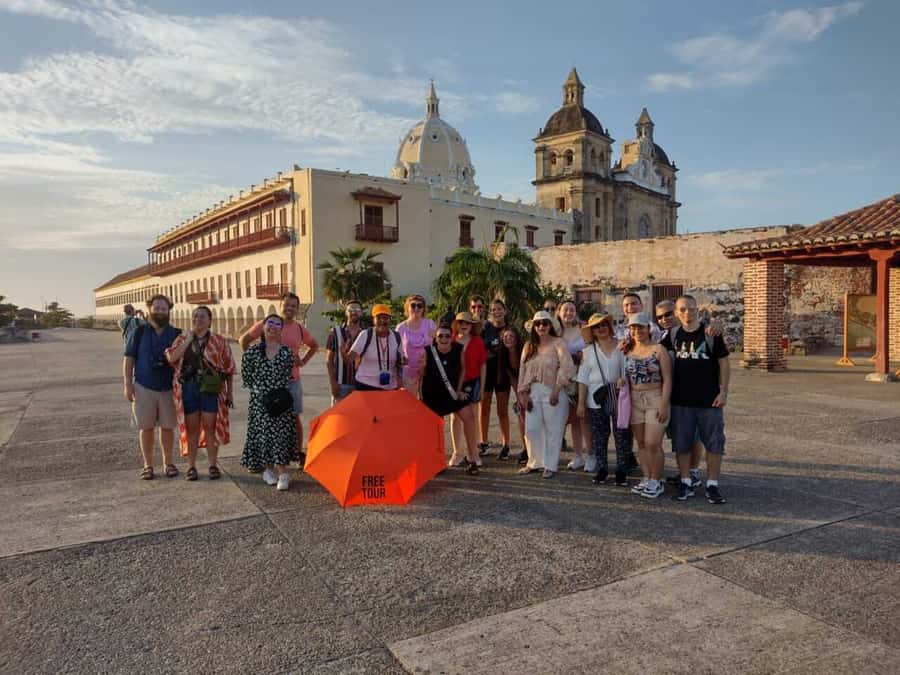
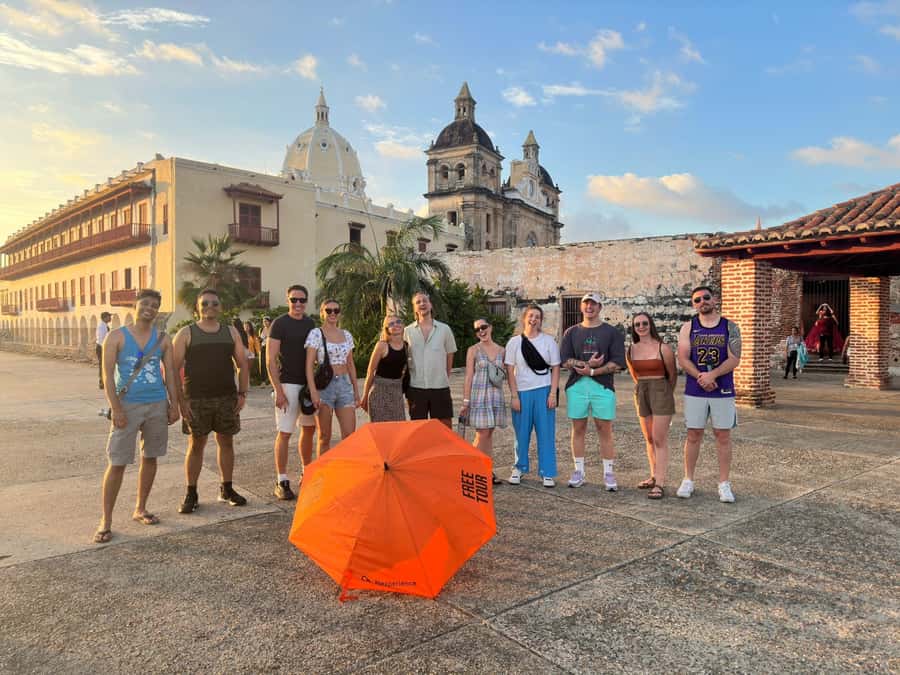
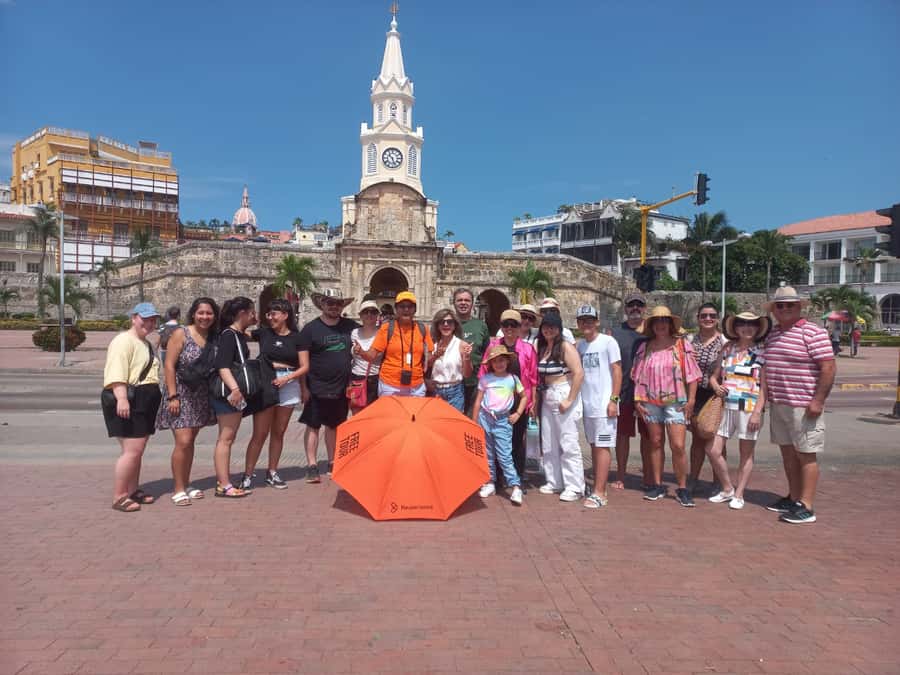
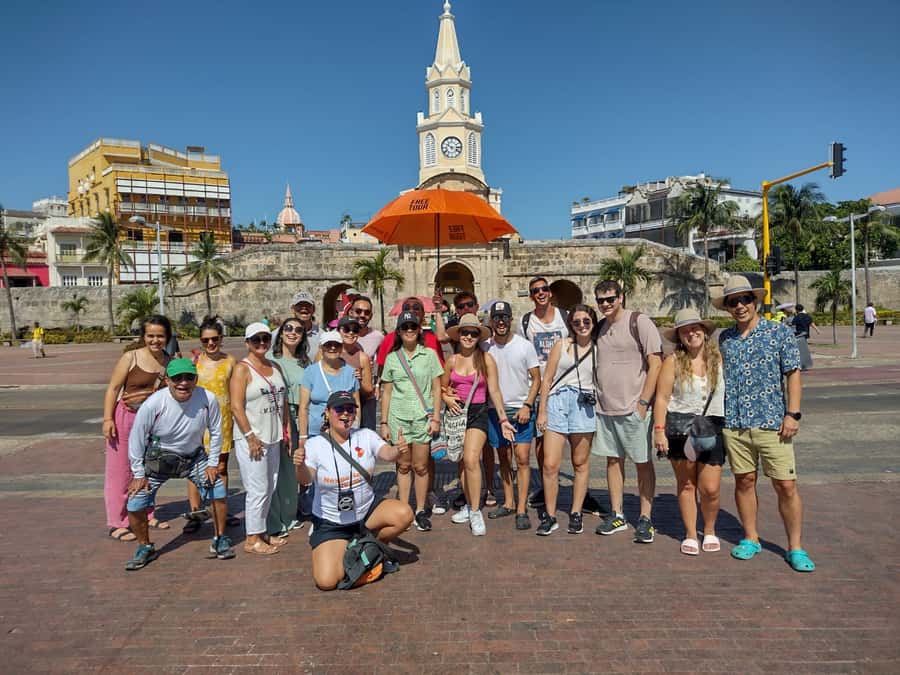
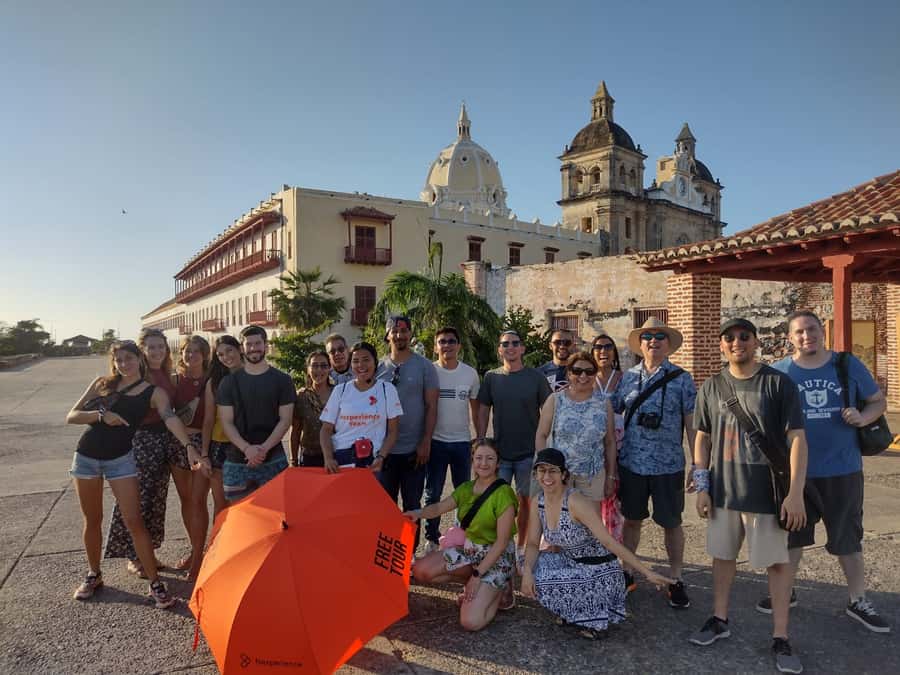
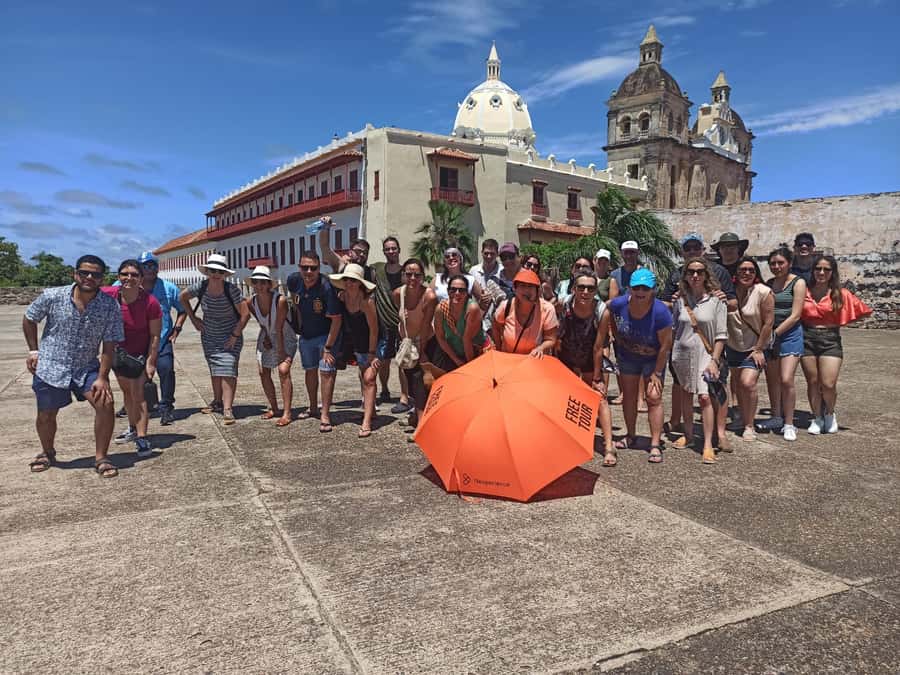
- The meeting point is easy to find: Look for the orange umbrella at Plaza Cervantes, also called Camellón de los Mártires, in front of the Clock Tower.
Why this route works as a first look at Cartagena
Cartagena can seem almost too pretty at first. Bright walls, balconies, flowers, churches, and plazas make it easy to admire the city without asking who built it or who paid the price. This walk corrects that shallow view.
The first part focuses on the Historic Center, also called the Walled City. You hear about the Indigenous people who lived here before and during the arrival of the Spanish, then follow the city through conquest, colonial rule, independence, and modern life. That broad timeline helps you make sense of the buildings instead of seeing them as disconnected photo stops.
The route also gives proper attention to African influence and the legacy of slavery. This matters because Cartagena’s food, music, language, hairstyles, dance, and social customs cannot be understood through Spanish colonial history alone. One of the most memorable subjects raised on the walk is the role of African braids as a sign of freedom, pride, and hope.
I especially like the balance between formal history and living culture. You may hear about Pedro de Heredia, military defenses, and colonial trade in one section, then learn about champeta or local street customs a short time later. That contrast gives the city more meaning.
More Old Town Walking Tours in the world:
- Underground Vaults Walking Tour in Edinburgh Old Town
★ 4.5 · 8,506 reviews - Prague: 3-Hour Walking Tour of Old Town & Prague Castle
★ 4.7 · 5,696 reviews - Dubrovnik: Old Town Walking Tour
★ 4.8 · 5,174 reviews
Starting at Plaza Cervantes and the Clock Tower
The meeting point is Plaza Cervantes, part of the Camellón de los Mártires, directly in front of Cartagena’s Clock Tower. Find the orange umbrella. This is a busy and central place, so arriving a little early should make it easier to locate the group.
The opening talk covers the Indigenous communities present before and during the Spanish arrival. It is a useful choice because it sets the story before the familiar colonial buildings take over.
From there, the group moves toward the Clock Tower, known as the Golden Key of Cartagena. You enter Plaza del Ecuador, formerly known as Plaza del Esclavo, and begin following part of the old enslavement route through Porto Carrero and Candilejo streets.
This section may feel emotionally heavier than the postcard views suggest. The walk does not treat Cartagena as a pretty colonial stage. It points out how people, goods, and enslaved Africans passed through these streets, giving the center a more honest context.
Pedro de Heredia also appears in the story. His role connects the founding of the Spanish city with the larger process of conquest. The guide’s job here is important: a lively delivery helps you follow the timeline, but the subject deserves attention beyond colorful anecdotes.
Portal de los Dulces and the old trading center
Portal de los Dulces is one of the more approachable stops. Today, it is associated with sweets and female vendors. The tour explains how women’s activity here connects to the period of slavery and how descendants continue related traditions.
That detail is easy to miss if you are simply walking through the square. I like it because it shifts attention away from grand men and military events. Cartagena’s story also belongs to the women who worked, sold, cooked, traded, and kept customs alive.
The route then reaches Plaza de la Aduana, the old customs square. This was an important center for the movement and sale of merchandise, including enslaved people. Buildings such as the Municipal Hall help you picture how government and commerce operated in the colonial city.
You will hear a lot in this section, so do not expect a slow architectural survey of every facade. The value comes from the connections: trade shaped the city, slavery supported that trade, and the buildings around the square reflect that system.
Museums, art, and the city’s many identities
The walk passes several cultural institutions, including the Museum of Modern Art, the Gold Museum, and the Emerald Museum. The modern art museum focuses on Caribbean and Latin American art from the 1950s onward. The Gold Museum displays Indigenous pieces from the Colombian Caribbean. The Emerald Museum presents the bright stones that Colombia is famous for.
These are mainly exterior or passing points within the walking route, not long museum visits. That distinction matters. If you want to study the collections, set aside separate time. During the tour, the museums help show that Cartagena is not only about colonial churches and fortress walls.
The Gold Museum is particularly useful as a reminder that the area’s story began long before Spain. The Emerald Museum adds a modern commercial angle, with stones associated with celebrity jewelry and Colombia’s international image.
The route gives you a sample of these institutions without making the day too academic. I would use the guide’s introduction to decide which museum deserves a return visit.
More History Walking Tours in the world:
- History and Hauntings of Salem Guided Walking Tour
★ 5.0 · 14,564 reviews - Lisbon: History, Stories and Lifestyle Walking Tour
★ 4.8 · 10,902 reviews - Boston: Freedom Trail History Small Group Walking Tour
★ 5.0 · 6,450 reviews - Historic Charleston Guided Sightseeing Walking Tour
★ 5.0 · 6,216 reviews
San Pedro Claver and the moral weight of the city
Religion enters the walk through San Pedro Claver, known as the Slave of the Slaves. The tour visits the church and the museum-monastery named for him. The site also serves as the headquarters of human rights work.
This is one of the most meaningful parts of the route because it places faith beside the realities of enslavement. The building is beautiful, but the guide also helps you think about the people whose labor and suffering shaped Cartagena.
Do not expect a long museum visit within the 150-minute schedule. The stop works best as a focused explanation of the church, the man associated with it, and the ongoing human rights connection.
Cartagena’s walls, pirates, and the San Ignacio Bastion
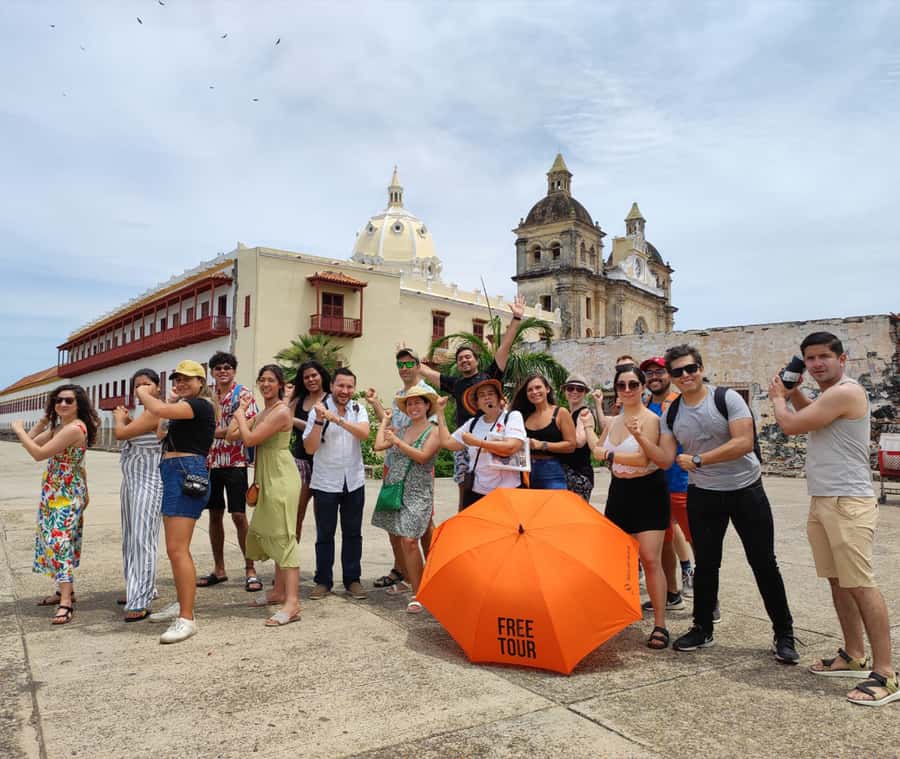
At the San Ignacio Bastion, the story turns to defense. The structure was built to protect the Bay of Souls from pirate attacks, and it offers a clear example of Spanish military planning.
This is where the tour’s pirate and corsair stories come in. The subject is naturally entertaining, but the useful part is learning how the walls and bastions worked as a system. Cartagena’s defenses were not decoration. They protected a major port and the wealth moving through it.
The walk explains military strategies and the pressures that led to the city’s fortifications. You may not get the same sweeping experience as a dedicated fortress tour, but the bastion gives the rest of the Walled City a practical purpose.
If you are especially interested in military architecture, plan another visit to Cartagena’s major fortifications. This walk offers the essential background rather than a detailed engineering lesson.
Plaza Bolívar and a needed pause
The route continues to Plaza Bolívar, named for the leading figure of independence. This is a natural place to pause, take in the surroundings, and let the earlier history settle.
The square also gives you a break from the pace of the streets. Guides often use moments like this to answer questions, explain what you have just seen, or point out places worth returning to later.
The format is not a nonstop lecture. Guides such as Legacy and Dani are praised for keeping people involved, and some groups stop to dance during the route. That informal style may suit you if you like history with conversation and humor. If you prefer quiet, detailed architectural study, you may find the group energy a little much.
Centenary Park and Cartagena’s urban wildlife
Centenary Park is one of the route’s pleasant surprises. It was once connected to the railway station and now provides a leafy break within the city. The park is described as an important green area and a remnant of tropical dry forest.
Look for sloths, squirrels, and iguanas. You may also notice how much shade changes the walking experience. Several guides, including Robert and Legacy, make a point of keeping the group in cooler areas when possible.
The animals are not guaranteed on every outing, so treat them as a bonus rather than the main purpose of the park stop. The bigger value is seeing a different side of Cartagena, one that is not made up only of churches, walls, and tourist shops.
This is also a good section for families. A two-year-old child was included successfully on one outing, with the guide checking that the child and family were doing well. Still, parents should remember that the full route lasts two and a half hours in hot weather.
Crossing into Getsemaní
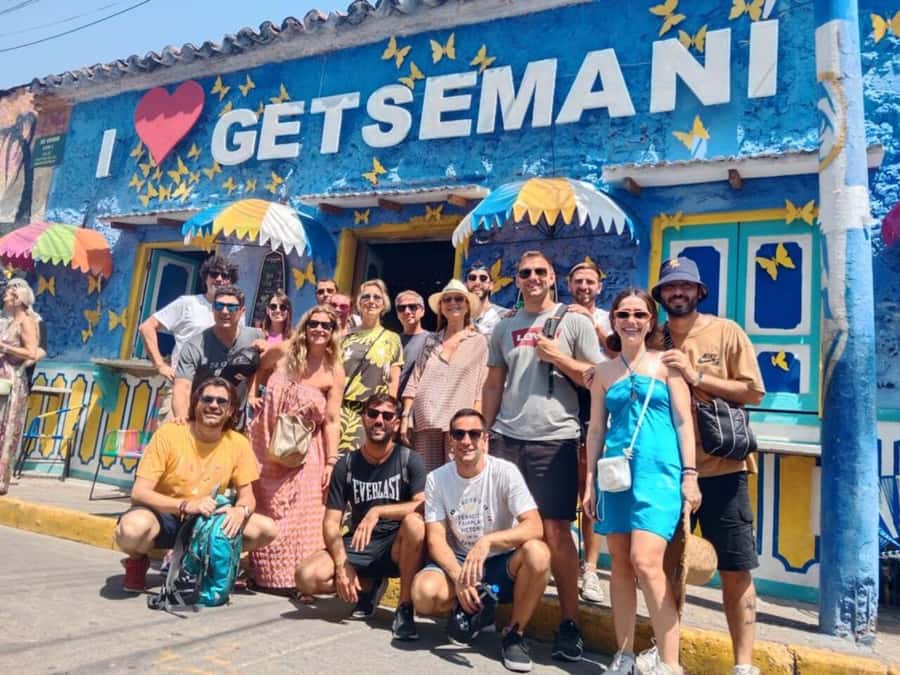
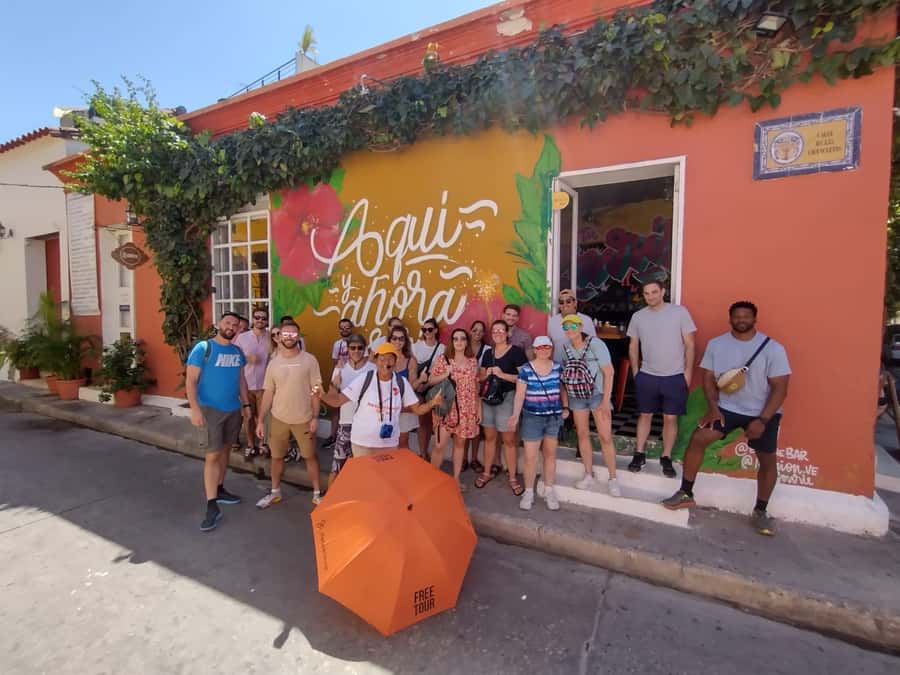
The move into Getsemaní changes the tone. The neighborhood is known for its colorful cultural corridors, umbrella displays, graffiti, and distinctive architecture. Compared with the formal plazas of the Walled City, Getsemaní feels more connected to street life and local expression.
The route shows how the neighborhood fits into Cartagena’s changing social order. You hear about music, neighborhood identity, African influence, and the customs that continue to shape the city.
Salsa and champeta become especially important here. Champeta has strong African and Caribbean roots, and it is not just background music for a night out. It belongs to the story of Cartagena’s people and neighborhoods.
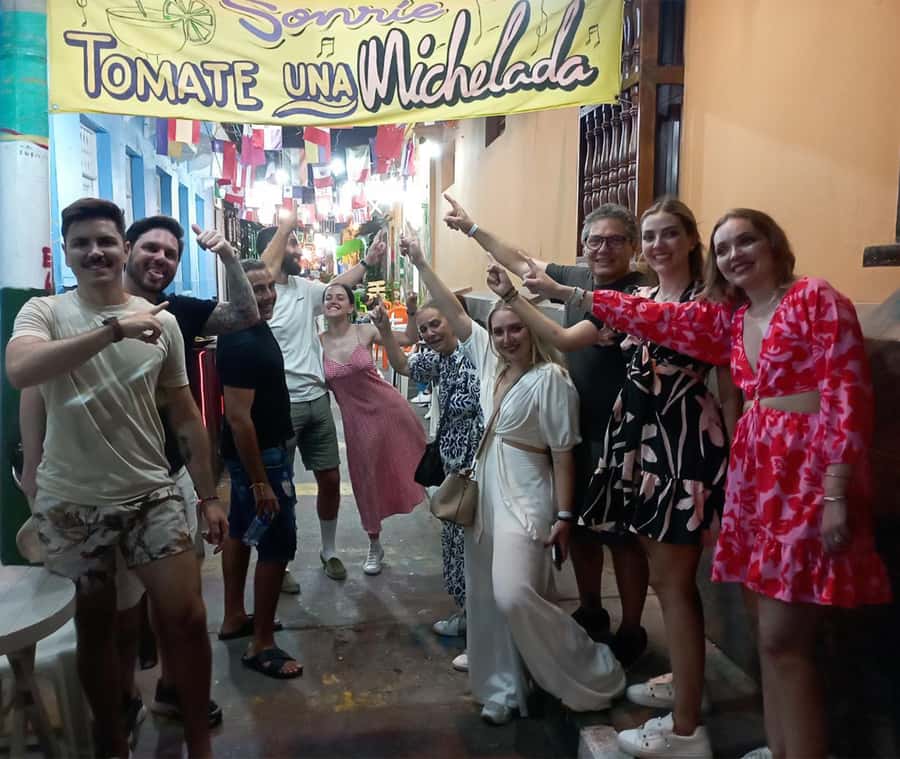
Several guides make the experience physical by teaching dances or getting the group to move along the way. Dani, Daniela, and Legacy are particularly praised for using dance to keep the history lively. You do not need dance experience, but you should be ready for a little participation.
The route ends through Callejón Ancho and finishes on Calle San Juan, with salsa and champeta providing the final soundtrack. That ending makes sense: the walk begins with conquest and colonial power, then closes with present-day culture expressed through music and movement.
What the guide can add to your stay
The guide makes a large difference on a shared tour. Recent groups have been led by Álvaro David, Dani, Daniela, Legacy, Robert, Ingrid, Liz, Rebecca, and others. The strongest descriptions consistently point to clear historical explanations, local pride, humor, and useful advice.
Álvaro is praised for explaining major events and helping people understand what to expect from local life. Robert is known for recommendations about food and drinks, along with practical help on prices. Ingrid and Rebecca are praised for answering questions patiently and explaining Cartagena’s past and present in an approachable way.
English and Spanish are available. Most English-language experiences appear to work well, but the pace can vary by guide. One person found a guide’s English harder to follow when she spoke quickly. If you are struggling, ask politely for a slower pace. That simple request can make a big difference in a history-heavy walk.
The best guides do not only recite dates. They connect a church to slavery, a dance to African heritage, a park to the city’s ecology, and a restaurant suggestion to your evening plans.
Price, pace, and practical comfort
At $12 per person, this is strong value if you want an orientation to Cartagena. You are paying for a professional guide, the Historic Center walk, the Getsemaní walk, and the included tip. Food, drinks, and hotel pickup are not included.
The tour lasts 150 minutes. The stated schedule breaks that into roughly two hours in the Historic Center and one hour in Getsemaní. That is enough time to see key areas and understand the basic story, but not enough for long museum visits or extended stops at every monument.
Wear comfortable shoes. Add sunscreen, light clothing, and weather-appropriate layers. Bring water, even if it is not listed as a formal inclusion. One person specifically advised bringing plenty of water, especially for a late afternoon start.
Shade helps, but you should still prepare for sun. Rain can make the walk less pleasant, and there is no promise of a dry route. The experience is wheelchair accessible, but the practical comfort of any shared route can still depend on weather, pavement, and group pace.
Free cancellation is available up to 24 hours before the start for a full refund, and you can reserve now and pay later. Those policies are useful if your Cartagena plans are still shifting.
Who should book this walk?
I would choose this tour if you are arriving in Cartagena for the first time and want context before exploring on your own. It is also a good fit if you want history, local culture, music, and practical food advice in one affordable outing.
Families can make it work, especially with a supportive guide, but the heat and length require preparation. People who dislike group activities, audience participation, or frequent explanations may prefer a private guide or a shorter architectural walk.
History fans should appreciate the treatment of conquest, slavery, independence, and military defense. Culture-focused visitors will get more from the sections on braids, salsa, champeta, Getsemaní, and modern social life.
Should you book it?
Book it if you want a lively first orientation rather than a quiet museum tour. The $12 price buys a useful framework for the city, and the strongest guides add something you cannot get from a map: pride, humor, local perspective, and a clearer sense of how Cartagena’s painful past connects to its music and daily life.
Go prepared for heat, walking, and a shared group pace. Arrive at Plaza Cervantes, find the orange umbrella, bring water, and keep your afternoon open for the full 150 minutes. For most first-time visitors, this is a sensible way to begin.
FAQ
How much does the Cartagena Historic Center and Getsemaní tour cost?
The tour costs $12 per person. The listed tip is already paid as part of the free walking tour arrangement.
How long does the tour last?
The experience lasts 150 minutes, or two and a half hours. About two hours are spent in the Historic Center and one hour in Getsemaní.
Where does the walking tour begin?
It begins at Plaza Cervantes, also called Camellón de los Mártires, in front of the Clock Tower. Look for the orange umbrella.
What language is the tour offered in?
The tour is available in English and Spanish with a live guide.
Does the tour include hotel pickup?
No. Hotel pickup and drop-off are not included.
Are food and drinks included?
No. You need to pay separately for any food and drinks.
Is the tour wheelchair accessible?
Yes, the activity is listed as wheelchair accessible.
What should I bring?
Bring comfortable shoes, sunscreen, comfortable clothing, and clothing suited to the weather. Bringing water is also a practical choice because the route can be hot and lengthy.
Can I cancel for a full refund?
Yes. You can cancel up to 24 hours in advance for a full refund. You can also reserve now and pay later.
Just added around the world
- Walking Tour of Boston’s Freedom Trail★ 4.5 · 77 reviews
- Downtown Freedom Trail Walking Tour – History & Architecture★ 4.5 · 194 reviews
- Boston Food of the North End Private Walking Tour★ 5.0 · 174 reviews
- Boston Seafood Lovers Food and History Walking Tour★ 5.0 · 208 reviews
- Boston “Death and Dying” Walking Ghost Tour★ 4.5 · 223 reviews
- Boston Movie Mile Walking Tour★ 4.5 · 119 reviews
- 1 If By Land Walking Tours★ 5.0 · 95 reviews
- Boston History and Freedom Trail Private Walking Tour★ 5.0 · 117 reviews
History Walking Tours, compared.
History and Hauntings of Salem Guided Walking Tour
Read our review →
Freedom Trail History Small Group Walking Tour
Read our review →
Historic Charleston Guided Sightseeing Walking Tour
Read our review →
Tapas Walking Tour with Food, Wine, and History
Read our review →
Savannah History and Haunts Candlelit Ghost Walking Tour
Read our review →
A History of Terror – Belfast City Centre Walking Tour
Read our review →Browse the lists this tour appears in