
Review · HISTORY WALKING TOURS
Barcelona in 2 Hours: Guided Walk Through History and Sights
Barcelona reveals itself one old street at a time. This two-hour walk links the Gothic Quarter and El Born through stories of artists, saints, political struggle, and Catalan identity. I like the route for two clear reasons: it visits famous places such as the Barcelona Cathedral and Santa Maria del Mar, while also pointing out easy-to-miss corners such as Casa de l’Ardiaca and Plaça de Sant Felip Neri.
I also like the way the walk uses Els 4 Gats and Catalan history to give the city some character beyond its grand façades. Guides such as Darren, Petra, Jorge, Sonia, and Vanessa have been praised for clear storytelling and useful local suggestions. The main drawback is pace: eleven stops in about two hours leaves little time to linger, and one report noted that street noise made some explanations hard to hear without a speaker.
Key points to know before you book
- Eleven historic stops in two hours: The route moves from Els 4 Gats through the Gothic Quarter and El Call to Santa Maria del Mar.
- A strong first-day activity: The walk gives you a useful map of central Barcelona and local ideas for what to do next.
- History beyond the postcard view: You’ll hear about Picasso, Gaudí, Catalan defeat, Jewish Barcelona, the Inquisition, and Saint Eulalia.
- Small-group format: The group can include up to 20 people, with a private upgrade available for more personal attention.
- Mostly free outdoor sights: Admission is not included at Barcelona Cathedral or Santa Maria del Mar.
- Good shoes matter: The route is on foot, and one guide specifically advised comfortable walking shoes and sun protection.
Why this two-hour route works so well
Barcelona can feel like several cities piled on top of one another. Roman Barcino, medieval trade, Catholic power, Catalan politics, modernist art, and contemporary street art all occupy the same central streets. This walk gives you a fast way to connect those layers.
You begin at Plaça del Vuit de Març in Ciutat Vella and finish at Basílica de Santa Maria del Mar in El Born. That direction makes sense. You start among the tight lanes of the Gothic Quarter, then gradually move toward the broad historical story of Barcelona’s old commercial and maritime districts.
The route is not designed for long visits inside every building. Most stops are timed at around ten minutes. Think of it as a guided orientation with strong storytelling, not an in-depth cathedral tour or an archaeology lecture.
That distinction matters. If you want time to study stonework, enter every church, or take dozens of photos, two hours will feel brisk. If you want a smart introduction before exploring on your own, the format is useful and efficient.
More History Walking Tours in Barcelona
- Barcelona: Tapas Walking Tour with Food, Wine, and History
★ 4.8 · 4,261 reviews - Barcelona Tapas Walking Tour: Food, Wine & History
★ 4.5 · 1,928 reviews - Barcelona: Dark History Night Walking Tour
★ 4.8 · 344 reviews
Els 4 Gats begins with Barcelona’s artistic side
Els 4 Gats is a fine place to begin because it brings Barcelona’s creative reputation down to one small, memorable address. The café and restaurant became a meeting place for artists and thinkers, including Pablo Picasso and Antoni Gaudí.
You’ll hear about its role in the city’s cultural life and see the distinctive exterior and Art Nouveau design. This is not just a stop for a quick photograph. It helps explain why Barcelona became such an important setting for artists at the turn of the twentieth century.
The stop lasts about ten minutes and does not require an admission ticket. I’d pay attention to the guide’s explanation here, since the value is in the story behind the place rather than in simply looking at the façade.
A mosaic turns a photograph into a history lesson
At El Mon Neix En Cada Besada, the familiar photo opportunity has a heavier story. The photomosaic is tied to Catalonia’s defeat on September 11, 1714, an event connected to the annual celebration of La Diada, or Catalonia Day.
This is one of the walk’s most useful moments because it links present-day Barcelona with the political identity you’ll see throughout the city. Catalan symbols can otherwise seem like decoration. Here, the guide explains why they carry real emotional weight.
The stop is free and takes about ten minutes. You may want a photo, but don’t rush away before hearing the explanation. This is one of the places where a local guide adds much more than a map can.
Barcelona Cathedral and the story of Saint Eulalia

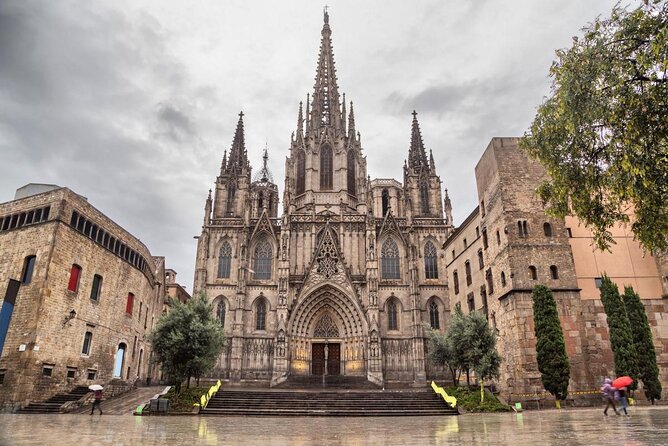
The Barcelona Cathedral gives the Gothic Quarter its grand religious center. Construction took place over centuries, and the building is linked to Saint Eulalia, Barcelona’s patron saint.
The story of Eulalia’s martyrdom is grim, and the guide uses it to explain the cathedral’s religious importance. You’ll also get a sense of how the church fits into the wider medieval city around it.
Admission is not included, so treat this as an exterior visit unless you choose to enter separately. Ten minutes is enough for a guided introduction, but not enough for a serious look inside. If the cathedral matters to you, return later with time to spare and check the admission arrangements yourself.
Same streets, a different way to see them:
- Barcelona Tapas and Wine Experience Small-Group Walking Tour
★ 5.0 · 5,804 reviews - Barcelona: Food Walking Tour with Tapas and Wine
★ 4.9 · 2,180 reviews - Barcelona Helicopter, Sailboat & Old Town Private Walking Tour
★ 5.0 · 1,395 reviews - Barcelona: Old Town and Gothic Quarter Walking Tour
★ 4.8 · 1,393 reviews
Roman traces at Casa de l’Ardiaca
Casa de l’Ardiaca is a small stop with a lot packed into it. Its architecture combines Gothic and Renaissance elements, while remnants of the Roman wall and old aqueduct arcades point back to Barcino, the Roman city beneath modern Barcelona.
I like this part of the route because it shows how the city’s oldest remains are not always found in a major museum. They can appear in a courtyard, beside a doorway, or in the structure of a later building.
The visit is free and lasts around ten minutes. Your guide’s explanation is especially useful here because the Roman details may not be obvious at first glance.
Pont del Bisbe and a legend over your head
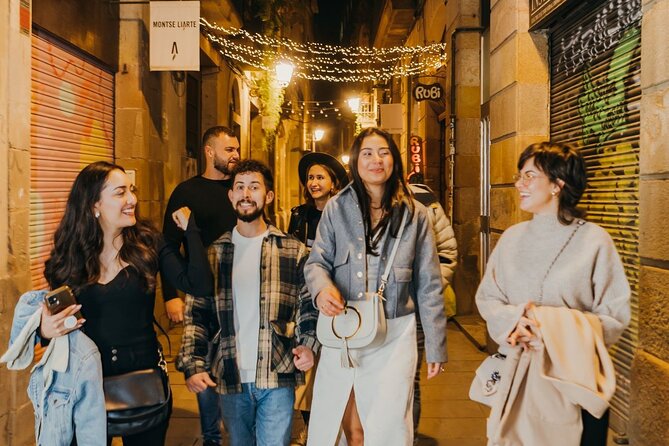
Pont del Bisbe is one of the Gothic Quarter’s most photographed sights. The narrow bridge connects buildings above the street and gives the surrounding lanes a theatrical finish.
The stop also comes with a legend that may appeal to superstitious visitors and make skeptics pause before walking beneath it. The walk does not treat Barcelona as a collection of dry dates. Stories, rumors, and local beliefs are part of the experience.
This is a free stop and takes roughly ten minutes. Expect a popular photo point, so your guide’s timing and positioning can affect how much you enjoy it.
Plaça Sant Felip Neri carries a painful memory
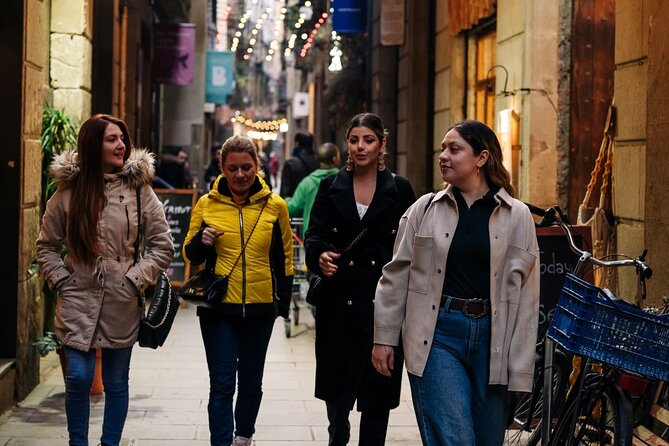
Plaça Sant Felip Neri is quieter in mood. The square holds a tragic story connected to the struggle for Catalan independence, and its physical scars remain part of the setting.
This is the sort of place where a short explanation can change what you see. Without context, it may look like a peaceful square with old walls. With context, it becomes a reminder that Barcelona’s political history is not confined to museums or official buildings.
The stop is free. Give yourself a moment to take in the square rather than treating it as another quick photo stop. The tone here is more solemn than at Els 4 Gats or Pont del Bisbe.
El Call recalls Barcelona’s Jewish past
MUHBA El Call takes you into the former Jewish quarter, known for narrow streets and medieval buildings. The route introduces the history of Barcelona’s Jewish population and the shape of the district they once occupied.
This part of the walk adds needed balance. Barcelona’s medieval story was not only about kings, cathedrals, and merchants. Different communities lived and worked in the city, and their presence still helps explain the old street plan.
The stop is free and lasts about ten minutes. Since the lanes are tight, staying close to the group will help you hear the guide, especially if the area is noisy.
Plaça de Sant Jaume links power and public life
Plaça de Sant Jaume is Barcelona’s main civic square. It holds the seat of the Catalan government and City Hall, making it a natural place to discuss political identity and public life.
The square has hosted celebration and protest, so it gives you a direct view of how history continues to play out in the city. The guide also connects it with an important figure celebrated during one of Catalonia’s best-loved holidays.
This stop is free and takes about ten minutes. I find it especially helpful for understanding that Catalan identity is not only a subject from the past. It remains part of daily civic life.
Plaça del Rei brings royal power and darker history
Plaça del Rei has a more imposing feel than many of the smaller squares on the route. The Royal Palace occupies the setting, and the guide uses it to explain Barcelona’s royal past and the darker period of the Spanish Inquisition.
The contrast is valuable. Barcelona’s medieval center can look picturesque, but its stones also carry stories of authority, punishment, and religious pressure. The stop adds weight to the walk without requiring a long museum visit.
Admission is free for the exterior stop, and the planned time is about ten minutes. If you want to explore the surrounding royal complex in depth, plan a separate visit rather than expecting the walking tour to cover everything.
Plaça de l’Àngel and the legend of Saint Eulalia
Plaça de l’Àngel was once known as Wheat Square, reflecting its role in grain trading. It later took its current name after a heavenly apparition appeared during a procession carrying Saint Eulalia’s body.
This stop shows how practical commerce, religious tradition, and urban naming can overlap. It also brings Saint Eulalia’s story back into the walk after the cathedral visit.
The square is free to visit and takes about ten minutes. It is a short stop, but it helps tie together several earlier themes: trade, faith, public ceremony, and the city’s changing identity.
Santa Maria del Mar finishes in El Born
The final stop is Basílica de Santa Maria del Mar, one of Barcelona’s best-known Gothic churches. Its location in El Born and its connection to the city’s maritime past make it a fitting end to the route.
After the narrow lanes of the Gothic Quarter, reaching this basilica gives the walk a strong finish. You’ll hear how the church reflects Barcelona’s relationship with the sea and the commercial world that helped shape the old city.
Admission is not included, so the guided visit should be understood as an introduction rather than a full interior tour. You can return later if you want more time with the building.
The endpoint is Plaça de Santa Maria, 1, in Ciutat Vella. That is useful for planning the rest of your day in El Born, though no further activities are included in the tour itself.
What the guide adds to the experience
The best part of this walk is the guide’s ability to connect separate sights into one story. Darren was praised for clear English, energy, and practical recommendations. Petra brought Catalan culture into the discussion, while Jorge was noted for pointing out lesser-known places and offering local tips.
Sonia was especially valued for an archaeological viewpoint and for a restaurant suggestion that worked well. Vanessa handled questions and moved between archaeology, art, religion, government, and Catalan politics with confidence. Lydia was described as conversational and high-energy, and Sonja was praised for being friendly and engaged.
Those details matter because this route depends on explanation. Several stops are attractive but small. The bridge, mosaic, Roman remains, and old lanes become far more meaningful when someone explains what you are seeing.
There is one practical warning. One participant found the background noise so loud that parts of the explanation were difficult to understand because no speaker or audio guide was used. I would stay near the guide, especially in crowded streets, and ask for a repeat if you miss an important point.
Is $22.99 good value for two hours?
At $22.99 per person, the walk is priced as an affordable introduction rather than a premium private experience. You are paying for a guide, a planned route, and historical context across eleven stops. There are no included entry tickets for Barcelona Cathedral or Santa Maria del Mar.
The value is strongest if this is your first time in Barcelona or your first morning in the old city. You get a working sense of where the Gothic Quarter and El Born fit together, plus ideas for places to revisit on your own.
A private upgrade is available if you want more personal attention. That may suit you if you prefer to ask many questions, need a slower pace, or want the guide to focus more closely on art, religion, archaeology, or Catalan politics.
The group limit is 20 people. That is small enough to feel organized, though not so small that every street corner will be quiet. Group discounts are available, and the experience is offered in English with a mobile ticket.
Practical advice for the route
The meeting point is Plaça del Vuit de Març in Ciutat Vella. The tour ends at Basílica de Santa Maria del Mar, and the route is near public transportation.
Wear comfortable walking shoes. You will be on foot for about two hours, with repeated stops and movement through old streets. Sun protection is also sensible, especially since one guide specifically advised using sunblock.
Try to arrive ready to listen from the start. The opening stop at Els 4 Gats sets up the artistic side of Barcelona, while the later stops build toward Catalan politics and medieval society. Missing the first part can make the rest feel less connected.
The tour is offered in English, and most people can participate. Confirmation is provided when you book. Free cancellation is available up to 24 hours before the start time, but changes or cancellations inside that window are not accepted for a refund.
Who should book this Barcelona walk?
I would book this tour for a first visit, especially if you want a quick orientation before spending several days in Barcelona. It is also a good choice if you enjoy history told through streets and buildings rather than a long indoor presentation.
You’ll get the most from it if you like asking questions, noticing architectural details, and hearing how Catalan identity shapes the city. It also suits anyone who wants practical restaurant or sightseeing suggestions from a local guide.
I would choose another format if you want extensive time inside the cathedral and basilica, a slow photography walk, or a highly specialized architectural tour. The schedule is tight, and the route covers a lot of ground in a short time.
For most people, though, $22.99 is a fair price for a lively introduction to Barcelona’s old center. Book it early if your plans are firm, since the experience is often reserved well ahead of time, with an average booking point around 42 days before the visit.
FAQ
How long does the Barcelona history walk last?
The tour lasts approximately two hours.
What language is the tour offered in?
The tour is offered in English.
Where does the tour begin?
It begins at Plaça del Vuit de Març, Ciutat Vella, 08002 Barcelona, Spain.
Where does the tour end?
It ends at Basílica de Santa Maria del Mar, Plaça de Santa Maria, 1, Ciutat Vella, 08003 Barcelona, Spain.
How many people can join the group?
The maximum group size is 20 people.
Are admission tickets included?
Admission is not included for Barcelona Cathedral or Santa Maria del Mar. The other listed stops are free.
Is a private option available?
Yes. You can upgrade to a private tour for more personalized attention.
Can I cancel for a full refund?
Yes, if you cancel at least 24 hours before the experience start time. Cancellations or changes made less than 24 hours before the start time are not accepted for a refund.
More 2-Hour Experiences in Barcelona
- Barcelona: Jewish Quarter 2-Hour Walking Tour
★ 4.8 · 333 reviews - Barcelona 2-Hour Gothic Walking Tour
★ 4.7 · 317 reviews - Jewish Walking Tour Barcelona by Expert Jewish Guide 2h
★ 5.0 · 297 reviews - Berlin’s Best: 2 Hour Walking Tour Third Reich and the Cold War
★ 5.0 · 5,486 reviews
Just added around Barcelona
- Barcelona Private Food Tour: Tapas, Paella & 8+ Food Tastings★ 5.0 · 164 reviews
- Barcelona Gothic Quarter Walking Tour with Tapas★ 5.0 · 248 reviews
- Picasso Museum and Walking Tour Plus Optional Wine & Food Tasting★ 5.0 · 596 reviews
- Private Barcelona Old Town and Gothic Quarter Walking Tour★ 5.0 · 134 reviews
- Barcelona Architecture Walking Tour With Casa Batlló Upgrade★ 5.0 · 137 reviews
- Montjuïc Walking Tour With Optional Flamenco Show★ 5.0 · 196 reviews
- Semi-Private Montserrat Monastery, Funicular & Scenic Nature Walk★ 5.0 · 172 reviews
- Barcelona: La Boqueria Food, Wine & History Walking Tour★ 5.0 · 126 reviews
History Walking Tours, compared.
History and Hauntings of Salem Guided Walking Tour
Read our review →
Freedom Trail History Small Group Walking Tour
Read our review →
Historic Charleston Guided Sightseeing Walking Tour
Read our review →
Tapas Walking Tour with Food, Wine, and History
Read our review →
Savannah History and Haunts Candlelit Ghost Walking Tour
Read our review →
A History of Terror – Belfast City Centre Walking Tour
Read our review →Browse the lists this tour appears in