
Review · SMALL-GROUP WALKING TOURS
Best of Lisbon Small-Group Guided Walking Tour
Lisbon reveals itself one hill at a time. This half-day walk links the city’s main central sights with personal stories about Portugal’s past, from the Restoration of independence to the Carnation Revolution. I like the small maximum of 14 people and the thoughtful food stops: a pastel de nata, wine tasting, and a tapa make the history easier to remember. The main drawback is simple: you see many places from outside, and Lisbon Cathedral is not included.
At $23.94, this is one of the better-value ways to get your bearings on a first visit. I also like the route’s useful mix of flat Baixa streets, old Alfama lanes, viewpoints, and public elevators where available. You should still bring good shoes, allow for hills, and expect a brisk three to four hours on foot.
Key things to know before you book
- A compact Lisbon primer: You cover Rossio, Restauradores, Carmo, Chiado, Baixa, Alfama, and Commerce Square in one morning or afternoon.
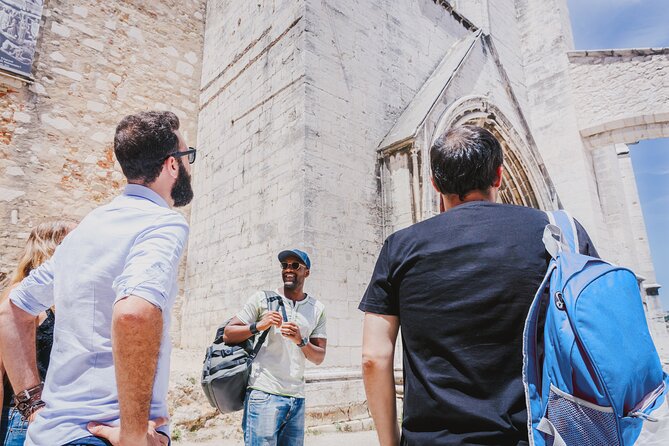
- Small group, capped at 14: The format gives you a better chance to ask questions and hear your guide clearly.
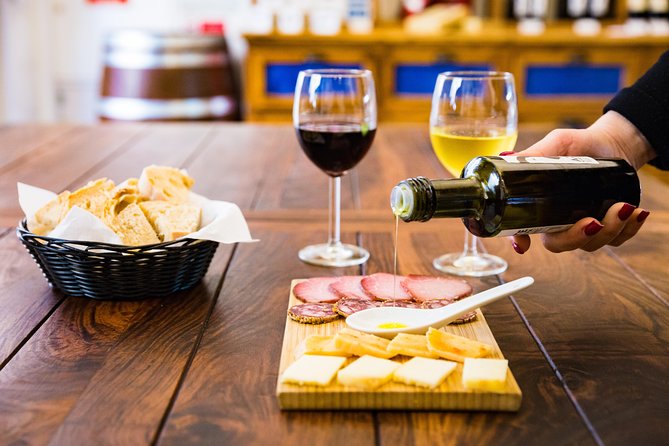
- Three useful tasting stops: The price includes a pastel de nata, wine tasting, and a tapa.
- History with a modern edge: The tour explains both the 1755 earthquake and the 1974 Carnation Revolution.
- A real walking workout: Baixa is relatively easy, but Alfama and the viewpoints bring slopes, steps, and uneven streets.
- Best for first-time visitors: It gives you a city map in your head, though repeat visitors may find some stops familiar.
Starting at Rossio, Lisbon’s city center
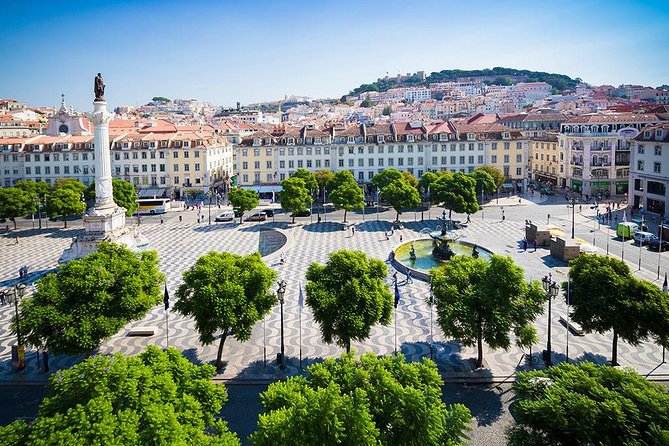
The tour begins at Praça Dom Pedro IV, better known as Rossio Square. This is a sensible meeting point because it sits in central Baixa, close to public transportation and surrounded by several of Lisbon’s key sights.
Rossio is more than an open square for taking photographs. Your guide explains how the 19th-century paving uses traditional Portuguese stones arranged in wave patterns, echoing the nearby Atlantic. That detail gives you an early lesson in how Lisbon mixes practical urban design with decoration.
The square is also a good place to notice Lisbon’s scale. Grand buildings frame the open space, yet the streets leading away quickly narrow into older quarters. I like beginning here because you can understand the city as a series of connected neighborhoods rather than a list of separate monuments.
You spend only about 10 minutes at Rossio, so this is an introduction, not a long architectural lecture. The short stop keeps the route moving, but you may want to return later if you want more time for photographs.
More Small-Group Walking Tours in Lisbon:
- Lisbon: Food and Wine Small Group Walking Tour
★ 4.9 · 4,082 reviews - Lisbon Roots – Small group Food & Culture Walking Tour w/tastings
★ 5.0 · 910 reviews - Small Group Walking Tour of Belém
★ 4.9 · 80 reviews
São Domingos and the grand avenue
A brief stop at Igreja de São Domingos adds a more somber note. The church sits beside São Domingos Square, and its place in the central city makes it an easy addition to the route.
The itinerary then passes toward Lisbon’s most expensive and fashionable avenue. The stop is short, but it helps contrast the city’s grand commercial face with the older lanes you will see later. The tour works best when you pay attention to those changes in character: broad avenues become intimate streets, and formal squares give way to worn stone stairways.
The guide-led format matters here. You could walk through these areas alone, but you might miss the connections between the buildings, political events, and daily life. Guides such as Felipe, Maria, Jose, Filipa, and Joana have been praised for making those links clear while keeping the group moving.
Restauradores and Rossio Station
At Praça dos Restauradores, the central obelisk commemorates Portugal’s restoration of independence from Spain in 1640, after six decades of Spanish rule. The monument records battles from the Portuguese Restoration War, so this short stop turns a striking piece of street furniture into a readable part of national history.
Next comes Rossio Station, one of central Lisbon’s most memorable facades. Its exterior borrows from Manueline design, the ornate Portuguese style associated with the age of exploration. Your guide also explains the railway engineering behind the line toward Sintra and may point out a train heading into the tunnel.
This is a good example of the tour’s range. You are not only looking at old churches and royal squares. You also get a quick lesson in 19th-century transport and the way railways changed access to Lisbon’s surrounding towns.
The stop lasts about five minutes, so do not expect to board a train or explore the interior at length. If Sintra is on your plans, the explanation gives useful context, but this tour does not replace a dedicated Sintra visit.
Carmo Square and the Carnation Revolution
Largo do Carmo is one of the most meaningful places on the route. The square is associated with the old Carmelite convent and with the Carnation Revolution of 1974, when Portugal’s long dictatorship collapsed.
This is where the tour moves from medieval and imperial history into living memory. Your guide describes how the 48-year authoritarian regime ended, giving you a clearer sense of why the revolution remains so important in Portugal.
The square is also a natural pause in the walk. You have already covered several central sights, and the open space offers time to listen without squeezing through a busy lane. Guides praised for their energy, including Martin and Carlos, have helped make this kind of history accessible rather than dry.
More Guided Walks in Lisbon:
- Lisbon: City Highlights Guided Walking Tour
★ 4.7 · 168 reviews - Lisbon: Private Boat Trip, Guided Walking Tour, Bike & Tram
★ 4.8 · 116 reviews - Lisbon by Night: Guided Walking Tour – The Unholy Secrets
★ 4.8 · 93 reviews - Lisbon: City of Spies Guided Walking Tour
★ 4.7 · 81 reviews
Santa Justa and Chiado’s literary streets
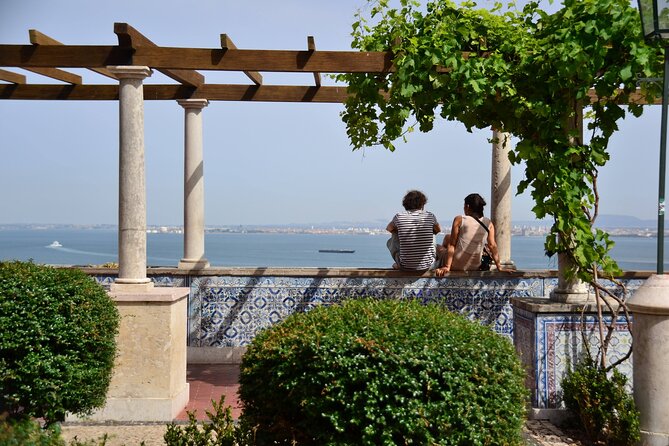
The Santa Justa Elevator is one of the city center’s most recognizable structures. The tour takes you to the monument and its viewing area, where you can look across Lisbon’s tiled roofs and central streets.
A practical point matters here: the experience does not promise a private ride to the top or a guaranteed long stop at the viewpoint. The guide may use public elevators and escalators where available to reduce some of the uphill work, as one particularly detailed account noted. That can make a difference, especially on a warm day or after a flight.
From there, you continue into Chiado. This elegant district developed in the 19th century as a center for Lisbon’s wealthy and intellectual circles. Bookshops, theaters, cafes, boutiques, and older facades give the neighborhood a more polished feel than Alfama.
Chiado is a good place to pause and watch the city change around you. The tour allows roughly 10 minutes here, enough for orientation but not for serious shopping or a cafe visit. If you like browsing bookstores or historic cafes, mark the neighborhood for a return visit.
Rua Augusta and rebuilt Baixa

Rua Augusta leads you into the heart of downtown. It is Lisbon’s main central street, and the walk here becomes easier underfoot than the steeper sections around Alfama.
Baixa was rebuilt after the great earthquake of 1755. The rebuilding followed new urban rules, with straighter streets and construction methods designed to reduce the effects of future earthquakes. Your guide explains these ideas as you walk, so the grid of Baixa becomes more than a convenient shopping area.
I find this one of the most useful parts of the experience because it explains why central Lisbon feels so different from its older hills. Baixa is planned, broad, and orderly. Alfama, which comes later, is winding, uneven, and shaped by centuries of gradual growth.
You spend about 15 minutes in Baixa. That is enough to understand the plan of the district and hear the main story, but not enough to visit museums or enter monuments. Entry fees are not included, and the tour is mainly an outdoor walk.
Chão do Loureiro and the city’s high points
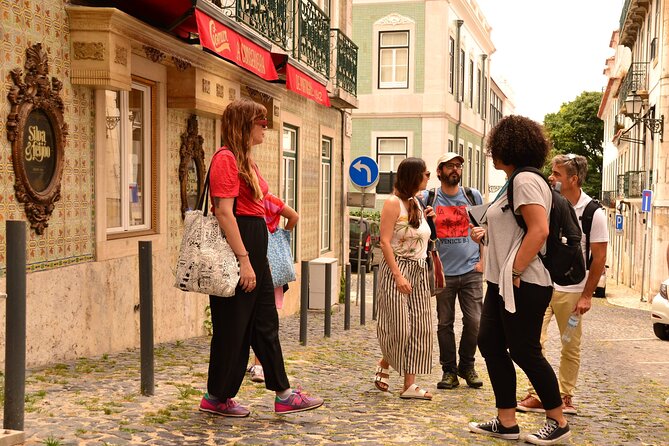
The Miradouro de Chão do Loureiro provides a panoramic pause. Viewpoints are especially useful on an orientation tour because they let you see how the hills, riverfront, and central neighborhoods fit together.
The stop is short, around five minutes, but the view gives you a chance to reset before the older streets of Alfama. Bring your camera, but also listen for practical advice about moving around Lisbon. Several guides, including Katerina and Jose, have been praised for offering suggestions about places to visit, restaurants, and ways to handle the city’s slopes.
The route’s use of public elevators and escalators, when available, is helpful, but this is still a walking experience. Comfortable shoes are not optional. Expect uneven paving, hills, and stretches where your attention needs to stay on the ground as well as on the buildings.
Alfama, fado, and the route’s most atmospheric stretch

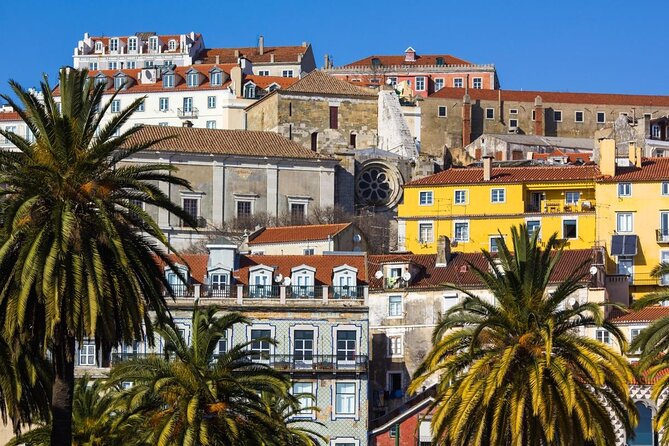
Alfama is the oldest neighborhood on the route and perhaps the most rewarding section for atmosphere. Its narrow lanes, winding streets, Moorish influence, and fado restaurants show a different side of Lisbon from the ordered streets of Baixa.
The tour allows about 20 minutes here, making Alfama one of the longer stops. Your guide explains fado, Portugal’s often melancholy musical tradition, and points out restaurants tucked into the alleys. You do not attend a full fado performance, but you get useful context for planning one later.
This is also where the walk can feel most demanding. Alfama’s slopes and tight streets are part of its appeal, yet they require a moderate level of fitness. A detailed account of the tour described a reasonable pace with well-timed pauses, and that balance seems important. The guide sets the rhythm, but you should not book this expecting a flat stroll.
One limitation is worth knowing. Lisbon Cathedral is not included, even as a dedicated outside stop. If it is high on your list, plan to visit it separately after the tour.
Pastel de nata, wine, and a small local bite
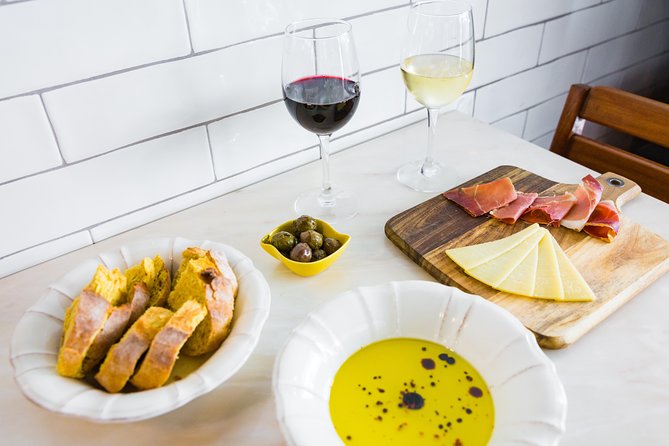
The food inclusions add real value to a low-cost city walk. You receive a classic pastel de nata, Portugal’s custard tart, along with a wine tasting and tapa.
These are not substitutes for a full meal. The tour description makes clear that other food and drinks are not included unless specified, so you should eat beforehand or plan a meal afterward. Still, a sweet pastry and a small savory tasting break up three to four hours of walking.
The food stops also give you a chance to ask questions about Portuguese eating and drinking customs. Vegetarian requests have been accommodated in at least one reported instance, but you should communicate dietary needs when booking rather than rely on it automatically.
Commerce Square and the end by the Tagus
The walk finishes at Praça do Comércio, the grand waterfront square also known as Terreiro do Paço. Its name recalls the royal palace that occupied the site before the 1755 earthquake destroyed it.
After the disaster, the square was rebuilt as part of the Pombaline plan for downtown Lisbon. Its broad arcades and open space make a strong final scene after the narrow streets of Alfama.
The square once welcomed people arriving from the Atlantic, so your guide ends the tour with a reminder that Lisbon’s identity has long been tied to the river and the sea. From here, you are well placed to continue exploring on your own.
The endpoint is different from the starting point, but the route is logical. You begin in central Baixa and finish near the Tagus, so you do not need to retrace the entire walk. Allow yourself a little time at the square after the tour for photos and orientation.
What the $23.94 price really buys you
At $23.94 per person, the value is strong if you are new to Lisbon. You get three to four hours with a local guide, a route through several major neighborhoods, a pastry, wine tasting, and a tapa. Booking 38 days ahead on average also suggests that planning early is sensible, especially if your dates are fixed.
The main value is not admission to attractions. No museums or monuments are included, and the tour does not promise interior visits. You are paying for structure, explanation, local recommendations, and the ability to cover a wide area without planning every turn yourself.
For an independent visitor, the tour can save a first day of map reading and help you choose where to return. For someone who already knows central Lisbon well, the route may feel familiar. The guide’s stories can still add interest, but the experience is designed as an introduction rather than a specialist walk.
Who should book this Lisbon walk?
I would recommend it most strongly for first-time visitors, short stays, solo visitors who want an easy social start, and anyone who prefers history explained in plain language. It also works well as a first-day activity because you finish with a better sense of where Baixa, Chiado, Alfama, and the riverfront sit in relation to one another.
The small group is a real advantage. With no more than 14 people, you have a better chance of hearing the guide and asking questions. The strongest guide experiences described Jose, Maria, Felipe, Joana, Filipa, Franco, and others as warm, patient, funny, and passionate about Lisbon.
I would hesitate only if you dislike hills, want long interior visits, or have already explored all the central neighborhoods. Rain does not automatically stop the walk, but poor weather makes good shoes and a light waterproof layer more important.
Final verdict: a smart first look at Lisbon
This is a well-priced, useful introduction to central Lisbon. Its best qualities are the small group, the broad route, the clear historical thread, the food and wine tastings, and guides who bring real enthusiasm to the job.
Book it if you want to cover the city’s central highlights in one outing and still have energy to explore on your own afterward. Skip it if you want a museum-heavy experience, a cathedral visit, or a slower focus on one neighborhood. For most first-time visitors, I would schedule it early in the trip, wear comfortable shoes, and use the guide’s recommendations to shape the days that follow.
FAQ
How long does the Best of Lisbon Small-Group Guided Walking Tour last?
The tour lasts approximately three to four hours.
How much does the tour cost?
The listed price is $23.94 per person.
Where does the tour begin?
The meeting point is Praça Dom Pedro IV, 1100 Lisboa, Portugal.
Where does the tour finish?
The tour ends at Praça do Comércio, 1100-148, Portugal.
What food and drink are included?
The experience includes a pastel de nata pastry, a wine tasting, and a tapa.
Are museum and monument entrance fees included?
No. Entry to museums and monuments is not included.
Is hotel pickup provided?
No. Hotel pickup and drop-off are not included.
How large is the group?
The tour has a maximum of 14 travelers.
Is the tour offered in English?
Yes. The experience is offered in English.
How far in advance can I cancel for a full refund?
You can cancel at least 24 hours before the start time for a full refund. Cancellations or changes made less than 24 hours before the start time are not refunded or accepted.
Just added around Lisbon
- Small Group Walking Tour of Belém★ 4.9 · 80 reviews
- Lisbon Tram No. 28 Ride & Walking Tour★ 4.1 · 766 reviews
- Lisbon: Walking Tour in the Center (Max 12 Participants)★ 5.0 · 741 reviews
- Lisbon Through the Eyes of a Local – Food and Walking Tour★ 4.9 · 141 reviews
- Lisbon: Private Boat Trip, Guided Walking Tour, Bike & Tram★ 4.8 · 116 reviews
- Lisbon: Kickstart Street Art Walking Tour★ 4.9 · 717 reviews
- Lisbon: Food & Wine Walking Tour Through Baixa★ 4.9 · 287 reviews
- Lisbon: Helicopter Ride, Boat Trip, & Old Town Walking Tour★ 4.7 · 480 reviews
Small-Group Walking Tours, compared.

Amsterdam Anne Frank: Small-Group Walking Tour & Local Guide
Read our review →
Freedom Trail History Small Group Walking Tour
Read our review →
New Orleans Food Walking Tour of the French Quarter with Small-Group Option
Read our review →
Barcelona Tapas and Wine Experience Small-Group Walking Tour
Read our review →
Reykjavík Small group Walking Tour – by CityWalk
Read our review →
Small Group Boat Cruise and Guided Walking Tour
Read our review →
Madrid Tapas & Wine Tasting Walking Tour – Small Group Local Bars
Read our review →Browse the lists this tour appears in