
Review · HISTORY WALKING TOURS
Historical Walking Tour: Legends of Bruges
Bruges reveals its best stories on foot. This English-language walk links the city’s grand squares, canals, churches, and medieval corners in about two hours and fifteen minutes, making it a smart first outing for anyone with limited time. I especially like the route’s strong mix of famous sights and local legends, along with the unusually low price of $3.62 per person.
I also like the human touch supplied by guides such as Louis, Victoria, Martin, Sander, Wouter, and Celine. Their style can make the difference between looking at old buildings and understanding why they matter. The main drawback is that this is a fast-moving overview, so you may want more time inside museums and churches, and one scheduled group reportedly waited when the guide did not appear.
Key points at a glance
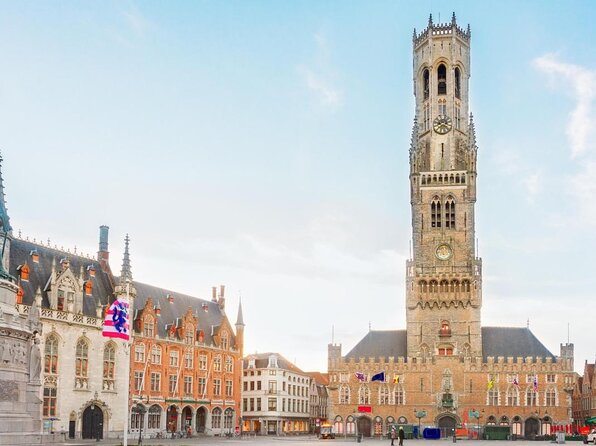
- Eleven central stops: The route covers the Markt, Belfort, Beguinage, Minnewater Lake, Our Lady’s Church, and Burg Square.
- A remarkably low price: At $3.62, this is an easy way to get your bearings, though tips are recommended.
- Story-led guiding: Guides use tales about swans, beer pipes, French kings, emperors, and Bruges’ trading past.
- Good first-day choice: The walk gives you practical ideas about places to revisit on your own.
- Small enough to stay personal: Groups can reach 24 people, while some departures may be much smaller.
- Plan for weather: The tour requires good weather and involves more than two hours on foot.
Why this Bruges walk makes sense early in your visit
Bruges can feel almost too pretty at first. Canals, stepped gables, horse carriages, and polished squares make it easy to enjoy the city without understanding it. This tour gives you a useful framework, connecting the city’s medieval wealth, political struggles, religious institutions, and beer culture.
I would book it near the start of a Bruges stay. The route passes many places you may later want to enter, including the Belfort, Gruuthusemuseum, Sint-Janshospitaal, Onze-Lieve-Vrouwekerk, and Groeningemuseum. A guide can point out what deserves a return visit, and several guides also offer tips about food, chocolate, and other things to do.
The route is also practical for a short visit. You begin at Pieter de Coninck en Jan Breydelmarkt and finish at Burg Square, close to the city center. You do not spend time on buses or transfers, so the city’s scale becomes clear as you walk from the Markt toward the canals and southern sights.
The pace appears manageable, with regular stops. A family with a toddler had to leave early on a freezing day, so weather and footwear matter. Bruges is easy to walk, but two hours and fifteen minutes on old streets can feel long in cold rain.
More History Walking Tours in Belgium
- Historical Walking Tour: Legends of Antwerp
★ 5.0 · 1,837 reviews - Historical Walking Tour: Legends of Gent
★ 5.0 · 1,761 reviews - Brussels: Historical Walking Tour with Chocolate & Waffle Tasting
★ 5.0 · 1,165 reviews
The Markt begins with Bruges as a trading power
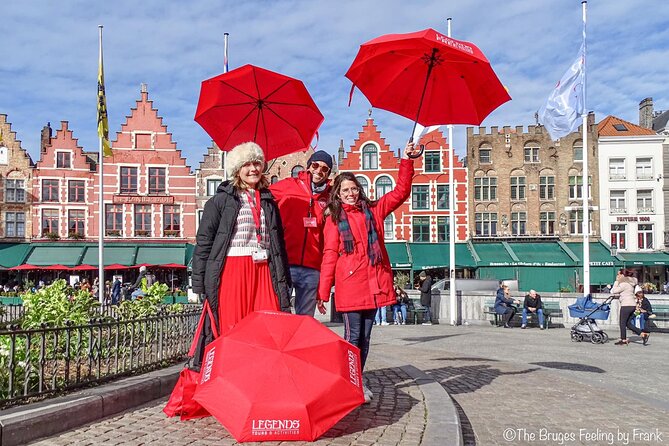
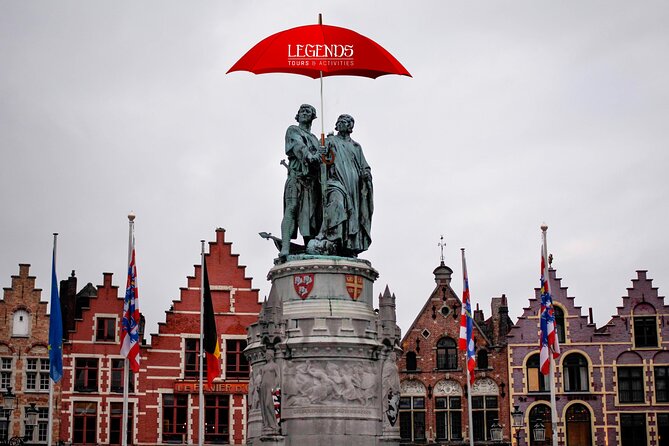
The Markt is a sensible starting point because it presents Bruges at full scale. The square introduces the city’s medieval role as a commercial center, while the guide explains the uneasy relationship between Bruges and the French king.
This opening is more useful than a basic list of dates. It helps explain why the city built such impressive civic buildings and why local independence mattered. Bruges was not simply a charming old town. It was a powerful trading center with enough wealth and confidence to challenge outside authority.
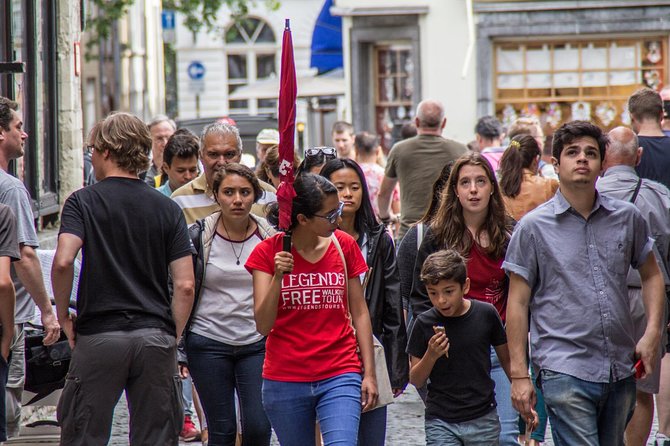
The square can be crowded, especially during busy periods, so stay close enough to hear. The tour is offered in English, and guides such as Martin and Victoria are praised for clear storytelling and humor. Your experience will depend partly on who leads your group, but the strongest guides appear to turn the first fifteen minutes into a lively introduction rather than a lecture.
Belfort brings medieval power into view
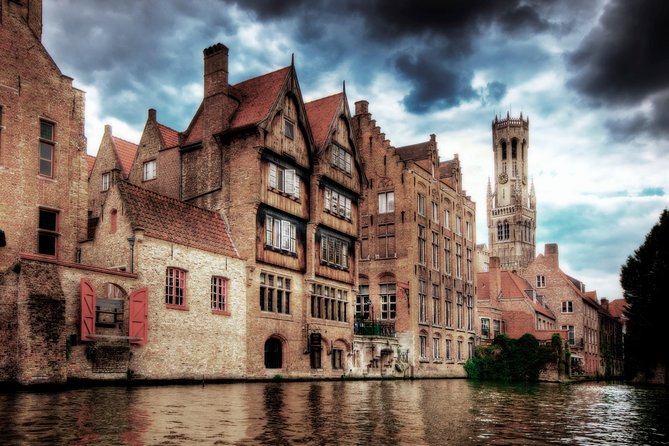
The Belfort, or bell tower, is one of Bruges’ defining landmarks. The tour visits the halls behind the belfry and explains the tower’s role during the Middle Ages.
This stop is valuable even if you do not climb the tower. It gives the building a civic purpose: bells, records, warnings, and public authority were all tied to the city’s tower. The visit described here is not a tower climb, so you should treat it as an introduction rather than a substitute for the full Belfort experience.
One useful tip is to buy climbing tickets early in the morning if you plan to go up separately. The guide can explain why the tower mattered, but the actual climb requires its own planning and ticket.
Gruuthusemuseum shows how wealth was made
The Gruuthusemuseum occupies a former city palace belonging to a wealthy Bruges family. The guide explains how the family held a monopoly in part of the beer trade, giving you a more specific picture of medieval business life.
I like this detail because it moves the story beyond kings and churches. A palace was paid for by trade, and trade depended on control of goods, markets, and supply. The Gruuthuse family’s connection to beer makes Bruges’ commercial past feel more concrete.
The tour does not promise a full museum visit. You should think of this stop as a preview of the building and its owners. If the subject interests you, save time to return and explore the collections at your own pace.
More Crime and Mystery Walks in Belgium:
- Historical Walking Tour: The Story of Bruges – by Legends
★ 4.7 · 483 reviews - Private Historical Tour: Legends of Antwerp
★ 5.0 · 125 reviews - Bruges Guided Walking Tour: Stories, Mysteries and People
★ 4.2 · 71 reviews - Prague: Ghost Walking Tour Where Legends Come To Life
★ 4.4 · 5,253 reviews
Sint-Janshospitaal explains medieval care
At Sint-Janshospitaal, the group pauses at one of Europe’s oldest surviving hospitals. The guide presents the institution as a cornerstone of medieval society, not just as another attractive building.
This is one of the route’s most meaningful stops. Churches and merchant houses show Bruges’ wealth, while the hospital reveals how the city cared for sick people, pilgrims, and those in need. It adds social history to the grand architectural story.
The stop lasts about ten minutes, which is enough for context but not for a complete museum visit. If you want art and hospital history in more detail, plan a separate visit.
The Beguinage offers a quieter side of Bruges

The Princely Beguinage Ten Wijngaarde brings the group into a picturesque community where women have lived together for more than 800 years. The stop offers a change of mood after the busy center.
I find this part of the route especially useful because it shows Bruges as a place of daily life, faith, and community. The guide can explain the beguines without reducing the site to a pretty courtyard and whitewashed façades.
Keep your expectations sensible. Ten minutes is enough for a walk and an explanation, but not for a slow visit. You will want to respect the calm of the place and listen rather than treat it as a quick photo stop.
De Halve Maan connects beer with city folklore
Outside De Halve Maan Brewery, the guide tells the story behind Bruges’ nickname, the Fools of Bruges, and points out part of the beer pipeline running beneath the city.
This is a memorable example of the tour’s approach. A brewery becomes a doorway into local humor, civic identity, and modern engineering. You also get a detail that is easy to miss when walking alone: a beer pipeline under the city.
The tour does not include a brewery visit or tasting as a standard feature. Some guides may add small extras, such as chocolate samples, but you should not count on those as part of the advertised experience. The included feature is the guiding and the historical explanation.
Minnewater Lake brings in swans and imperial conflict
At Minnewater Lake, also called the Lake of Love, the guide explains why swans appear on Bruges’ canals and how the city came into conflict with Emperor Maximilian of Austria.
This is a strong stop for anyone who enjoys stories attached to ordinary sights. Swans may look like decoration, but the tale gives them a political and historical connection. The story of Maximilian also shows that Bruges’ problems were not limited to its relationship with the French king.
The lake provides a welcome pause after several built-up locations. It is one of the more atmospheric parts of the walk, though the full tour continues afterward, so do not mistake this stop for the end.
Our Lady’s Church packs art, architecture, and dynastic history
Onze-Lieve-Vrouwekerk is one of the tour’s major highlights. Its brick tower is described as the second tallest brick tower in the world, and the church houses a Michelangelo statue along with the tombs of the last Dukes of Burgundy.
That is a lot of material for a ten-minute stop. The guide’s job here is to identify the key details and help you understand why the church matters. You may not have time to study every work or inscription, but you will know what to look for when you return.
The church links Bruges’ religious life with elite power and art. The Michelangelo connection draws attention, while the ducal tombs show how closely the city’s story is tied to Burgundian rulers.
Groeningemuseum gives a short taste of Flemish art
The route enters the garden of the Groeningemuseum, where works by major Flemish masters are on display. The stop lasts about five minutes, so this is clearly an orientation rather than a museum tour.
That brief visit still has value. You get a visual introduction to one of Bruges’ key art institutions and can decide if it deserves more of your time. I would not plan the tour as your main art experience, but I would use this stop to mark the museum for later.
The short pause also helps keep the full walk moving. A tour that tried to cover every collection in depth would take far longer than two hours.
Huidenvettersplein makes old work feel real
At Huidenvettersplein, the former Tanner’s Square, the guide explains how workers greased skins and turned them into leather.
This is one of the route’s more grounded stops. Grand churches and palaces can make medieval Bruges seem elegant and polished, but tanning was smelly, physical work. The square gives you a glimpse of the trades that supported city life.
I appreciate this kind of detail because it makes the old center less decorative. Bruges was built by merchants, craftspeople, laborers, clergy, and officials, not only by wealthy families.
Burg Square closes with the city’s political heart
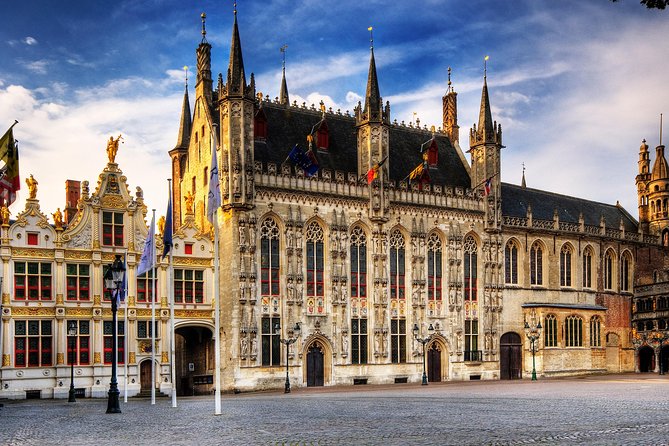
The tour passes the old Fishmarket and ends at Burg Square, described as the political heart and birthplace of Bruges.
This is a fitting finish. The Markt introduces trade and civic power, while Burg Square gathers the political story into one final place. It also gives you a central point from which to continue exploring after the guide says goodbye.
Ending here is convenient, since you can continue toward nearby streets, return to a museum, or find a place to eat. The endpoint is listed as De Burg, Burg 15. The tour does not provide transport back to your accommodation, but in central Bruges that is rarely a major problem.
Guides make the biggest difference
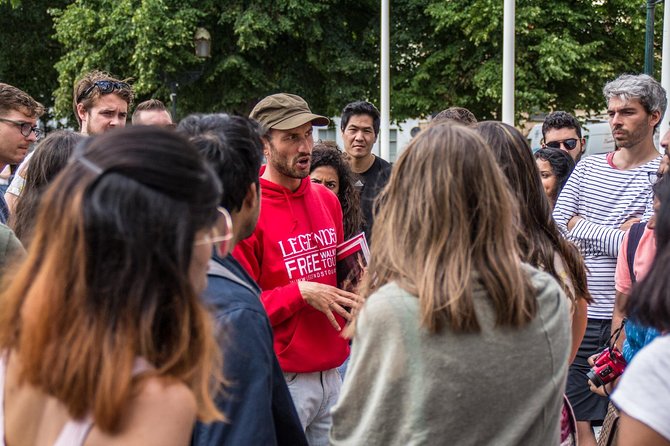
The strongest praise is directed at the guides’ storytelling, humor, local connection, and ability to answer questions. Louis is described as a Bruges native whose affection for the city came through clearly. Victoria is praised for charisma and historical detail, while Martin is singled out for an entertaining, in-depth approach.
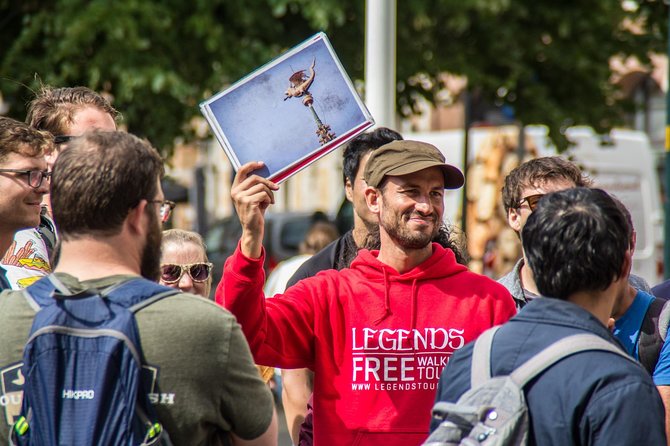
Sander, Wouter, Thomas, Erik, Emiel, Patrick, Celine, Sam, and Willem are also named as guides who helped make the walk enjoyable. Celine’s local tips were especially useful, and one guide used visual aids to support the stories.
That range matters because a low-cost walking tour can vary with the person leading it. The strongest guides appear to combine facts with personal flair, rather than reciting a script. One complaint describes a guide who did not arrive, so I would keep your booking confirmation available and arrive at the exact meeting point.
Is $3.62 really good value?
At $3.62 per person, the tour is priced more like an introductory orientation than a standard paid excursion. All fees and taxes are included, and tips are recommended. The guide may need to pay to operate the tour, so a fair tip is part of the practical cost if the experience is useful.
The value is strongest if you are visiting Bruges for the first time, have only one day, or want help deciding what to revisit. You receive more than a route map: you get context for eleven major places and a set of stories that can make later sightseeing easier.
The value is lower if you want long museum visits, a brewery tasting, or a slow photography walk. This tour points you toward those experiences but does not replace them.
Group size, weather, and who should book
The maximum group size is 24 people, which is still manageable but not especially intimate. Some departures may be much smaller, allowing more questions. The tour is near public transportation, service animals are allowed, and most people can participate.
I would recommend comfortable shoes and a weather check. The tour requires good weather, and a cancellation for poor conditions results in either another date or a full refund. You can cancel for a full refund up to 24 hours before the start time, but changes or cancellations inside that window are not refunded.
This walk suits first-time visitors, couples, families with older children, solo visitors, and anyone who wants a quick historical frame. It may be less suitable for very young children on cold days, anyone who dislikes group walks, or repeat visitors who already know the central sights well.
Should you book Legends of Bruges?
I would book it, especially at the beginning of a Bruges visit. The combination of central landmarks, local legends, practical orientation, and a $3.62 starting price is hard to beat.
Choose it for stories about trade, beer, swans, political conflict, churches, and everyday medieval work. Do not choose it expecting extended time inside every museum or a guaranteed private guide. Arrive at the Markt early, dress for the weather, listen for the guide’s local suggestions, and leave room in your schedule to revisit the places that catch your interest.
FAQ
Where does the tour start?
The tour starts at Pieter de Coninck en Jan BreydelMarkt, 8000 Brugge, Belgium.
Where does the tour end?
The tour ends at De Burg, Burg 15, 8000 Brugge, Belgium.
How long does the walking tour last?
The tour lasts approximately two hours and fifteen minutes.
What language is the tour offered in?
The tour is offered in English.
How much does the tour cost?
The listed price is $3.62 per person. Tips are recommended.
How many people can join the tour?
The maximum group size is 24 people.
Does the tour include entrance tickets?
The stops are listed with free admission, and all fees and taxes are included. The tour does not state that separate museum, church, or Belfort climbing tickets are included.
Can I climb the Belfort during the tour?
The tour visits the halls behind the belfry and explains its medieval role. A separate review notes that climbing tickets should be purchased in the morning, so the climb should be treated as an additional activity.
Can I cancel for a refund?
Yes. You can cancel at least 24 hours before the start time for a full refund. Cancellations within 24 hours are not refunded.
What happens if bad weather cancels the tour?
If poor weather causes cancellation, you will be offered another date or a full refund.
Just added around Belgium
- Walking Tour: Highlights of Antwerp★ 5.0 · 98 reviews
- Historical Walking Tour in Antwerp Old City★ 5.0 · 277 reviews
- Evening Walking Tour: The Dark Side of Antwerp★ 5.0 · 193 reviews
- Private Historical Tour: Legends of Antwerp★ 5.0 · 125 reviews
- Brussels: Private 3-Hour Sightseeing Walking Tour★ 4.6 · 112 reviews
- Historical Walking Tour: The Story of Bruges – by Legends★ 4.7 · 483 reviews
- Antwerp: Historical Walking Tour in the Old City★ 4.8 · 373 reviews
- Ghent: Guided Walking Tour and Canal Boat Trip★ 3.8 · 128 reviews
History Walking Tours, compared.
History and Hauntings of Salem Guided Walking Tour
Read our review →
Freedom Trail History Small Group Walking Tour
Read our review →
Historic Charleston Guided Sightseeing Walking Tour
Read our review →
Tapas Walking Tour with Food, Wine, and History
Read our review →
Savannah History and Haunts Candlelit Ghost Walking Tour
Read our review →
A History of Terror – Belfast City Centre Walking Tour
Read our review →Browse the lists this tour appears in