
Review · NIGHT WALKING TOURS
Kyoto: Gion Magical Night Walking Tour with Geisha Trivia
Gion changes after sunset. This 100-minute walk brings you through Hanamikoji, quiet side streets, illuminated shrines, and a glowing Buddhist pagoda while your English-speaking guide explains Kyoto’s geisha traditions and local customs. I especially like the small groups of up to 10 people and the chance to ask questions without shouting over a crowd. The $24 price is also fair for a guided introduction to one of Kyoto’s most atmospheric districts.
I also like the route’s wider view of Gion. It is not only a geisha walk. You visit a matchmaking shrine, learn how to behave at Shinto sites, and finish at a shrine more than 1,000 years old. The main consideration is mobility: stairs make this unsuitable for wheelchair users, baby carriages, and people with limited mobility. You also need to arrive early, since the listed time is when the walk leaves, not the meeting time.
Key points at a glance

- Nighttime Gion atmosphere: See Hanamikoji and nearby lanes after many daytime crowds have gone.
- Geisha culture explained clearly: Learn about geisha and maiko traditions, clothing, etiquette, private clubs, and local rules.
- Small-group format: Groups are limited to 10, with some tours running with only four people.
- More than the geisha district: The route includes a matchmaking shrine, an illuminated Buddhist pagoda, quiet paths, and an ancient shrine.
- Helpful local guidance: Guides such as Shino, Hina, Masami, Sho, Pam, and Yuri have been praised for clear English, friendly conversation, and practical recommendations.
- Good value at $24: Photography help and a 100-minute guided walk are included, with free cancellation up to 24 hours before departure.
Starting at Minamiza Theatre in central Gion
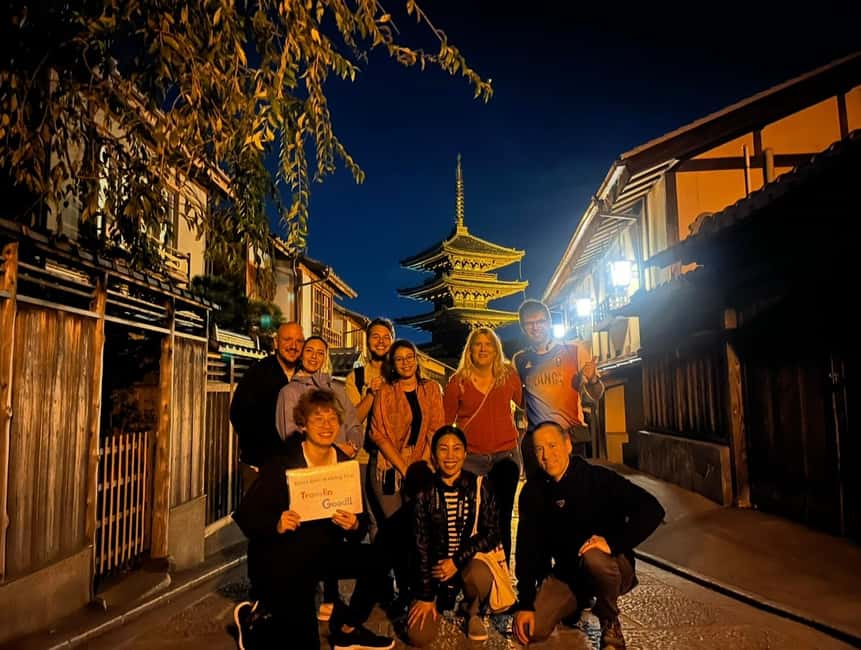
Your meeting point is in front of the Minamiza Theatre. Look for the guide holding a TravelinGood sign, and use the front side of the theatre rather than waiting somewhere behind the building.
This is a useful location because you begin right in the heart of Gion. It also means you should plan extra time if you are arriving by bus or taxi. Kyoto traffic can slow down, and the tour does not wait for late arrivals once the group leaves.
The listed time is the departure time. Arrive at least five minutes early, ideally with enough margin to find the guide and settle in. This small detail matters more than it sounds. If you treat the start time as a meeting time, you could arrive just as the group disappears into the lanes.
The tour is offered in English. Guide quality is a major part of the experience, and the names appearing in recent feedback include Shino, Hina, Masami, Sho, Pam, Yuri, Kevin, Sora, Wasabi, and Hinari. Their styles differ, but the strongest pattern is clear English, an easy manner, and a willingness to answer questions.
More Night Walking Tours in Kyoto
- Night Walk in Gion: Kyoto’s Geisha District
★ 4.5 · 2,003 reviews - Kyoto Gion Night Walk & Geisha District Guided Tour
★ 5.0 · 786 reviews - Gion Walking Tour by Night
★ 4.5 · 429 reviews
Walking Hanamikoji after dark
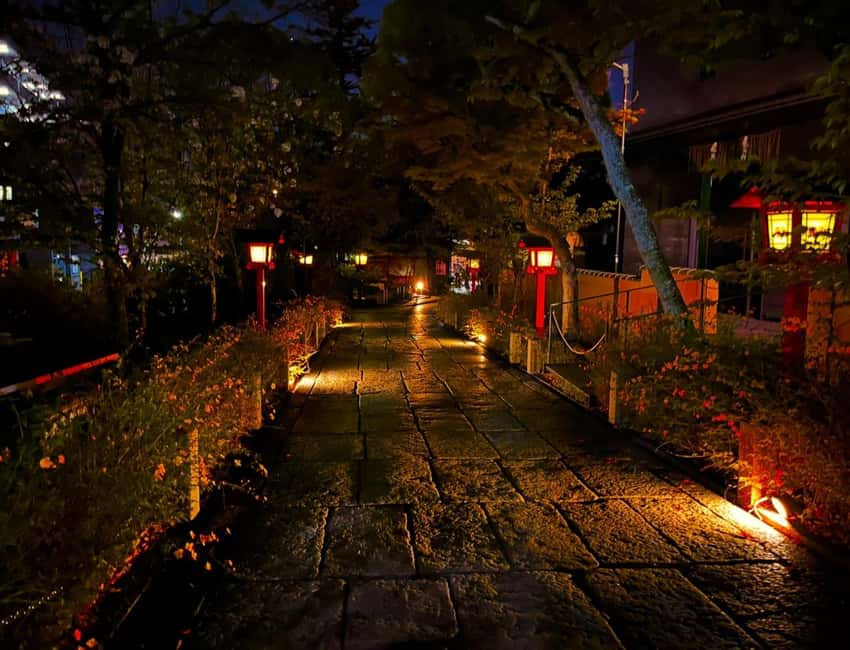
The first major area is Hanamikoji, one of Gion’s best-known streets. Traditional wooden buildings, lanterns, and narrow lanes give this part of Kyoto its familiar look, but nighttime changes the mood. The streets can feel calmer, and the warm light makes the architecture especially attractive.
Your guide explains how Gion works rather than simply pointing out old buildings. You learn about the difference between geisha and maiko, the customs of the entertainment district, and the private nature of the clubs. Guides have also explained details such as lanterns, clothing, and the traditions that visitors often misunderstand.
This is where the tour earns its price. You could walk Hanamikoji alone for free, but without context, it is easy to see only a line of pretty facades. With a guide, you get the social and cultural background that gives the street meaning.
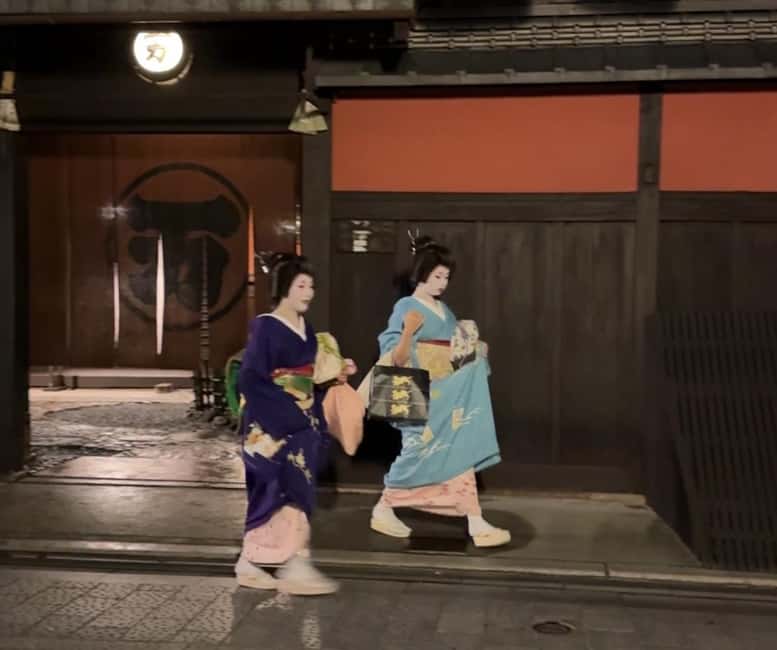
The tour also handles the subject of geisha culture with a useful amount of care. You may spot a geisha or maiko entering a taxi or walking along the street, but seeing one is luck, not the purpose of the tour. The experience is not a guaranteed meeting or photo opportunity. That distinction is important, both for your expectations and for respectful behavior in Gion.
If you are fortunate enough to see a performer, follow your guide’s lead. Avoid blocking the street, chasing someone for a photograph, or treating the person as a character in a theme park. The walk is better when you observe quietly and let the district remain a working neighborhood.
Geisha and maiko traditions without the tourist myths
The geisha portion is the main reason many people book this walk, and the guides make the topic approachable. You learn how geisha and maiko differ, how training and appearance can vary, and why the district has its own etiquette.
One guide used photographs and videos to show the differences between geisha and maiko. That is particularly useful because the clothing, hairstyles, and makeup can be hard to distinguish at a glance. A guide can also explain what you are seeing without reducing the tradition to costumes and photo stops.
Several guides have local or personal connections to Kyoto. Wasabi, for example, was praised for explaining geisha customs alongside nearby temples and shrine rituals. Masami was noted for answering questions patiently and adding small stories about the places along the route. Hinari received praise for making the subject easy to follow while keeping the mood relaxed.
You will not get an academic lecture. The tone is conversational, with room for questions and casual talk. That works well for most visitors because you can ask about points that interest you instead of listening to a fixed script from start to finish.
The tour is especially useful if you are new to Kyoto. It gives you a basic framework for understanding Gion, so later walks through the district make more sense. If you have already studied geisha culture or spent several days exploring Gion with a private guide, some explanations may feel familiar. One person found the content better suited to first-time visitors for exactly that reason.
A matchmaking shrine and the rules of a Shinto visit
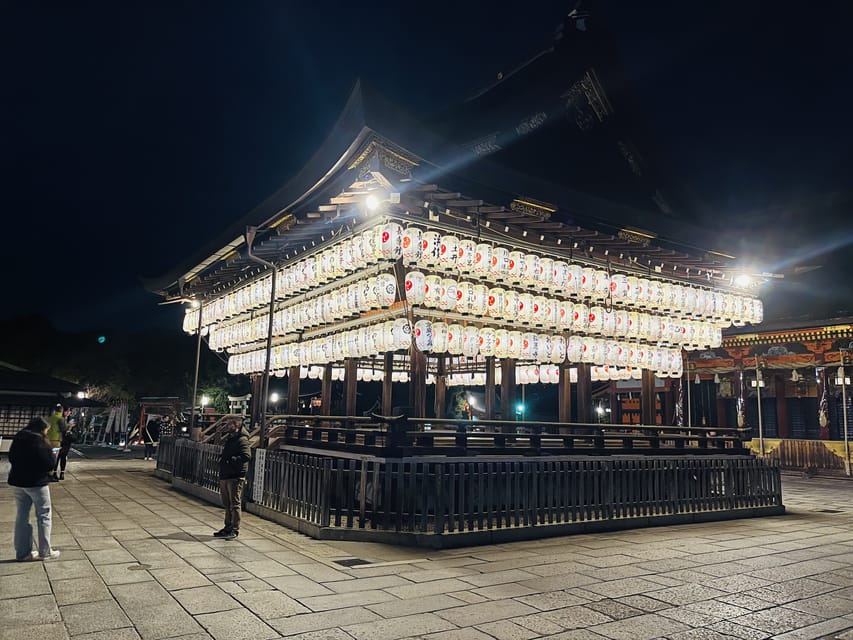
The route then leaves the main geisha streets and introduces a shrine associated with matchmaking. This adds a different side of local life. Gion is not only about entertainment districts and old houses. It is also a place where people come to pray, make wishes, and follow rituals that are still part of everyday Japanese culture.
Your guide explains how to approach a Shinto shrine and how to pray. Shino was praised for helping the group practise the ritual and making sure everyone understood what to do. That kind of instruction is valuable because many visitors want to participate but worry about getting the steps wrong.
The guide may also explain the difference between Shinto and Buddhism, a subject that can seem confusing when shrines and temples appear close together. The tour presents the distinction in a practical way, tied to the actual sites you are visiting.
This is one of the walk’s best features. You are not just collecting photographs. You learn how to read the place and behave with more confidence at other shrines during the rest of your trip.
Same streets, a different way to see them:
- Kyoto Geisha Walking Tour: Gion District & Hidden Gems
★ 4.7 · 3,273 reviews - Kyoto: Gion Geisha District Walking Tour – Stories of Geisha
★ 4.7 · 2,187 reviews - Best of Kyoto: Gion, Geisha, Pagodas & Cobblestones
★ 4.9 · 2,058 reviews - Kyoto Gion Geisha District Walking Tour – The Stories of Geisha
★ 5.0 · 1,441 reviews
The illuminated Buddhist pagoda
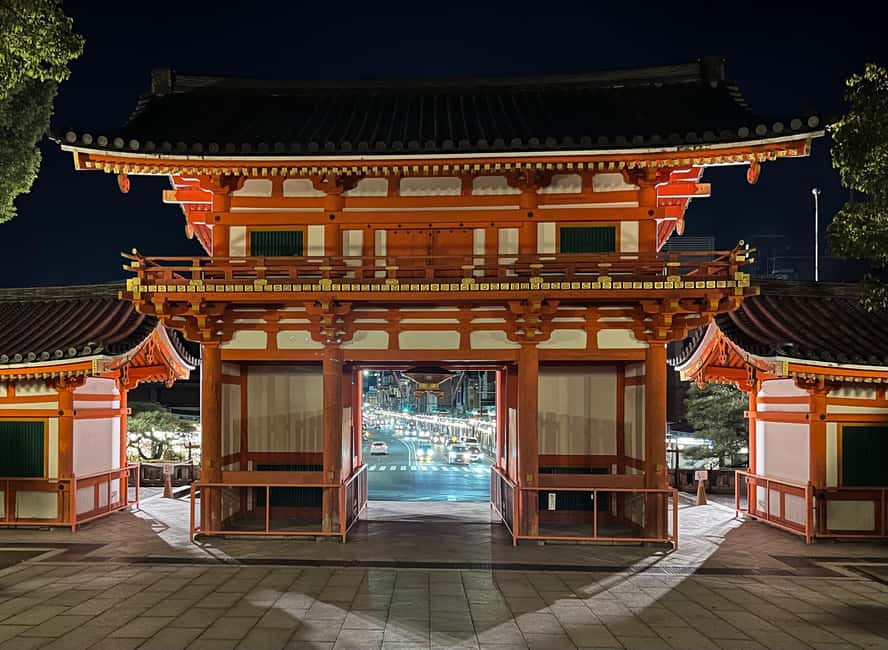
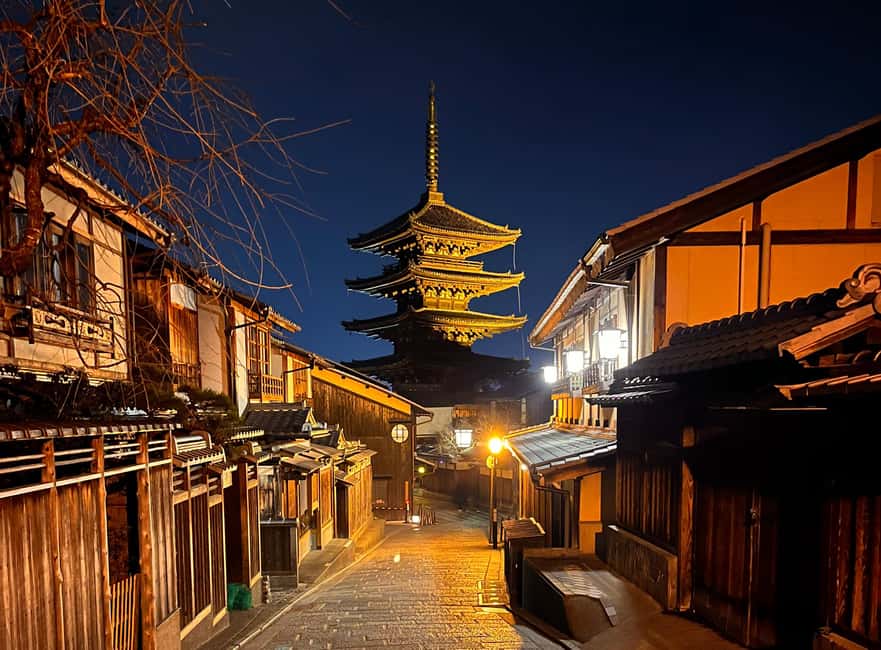
One of the route’s visual highlights is a Buddhist pagoda outside the main geisha district. At night, it is lit up and can look especially striking against the darker streets.
Several guides have treated the pagoda as a key moment in the walk. The appeal is not only the structure itself, but also the change of pace. After the narrow lanes and geisha stories, you get a larger view of Kyoto’s religious architecture and a strong night photograph.
The route does not promise a long stop at every sight, so think of this as a guided viewing point rather than a formal temple visit. You see the pagoda from outside, hear about its setting, and continue through the district.
Photography help is included. That does not mean a dedicated photo shoot, but your guide can help take pictures along the way. This is handy for solo visitors or couples who want a photograph together without asking strangers repeatedly.
Quiet lanes, side paths, and the old shrine at the end
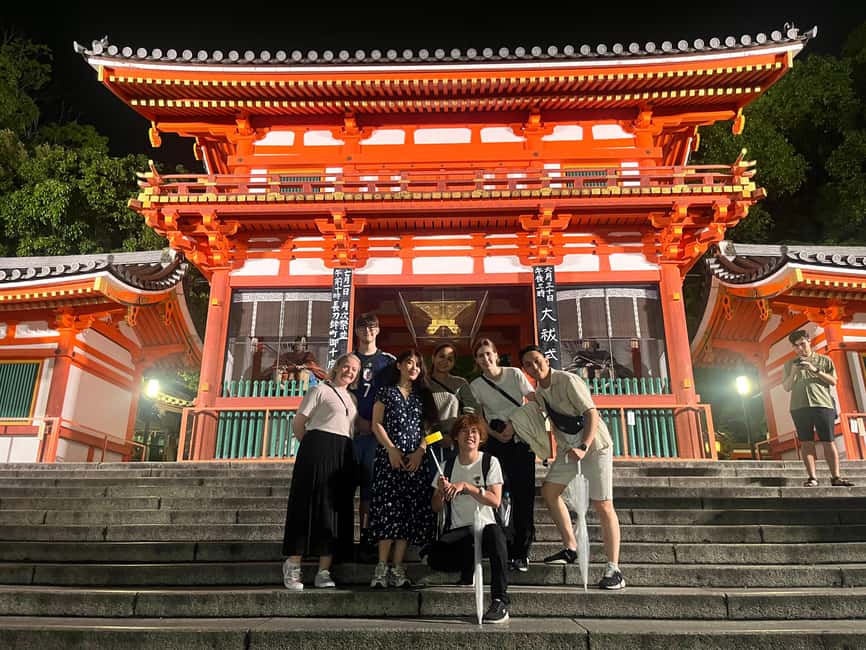
The walk continues through lesser-known paths and side streets. These quieter sections help you see why the experience works better at night than during the busiest daytime hours. You can focus on lanterns, entrances, old walls, and small details instead of moving with a large stream of people.
The pace is generally gentle. One older participant found the amount of walking manageable, and another described the route as a slow walk through Gion. Still, this is not a completely flat, step-free outing. Stairs are part of the route, so you should be comfortable walking for 100 minutes and handling uneven or stepped sections.
The final stop is a shrine more than 1,000 years old. Ending at an ancient religious site gives the walk a sense of scale. You begin with the modern activity of Gion and its evening visitors, then finish with a place connected to centuries of worship.
Guides often add local stories, legends, and suggestions for daytime sights. Shino and Hina were particularly praised for offering restaurant ideas and tips for the rest of a Kyoto visit. These small additions can be useful because you finish near an area filled with places to eat, yet choosing somewhere in Gion can be difficult when you do not know the neighborhood.
Why the small group matters
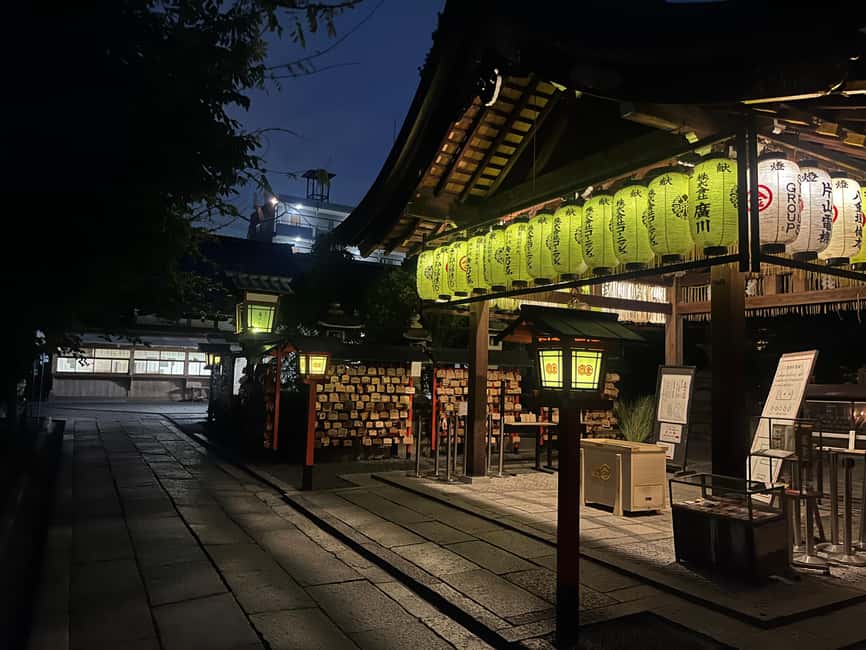
The group limit is 10 people, and some departures are much smaller. One group had only four participants, while another had three guests plus the guide. That difference changes the feel of the walk.
In a small group, you can ask about a particular shrine, stop briefly for a photograph, or request clarification without holding up a large crowd. The guide can also notice if someone is lost, cold, or having trouble with the pace.
This personal attention is a repeated strength of the experience. Yuri was praised for making everyone comfortable asking questions. Hina was described as patient and friendly. Pam was appreciated for her energy, while Kevin received praise for clear English and easy-to-follow stories.
A small group also helps the walk stay respectful in Gion. Large groups can block narrow lanes and draw attention. Ten people is still a group, but it is far easier to manage than a party of 20 or 25.
Choosing the right departure time
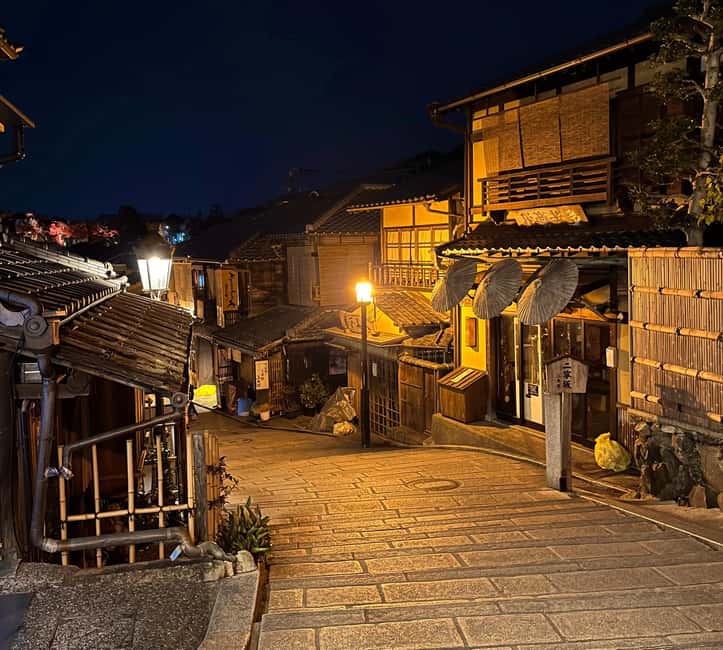
The regular experience is designed for nighttime, when Gion’s lanterns and illuminated religious buildings create much of the appeal. The quiet streets are a major reason to choose this tour instead of a daytime orientation walk.
A winter option has also been offered at 3 p.m. during February. This is useful if you have evening plans or prefer to see the district while there is still daylight. A late-afternoon start can give you both fading daylight and the first evening lights, though the atmosphere will not be exactly the same as a fully nocturnal walk.
If your main goal is a calmer Gion, choose the latest suitable departure. If you are travelling with children or prefer better visibility on the paths, an earlier time may feel easier.
The walk is also a good first or second activity in Kyoto. It gives you an orientation to Gion, introduces shrine etiquette, and ends with practical food and sightseeing suggestions. You do not need to book it only at the start of your trip, though it can help you get your bearings quickly.
Is $24 a fair price?
At $24 per person, this is a sensible price for a 100-minute guided walk in one of Kyoto’s most famous districts. You are paying for a live English-speaking guide, a small group, photography assistance, and cultural explanation rather than admission to a major attraction.
The value is strongest if you want context. If you are content to stroll Hanamikoji alone and read about geisha culture later, you can see parts of the route without paying. But you will miss the explanations about private clubs, geisha and maiko customs, shrine rituals, and the stories attached to the smaller stops.
The small group also makes the price more attractive. A large walking tour can be cheap but frustrating when you cannot hear or ask questions. Here, the limit of 10 helps keep the experience personal.
Free cancellation up to 24 hours before the start gives you some flexibility, and you can reserve now and pay later. Your ticket is valid only for the booked date and time, so do not assume you can join another departure without confirmation.
Who should book this Gion walk?
I would recommend it most strongly to first-time visitors who want a clear introduction to Gion without spending a large amount on a private tour. Families with older children can also enjoy it. One guide kept two children, ages 9 and 11, interested throughout the walk.
It suits solo visitors, couples, and small groups who want photographs and a chance to ask questions. It is also useful for people who have seen Gion during the day but want to experience the district after dark.
You should think twice if you already know a great deal about Kyoto’s geisha traditions. The guide can still add local stories and point out details, but the basic explanations may not be new.
This is not suitable for wheelchair users, people with limited mobility, or baby carriages because of the stairs. Babies under one year are also listed as unsuitable, and children under six do not need to buy a ticket.
Should you book it?
Book this tour if you want Gion explained as a living cultural district, not just a backdrop for photographs. The best parts are the small group, the calm nighttime setting, the clear explanations of geisha and maiko traditions, and the extra stops beyond Hanamikoji.
I would choose a nighttime departure for the full atmosphere and arrive at least 10 minutes early at Minamiza Theatre. Keep your expectations realistic: you may see a geisha or maiko, but no sighting is promised. At $24, the walk offers good value, especially when you want a friendly guide to connect Gion’s streets, shrines, customs, and stories.
FAQ
Where does the tour meet?
Meet in front of the Minamiza Theatre, on the front side of the building. Your guide will hold a TravelinGood sign.
How long does the tour last?
The walking tour lasts 100 minutes.
What time should I arrive?
Arrive at least five minutes before the listed start time. The listed time is when the group leaves the meeting point, not simply the time to begin gathering.
How many people are in the group?
The tour is limited to 10 participants. Some departures may have fewer people.
What language is the tour conducted in?
The live tour guide speaks English.
Does the tour guarantee a geisha sighting?
No. You may see a geisha or maiko, but the tour is not intended as a guaranteed meeting with geisha.
What places does the route visit?
The route includes Hanamikoji and the geisha district, a matchmaking shrine, an illuminated Buddhist pagoda, quiet paths, and a shrine more than 1,000 years old.
Are photographs included?
Photography service is included. Your guide can help take photographs during the walk.
Is the tour accessible for wheelchair users?
No. Stairs along the route mean it is not suitable for wheelchair users, baby carriages, or people with limited mobility.
Can I cancel for a refund?
Yes. You can cancel up to 24 hours in advance for a full refund. Your ticket is valid only for the date and time you booked.
Just added around Kyoto
- Kyoto : Private Custom Walking Tour With A Local Guide★ 4.6 · 144 reviews
- Kyoto: Private 2.5 Hour Historical Walking Tour★ 4.9 · 121 reviews
- Kyoto: Private Walking Tour with a Local★ 4.6 · 118 reviews
- Kyoto: Gion Sunset Walking Tour with Local Guide★ 4.7 · 351 reviews
- Kyoto: Gion Walking Tour★ 5.0 · 195 reviews
- Kyoto: Izakaya Bars Guided Walking Tour★ 4.9 · 815 reviews
- Kyoto: Imperial Palace & Nijo Castle Guided Walking Tour★ 4.7 · 453 reviews
- Kyoto Gion Cultural Walk & Geisha Show with Dining Options★ 5.0 · 518 reviews
Night Walking Tours, compared.

Private Street Food Evening Walking Tour in Ho Chi Minh City
Read our review →
Albaicín and Sacromonte Guided Sunset Walking Tour
Read our review →
Bremen: Walking Tour in German with Night Guard
Read our review →
Ghosts of Charleston Night-Time Walking Tour with Unitarian Church Graveyard
Read our review →
Savannah’s Ghost City “Dead of Night” Walking Night Tour
Read our review →

Browse the lists this tour appears in