
Review · HISTORY WALKING TOURS
Pula: Historic Sites Guided Walking Tour
Pula’s old town is a history lesson in stone. This 90-minute walk links the Roman Arena, Venetian castle, cathedral, forum, temples, mosaics, market, and ancient gates in one compact route. I like the strong coverage of major sights and the way a local English-speaking guide connects Roman, Venetian, and later Pula. I also like the low $20 price, especially if you want a quick orientation before exploring on your own.
The main consideration is pace and access. You cover plenty of ground in a short time, and the tour is not suitable for people with mobility impairments. Entry tickets are not included, and the experience goes ahead in rain or shine.
Key points at a glance
- Starts at Pula Arena: Meet in front of the Amphitheater entrance, where your guide wears a blue card and carries an umbrella.
- A compact Roman and Venetian route: See the Arena, castle, cathedral, Roman Forum, Augustus Temple, City Hall, Arch of Sergii, market, mosaics, and Twin Gate.
- Panoramic castle views: The Venetian-built Pula Castle adds a higher viewpoint and a change from the city streets.
- Strong guide-led storytelling: Guides called Sini, Sinisha, and Sinsije receive repeated praise for clear English, humor, and detailed answers.
- Good value at $20: The tour gives you a useful introduction to Pula without charging for admission, though any entry tickets are extra.
- Useful in any weather: It runs rain or shine, so bring suitable shoes and clothing.
Why this short Pula walk works
Pula is easy to underestimate. You can see a Roman arch, a medieval-looking street, an Austro-Hungarian building, and a Venetian fort within a few minutes of one another. Without context, the city can feel like a collection of attractive stones. With a good guide, those stones begin to explain Pula’s long past.
This tour is built as an introduction rather than a slow archaeological study. In 90 minutes, you move through the old center and learn how the city changed over time. The Roman period gets the greatest attention, but the route also brings in Venetian rule, local culture, architecture, and the modern market.
I think the timing is one of the tour’s best features. It is long enough to cover the important monuments but short enough to fit before lunch, after arriving from a cruise ship, or at the start of a day in Istria. The trade-off is that some stops receive only a short explanation. If you want to linger inside every monument, you will need to return independently.
The guide’s role matters here. The most warmly praised guides are Sini, Sinisha, and Sinsije, with names appearing in slightly different forms. The consistent picture is of an English-speaking guide who explains clearly, uses humor, welcomes questions, and keeps the group moving at a comfortable pace.
More History Walking Tours in Croatia
- Dubrovnik Old Town History Walking Tour
★ 5.0 · 1,684 reviews - Dubrovnik: Ancient City Walls & Wars Walking Tour
★ 5.0 · 1,270 reviews - Zagreb: City & History Walking Tour & WW2 Tunnels
★ 4.9 · 1,202 reviews
Meeting the guide at Pula Arena
The meeting point is in front of the Amphitheater entrance at Istarska ul. 50. Look for a guide with a blue card around the neck and an umbrella. That detail is useful because the Arena area can be busy, and a precise visual marker saves you from wandering around asking every guide if you are in the right place.
The Pula Arena is the right place to begin. It is the city’s most famous Roman monument and gives your guide an immediate way to explain Pula’s importance in the ancient world. You receive a brief overview before walking onward, so the tour starts with a clear sense of place rather than a long wait or a complicated check-in.
Entry tickets are not included. The tour may explain the Arena from outside, but you should not assume that admission to the interior is part of the $20 fee. If seeing the inside matters to you, check the entry arrangements separately and allow time beyond the walking tour.
The area around the Arena is open and exposed. In summer, the stone and pavement can feel hot. In cooler months, wind or rain can make the opening portion less comfortable, particularly because the tour runs in all weather.
Pula Castle and the city from above
From the Arena, the route continues to Pula Castle, built by the Venetians in the 17th century. This changes the mood of the walk. The Arena presents Roman power on a huge scale, while the castle helps explain a later period when Pula’s position on the Adriatic made it valuable to Venetian rulers.
Your guide covers the castle’s past and former inhabitants, then uses the site for panoramic views. That viewpoint is one of the tour’s most useful features because it helps you understand the layout of the old city. After walking among separate monuments, you can look across Pula and see how the historic center fits together.
The castle section may appeal most to people who enjoy the relationship between history and geography. A fortress is not just an old building. Its position tells you something about defense, authority, and control of the town. The Roman Arena and the Venetian castle also create a helpful contrast: one belongs to imperial antiquity, the other to a later maritime power.
You should keep your expectations practical. The experience is a guided walk, not a dedicated castle visit. Since admission is not included, confirm what parts of the castle are accessible during your chosen time. The major value here is the explanation and the view, not an extended interior tour.
Cathedral, Roman Forum, and Augustus Temple
The walk then heads toward the Cathedral before reaching the Roman Forum. These stops show how Pula’s center continued to serve public and religious purposes across different eras.
The Cathedral gives the guide another chance to explain how the city’s identity changed after the Roman period. You may find the building more interesting when you see it as part of the old urban fabric rather than as an isolated church. The route does not treat Pula as only a Roman site. That broader view is important, since the city’s character comes from several layers placed close together.
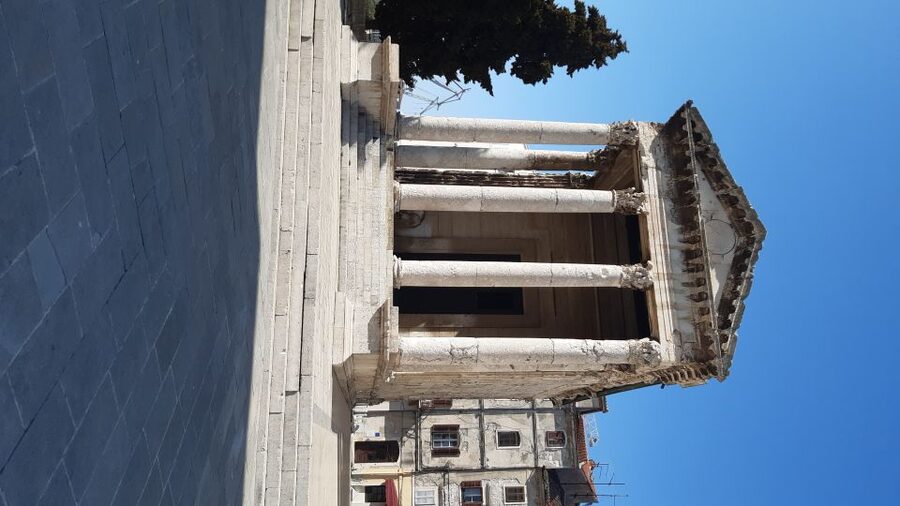
At the Roman Forum, the focus returns to antiquity. The forum was the civic heart of Roman Pula, and the Augustus Temple remains its clearest surviving monument. The temple is roughly 2,000 years old, so this is one of the moments when the age of the city becomes more than a date in a guidebook.
The Augustus Temple is not large compared with the Arena, but that is part of its appeal. Its columns and formal design show the public face of Roman power in a more concentrated way. The guide can point out architectural details that are easy to miss if you simply take a photograph and move on.
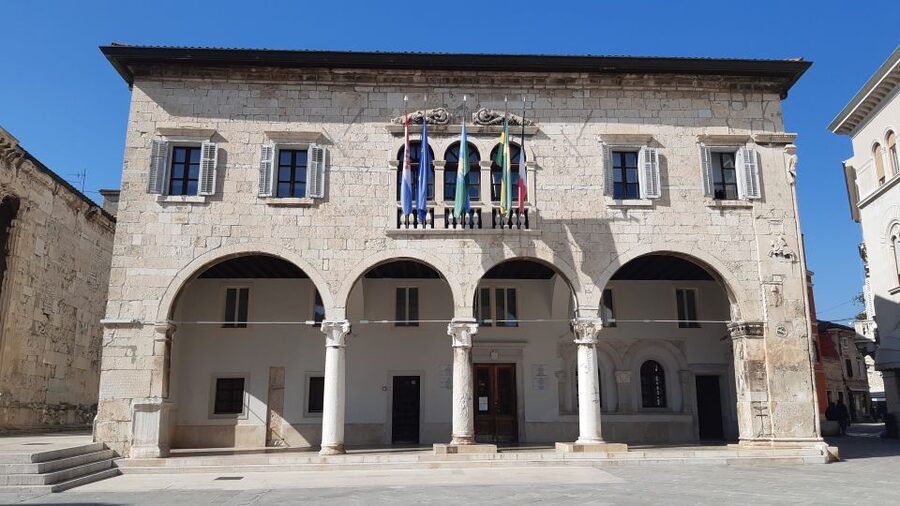
City Hall sits by the Forum, creating a useful visual conversation between ancient and later government. The Roman Forum was a place of public life in antiquity, while City Hall represents civic administration in a newer period. You do not need to know every date to appreciate the connection. The square lets you see how later Pula grew around the Roman core rather than replacing it completely.
Same streets, a different way to see them:
- Dubrovnik: Old Town Walking Tour
★ 4.8 · 5,174 reviews - Dubrovnik: The Original Game of Thrones Tour & Lokrum Option
★ 4.8 · 5,064 reviews - Split: Old Town and Diocletian Palace Walking Tour
★ 4.9 · 4,727 reviews - Dubrovnik Discovery Old Town Walking Tour
★ 5.0 · 4,458 reviews
Roman mosaics and the Arch of Sergii
Along the route, you see Roman mosaics and learn about traces of the ancient city that are less imposing than the Arena. This is where a guide adds real value. Large monuments announce themselves, but mosaics and fragments can disappear into the streetscape unless someone tells you what to look for.
The mosaics also make the Roman past feel more domestic. An amphitheater and temple speak of public life, power, and ceremony. A mosaic suggests homes, decoration, and everyday taste. That shift helps make ancient Pula feel like a lived-in city rather than a museum display.
The Arch of Sergii is another major stop. It gives the tour a strong architectural marker near the end of the Roman portion. Your guide explains its history and design, helping you read the arch as more than a photogenic gateway.
This section should suit you if you enjoy small discoveries as much as headline attractions. You will not spend the whole walk inside major monuments. Instead, the guide points out details across the city, including traces you might miss while following your map.
Pula Market and everyday city life
The route continues to Pula Market, established in the early 1900s. After temples, arches, and Roman remains, the market brings you back to the city’s daily rhythm. It is a useful stop because historic Pula is not only an archaeological site. People still shop, meet, work, and pass through the same central streets.
The market also broadens the tour beyond ancient history. You hear about local culture and the way the town functions in the present day. The contrast is welcome. A walk that included only Roman monuments could feel like a history lecture with pavement underfoot. The market gives it a more human scale.
Do not expect a long food tour or a dedicated shopping stop. The market is one part of a larger route, and the guide needs to keep moving toward the final monuments. If you want to browse stalls at length, return later on your own.
Finishing at the Gate of Hercules and Twin Gate
The final section heads toward the ancient Gate of Hercules and finishes at Twin Gate. These gates help you understand how people entered and moved through the old city. They are also a fitting close to a walk that has followed Pula from major public monuments to smaller traces and urban passages.
Ending at Twin Gate gives you a clear location for continuing your day. You can use the route as a mental map and return to any site that deserves more time. The tour does not finish where it begins, so plan your onward route rather than assuming you will be back at the Arena.
The finish also reflects the tour’s overall purpose. You are not simply taken to one attraction and returned to the same spot. You cross the historic center, see how its pieces relate, and finish with enough orientation to explore independently.
Is $20 good value for 90 minutes?
At $20 per person, I consider this a strong-value introduction to Pula. You get a local English-speaking guide and a route that includes most of the city’s major historic points. The price works especially well for first-time visitors who want context before deciding which monuments deserve paid admission or a longer visit.
The value comes from the number of stops and the guide’s interpretation. If you walked the same streets alone, you would still see the Arena, Forum, temple, arch, and gates. You would not automatically understand how Roman, Venetian, religious, civic, and modern layers connect.
There are limits. The price does not include entry tickets, and 90 minutes is not enough for lengthy visits inside every attraction. You are paying for the guided route and explanation, not an all-inclusive sightseeing pass.
I would also compare the price with your schedule. If you have only a short time in Pula, this tour makes sense because it covers the key center quickly. If you already know the city well or prefer to explore at your own pace, you may find the fixed route less useful.
Pace, language, and practical comfort
The tour is conducted in English with a live guide. The feedback attached to the experience repeatedly praises the guides’ English, humor, friendliness, and ability to answer questions. That matters because Roman sites can become a string of dates and names if the explanation is too formal.
Several comments describe the pace as leisurely or comfortable, but the route still covers a lot in 90 minutes. Wear shoes you can walk in, and expect streets, paved areas, and changes in level. The experience is specifically not suitable for people with mobility impairments.
Video recording is not allowed. You can still pay attention to the guide, take ordinary photographs where appropriate, and make notes if you want to remember names and dates. Since the tour runs rain or shine, check the forecast and dress for the conditions rather than assuming clear weather.
The meeting instructions are simple, but arrive with enough time to find the Arena entrance. Look for the blue card and umbrella. That is more useful than relying only on a general map pin.
Who should book this Pula tour?
I would recommend it most strongly to:
- First-time visitors who want a quick introduction to Pula
- History fans who want Roman monuments explained in context
- Cruise passengers or short-stay visitors with limited time
- People who prefer a local guide to a written guidebook
- Anyone deciding which paid sites to revisit afterward
- Visitors who enjoy questions, stories, and a relaxed walking pace
You may want another option if you need step-free access, dislike walking in poor weather, or want extended indoor visits. It is also not the best match if your main goal is shopping, food tasting, or a detailed archaeological study of one monument.
Should you book the Pula Historic Sites Guided Walking Tour?
Book it if you want the best quick orientation to Pula’s historic center at a modest price. The route packs in the Arena, castle, cathedral, Forum, Augustus Temple, City Hall, mosaics, Arch of Sergii, market, and ancient gates without taking up a full morning or afternoon.
I would especially choose it near the start of a Pula stay. The guide’s explanations can help you decide where to return, while the castle viewpoint and city route give you a useful sense of direction. Just remember that entry tickets cost extra, the walk runs in rain or shine, and the route is not suitable for people with mobility impairments.
For $20, this is a practical, focused walk with unusually broad coverage. Its strength is not luxury or lengthy access to monuments. Its strength is a good guide, a sensible route, and a clear introduction to a city where Roman and later history sit side by side.
FAQ
How long does the Pula walking tour last?
The tour lasts 90 minutes, or one and a half hours.
Where does the tour begin?
It begins at Istarska ul. 50, in front of the Amphitheater entrance. The guide will have a blue card around their neck and hold an umbrella.
Where does the tour finish?
The walk finishes at Twin Gate.
What language is the tour conducted in?
The live tour guide conducts the experience in English.
Are entry tickets included?
No. Entry tickets are not included in the $20 price.
Does the tour run in bad weather?
Yes. The tour takes place rain or shine. Video recording is not allowed, and the experience is not suitable for people with mobility impairments.
Just added around Croatia
- Split: Food Tasting Walking Tour★ 4.9 · 102 reviews
- Split: Local History and Culture 90-Minute Walking Tour★ 5.0 · 194 reviews
- Split: 1.5-Hour Walking Tour and Diocletian’s Palace★ 4.7 · 256 reviews
- Split: Diocletian Palace & Old Town Guided Walking Tour★ 4.7 · 882 reviews
- Split: Walking tour of Split with a ‘Magister’ of History★ 5.0 · 110 reviews
- Shipwreck – Blue Lagoon All Inclusive + Trogir Walking Tour★ 4.4 · 110 reviews
- Rovinj: Guided Walking Tour★ 4.8 · 113 reviews
- Pula: Historic Walking Tour with Local Guide & City Views★ 4.8 · 214 reviews
History Walking Tours, compared.
History and Hauntings of Salem Guided Walking Tour
Read our review →

Freedom Trail History Small Group Walking Tour
Read our review →
Historic Charleston Guided Sightseeing Walking Tour
Read our review →
Tapas Walking Tour with Food, Wine, and History
Read our review →
Savannah History and Haunts Candlelit Ghost Walking Tour
Read our review →
A History of Terror – Belfast City Centre Walking Tour
Read our review →Browse the lists this tour appears in