
Review · HISTORY WALKING TOURS
Pula: Historic Walking Tour with Local Guide & City Views
Ancient stones, local stories, and one very curious goat. This Pula walking tour connects the Roman Amphitheatre with the city’s old gates, market, and Forum, while a local guide adds the odd facts that make the ruins easier to remember. I especially like the focus on alternative city stories and the chance to shape the conversation around food, daily life, culture, or nature.
I also like that the tour stays small and personal, with a German-speaking licensed guide and a private-group option. The main consideration is that entrance fees are not included, so the advertised $29 price covers the walking tour rather than every sight along the route.
Key things to know before you book
- The Roman Amphitheatre is the starting point: You learn that Pula’s Arena had uses beyond gladiator contests.
- Three Roman gates remain in the city: The Twin, Hercules, and Sergii gates each reveal a different piece of Pula’s ancient past.
- The farmer’s market adds everyday Istria: This is where the tour shifts from monuments to local food and ordinary life.
- The Forum links Roman and Venetian Pula: You see the August Temple and Venetian city hall in the same central square.
- The tour is designed around conversation: Marina can focus on local customs, cuisine, nature, culture, or other interests.
- German is the tour language: The experience lasts about 90 minutes to two hours, with wheelchair access and private groups available.
Starting beneath Pula’s Amphitheatre
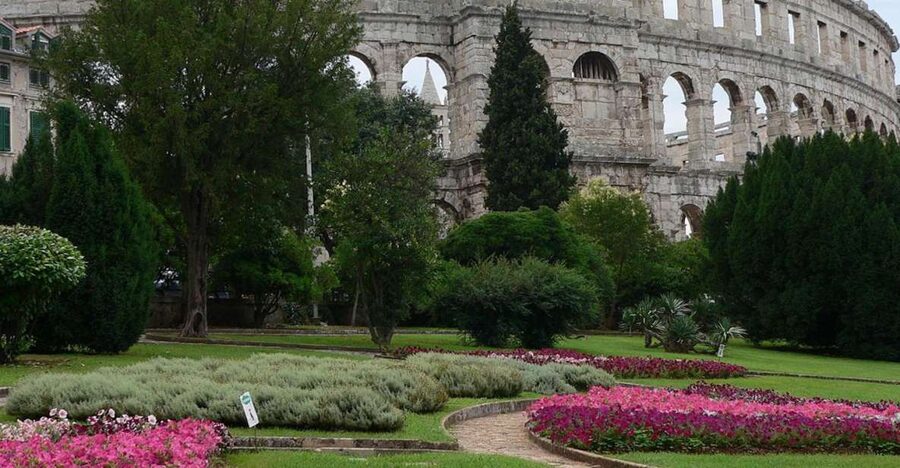
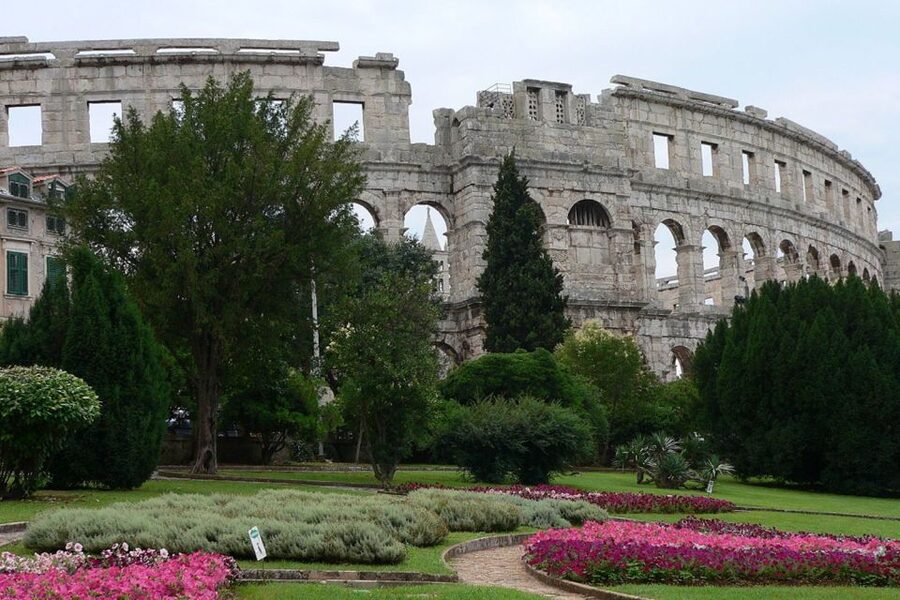
Meet at the entrance to the Arena, under the wooden roof. This is an easy place to recognize because Pula’s Roman Amphitheatre dominates the city and serves as the natural front door to its old center.
The opening stop gives your guide a strong setting for explaining Pula’s Roman past. You will hear what the building was made for and how its role reached beyond gladiator games. That wider explanation matters. If you only see the Arena as a place for combat shows, you miss how closely it was tied to the social and public life of the city.
Marina has worked as a licensed guide in Istria for more than 18 years. Her stated specialty is German-speaking visitors, and the tour is presented as a personal city walk rather than a fixed speech delivered at every corner. That distinction can make a real difference when you want to ask why something matters, rather than simply collect dates.
The Arena itself is the obvious visual high point, but it is not necessarily a full interior visit. Entrance fees are separate. In one recent experience, the group was able to choose whether to enter, so you should clarify that option with your guide if seeing the inside is important to you. At $29 per person, the price is easier to judge as a guided orientation tour, not as a bundled sightseeing ticket.
More History Walking Tours in Croatia
- Dubrovnik Old Town History Walking Tour
★ 5.0 · 1,684 reviews - Dubrovnik: Ancient City Walls & Wars Walking Tour
★ 5.0 · 1,270 reviews - Zagreb: City & History Walking Tour & WW2 Tunnels
★ 4.9 · 1,202 reviews
Looking beyond gladiators at the Arena
The Amphitheatre is usually the place where Pula first grabs your attention. Its scale is hard to miss, but a good explanation helps you look past the giant stone walls and ask practical questions: Why was it built here? Who used it? What happened around the contests?
This tour promises that broader context. You are not limited to a quick photo stop and a sentence about gladiators. The guide can explain the building’s other functions and place it within the changing life of Pula.
That is one of the tour’s strongest features. The city has been claimed and shaped by several cultures over many centuries, and the Arena gives you a clear way to begin sorting those layers. You start with Roman Pula, then walk into a town where later buildings and public spaces tell a different part of the story.
If you choose to enter, allow for the possibility that the walk may take longer than the basic 90-minute schedule. The stated duration is 90 minutes to two hours, and the final length will depend on the pace, questions, and whether the group adds an admission visit.
Following the Roman gates through the old city
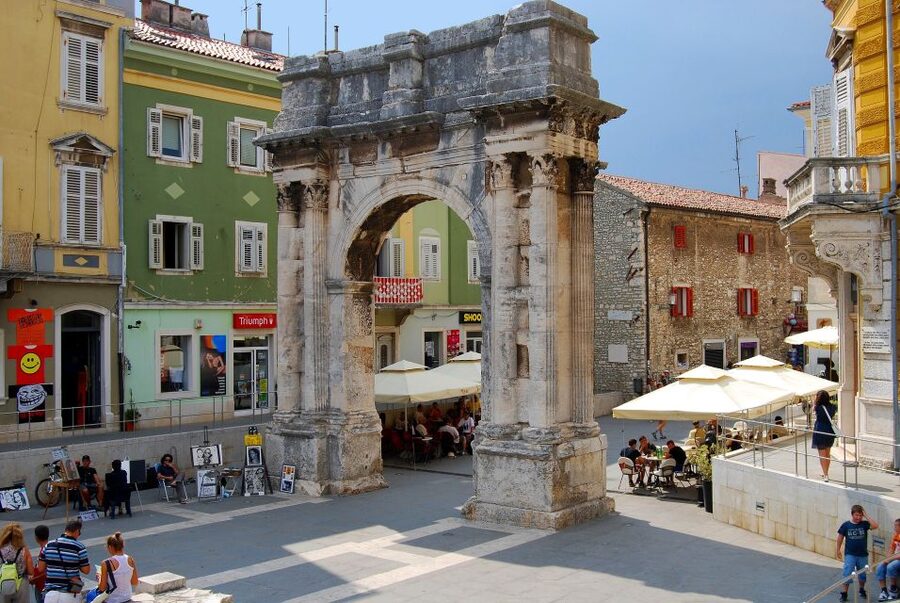
From the Arena, the route naturally leads toward other ancient parts of Pula. Three Roman gates remain: the Twin Gate, Hercules Gate, and Sergii Gate. These are not just decorative fragments to photograph. Their surviving details give the guide a chance to show how people entered and moved through the old city.
The Twin Gate is one of the places where the name itself helps you notice the structure. The Hercules Gate has its own story and preserved details, while the Sergii Gate gives you another view of Roman public architecture. The value here is not simply seeing three old entrances in a row. It is learning to read small clues in stone, shape, and decoration.
I like this part of the walk because it keeps the ancient remains connected to the streets you are actually using. You are not isolated in a museum display. You are moving through the city, with Roman traces appearing among later buildings and modern daily activity.
The guide’s role is especially useful at stops like these. Without context, an old gate can become another background for a photograph. With explanation, it becomes evidence of how the city was planned and how its identity changed over time.
A local pause at Pula’s farmer’s market
The farmer’s market brings the tour down from grand monuments to the practical side of Istria. This is where local people buy and sell products from the surrounding soil, and it gives you a look at food as part of the city’s routine rather than as a staged tasting.
Marina describes herself as a passionate cook and a person who cares about local cuisine. That makes the market a particularly good fit for anyone who wants more than architecture. You can ask about native ingredients, local habits, and the foods that belong on an Istrian table.
The market also helps explain why this tour is not only an ancient-history walk. Pula is presented through its food, people, city streets, and regional customs. If you like to connect a destination with what people eat and buy, this stop should be one of the most useful parts of the route.
There is one practical limit. The tour information does not promise tastings or included food. Think of the market as a place for explanation and observation, not a guaranteed meal or food workshop. If you want specific recommendations for local dishes or places to eat, ask the guide directly. The experience is designed to make that kind of conversation possible.
Same streets, a different way to see them:
- Dubrovnik: Old Town Walking Tour
★ 4.8 · 5,174 reviews - Dubrovnik: The Original Game of Thrones Tour & Lokrum Option
★ 4.8 · 5,064 reviews - Split: Old Town and Diocletian Palace Walking Tour
★ 4.9 · 4,727 reviews - Dubrovnik Discovery Old Town Walking Tour
★ 5.0 · 4,458 reviews
Understanding the Forum and its Roman center
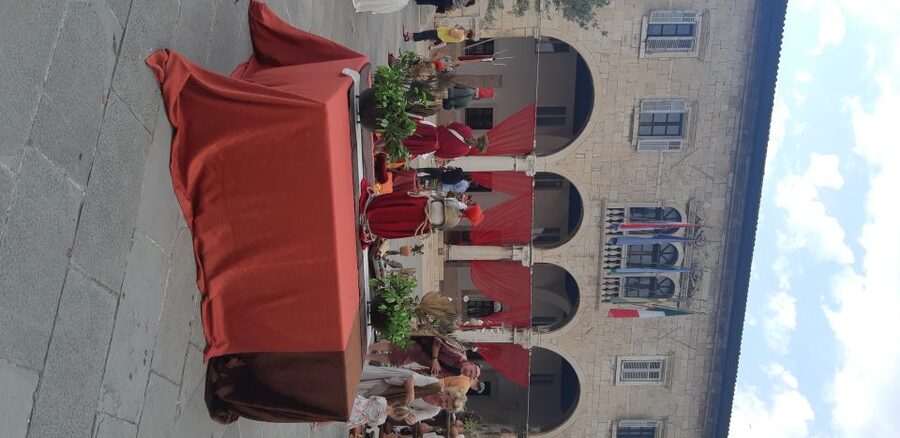
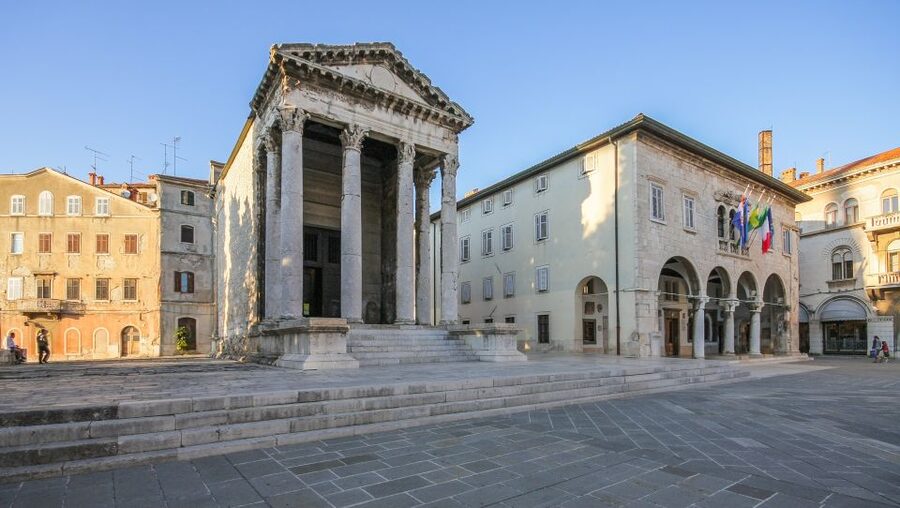
The route continues to Forum Square, the heart of ancient Pula. The guide compares the Roman Forum with the farmer’s market, which is a helpful idea because it shows the square as more than a collection of ruins. It was a central place for public activity, trade, and city life.
Here you can see the remains of the August Temple. The surviving structure gives the guide another chance to explain Roman religious and civic life without turning the tour into a list of emperors and dates.
You will also admire Pula’s Venetian city hall. Having the August Temple and Venetian government architecture in the same square makes the city’s long succession of rulers visible in one glance. Rome is not the only story here. Venetian influence is part of what gives central Pula its particular character.
The goat on the regional flag is another small but memorable detail tied to this stop. It is exactly the kind of fact that can make a walking tour stick in your mind. You leave with a simple image and a question answered, rather than a vague sense that you saw some old buildings.
What the guiding style adds
The experience is built around a personalized walk. You can focus on local lifestyle, culture, nature, food, or the subjects that interest your group most. That flexibility is valuable if you have already visited major Roman sites or if you want your first hour in Pula to help you decide what deserves more time.
The tour language is German. This is important to confirm before booking if anyone in your group needs another language. Marina is specifically experienced with German-speaking visitors, and the published experience lists German as the available language.
The feedback associated with the tour places strong emphasis on clear explanations, useful answers, and a lively pace. One group of seven, including a young child, found the walk enjoyable and manageable. Another group described the tour as informative and entertaining, with the guide giving them the choice about visiting the Arena.
The name Veronika also appears in direct tour feedback, while the main description introduces Marina. That suggests you may not always have the same guide, so check the assigned guide when you book if Marina specifically is important to you. Either way, the qualities to look for are clear German explanations, time for questions, and a willingness to adapt the route to your interests.
How long the walk takes and who will enjoy it
The official duration is 90 minutes to two hours. That is a useful range for a port stop, a first afternoon in Pula, or a short city visit when you want orientation without giving up half the day.
The shorter timing should suit you if you want the key sights, a clear introduction, and a few strong stories. The longer timing may appeal more if you ask questions, discuss food and local life, or add an Arena visit.
The walk is wheelchair accessible, which makes it a practical option for many visitors. Still, the route passes through old city streets, and the exact ease of movement can depend on the selected path and any interior access. If you use a wheelchair, confirm the route details before setting out, especially if you hope to enter the Amphitheatre.
Families can also consider it. The direct feedback from a group with a friendly young child suggests that the guide can keep the experience comfortable for a small family group. The mix of gates, an enormous arena, a market, and the goat story gives children more to notice than a lecture focused only on dates.
Private groups are available. That option is worth considering if you want to ask many questions, keep a slower pace, or build the walk around food and local customs. A private format can also help if your group has mixed interests.
Is $29 a fair price?
At $29 per person, this is reasonably priced for a 90-minute to two-hour guided introduction, especially if you value personal explanation over simply walking between landmarks with a phone guide.
The price includes the local walking guide, but not entrance fees. That is the main point to keep in mind. If you only want an exterior tour, the cost gives you a focused route through the Arena area, Roman gates, market, and Forum. If you want to enter the Amphitheatre, budget for that separately.
The value also depends on how much you use the flexible format. If you ask about Istrian food, local customs, and the city’s mixed past, you get more than a monument checklist. If you prefer to explore silently at your own speed, the price may feel less attractive.
A 4.8 rating from 214 reviews supports the impression that the guiding and explanations are the main strengths. The highest praise centers on the guide’s information, friendly manner, willingness to answer questions, and ability to keep the tour interesting. Those are the qualities that justify paying for a person rather than following a free map.
Small details that can improve your visit
Arrive ready to begin at the Arena entrance under the wooden roof. That meeting point is specific, but the Amphitheatre has several sides, so allow a little time to locate the correct entrance.
Wear comfortable shoes. The walk is not long by touring standards, but you will be moving through old streets and stopping at several sites. You will get more from the tour if you can pay attention to the explanation instead of worrying about your feet.
Bring questions. This experience is especially well suited to people who want to discuss local food, daily life, culture, or nature. A quiet group can still enjoy it, but the personalized format has more value when you take part.
If entering the Arena matters to you, ask about the plan before the tour begins. Admission is not included, and one group was able to decide whether to visit inside. Clear communication will help you understand the final timing and cost.
The cancellation policy is forgiving: you can cancel up to 24 hours in advance for a full refund. You can also reserve now and pay later, which is useful when your Pula schedule depends on changing travel plans.
Should you book the Pula walking tour?
Book this tour if you want a short, personal introduction to Pula with a clear German-speaking guide. It is a good match for first-time visitors, families, food-minded visitors, and anyone who wants Roman ruins explained alongside Venetian buildings and present-day local life.
I would especially choose it if you want to ask questions. The strongest part of the experience is not simply the route. It is the chance to connect the Arena, Roman gates, market, Forum, August Temple, city hall, and regional goat story into one understandable picture.
Think twice if you want a long archaeological tour, guaranteed interior admission, or a multilingual experience. The entrance fee is extra, the listed language is German, and the walk is an introduction rather than a full-day study of Pula.
For most visitors, $29 is a sensible price for a flexible orientation with a local guide. You see the city’s major historic touchpoints, hear the unusual details that make them memorable, and finish with a better sense of what to explore on your own.
FAQ
How long does the Pula walking tour last?
The tour lasts between 90 minutes and two hours. The exact length can depend on the starting time, questions, pace, and whether you visit inside the Amphitheatre.
Where does the tour meet?
The meeting point is at the entrance to Pula’s Arena, under the wooden roof.
Is admission to the Amphitheatre included?
No. Entrance fees are not included in the tour price. One group was able to choose whether to visit inside, so ask the guide about the current arrangement if this matters to you.
What language is the tour offered in?
The listed tour language is German. Marina is a licensed Istrian guide who specializes in German-speaking visitors.
Is the tour wheelchair accessible?
Yes, the activity is listed as wheelchair accessible.
Can I book a private group?
Yes. A private-group option is available. The tour can also be adapted around interests such as local lifestyle, culture, nature, or food.
Just added around Croatia
- Split: Food Tasting Walking Tour★ 4.9 · 102 reviews
- Split: Local History and Culture 90-Minute Walking Tour★ 5.0 · 194 reviews
- Split: 1.5-Hour Walking Tour and Diocletian’s Palace★ 4.7 · 256 reviews
- Split: Diocletian Palace & Old Town Guided Walking Tour★ 4.7 · 882 reviews
- Split: Walking tour of Split with a ‘Magister’ of History★ 5.0 · 110 reviews
- Shipwreck – Blue Lagoon All Inclusive + Trogir Walking Tour★ 4.4 · 110 reviews
- Rovinj: Guided Walking Tour★ 4.8 · 113 reviews
- Pula: Historic Sites Guided Walking Tour★ 4.8 · 78 reviews
History Walking Tours, compared.
History and Hauntings of Salem Guided Walking Tour
Read our review →

Freedom Trail History Small Group Walking Tour
Read our review →
Historic Charleston Guided Sightseeing Walking Tour
Read our review →
Tapas Walking Tour with Food, Wine, and History
Read our review →
Savannah History and Haunts Candlelit Ghost Walking Tour
Read our review →
A History of Terror – Belfast City Centre Walking Tour
Read our review →Browse the lists this tour appears in