
Review · HISTORY WALKING TOURS
Split: Walking tour of Split with a ‘Magister’ of History
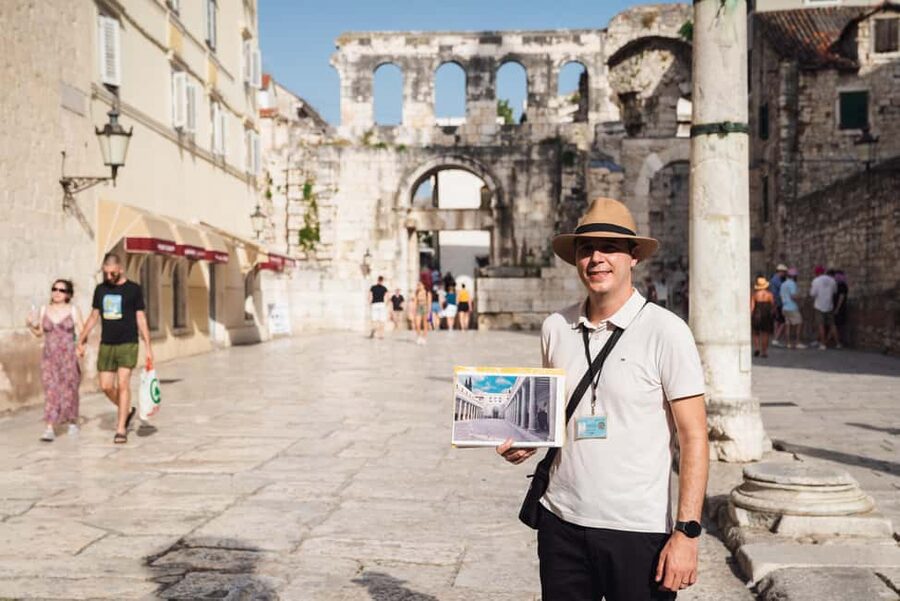
Split’s stones still serve daily life. This 110-minute walk pairs you with Toni Šare, a local historian and former teacher, for a clear look at Diocletian’s Palace and the city built inside it. I like the way the tour moves from Roman times through the medieval and Venetian periods to modern Split, rather than treating the palace as a frozen ruin. I also like the hand-held 3D reconstructions, which show what the damaged and altered buildings may once have looked like.
The main consideration is that this is a history-led tour, not a ticketed museum visit. You will see and discuss the Cathedral, Jupiter’s Temple, the cellars, and other major sights, but you will not enter paid sites or museums. The route is also on foot, takes place rain or shine, and is not suitable for wheelchair users.
Key points to know before you book
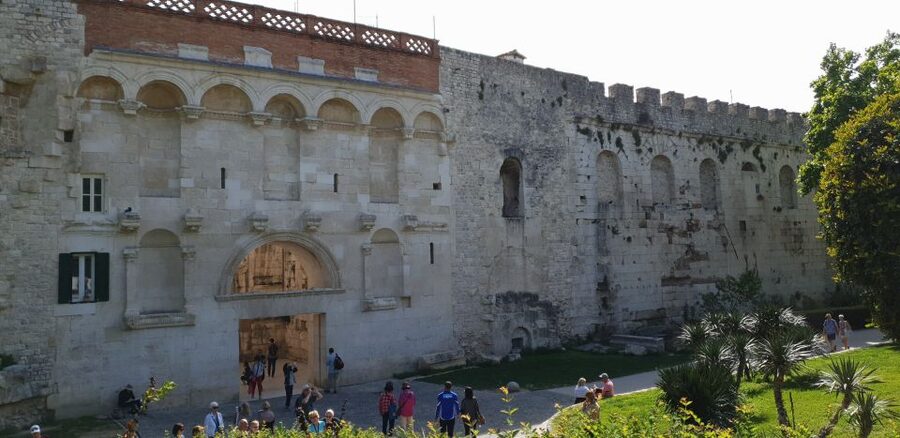
- Toni Šare is a local historian and former teacher: His lifelong connection to Split gives the tour a personal, classroom-style feel.
- The route follows the city’s layers: You begin with Roman Split, then move through medieval, Venetian, and modern periods.
- 3D images make the ruins easier to understand: Toni uses visual reconstructions to show how key buildings may have appeared in antiquity.
- Questions are part of the format: This is built around conversation, so you can ask about architecture, politics, daily life, or more recent Croatian history.
- The price is $33 per person: That is fair for a focused, expert-led walk, especially if you want context before exploring Split on your own.
- The first time slot is a smart choice: Split’s old core can become much more crowded as the day goes on.
Why Diocletian’s Palace is the right place to begin
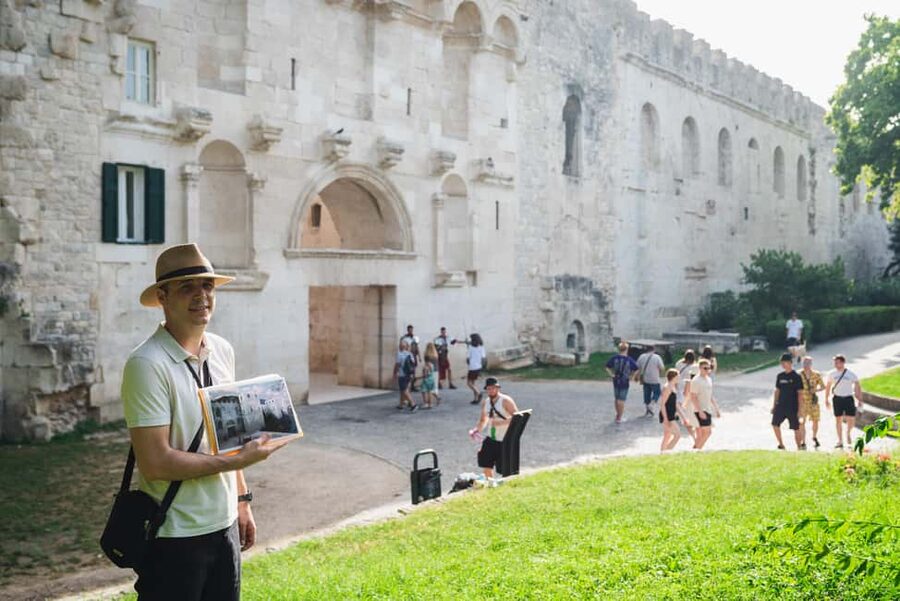
Split does not keep its Roman past behind a fence. It lives inside it.
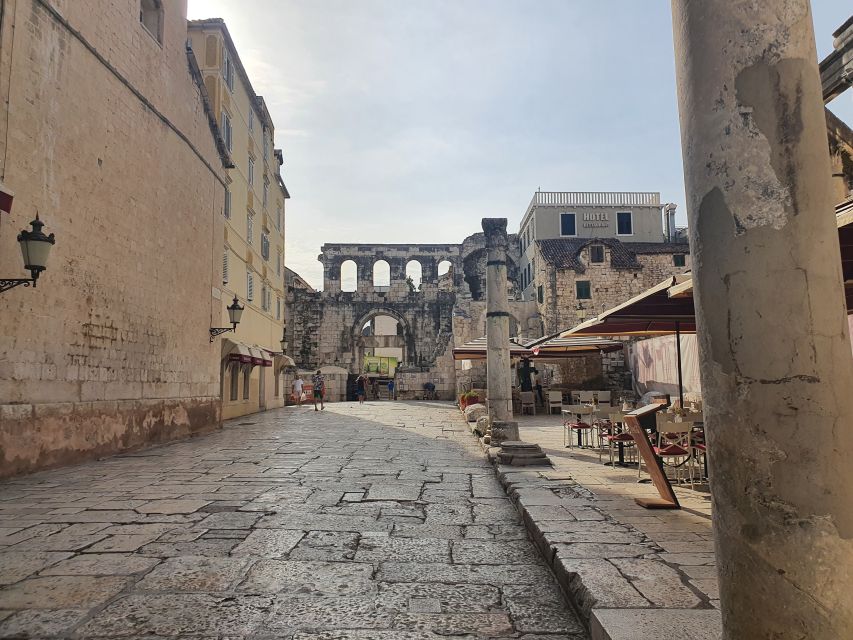
Homes, shops, cafés, narrow lanes, and public squares occupy the old palace complex. The result can be confusing at first. You are not simply walking through a preserved imperial residence. You are walking through a city that grew within, around, and over Roman walls for centuries.
That is why this tour is useful early in a Split visit. Toni gives you a map of the old core, both physically and historically. Once you understand the palace plan, the city becomes easier to read.
The meeting point is by the Bronze Gate, at the southern seaside entrance from the Riva Promenade. Use the address Obala Hrvatskog narodnog preporoda 22 if you need a precise location. The simplest approach is to find the Riva first, then walk along the waterfront toward the palace entrance.
From there, the tour moves inward through the Bronze Gate and into the Roman complex. I like this starting point because it gives you a natural transition from modern Split into the older city. You leave the waterfront behind and begin tracing the structure of the imperial residence.
More History Walking Tours in Croatia
- Walking Tour of Split with a ‘Magister’ of History
★ 5.0 · 1,122 reviews - Split Walking Tour with Professor of History
★ 5.0 · 926 reviews - Split: History and Heritage Walking Tour
★ 4.9 · 650 reviews
The Bronze Gate and Diocletian’s Cellars
The Bronze Gate is one of the four main entrances to Diocletian’s Palace. It faces the sea and once served as a practical access point rather than a grand ceremonial approach.
Toni uses the entrance to explain the basic design of the palace. That foundation matters. Without it, the old center can feel like a collection of unrelated walls and doorways.
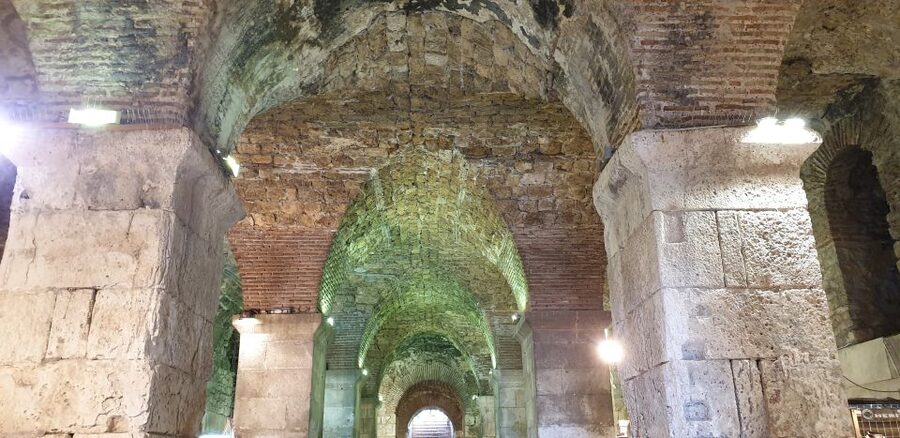
The route then passes by Diocletian’s Cellars, with about ten minutes devoted to the area. These underground halls are among the clearest places to understand the original palace layout. They helped support the upper level, and their preserved form gives you a useful idea of the scale and engineering of the Roman building.
You do not need a separate admission ticket to enter Diocletian’s Palace itself. However, this tour does not include entry to paid parts or museums. That distinction is important. You get an outdoor walk and explanations of the main sites, but this is not a full museum admission package.
The cellars also offer one of the tour’s best teaching moments. Toni uses the remains to show how the palace worked as a whole, not merely as a collection of ancient fragments. His background as a history teacher is especially useful here, since he focuses on connections and causes rather than simply listing dates.
Peristyle, the palace’s great public room
The route’s central stop is the Peristyle, the open square at the heart of the palace.
This is where the Roman design becomes most legible. Tall columns, stone walls, and later additions frame a space that once had a formal imperial purpose. Today, it is also one of Split’s most photographed places, which means the setting can be busy.
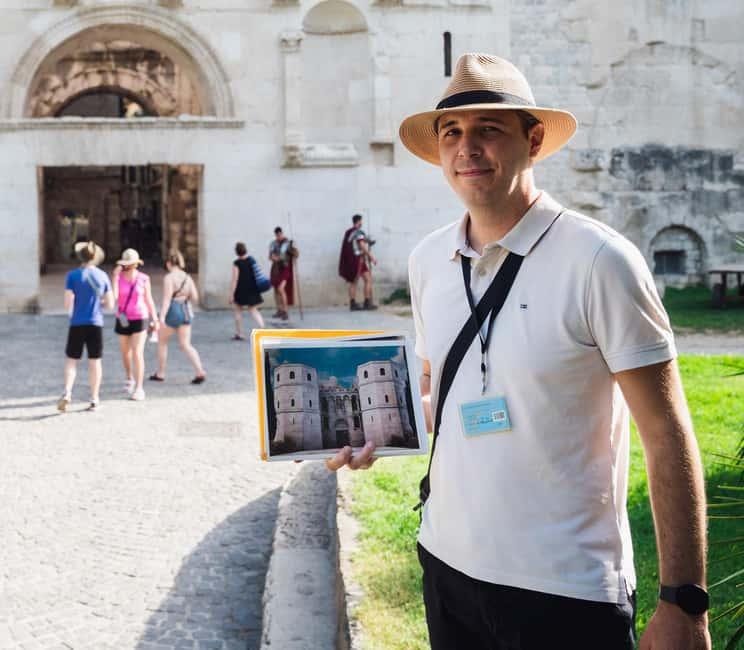
Toni’s 3D reconstructions help solve a common problem: ancient ruins often show you what survived, but not what was lost. A visual reconstruction can show the full height, decoration, roofline, and relationship between structures. It gives you something to compare with the stones in front of you.
I especially like this approach for visitors who do not usually spend much time studying archaeology. You do not need specialist knowledge to follow the explanation. The images provide a simple before-and-after view, while Toni explains what is certain, what is reconstructed, and what remains open to interpretation.
The Peristyle is also where the tour brings Roman power into focus. Diocletian was not simply building a comfortable retirement home. The scale and ceremonial design communicated status. Toni connects the architecture to the emperor’s role and to the way later generations reused the site.
The Vestibule, Triklinij, and the emperor’s private quarters
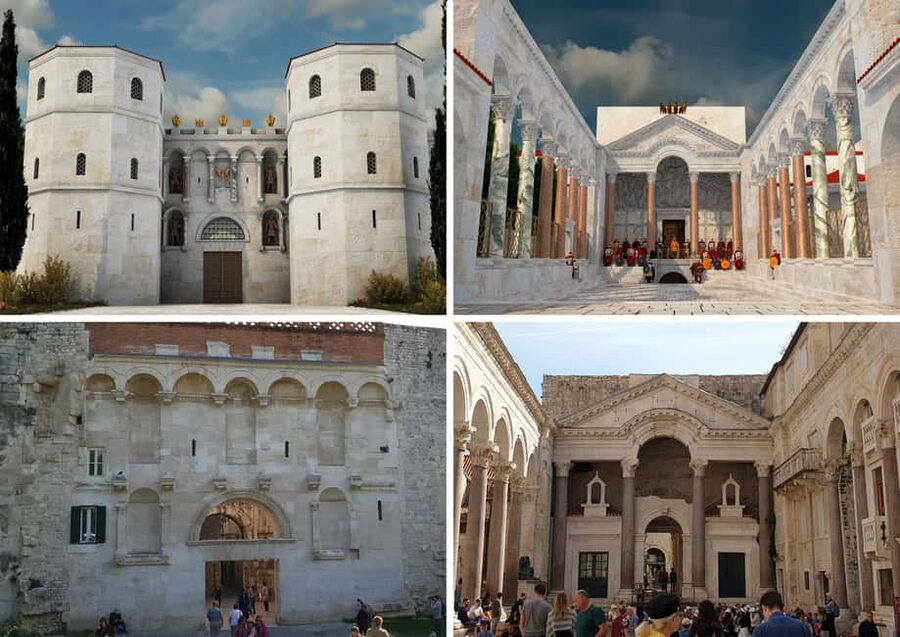
From the Peristyle, the walk continues to the Vestibule. This circular space once formed part of the approach to the emperor’s private residence.
The Vestibule is a good example of how much has changed while the basic structure remains visible. Toni explains its original purpose and helps you picture how people would have moved through the palace. The stop is brief, around five minutes, but it adds an important piece to the palace plan.
The tour also includes Triklinij, another remnant connected with the imperial residence. The name refers to a dining room, and the site helps shift the story from public ceremony to private life.
This is one of the tour’s strengths. You do not only hear about emperors and major events. You also get a sense of how the palace functioned as a place of residence, administration, ceremony, and everyday activity.
You then pass through preserved medieval houses and remains of the private quarters. These later buildings are not distractions from the Roman story. They are evidence of how Split adapted the old palace instead of abandoning it.
That layering is central to the experience. Roman walls became part of a medieval town. Medieval homes later sat beside Venetian additions. Modern life now uses the same narrow streets. Toni’s explanation helps you see the old core as a living city with several eras sharing one address.
More History Walking Tours in Split:
- Split: Local History and Culture 90-Minute Walking Tour
★ 5.0 · 194 reviews - History and Hauntings of Salem Guided Walking Tour
★ 5.0 · 14,564 reviews - Lisbon: History, Stories and Lifestyle Walking Tour
★ 4.8 · 10,902 reviews - Boston: Freedom Trail History Small Group Walking Tour
★ 5.0 · 6,450 reviews
Saint Domnius and Jupiter’s Temple
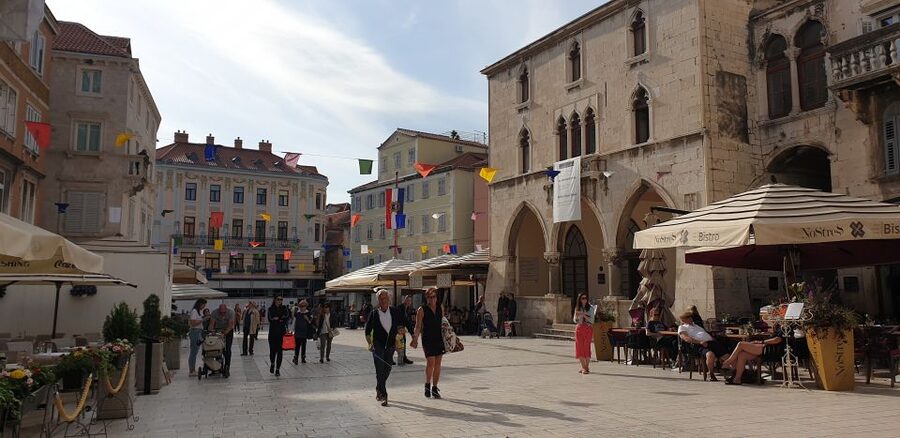
The Cathedral of Saint Domnius appears along the route, with about five minutes spent passing by and discussing the site.
The building is especially important because it occupies the former mausoleum of Diocletian. The shift from imperial tomb to Christian cathedral tells you a great deal about the changes that took place inside the palace after the Roman period.
You do not enter the cathedral as part of this experience, so you should think of this stop as an outside explanation rather than a full church visit. If you want to see the interior or climb other paid attractions later, you will need to arrange that separately.
Jupiter’s Temple is also passed by. It was part of the Roman religious center, and Toni explains its place within the palace complex. Again, the value is less about spending a long time at one monument and more about understanding how the individual buildings worked together.
The tour’s pace is designed to cover many layers in under two hours. That is efficient, but it also means you should not expect extended time at every location. If you prefer a slow architectural study of one monument, a longer specialist tour may suit you better.
Silver Gate, Golden Gate, and the medieval city
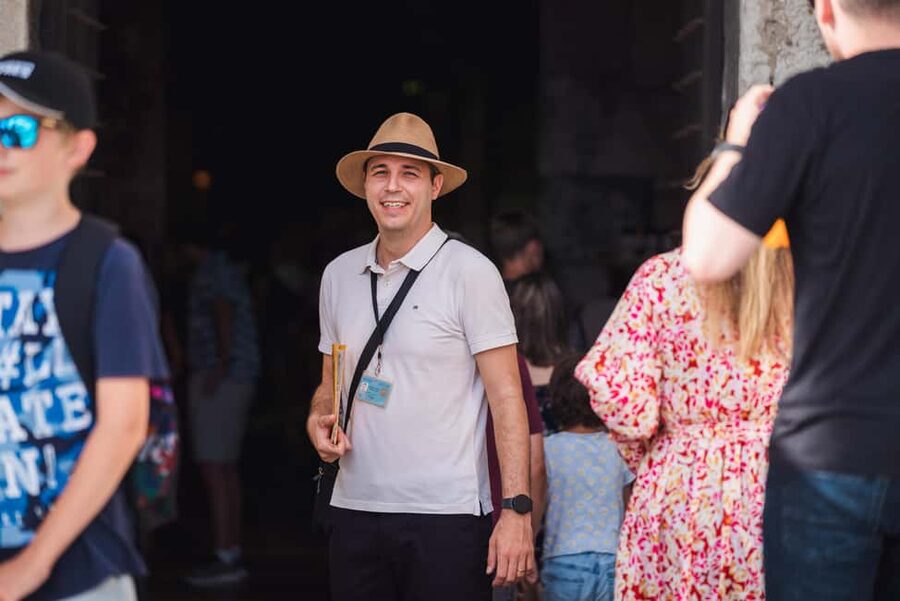
The Silver Gate receives a short guided stop before the route continues toward the Golden Gate.
These entrances help you understand the palace as a fortified complex. Each gate faced a different direction, and their positions show how the original site connected with the surrounding area.
The Golden Gate is the final stop. It is the largest and most imposing of the palace entrances, and it leads you toward the northern side of the old core.
Near the north wall, you can see the statue of Bishop Gregory of Nin. This well-known figure gives the final part of the walk a distinctly Croatian and medieval focus. The route then finishes at the Golden Gate, where you can continue exploring Piazza Square and the nearby streets on your own.
Ending here is practical. You finish in a central part of the old town, not back at the waterfront. Toni can also give you a better sense of what to explore next, and one past participant received suggestions by WhatsApp before the tour. That sort of local contact can be useful if you are trying to plan the rest of your time in Split.
Toni’s teaching style and the value of local knowledge
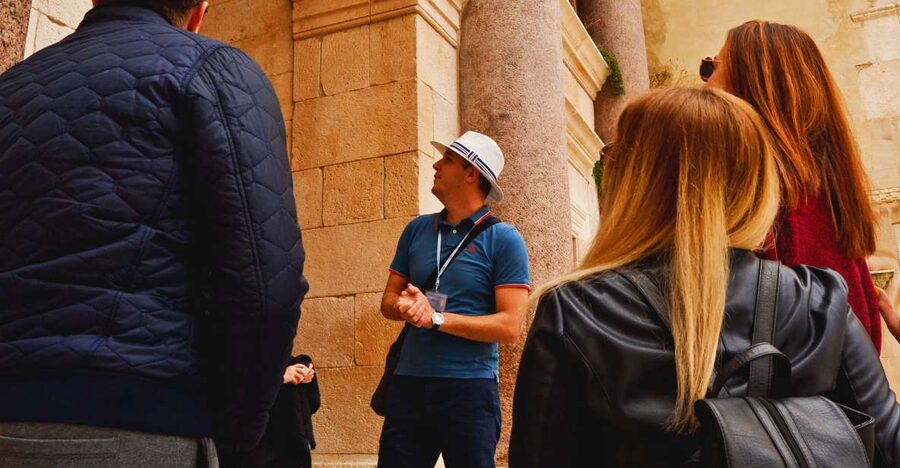
The strongest reason to book this walk is Toni himself.
He holds a Master’s degree in history, worked as a teacher, and was born and raised in Split. Those details shape the experience. He does not simply recite a prepared list of dates. He explains why the palace mattered, how the city changed, and what those changes mean for Split today.
The format encourages questions, which makes a difference. You can ask about Roman customs, medieval buildings, Venetian influence, Croatian history, or more recent events. Toni has also been praised for being open about what is firmly established and what is uncertain. That is a good habit in a historic site, where attractive legends can easily blur with evidence.
His local perspective adds another layer. You are not only hearing about architecture from a textbook. You are hearing about the city from someone who has lived there all his life and has watched it change.
The tone is serious but not stiff. The feedback consistently describes Toni as friendly, funny, patient, enthusiastic, and easy to understand. Families can also find the format approachable. A 12-year-old was said to enjoy the walk, which suggests the teaching style is accessible beyond an adult history audience.
The 3D reconstructions are more than a visual extra
Many old-city tours point at ruins and ask you to imagine the original structure. That can be a tall order, especially when walls have been reused or buildings have disappeared.
Toni brings printed 3D images showing how parts of the palace may have looked in Roman times. These visual aids are one of the most distinctive parts of the experience.
They help you compare the present-day remains with the original palace plan. You can see how a damaged structure fitted into the larger complex and how later construction altered the appearance.
The images do not replace the real site. They make it easier to interpret. I see them as particularly useful for first-time visitors, children, and anyone who finds architectural history hard to picture from words alone.
They also give the tour a personal touch. The visualizations were created for this experience rather than added as a generic screen presentation. That extra effort helps explain why the walk can feel more considered than a basic route around the main sights.
Is $33 a fair price?
At $33 per person, this is not the cheapest way to walk through Split. You can enter the public streets of the old core without paying for a tour.
The question is what you want from your time. If you simply want to take photographs and wander, you can explore independently. If you want the palace explained in a logical order, with Roman, medieval, Venetian, and modern context, the price is reasonable.
You are paying for 110 minutes with a trained historian, a former teacher, a local guide, and custom visual material. The tour also saves you from trying to work out the palace plan by yourself.
The value is strongest for a first visit, especially if Split is part of a short Croatian itinerary. A clear introduction can make the rest of the city easier to enjoy. You will recognize the gates, notice reused walls, and understand why modern homes sit inside an ancient imperial complex.
The value is less clear if you have already spent several days studying the palace or plan to visit several paid museums with a specialist guide. In that case, you may prefer a shorter orientation or independent exploration.
Timing, comfort, and practical planning
The walk lasts 110 minutes and is conducted in English. Wear comfortable shoes and bring a drink. The route is outdoors and takes place rain or shine, so check the forecast and bring suitable protection.
Summer heat and crowd levels can affect the experience. An early start is a smart choice. The first time slot can give you cooler conditions and fewer people in the narrow old-town spaces. One particularly useful detail from the feedback is that the crowds had grown noticeably by the end of a later visit.
Toni makes an effort to use shade and quieter areas when possible, but he cannot control the weather or the number of people in the palace. You should still expect an active walking tour through stone streets and busy public spaces.
The experience is not suitable for wheelchair users. It is also listed as unsuitable for people over 95. Food and drinks are not included, so plan to eat before or after the walk.
You can cancel up to 24 hours before the start for a full refund, and the reserve-now, pay-later option keeps your plans flexible.
Who should book this Split walking tour?
I would choose this tour if you want more than a quick introduction to Diocletian’s Palace. It is a strong fit for:
- First-time visitors to Split
- People who enjoy Roman and medieval history
- Families who want an accessible educational walk
- Visitors who like asking questions rather than listening to a fixed script
- Anyone who wants local context about Croatia and modern Split
- Travelers who find ruins difficult to picture without visual help
You may want something else if you need wheelchair access, want to enter paid monuments, or prefer a very short and casual stroll. The tour covers a lot in 110 minutes, so it favors explanation and context over long stops inside individual buildings.
Should you book it?
Yes, if you want to understand why Split feels like a city built inside an ancient palace.
Toni Šare’s history training, teaching background, local roots, and custom 3D images give this walk real substance. The route covers the Bronze Gate, cellars, Peristyle, Vestibule, Triklinij, Saint Domnius, Jupiter’s Temple, Silver Gate, and Golden Gate, while explaining how Roman, medieval, Venetian, and modern Split overlap.
Book an early time if you can. Bring water, wear shoes suited to old stone streets, and expect a guided history walk rather than admission to museums. At $33, it is best value for visitors who want a clear foundation before exploring the old town on their own.
FAQ
Where does the tour begin?
It begins at the Bronze Gate, also called the Brass Gate, on the seafront side of Diocletian’s Palace. The address is Obala Hrvatskog narodnog preporoda 22, near the Riva Promenade.
Where does the tour finish?
The walk finishes at the Golden Gate of Diocletian’s Palace.
How long does the tour last?
The tour lasts 110 minutes.
What language is the tour in?
The live tour guide speaks English.
Who leads the tour?
The guide is Toni Šare, a local historian with a Master’s degree in history and a background as a teacher. He was born and has lived his entire life in Split.
Does the tour include entry to paid sites?
No. The tour does not enter paid sites or museums. Entry into the general Diocletian’s Palace area does not require admission.
Are food and drinks included?
No. Food and drinks are not included. You should bring a drink with you.
Does the tour operate in bad weather?
Yes. The tour takes place rain or shine.
Is the tour suitable for wheelchair users?
No. The experience is not suitable for wheelchair users. It is also not suitable for people over 95 years old.
Just added around Split
- Split: Food Tasting Walking Tour★ 4.9 · 102 reviews
- Split: Local History and Culture 90-Minute Walking Tour★ 5.0 · 194 reviews
- Split: 1.5-Hour Walking Tour and Diocletian’s Palace★ 4.7 · 256 reviews
- Split: Diocletian Palace & Old Town Guided Walking Tour★ 4.7 · 882 reviews
- From Split: Krka Waterfalls Cruise & Trogir Walking Tour★ 4.7 · 681 reviews
- Split: History and Heritage Walking Tour★ 4.9 · 650 reviews
- Diocletian’s Palace and Old Town SMALL GROUP Walking Tour★ 5.0 · 502 reviews
- Split: City Walking Tour w/ Game of Thrones Locations★ 4.9 · 318 reviews
History Walking Tours, compared.

History and Hauntings of Salem Guided Walking Tour
Read our review →

Freedom Trail History Small Group Walking Tour
Read our review →
Historic Charleston Guided Sightseeing Walking Tour
Read our review →
Tapas Walking Tour with Food, Wine, and History
Read our review →
Savannah History and Haunts Candlelit Ghost Walking Tour
Read our review →
A History of Terror – Belfast City Centre Walking Tour
Read our review →Browse the lists this tour appears in