
Review · BERLIN WALKING TOURS
Berlin’s Best: 2 Hour Walking Tour Third Reich and the Cold War
Berlin’s hardest stories are close together. This two-hour walk links Nazi and Cold War sites in a compact route, from Brandenburg Gate to Checkpoint Charlie, with the city’s streets providing the setting. I like the strong mix of major landmarks and difficult history, and I like that a guide can show old photographs and explain what happened where you are standing. The main drawback is simple: you spend two hours outdoors, often stopping on exposed streets, so cold or wet weather can affect the experience.
The tour costs $24.07 per person, a fair price for an English-speaking walk that covers this much ground. Guides such as Glen, Maggie, James, Mikey, Tom, Mikhail, Peter F., and Georgia have been praised for clear explanations, good pacing, thoughtful humor, and patience with questions. Still, this is a brisk overview, not a full museum visit, and the serious subject matter may feel heavy for some families.
Key points to know before you book
- A compact route through 100 years of Berlin history: You move from imperial Germany and the Nazi dictatorship to the division of Berlin and reunification.
- The walk ends at Checkpoint Charlie: This gives you a useful place to continue exploring after the tour.
- Historical photographs may add real context: Guides including Glen and Mikhail have used old images to help you compare past and present views.
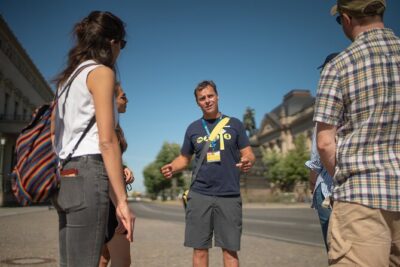
- The meeting point is easy to spot: Look for the guide with the pink umbrella outside the Tourist Information office at Brandenburg Gate.
- Cold-weather preparation matters: Sensible shoes, gloves, warm clothing, and a restroom stop before arrival will make the two hours easier.
- The group can reach up to 30 people: That is manageable, though a larger group may make questions and hearing the guide more difficult.
Brandenburg Gate sets the tone
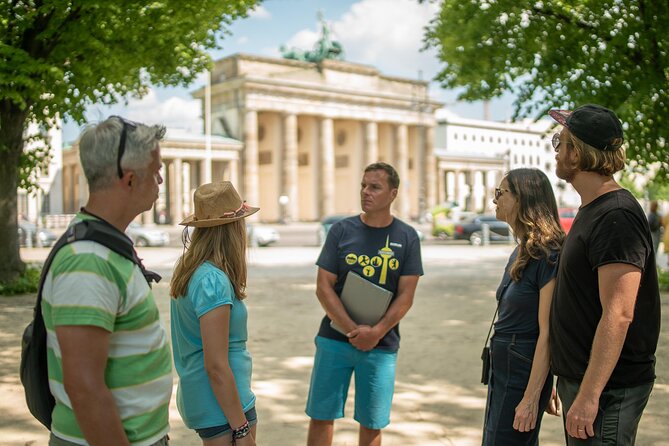
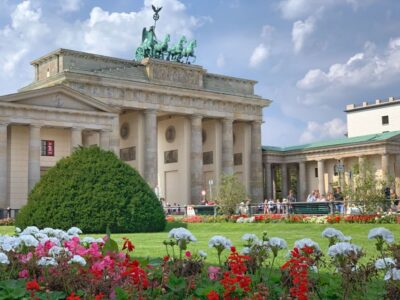
The tour begins at Brandenburg Gate, on the Pariser Platz side, where you should arrive 15 minutes early. The pink umbrella is the useful marker here. It is a small detail, but a good one in a busy square.
Brandenburg Gate is more than a classic photo stop. Your guide explains why it became a symbol of reunified Germany, which gives the monument a modern meaning beyond its neoclassical design. You are starting at a place tied to division, political power, and national unity, rather than simply ticking off a famous sight.
The stop lasts about 15 minutes. That is enough time for an introduction and orientation, but not enough for a long architectural lesson. I like this opening because it gives you a clear question to carry through the rest of the walk: how did Berlin move from dictatorship and war to division and reunification?
A few more walks around Berlin worth a look
- East Berlin and the Berlin Wall 2-Hour Walking Tour
★ 5.0 · 228 reviews - Berlin Highlights in 2 Hours: Express Walking Tour
★ 5.0 · 120 reviews - Budapest City Landmarks Walking Tour in 2 Hours
★ 5.0 · 2,048 reviews
The Reichstag and the politics of destruction
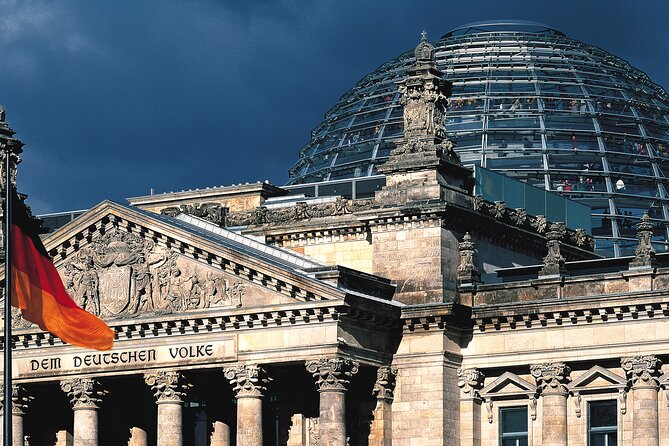
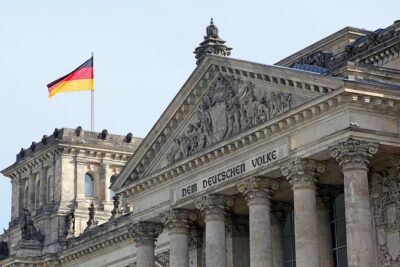
From Brandenburg Gate, the route continues to the Reichstag Building, Germany’s parliament. You do not go inside, and admission is free because this is an outdoor explanation rather than a building tour.
The Reichstag helps connect several periods of German history. The guide explains the 1933 Reichstag fire and how Hitler used the event during the creation of his dictatorship. That makes the building especially useful for understanding how political power can be seized through fear, emergency measures, and public manipulation.
You spend about 10 minutes here. The short stop works well as part of a moving narrative, though you should not expect a detailed account of every political event linked to the building. The value is in seeing the place and hearing why it mattered at a key turning point.
Soviet tanks in the Tiergarten
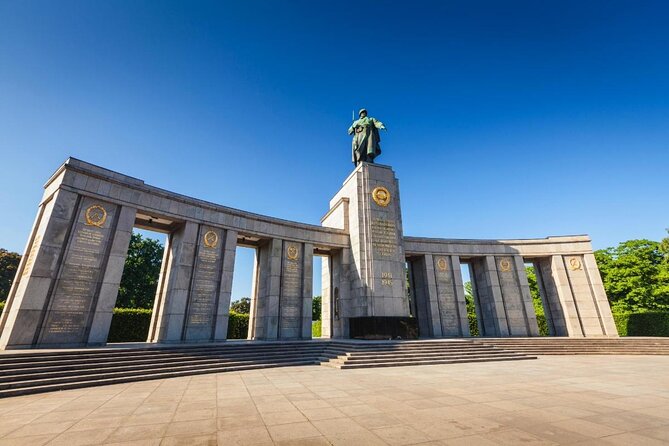
The Soviet Memorial in the Tiergarten adds a physical reminder of the Second World War. You see Soviet T34/76 tanks and field artillery displayed at the memorial.
This is one of the more unusual stops because the equipment makes the military story visible. Instead of hearing only about battles and dates, you are looking at the machines used by the Soviet forces. The tour spends roughly seven minutes here, so the explanation stays focused.
The stop also helps broaden the story beyond a purely German viewpoint. Berlin’s later division cannot be understood without remembering the Soviet role in defeating Nazi Germany and occupying the city after the war.
Victory Column and the unrealized Germania
The route also takes in the Victory Column and the plans associated with Albert Speer. You learn why Speer moved the column from its original location and hear about his plans for Germania, the proposed new capital of the world that would have replaced Berlin if Nazi Germany had won the war.
This section is valuable because it shows how architecture and city planning served political ambition. The Nazi regime did not see Berlin as just a place where people lived. It imagined a huge symbolic capital designed to project power across the world.
The tour does not list a separate fixed duration for this stop, so your guide may fold it into the walk between other locations. That is worth knowing if you want a long look at the monument itself. The focus is the political purpose behind the city plan, not a formal visit to the column.
Same streets, a different way to see them:
- Discover Berlin Half-Day Walking Tour
★ 5.0 · 9,624 reviews - Berlin City walk Government District and Places of Democracy
★ 4.7 · 8,467 reviews - Berlin: Third Reich & Cold War Guided Walking Tour
★ 4.9 · 8,378 reviews - Berlin: Discover Berlin Walking Tour
★ 4.9 · 5,998 reviews
Walking through the Holocaust Memorial
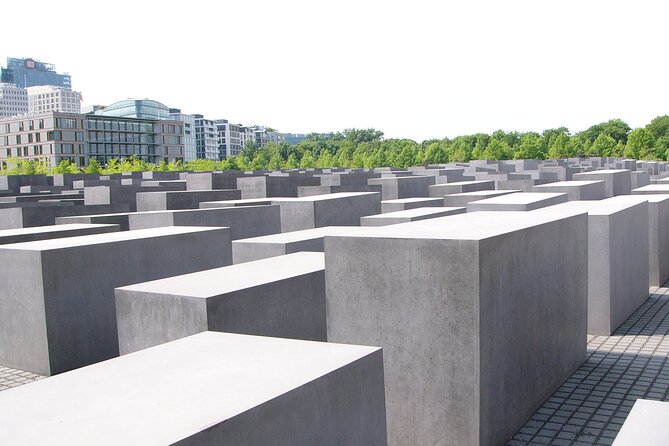
The Memorial to the Murdered Jews of Europe is one of the tour’s most important stops. You walk through the field of concrete slabs, a memorial that asks you to respond to the space rather than simply read a plaque.
The guide discusses the memorial and the murder of Europe’s Jews under the Nazi regime. The stop lasts about 10 minutes. That is enough to explain the site and allow you to walk among the blocks, but it is not a replacement for the nearby information centre or a full museum visit.
You should expect a serious tone here. The tour’s strongest guides handle the subject with care, using humor only where appropriate elsewhere. That balance matters. Berlin’s difficult past should not be treated as a string of dramatic stories for entertainment, and the best approach keeps the human cost in view.
The Führerbunker and Berlin’s uneasy memory
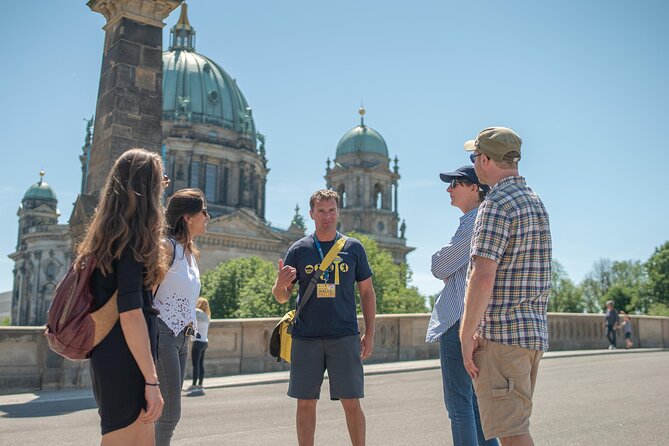
At the site of Hitler’s bunker, you stand above the location and hear about the final days of the war, Hitler’s suicide on April 30, 1945, and the way Germany has dealt with this destructive past.
There is no grand ruin to explore. The bunker itself is not presented as an attraction, and that absence is part of the point. You are standing at an ordinary-looking location connected to one of the darkest moments in modern European history.
The stop lasts about 10 minutes. It works best when the guide explains what happened without turning the site into a shrine. This is also where a good guide can connect physical place with public memory, including how Berlin has chosen to mark, conceal, or explain sites linked to the Nazi leadership.
The Aviation Ministry and East Germany’s beginning
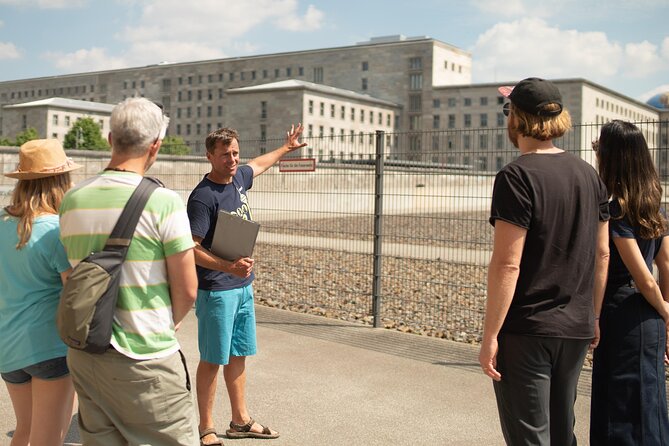
The walk continues to the former Aviation Ministry of Berlin, associated with Hermann Göring’s air force ministry. You walk along the length of the building and hear that it was also the location where East Germany, or the GDR, was proclaimed in 1949.
This stop shows how one building can carry different political identities over time. It first belonged to the Nazi state, then became linked to the creation of East Germany after the war. That transition helps explain why Berlin’s history cannot be divided neatly into separate chapters.
The stop lasts about five minutes. It is brief, but it adds useful detail between the better-known sites. You may not remember every architectural feature, but you will understand why the building matters.
Topography of Terror explains the machinery of Nazi rule
At the Topography of Terror, you see the former headquarters area of the SS, Gestapo, and SD. The site now houses an exhibition about the crimes carried out by these institutions during the Second World War.
The outdoor portion lasts about 15 minutes. Your guide explains what happened here and points you toward the exhibition, but this tour does not include a full visit inside. If you have more time, return later for a closer look at the displays.
I find this stop especially useful because it shifts attention away from Hitler alone and toward the institutions that organized persecution and terror. Understanding those agencies makes the Nazi dictatorship feel less like the work of one figure and more like a system operated by many people.
The Berlin Wall at Niederkirchnerstraße
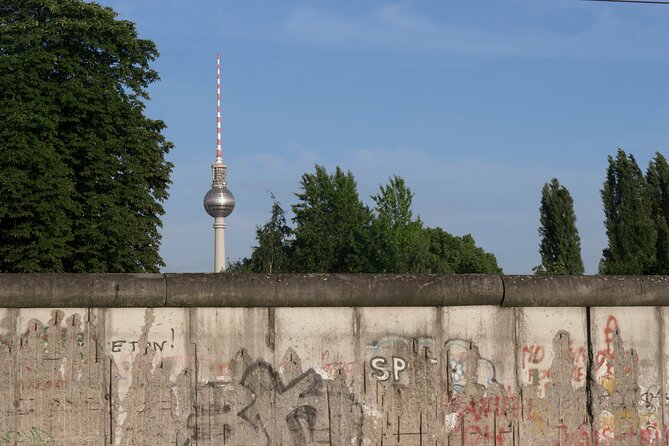
At Niederkirchnerstraße, you see a large remaining section of the Berlin Wall. The guide tells stories of people who escaped across the Wall and of those who tried but did not survive.
The stop lasts about seven minutes. That is short, but the wall segment gives you something concrete to look at while hearing about the human cost of the city’s division. You also learn about daily life on both sides, in East Berlin and West Berlin.
This is a good place to remember that the Wall was not only a political boundary. It cut through streets, families, workplaces, and ordinary routines. The stories of escape attempts keep the discussion personal rather than purely strategic.
Checkpoint Charlie closes the story
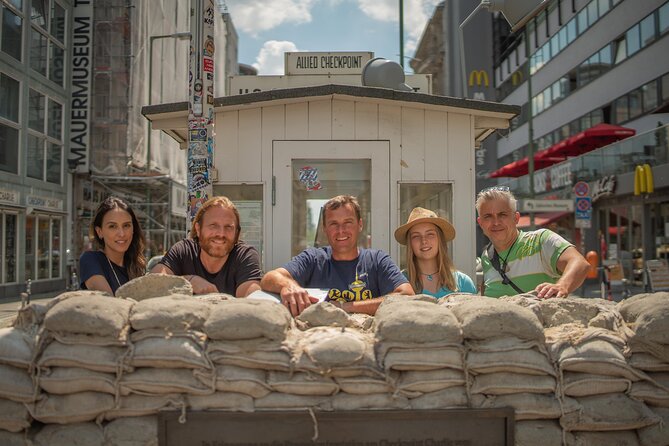
The tour ends at Checkpoint Charlie on Friedrichstraße, after about 15 minutes at the final stop. This was the best-known crossing point through the Berlin Wall, and the guide explains the 1961 confrontation between Soviet and American tanks nearby.
You also hear how the Wall came down on November 9, 1989, and how reunification has developed during the more than three decades since. That gives the route a clear ending. You begin with Brandenburg Gate as a symbol of reunified Germany and finish with the political crisis that made reunification possible.
Checkpoint Charlie is heavily associated with tourism today, so the location can feel more commercial than solemn. The historical explanation is what gives it value. Once the tour ends, you are well placed to continue around Friedrichstraße or visit nearby museums and exhibitions.
What the guides do well
The guide can make or break a history walk. This tour has been praised for strong individual guides, including Glen, Ben, Maggie, Rebecca, Tom, Joachim, Peter F., Simon, Paul, Mikey, Georgia, Mikhail, James, Jamie S, Eyan, Xavier, Ronja, and others.
Certain strengths come up again and again. Guides explain difficult material in clear language, answer questions, and keep the group moving without making the tour feel rushed. Glen and Mikhail have used historical photographs at stops, which can help you picture how a location looked during the Nazi period or the Cold War.
Mikey has been praised for making the tour work for families with children aged 11 and 16. James and Georgia are noted for balancing respectful treatment of Nazi crimes with a friendly, sometimes lightly humorous tone. That is a difficult line to walk, and it is one of the most important signs of a good guide.
The exact guide varies, so you cannot book the tour expecting a particular person. What you can reasonably expect is a format built around live explanation rather than a recorded script.
Pace, group size, and physical effort
The tour lasts about two hours and covers the route on foot. This is a practical way to reach places a bus cannot approach closely, and the route links sites that would otherwise feel scattered across central Berlin.
A maximum of 30 people is allowed. That is not a tiny group, so stay near the guide when the group gathers and speak up if you cannot hear. The frequent stops help, but the walk still works best when you are comfortable standing outdoors.
Wear sensible shoes. You should also bring warm clothing and gloves in winter. One useful piece of advice is to use the restroom before the tour begins, since the route is made up of outdoor stops rather than scheduled indoor breaks.
The walk is near public transport, and the start and finish are easy to connect with the wider city. The meeting point is in front of the Tourist Information office at Brandenburg Gate, while the end is at Checkpoint Charlie.
Is $24.07 good value?
At $24.07 per person, this is good value if you want a clear introduction to Berlin’s Nazi and Cold War past. You are paying for an English-speaking local guide, a carefully connected route, and two hours of explanation at sites that are free to enter.
The value is less convincing if you want extended time inside museums or detailed architectural study. The Holocaust Memorial and Topography of Terror, for example, deserve more time than this tour can provide. Think of the walk as a structured orientation, then use it to decide where you want to return.
The tour is also useful early in a Berlin visit. It gives you a map of the central historical area and helps you understand what you are seeing when you explore alone later.
Who should book this walk?
I would recommend it to first-time visitors, history-minded adults, and families with older children who can handle serious subjects. It suits anyone who wants the main Nazi and Cold War landmarks explained in one efficient outing.
It is less suitable if you dislike walking, standing outside, or discussing war, dictatorship, genocide, and political repression. It may also feel too quick for someone who already knows Berlin’s history well and wants specialist detail.
The operator allows free cancellation up to 24 hours before the start time. Inside that window, the payment is not refunded, and changes are not accepted. The tour is offered in English only.
Should you book Berlin’s Best?
Yes, if you want a short, well-priced introduction to Berlin’s most important Third Reich and Cold War sites. I especially like the way the route connects Brandenburg Gate, the Reichstag, the bunker site, the Berlin Wall, and Checkpoint Charlie into one story rather than treating them as isolated photo stops.
Book it early in your visit, arrive 15 minutes ahead, and look for the pink umbrella. Wear shoes you can walk in, prepare for the weather, and keep your expectations clear: this is a brisk outdoor history lesson, not a museum tour. With the right expectations, it is an efficient and thoughtful way to get your bearings in central Berlin.
FAQ
How long does the walking tour last?
The tour lasts approximately two hours.
Where does the tour begin?
It begins at Brandenburg Gate, Pariser Platz, 10117 Berlin, on the side near the Tourist Information office.
Where does the tour end?
The tour ends at Checkpoint Charlie, Friedrichstraße 43-45, 10117 Berlin.
How do I find the guide?
Meet 15 minutes before the start and look for the guide carrying a pink umbrella.
Is the tour offered in English?
Yes. The tour is offered in English only.
What is included in the price?
The price includes a professional English-speaking local guide and the walking tour in English.
What is the cancellation policy?
You can cancel up to 24 hours before the start time for a full refund. Cancellations or changes made less than 24 hours before the start are not accepted, and the payment is not refunded.
Just added around Berlin
- Berlin Walking Tour★ 4.5 · 378 reviews
- Small Group Walking Tour of East Berlin with a French Guide★ 5.0 · 176 reviews
- Berlin Street Art Walking Tour – Off The Grid★ 5.0 · 270 reviews
- Berlin Highlights Private Guided Walking Tour★ 4.5 · 89 reviews
- Private Walking Tour: World War 2 and Cold War Sites in Berlin★ 5.0 · 230 reviews
- East Meets West: Berlin Food Culture & Street Art★ 5.0 · 157 reviews
- Kreuzberg Berlin: Off the Beaten Track PRIVATE Walking Tour★ 5.0 · 128 reviews
- The History of Berlin: WWII PRIVATE Walking Tour With Locals★ 5.0 · 209 reviews
Berlin Walking Tours, compared.
Berlin City walk Government District and Places of Democracy
Read our review →
Explore Berlin: See All The Iconic Sights & Some Hidden Gems
Read our review →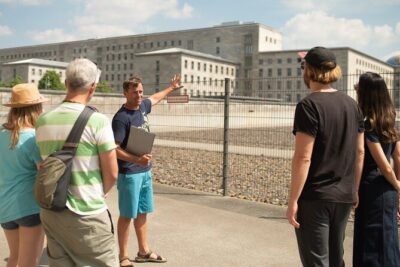
Third Reich Berlin: Hitler and WWII Walking Tour
Read our review →
Browse the lists this tour appears in