
Review · HISTORY WALKING TOURS
Walking Tour of Split with a ‘Magister’ of History
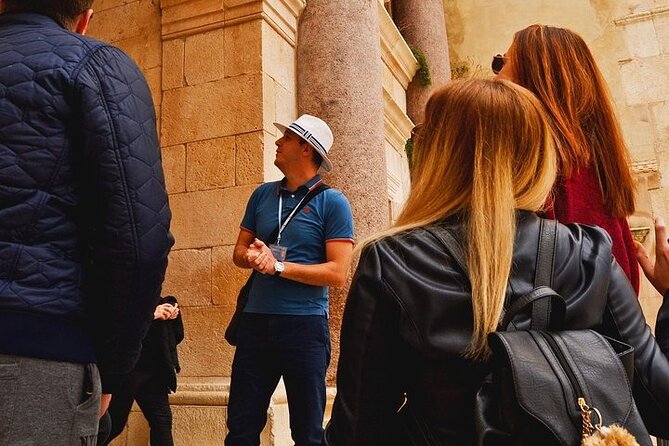
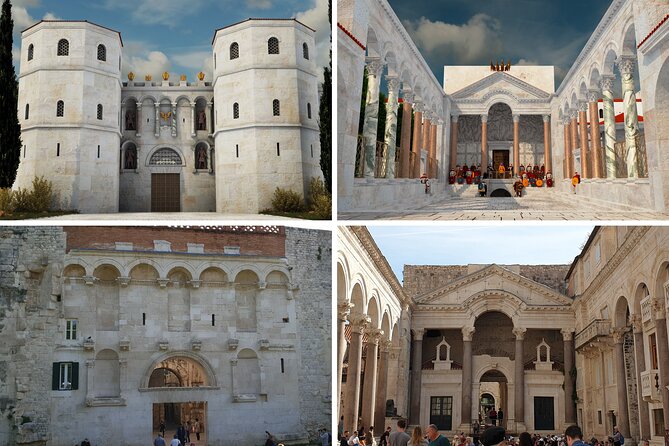
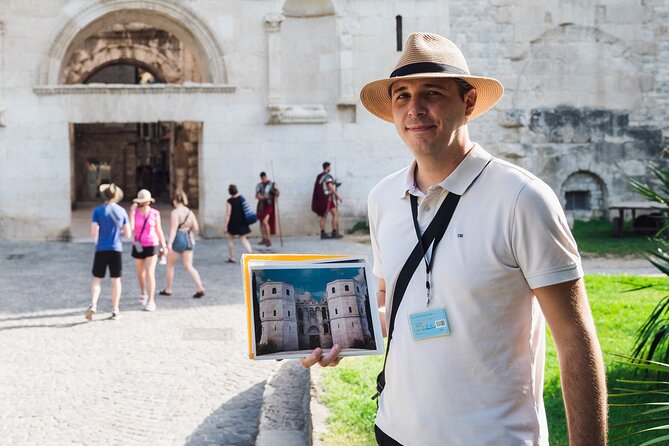
Split’s old town hides a Roman palace in plain sight. This walking tour makes sense of it, with Toni Šare, a local historian and the owner of DiocleSpot Tours, guiding you from the Riva to the medieval heart of town. His hand-prepared 3D reconstructions help you picture the palace before later centuries filled it with homes, shops, churches, and narrow lanes.
I like the way the tour treats Split as more than a Roman monument. You get Roman architecture, Venetian-era palaces, medieval symbols, Croatian culture, and modern local life in one compact walk. I also like the balance between a group price of $34.83 and the option to upgrade to a private tour. The main limitation is that paid interiors, including the Cathedral and museums, are not entered, so you may want to visit those separately.
Toni’s enthusiasm is the real engine of the experience. His explanations cover architecture, religion, politics, language, and local customs, and his timing may even bring you past a traditional singing quartet. Allow about 1 hour 40 minutes to 1 hour 50 minutes, wear sensible shoes, and arrive ready to look up, down, and into corners most people hurry past.
Five details that make this Split tour worth considering
- Toni Šare’s personal connection: Born and raised in Split, Toni brings local experience together with formal history study and teaching.
- 3D views of Diocletian’s Palace: His visual reconstructions show how the palace looked in its imperial prime, making surviving fragments easier to understand.
- A Roman route with later layers: The walk includes Renaissance noble palaces, medieval defenses, Venetian influence, and Croatian cultural symbols.
- A useful first-day orientation: The tour ends at Pjaca, or Narodni trg, putting you near many other parts of the old town.
- Small enough to ask questions: The group can have up to 18 people, and the route includes quieter corners where it is easier to hear.
- A fair choice of formats: You can manage your budget with a group tour or choose a private upgrade.
Why Toni’s approach works in Split
Split can be confusing at first. You enter what appears to be an old town, then realize the streets run through the remains of a Roman emperor’s retirement palace. A column may be ancient, a wall may have served several different rulers, and a modern café may occupy space that once belonged to the imperial residence.
Toni’s strength is connecting those layers. He does not treat Diocletian’s Palace as a frozen archaeological site. He explains how the Roman structure changed as people adapted it over time, including the way later residents used old walls for homes and defense.
That approach gives you a better way to explore on your own afterward. Instead of seeing isolated stones, gates, and squares, you begin to understand how they fit together. Several people who took the tour especially valued the combination of ancient history, local culture, religion, architecture, and modern Split.
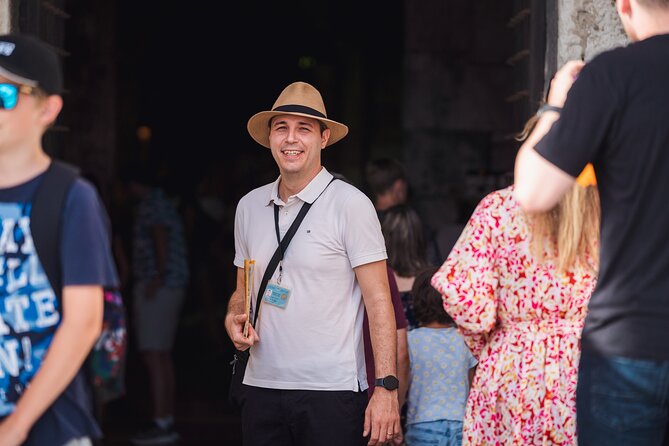
The presentation also has a personal quality. Toni grew up in the city and speaks about it with obvious affection. He is friendly, approachable, and willing to answer questions after the scheduled walk. His humor helps keep the material from feeling like a lecture, even when the subject turns to centuries of political and religious change.
More History Walking Tours in Croatia
- Split Walking Tour with Professor of History
★ 5.0 · 926 reviews - Split: History and Heritage Walking Tour
★ 4.9 · 650 reviews - Split: Local History and Culture 90-Minute Walking Tour
★ 5.0 · 194 reviews
Beginning at the Riva and the Brass Gate
The tour starts at the Brass Gate, also called Porta Aenea, along Obala Hrvatskog narodnog preporoda 22. This puts you beside the Riva, Split’s waterfront promenade and a key meeting place for local residents.
The opening 15 minutes are useful because Toni gives you a visual introduction before leading you into the palace. He uses graphic material and models to explain what you are about to see, while the southern wall of Diocletian’s Palace provides an impressive backdrop.
I like starting here because the waterfront gives you room to orient yourself. Once you enter the palace, the streets become tighter and the remains less obvious. Seeing the south wall first helps you understand that the palace was a large fortified complex, not simply a single building.
The Riva is also a practical meeting point. The tour is near public transportation, confirmation is sent at booking, and the group is capped at 18 people. That is not a private walk, but it is small enough to make questions realistic. Arrive early enough to find the Brass Gate without rushing.
The Peristyle reveals the palace’s Roman center
From the waterfront, the route reaches the Peristyle, the central square of Diocletian’s Palace. This is one of the most important stops because the square still gives you a strong sense of Roman planning and ceremony.
Toni uses his 3D reconstructions here to show how much decoration and structure have been lost or altered. The surviving columns and stonework are impressive on their own, but the images add scale and help you picture the original setting.
The stop lasts about 10 minutes. That is enough for a clear explanation, though it is not enough for a long archaeological study. The tour aims to give you a framework rather than cover every scholarly debate.
You will want to pay attention to how later life occupies the same Roman space. The Peristyle is not sealed off from the city. It remains part of Split’s daily movement, which is one reason the tour feels more connected to local life than a visit to an isolated ruin.
The Cathedral and Mausoleum without entering
The Cathedral of Saint Domnius follows. The building began as the mausoleum of Emperor Diocletian, and Toni explains how Christians later converted it for use as a cathedral. He also covers the bell tower and the building’s continued religious role.
The stop takes about 10 minutes. You do not enter the cathedral, and admission is not included. That is important to know if you want to see the interior, the treasury, or climb the bell tower. You can plan a separate visit rather than expect the walking tour to include it.
Still, the outside explanation has real value. The building is one of the best-preserved Roman structures in Split, yet its meaning changed sharply over time. Toni explains that change in a way that connects architecture to religion and local history.
For many visitors, this is where the tour’s main idea becomes clear: Split’s past did not disappear. It was reused, renamed, and reshaped.
More History Walking Tours in Split:
- Split: Walking tour of Split with a ‘Magister’ of History
★ 5.0 · 110 reviews - History and Hauntings of Salem Guided Walking Tour
★ 5.0 · 14,564 reviews - Lisbon: History, Stories and Lifestyle Walking Tour
★ 4.8 · 10,902 reviews - Boston: Freedom Trail History Small Group Walking Tour
★ 5.0 · 6,450 reviews
The Temple of Jupiter and its construction details
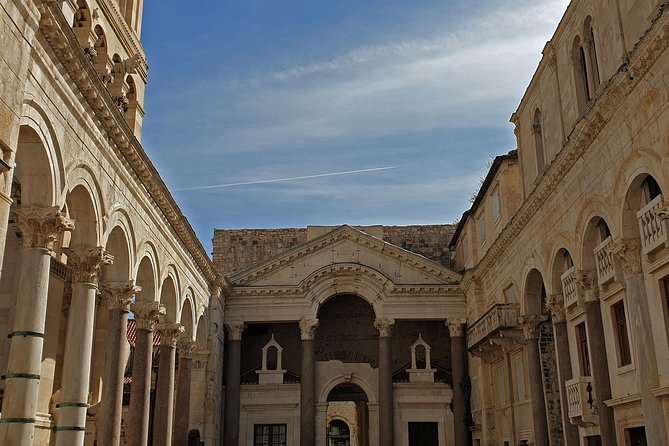
The next stop is the Temple of Jupiter, another well-preserved late Roman structure. Toni points out construction anomalies and mistakes made by the Roman builders. Those details make the site more approachable because they show the building process rather than presenting Roman work as flawless.
You see the temple from outside, with no interior admission included. The planned stop is about 15 minutes, giving Toni time to explain what you are looking at and where the building fits within the palace complex.
I especially like the focus on small imperfections. Grand imperial projects can feel distant, but an uneven detail or building error brings the workers and practical problems closer to you. Look carefully instead of simply checking the temple off your list.
The Silver Gate and the preserved Roman road
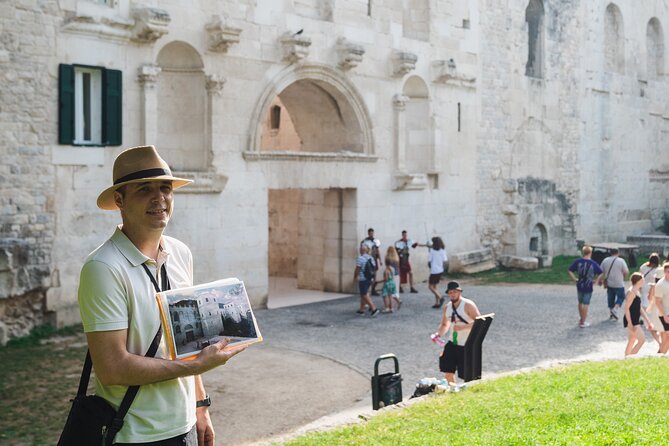
At the Eastern, or Silver, Gate, you get one of the clearest views of the palace’s layout. From this position, you can see the Cathedral and the gate, along with the only preserved part of the original road beneath you.
This is a short five-minute stop, but it carries a lot of visual information. Toni explains how the eastern entrance worked and how the road related to the wider palace plan.
The gate also shows how much Split was built around Roman remains. You are not looking at a single surviving monument. You are standing inside a city that continued using ancient routes and walls long after the emperor’s time.
Grgur Ninski and the meaning of Croatian language
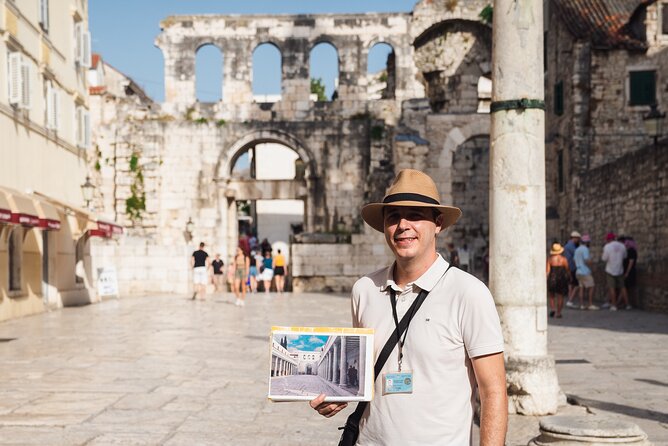
The Grgur Ninski statue is a quick stop, lasting about five minutes, but it shifts the subject away from Rome. Toni explains what the statue represents and its connection to the Croatian language and early medieval culture.
This helps prevent the tour from becoming Rome-only history. Split’s identity also comes from the medieval period and from the development of local religious and cultural traditions.
The statue is a recognizable city landmark, so this explanation gives you more than a photo opportunity. You leave knowing why it matters, not just where it is.
The Vestibule and Diocletian’s private residence
At the Vestibule, Toni shows you the ancient entrance to Diocletian’s private residence. The route then moves around the remaining parts of the emperor’s living quarters.
This is one of the more imaginative sections of the walk. Much of the palace is not preserved in its original form, so Toni’s reconstructions are especially useful here. They help you picture the relationship between public ceremonial areas and the emperor’s private spaces.
The stop lasts about 10 minutes. Do not expect to see a complete palace interior. Instead, expect fragments, foundations, walls, and an explanation of how to read them.
Along the way, Toni points out noble family palaces built in later centuries. These buildings add another layer to the old town, showing how wealthy families adapted the Roman setting and added their own architectural style.
Renaissance palaces and Split’s Venetian chapter
One courtyard associated with the City Museum of Split is included from the outside. The museum itself is not entered, but the courtyard lets you see a Renaissance noble palace from within.
Toni uses this stop to explain Split’s Venetian history. The point is not only to admire the courtyard, but to understand why these noble residences appeared and how the city changed after the Roman period.
This section is valuable if you want to see more than ancient stone. Split’s story includes Roman rule, medieval development, Renaissance architecture, and early modern influence. The route gives each period a place without requiring you to visit several separate museums.
If you are hoping for museum access, plan for another visit. The walk provides context, not admission.
Game of Thrones locations, if the group wants them
The route passes several filming locations associated with Game of Thrones, along with a fan shop. Toni can point these out if the group is interested.
This is a nice optional touch. It does not replace the historical content, but it gives fans a modern connection to the old streets. If your group is more interested in archaeology and architecture, the main route still has plenty to occupy you.
Because this part depends on group interest, do not book the tour solely as a television-location walk. Its main purpose is Split’s history and built heritage.
The Golden Gate shows the palace as a fortress
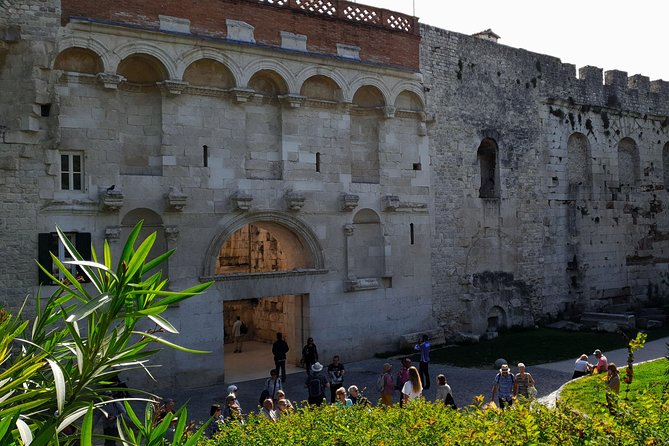
The Golden Gate is the longest major stop, at about 15 minutes. It is the best-preserved and most decorated of the palace’s four entrances, and it gives you a clear view of the northern wall.
Toni explains how the medieval city continued to use Roman structures for defense. He also points out what later residents removed because it was no longer useful. That practical history is more revealing than a simple date list.
The gate is a strong place for photographs, but look beyond the ornament. Notice the wall, the entrance design, and the way later Split grew around the imperial complex.
This is also a good point to appreciate the tour’s pace. The walk is short enough to cover the core old town, but it spends time on details that you might miss while moving quickly from one landmark to the next.
Ending at Pjaca and planning the rest of your day
The tour ends at the Old Town Hall on Narodni trg, commonly called Pjaca or Piazza Square. This has been the city’s main square since medieval times, and the 14th-century Town Hall gives the stop a clear historical finish.
I like this ending because it is easy to orient yourself from here. You are not left at an obscure street or distant viewpoint. From Pjaca, you can continue exploring the old town, return to an earlier site, or find somewhere to eat.
Taking the tour early in your Split visit makes the most sense. You can return later to the Cathedral, museum, or any palace corner that caught your attention. An evening departure can also help in summer heat, while a morning walk gives you the rest of the day for independent exploring.
What the $34.83 price buys you
At $34.83 per person, this is not the cheapest way to stroll through Split, since you can walk through many of the streets without a guide. The value comes from the interpretation, not from admission tickets. You are paying for Toni’s time, his visual reconstructions, and the connections between Roman, medieval, Renaissance, Venetian, and Croatian history.
The price is easier to justify if you want context and usually find old stones hard to read. It is also a sensible choice for a first visit, since the walk gives you a map of the city in both a physical and historical sense.
No museum or paid site is included. That keeps the price straightforward, but it means you should budget separately if you want to enter the cathedral, museum, or other attractions. Group discounts are available, and a private upgrade is offered for people who want a more personal format.
The tour has a maximum of 18 participants. That is a useful middle ground: more affordable than a private guide, but less unwieldy than a large coach group.
Who will get the most from this walk
I would recommend it most strongly if you enjoy history but want it explained in plain language. It suits first-time visitors, couples, families with older children, and anyone who wants a reliable introduction before exploring alone.
It is especially good for you if:
- You want to understand how a Roman palace became a living city.
- You care about local culture as well as famous monuments.
- You like asking questions during a guided walk.
- You want visual help showing what missing buildings may have looked like.
- You plan to visit Split’s old town independently after the tour.
You may prefer a different plan if entering monuments is your top goal. This experience stays outside paid sites, so it will not replace a cathedral or museum visit.
The route is on foot and most travelers can participate. Service animals are allowed, and the tour operates near public transportation. Good weather is required. If poor weather cancels the walk, you are offered another date or a full refund. You can cancel for a full refund up to 24 hours before the start time, but later cancellations and changes are not accepted.
Should you book Toni’s Split history tour?
Yes, if you want the story behind the stones. Toni Šare’s biggest strengths are his local connection, clear enthusiasm, and ability to show lost parts of Diocletian’s Palace through his own 3D reconstructions.
Book it early in your stay so you can use the advice and orientation for the rest of your time in Split. Choose the group version for good value, or consider the private upgrade if you want more control over questions and pace.
Skip it only if you want a self-guided stroll with no scheduled commentary or if paid interiors are essential to your visit. For most people who want Split to make sense, this is a lively, useful introduction that earns its price.
FAQ
How long does the Walking Tour of Split with a Magister of History last?
The tour lasts approximately 1 hour 40 minutes to 1 hour 50 minutes.
How much does the tour cost?
The listed price is $34.83 per person. Group discounts are available, and a private upgrade is offered.
Where does the tour begin?
It begins at the Brass Gate, also called Porta Aenea, at Obala Hrvatskog narodnog preporoda 22 in Split.
Where does the tour end?
The walk ends at Narodni trg, known as Pjaca or Piazza Square, beside the Old Town Hall.
Are admission tickets included?
No. The tour does not enter museums or paid sites. The Cathedral of Saint Domnius and the Temple of Jupiter are explained from outside.
Who guides the tour?
The guide is Toni Šare, owner of DiocleSpot Tours.
How many people can join the group?
The tour has a maximum of 18 participants.
Just added around Split
- Split: Food Tasting Walking Tour★ 4.9 · 102 reviews
- Split: Local History and Culture 90-Minute Walking Tour★ 5.0 · 194 reviews
- Split: 1.5-Hour Walking Tour and Diocletian’s Palace★ 4.7 · 256 reviews
- Split: Diocletian Palace & Old Town Guided Walking Tour★ 4.7 · 882 reviews
- Split: Walking tour of Split with a ‘Magister’ of History★ 5.0 · 110 reviews
- From Split: Krka Waterfalls Cruise & Trogir Walking Tour★ 4.7 · 681 reviews
- Split: History and Heritage Walking Tour★ 4.9 · 650 reviews
- Diocletian’s Palace and Old Town SMALL GROUP Walking Tour★ 5.0 · 502 reviews
History Walking Tours, compared.
History and Hauntings of Salem Guided Walking Tour
Read our review →

Freedom Trail History Small Group Walking Tour
Read our review →
Historic Charleston Guided Sightseeing Walking Tour
Read our review →
Tapas Walking Tour with Food, Wine, and History
Read our review →
Savannah History and Haunts Candlelit Ghost Walking Tour
Read our review →
A History of Terror – Belfast City Centre Walking Tour
Read our review →Browse the lists this tour appears in