
Review · JEWISH HERITAGE WALKING TOURS
Warsaw: Warsaw Ghetto Private Walking Tour with Hotel Pickup
Warsaw’s missing streets still tell a story. This three-hour private tour connects the former ghetto’s scattered traces with the larger story of Nazi persecution, Jewish life, and the 1943 uprising. I especially like the use of old photographs and maps, which help you read today’s streets alongside what stood there during the war. I also like the personal pace: guides such as Marzena and Mary have adjusted explanations, walking speed, and stops to suit each group. One practical caution is that the advertised hotel pickup may not always happen, so confirm the meeting details before you set out.
This is a serious tour, not a quick checklist of memorials. You will walk through a difficult chapter of Warsaw’s past, visit the city’s only surviving prewar synagogue that is still operating, and finish near the POLIN Museum. The private format gives you room to ask questions, but the $84 price per person is high compared with a large group walk. Its value depends on how much context and conversation you want.
Key points to know before booking
- The tour puts present-day streets beside wartime photographs, making vanished parts of the ghetto easier to understand.
- The route includes fragments of the ghetto wall and the last surviving street, rather than relying only on monuments.
- The 1943 Warsaw Ghetto Uprising receives serious attention, including why Jewish resistance began and who offered help.
- A synagogue visit adds a living place of worship to a tour otherwise focused on destruction and loss.
- The private guide can tailor the pace and depth, a useful feature for visitors with detailed questions or limited walking speed.
- Hotel pickup needs checking, since some bookings have required meeting at Prozna Street 9 instead.
Why this three-hour walk matters
Before the Second World War, Warsaw had one of Europe’s largest Jewish communities. Jewish residents made up about 30 percent of the city’s population, with a long-established cultural, religious, and commercial presence.
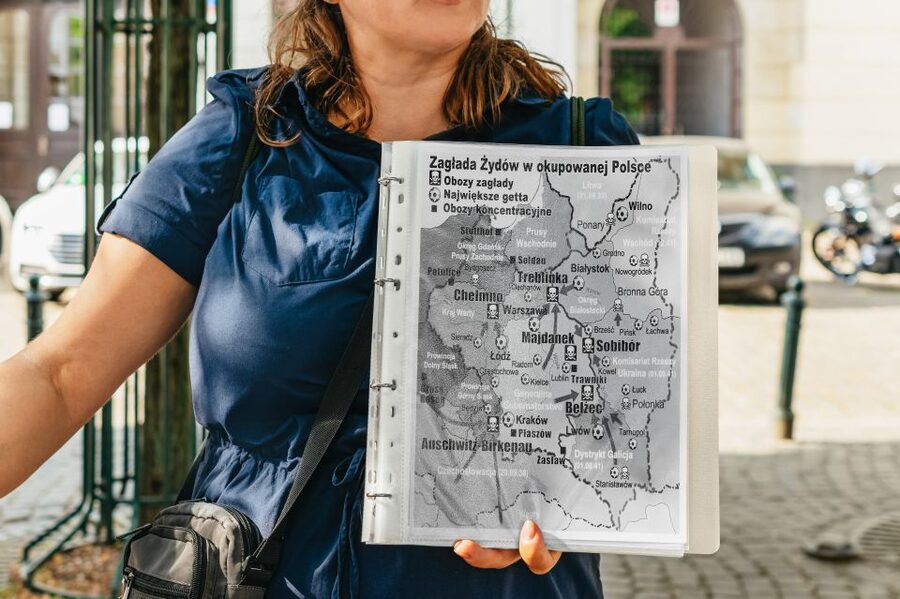
In 1940, Nazi authorities created the Warsaw Ghetto in the center of the city. More than 400,000 Jews from Warsaw and nearby areas were forced into roughly four square kilometers. About 100,000 people died inside the ghetto from hunger, illness, and exhaustion. More than 300,000 were sent to their deaths at Treblinka.
Those figures are horrifying, but numbers alone can feel distant. This tour’s main strength is that it ties them to actual places. You are not simply told that the ghetto existed. You are shown where streets ran, where walls once cut through the city, where people were gathered for deportation, and where the uprising unfolded.
The area was largely destroyed after the revolt, so you should not expect a preserved historic quarter. Much of the work involves imagination, comparison, and careful explanation. That is exactly why a guide is useful here.
More Jewish Heritage Walking Tours in Poland
- Krakow: Kazimierz Jewish Quarter Walking Tour
★ 4.8 · 571 reviews - Krakow: Jewish Ghetto Walking Tour
★ 4.6 · 349 reviews - Warsaw: Jewish History Guided Walking Tour in English
★ 4.7 · 324 reviews
Starting at Prozna Street 9
The listed meeting point is Prozna Street 9, between Bistro Charlotte Menora and Strefa Restaurant. Look for a guide carrying a PolinTours sign.
Prozna Street is a fitting place to begin because it preserves a visible link to prewar Jewish Warsaw. The surrounding area also helps introduce a key point: the former ghetto is not a single enclosed attraction with an obvious entrance. Its remains are spread across modern streets, memorial sites, rebuilt neighborhoods, and small surviving fragments.
The tour includes transport by car, and hotel pickup is listed as an option. Still, I would not assume that the guide will arrive at your hotel. Several bookings have instead involved meeting at the stated city location, and one person specifically noted the confusion between the pickup promise and the meeting instructions. Confirm this before the day of the tour.
If you meet at Prozna Street, arrive ready to walk. Wear comfortable shoes, bring sun protection and a hat in warm weather, and carry cash for the synagogue donation. Large bags and oversize luggage are not allowed.
Reconstructing the ghetto with maps and photographs
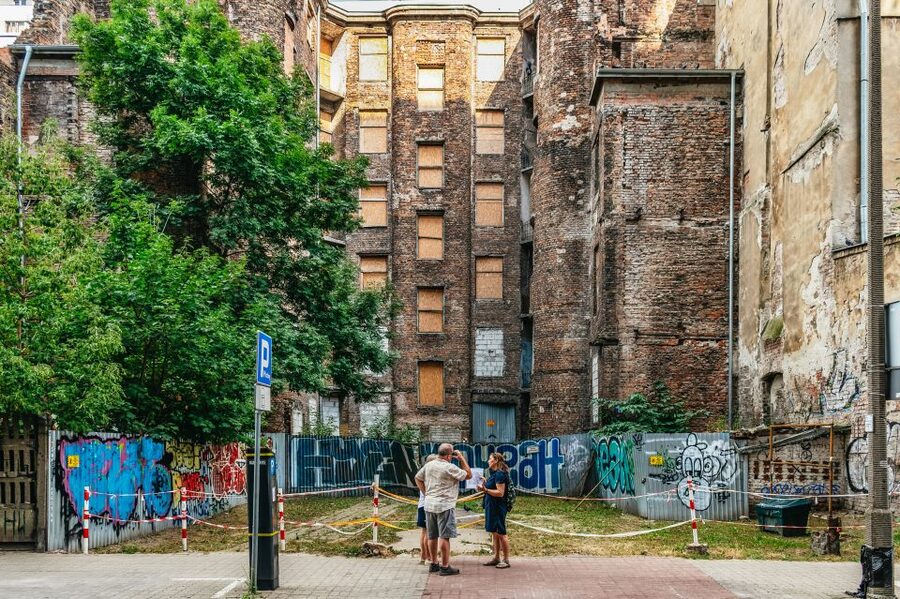
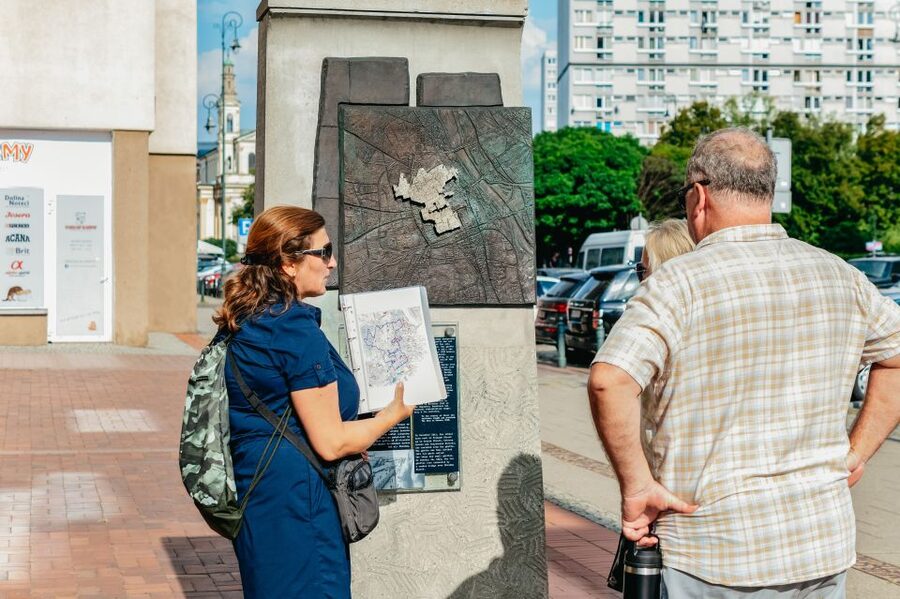
A strong guide makes this route work. Marzena is repeatedly praised for clear English, a warm manner, and the ability to explain the subject in chronological order. Mary has also been singled out for using maps, photographs, and background material to show how wartime locations relate to present-day Warsaw.
That visual material is not decoration. It solves the central problem of this tour: many of the original buildings are gone. A modern street may look ordinary until you see an old photograph showing the same location filled with ghetto walls, checkpoints, crowds, or destroyed buildings.
The guide’s role is to link three views at once:
- what Jewish Warsaw looked like before the war
- what Nazi occupation and ghettoization did to daily life
- what remains, or does not remain, today
You can ask questions throughout the walk, which is a major benefit of booking privately. People with extensive interest in the Holocaust can request more detail, while first-time visitors can ask for basic context without feeling rushed.
The pace also appears adaptable. One older participant described frequent stops and a patient guide, while others appreciated the freedom to ask many questions. That makes the experience more manageable than a fixed large-group walk, though it remains a three-hour walking tour and is not suitable for people with mobility impairments.
The last street and fragments of the ghetto walls
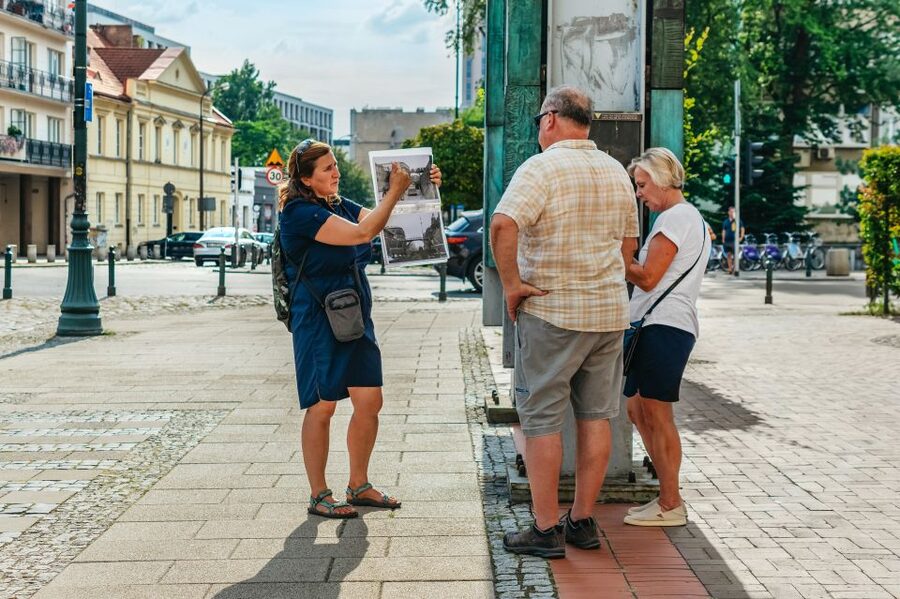
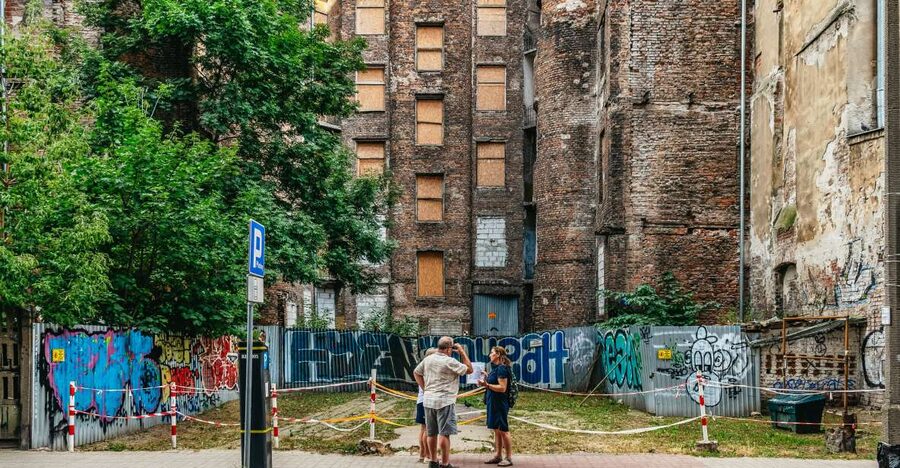
One of the most valuable parts of the route is the search for physical remnants. You will see fragments of the ghetto walls and visit what is described as the last street of the ghetto.
These are modest remains, not grand ruins. That can be frustrating if you expect a large preserved section of wall or a complete wartime street. Yet the small scale makes the guide’s explanation even more important. A surviving fragment can show how confinement was built into daily life, while a vanished street can raise a harder question: what happens when an entire community is erased and the city is rebuilt over it?
The walk also covers former ghetto neighborhoods. You may pass busy modern streets and ordinary buildings, but the guide uses photographs and maps to show where the wartime boundaries once ran. This contrast is one of the tour’s most affecting features. Warsaw has been rebuilt, but its reconstruction did not erase the need to remember what occupied the same ground.
Same streets, a different way to see them:
- Warsaw: Old Town Highlights Walking Tour in English
★ 4.7 · 1,516 reviews - Old Town Krakow & Wawel Castle Walking Tour
★ 5.0 · 1,508 reviews - Creepy Krakow: 2-Hour City Walking Tour
★ 4.7 · 1,131 reviews - Gdańsk City Sights & History Guided Walking Tour in English
★ 4.8 · 876 reviews
Everyday life inside four square kilometers
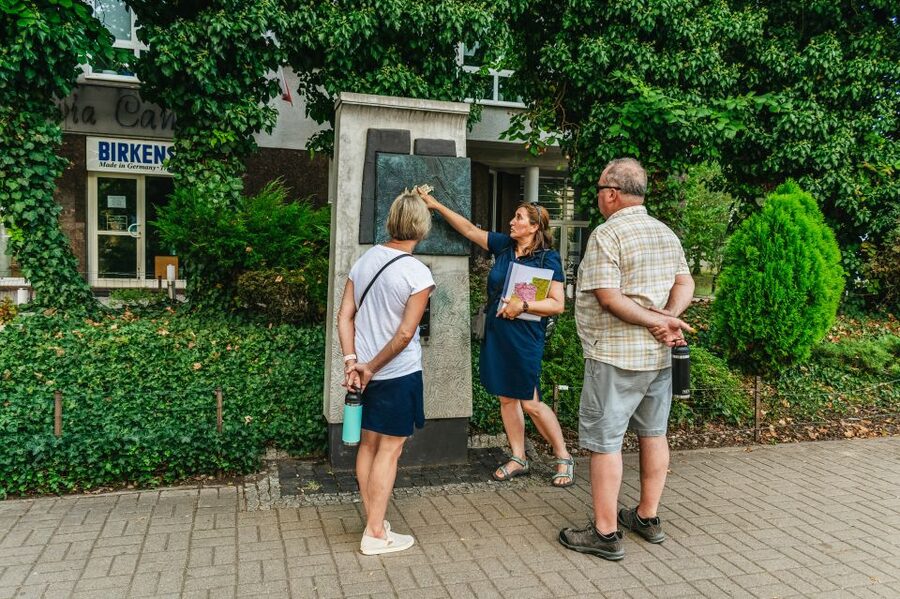
The tour does not focus only on Nazi decisions and military events. It also explains daily life inside the ghetto.
More than 400,000 people were forced into a very small area. Hunger, disease, overcrowding, and exhaustion shaped every part of life. The tour addresses how the ghetto was established, how the population was controlled, and why so many people died before the deportations to Treblinka.
This section gives the later uprising its proper context. Resistance did not appear in a vacuum. By the time the Nazis began the final liquidation of the ghetto, residents had endured years of persecution and mass death. The guide explains the supposed logic behind the Nazi plan and how the final solution was put into practice.
That language is difficult, but the tour treats it directly. The subject is not softened into a general lesson about wartime tragedy. You are taken to real sites and shown how policy became action.
Umschlagplatz and the machinery of deportation
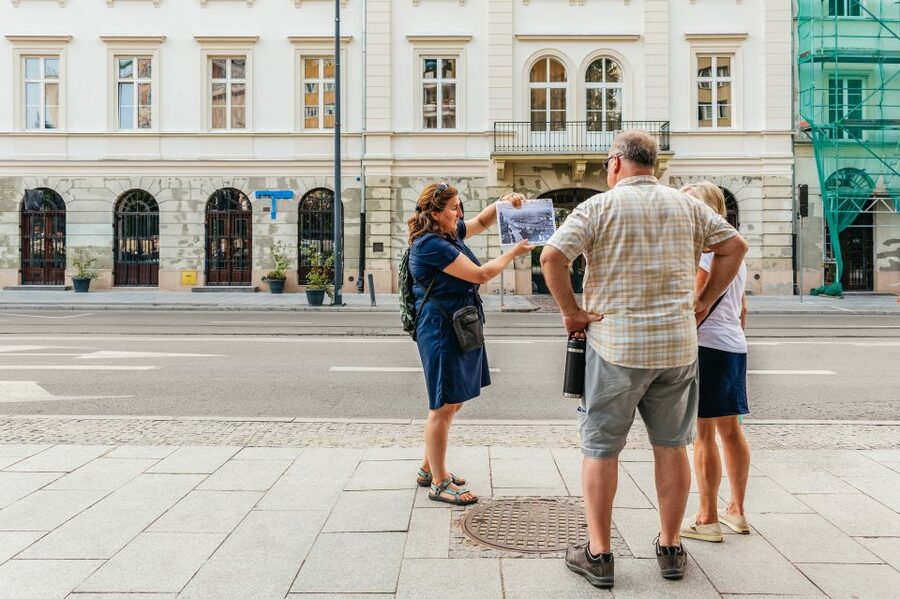
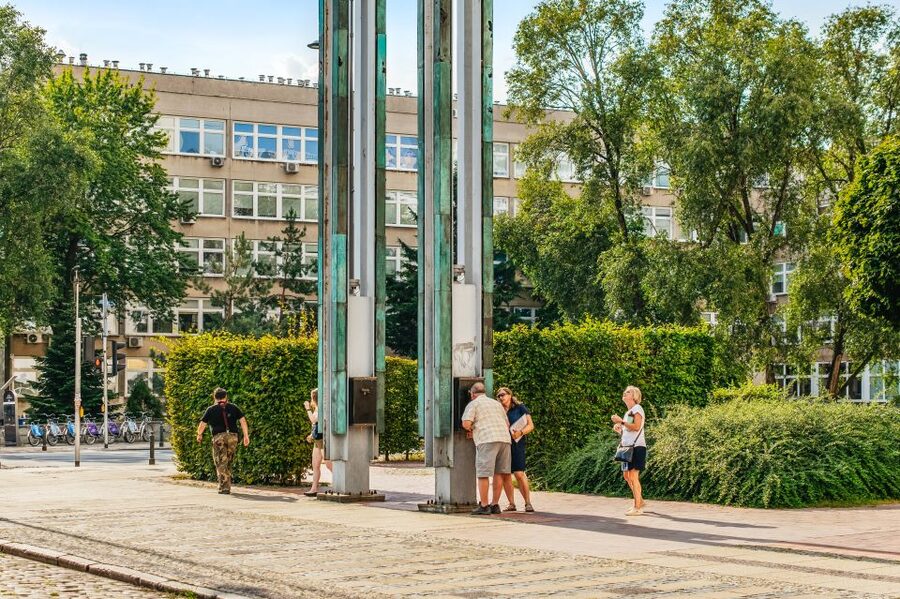
The Umschlagplatz was the collection point where Jews were assembled before deportation. Its symbolism is central to understanding the ghetto’s destruction.
Here, the tour moves from the geography of confinement to the system of deportation. The point was not simply to imprison people. The ghetto was part of a larger process that led to mass murder at Treblinka and elsewhere.
A good guide can explain the difference between what happened inside the ghetto and what happened after people were forced onto trains. The tour’s description promises that distinction, along with an explanation of how the final solution was carried out.
You should expect an emotionally heavy stop. The guide’s use of photographs and careful chronology helps prevent the experience from becoming a string of disconnected horrors. Instead, each place fits into the developing story.
The Warsaw Ghetto Uprising and its final month
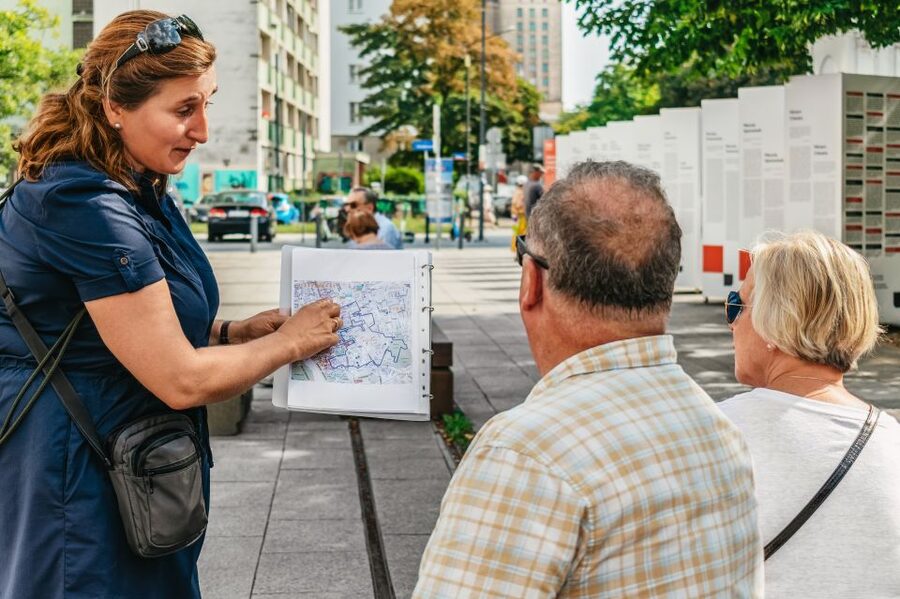
The uprising began in 1943 when the Nazis attempted to liquidate the remaining ghetto population. The Jewish fighters were badly outnumbered and outgunned, yet the unequal struggle lasted nearly a month.
The tour places the uprising within the physical area where it happened. You learn why residents took up arms, how the resistance operated, and who helped the fighters. The guide also explains the German response and the destruction that followed.
This is not presented as a simple victory story. The uprising was heroic, but it ended with the ghetto being systematically destroyed. Only a small number of Jews survived from the community that had once defined so much of Warsaw’s social and cultural life.
The story also includes Władysław Szpilman, the pianist whose wartime survival became widely known through Roman Polanski’s film The Pianist. His experience offers one personal link to the much larger history, although the tour remains focused on the ghetto as a community rather than one individual.
The route’s greatest emotional force comes from standing in places tied to the uprising while looking at a city that has changed almost beyond recognition. The guide helps you picture the old streets without pretending that the buildings themselves are still there.
The surviving synagogue
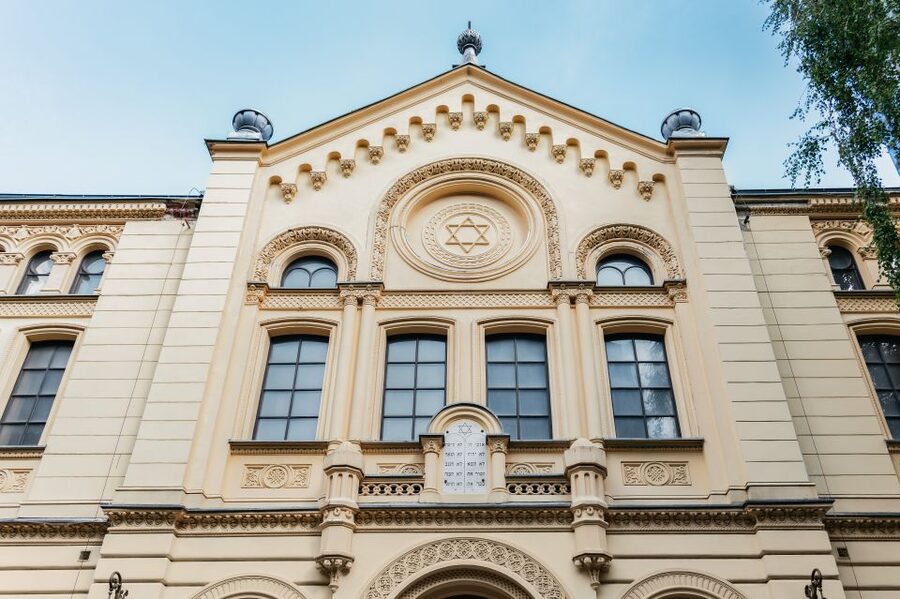
The tour visits the only synagogue in Warsaw that survived the Second World War and remains in operation. A donation is required at the entrance, listed as 20 PLN, 5 EUR, or 5 USD.
This stop adds something important. Much of the tour concerns destruction, empty spaces, and memorials. An operating synagogue gives you a living connection to Jewish religious life in Warsaw today.
You should bring a head covering or kippah. This is not an optional sightseeing prop, but part of showing respect at a functioning religious site. Cash is also useful for the donation.
The visit may be brief or shaped by the day’s schedule, so do not treat it as a replacement for a full museum visit. It works best as one part of the walking tour, showing that the story of Warsaw’s Jewish community did not end with wartime destruction.
Memorials and the likely finish near POLIN
The route includes the Monument to the Ghetto Heroes, one of Warsaw’s most important memorials to the uprising. The guide explains its symbolism and places it within the wider story of resistance, deportation, and destruction.
Several participants have ended at the POLIN Museum, and this is a smart way to continue the day. The outdoor tour gives you locations, personal stories, and wartime comparisons. The museum can then provide a broader account of Jewish life in Poland across many centuries.
If you plan to visit POLIN afterward, leave at least two additional hours, as one booking specifically advises. Check the museum’s opening hours for your date, since the tour information does not guarantee entry or museum admission.
Ending near the museum also gives the experience a useful shape. You begin with streets and fragments, build toward the uprising and its aftermath, and then have the option to continue indoors with a much wider historical view.
What the private format adds at $84
At $84 per person, this is not the cheapest way to see the former ghetto. You are paying for a private group, a licensed guide, transport by car, a city plan, information booklets, and the chance to shape the conversation around your interests.
For two people, the price can feel substantial. Yet the area is spread out, and many important traces are easy to miss without someone who knows where to look. A self-guided visit may show you the best-known monument, but it is less likely to connect scattered wall fragments, former streets, photographs, and the chronology of the final liquidation.
The price makes more sense if you value depth, private questions, and a flexible pace. It makes less sense if you want a fast overview or plan to spend most of your time inside POLIN Museum anyway.
Food and drinks are not included, and the synagogue donation costs extra. Children under 14 are not accepted, so this is designed for older teenagers and adults who can handle difficult material.
The guide can make or break the morning
The strongest praise goes to the guides. Marzena is described as passionate, patient, friendly, and able to keep the subject clear for three hours. Mary is praised for her use of maps and old photographs, her willingness to answer detailed questions, and her ability to adjust the route and pace.
Names may vary by booking, and you cannot guarantee a particular guide unless the operator confirms one. Still, the repeated pattern is encouraging: visitors received detailed explanations, strong historical context, and an engaging presentation rather than a dry recital of dates.
One useful detail is that the guides appear willing to meet different levels of prior knowledge. If you have studied the Holocaust for years, you can ask for less familiar details. If this is your first visit to Warsaw, you can pause for basic explanations about the city, the occupation, and the ghetto’s boundaries.
Practical advice for a respectful visit
Plan for three hours outside, with walking between sites and regular stops. Comfortable shoes are essential. A hat and sunscreen help in warm weather, while a raincoat is sensible because much of the experience takes place outdoors.
Bring a head covering for the synagogue and cash for the donation. Avoid large bags and luggage. The tour is not suitable for people with mobility impairments, and the subject matter is not appropriate for children under 14.
The tour is offered in English or German. It is a private group experience, so you can ask the guide to slow down, clarify a point, or spend more time with a particular site.
Free cancellation is available up to 24 hours before the start, and you can reserve now and pay later. Those policies are useful if your Warsaw schedule is still changing, but the more urgent practical step is confirming where the guide will meet you.
Should you book the Warsaw Ghetto tour?
I would book this tour if you want to understand Warsaw’s former ghetto through places, photographs, and a connected story rather than a few isolated memorials. The private format is especially worthwhile for couples, families with older teenagers, and serious history readers who want time for questions.
I would also book it before visiting POLIN Museum if your schedule allows. The walk gives the museum’s exhibits a physical setting, while the museum can broaden what you learn outdoors.
I would skip it only if three hours of walking and emotionally difficult material is not right for your trip, or if you need a fully accessible route. Also, do not pay the $84 price expecting a preserved ghetto district. The power of this tour comes from reconstructing a destroyed world through scattered remains and a strong guide.
For visitors ready to give the subject proper time, this is one of the more useful ways to approach Warsaw’s Jewish history. Confirm the pickup, bring sensible shoes, and let the guide do the hard work of connecting today’s city with the people and streets that were taken from it.
FAQ
How long does the Warsaw Ghetto private tour last?
The tour lasts three hours.
What languages are available?
The live guide is available in English or German.
Is this a private group experience?
Yes. The tour is offered as a private group experience.
Is hotel pickup included?
Hotel pickup and drop-off are listed as included, but some bookings have required meeting the guide at Prozna Street 9. Confirm the exact arrangement before the tour.
Where is the meeting point?
The stated meeting point is Prozna Street 9, between Bistro Charlotte Menora and Strefa Restaurant. Look for a guide holding a PolinTours sign.
How much does entry to the synagogue cost?
The synagogue donation is 20 PLN, 5 EUR, or 5 USD. It is not included in the tour price.
Is the tour suitable for children or people with mobility impairments?
The tour is not suitable for children under 14 or people with mobility impairments.
More Private Walking Tours in Poland
- Gdańsk: Old Town Private Walking Tour with Legends and Facts
★ 4.9 · 245 reviews - Krakow: Old Town Highlights Private Walking Tour
★ 4.9 · 79 reviews - Szczecin: Old Town Highlights Private Walking Tour
★ 4.7 · 76 reviews - Beijing: Forbidden City Tour(Group/Private)-Tickets Included
★ 4.8 · 7,974 reviews
Just added around Poland
- Krakow: Jewish Quarter Guided Walking Tour★ 4.8 · 119 reviews
- Szczecin: Old Town Highlights Private Walking Tour★ 4.7 · 76 reviews
- Old Town Poznan: Guided Walking Tour in English★ 4.6 · 78 reviews
- Krakow: Old Town Guided Walking Tour★ 4.6 · 94 reviews
- Krakow: Old Town Highlights Walking Tour★ 4.5 · 173 reviews
- Krakow: Street Food Walking Tour★ 4.8 · 285 reviews
- Kraków: Old Town & Wawel Castle Walking Tour in English★ 4.8 · 532 reviews
- Krakow: 2h Kazimierz (Jewish Quarter) Walking Tour★ 4.5 · 75 reviews
Jewish Heritage Walking Tours, compared.

Amsterdam Anne Frank: Small-Group Walking Tour & Local Guide
Read our review →
Anne Frank’s Story – Guided Walking Tour through Amsterdam
Read our review →
Jewish Quarter Walking Tour with Admission Tickets
Read our review →
Anne Frank Guided Walking Tour in DE/EN/IT/ES
Read our review →
Old Town and Jewish Quarter Guided Walking Tour
Read our review →
Anne Frank Walking Tour Amsterdam Including Jewish Cultural Quarter
Read our review →
Anne Frank’s Last Walk & See Anne Frank House in Virtual Reality
Read our review →Browse the lists this tour appears in