
Review · HISTORY WALKING TOURS
Paris: Le Marais & Montmartre Jewish History Walking Tour
Jewish Paris has many layers. I like the way this small-group walk links Le Marais’s Jewish landmarks with Montmartre’s Jewish artists and writers, rather than treating each neighborhood as a separate story. I also like the chance to visit the exterior of Hector Guimard’s Art Nouveau synagogue and finish at Sacré-Cœur with broad views across Paris. The main drawback is pace: 210 minutes, two neighborhoods, and public transport make this a full half-day on foot.
The subject is handled with care. Guides such as Benjamin, Benoit, Pierre-Louis, Achilles, and Pilu have been praised for clear explanations, thoughtful answers, and a calm approach to difficult chapters, including persecution and the Holocaust. Just know that the synagogues and historical sites are viewed from outside, and Le Marais today is a polished, heavily visited district rather than a preserved old Jewish quarter.
Key points to know before booking

- Two very different neighborhoods: Le Marais introduces Jewish community life, memory, and local landmarks, while Montmartre focuses on artists, writers, and creative circles.
- A small group of up to nine: This gives you a better chance to ask questions and hear the guide clearly on busy streets.
- The Agoudas Hakehilos Synagogue is an exterior visit: Its Hector Guimard design is a highlight, but you do not go inside.
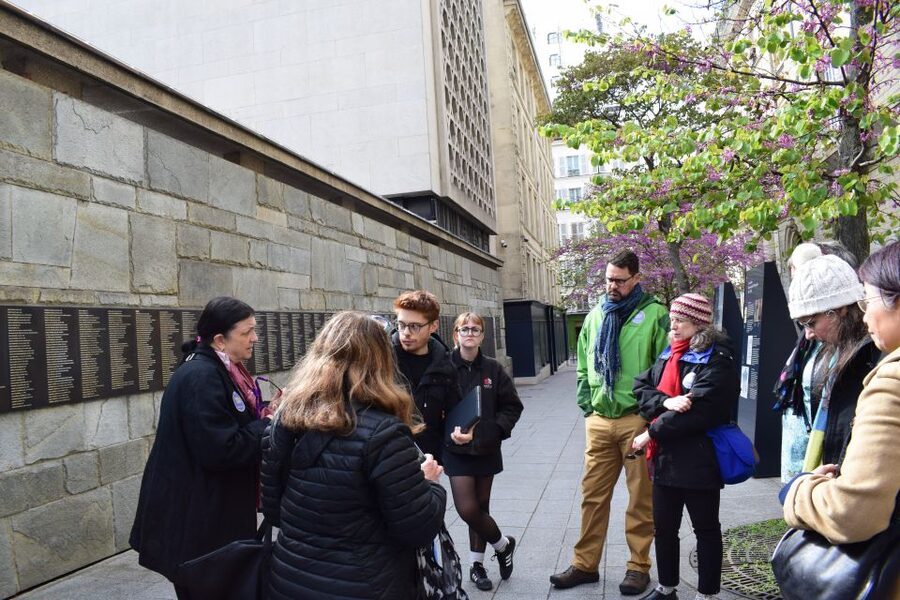
- The Shoah Memorial adds a solemn pause: The memorial’s wall of names and crypt give the tour emotional weight.
- Public transport connects the districts: Tickets are included, but the change of scene adds walking, street crossings, and a shift in pace.
- The final reward is at Sacré-Cœur: You end near Square Louise-Michel, with wide Paris views and a chance to reflect on the stories you have heard.
Why this Jewish Paris tour works
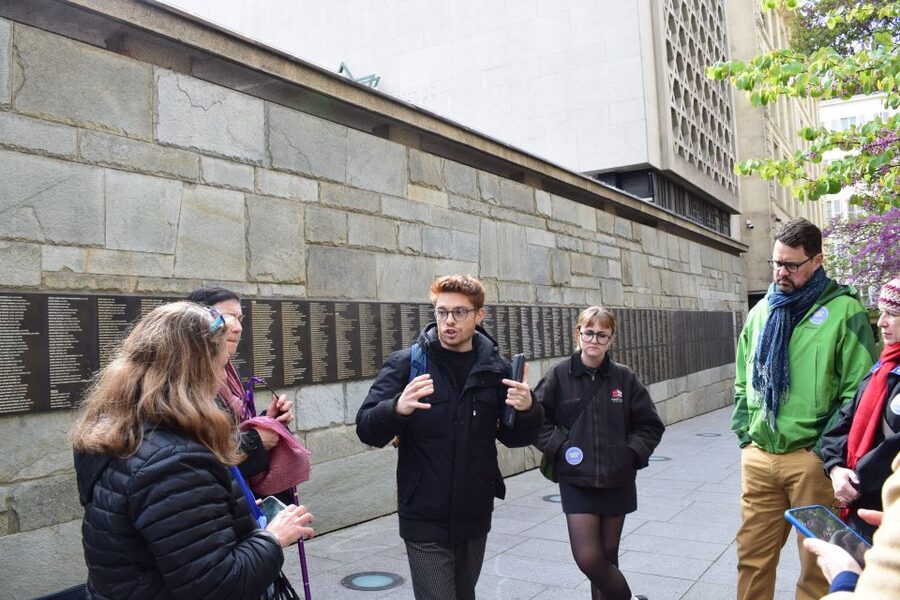
This is not simply a walk past old buildings. The guide uses streets, façades, memorials, and neighborhood changes to explain how Jewish life in Paris has shifted across the centuries.
The route begins in Le Marais, once home to long-established Jewish communities and still the city’s best-known Jewish district. It then moves to Montmartre, where the subject changes from community and persecution to creativity, ambition, and the role of Jewish artists and writers in modern Paris.
That contrast gives the tour a useful shape. You see Jewish Paris as more than a story of suffering, though the difficult chapters are not softened. You also hear about daily life, trade, food, art, fashion, and the people who helped shape Parisian culture.
The small size matters. With no more than nine people, you can stay close to the guide and ask questions without turning the walk into a lecture delivered to a crowd. The strongest praise has gone to guides who make French history easy to follow, answer questions patiently, and connect past events with the streets in front of you.
More History Walking Tours in France
- Paris: Dark History and Ghostly Guided Walking Tour
★ 4.7 · 1,000 reviews - Paris City of Fashion History Private Guided Walking Tour
★ 5.0 · 221 reviews - Historic Paris Walking Tour in English
★ 4.9 · 78 reviews
Starting near BHV Marais or L’Elephant Du Nil
The meeting point depends on the option you book. Possible starting points include BHV Marais and L’Elephant Du Nil, so check your confirmation carefully rather than relying on a general map pin.
One practical warning is worth taking seriously: BHV has several entrances, and finding the correct one can take a few minutes. Arrive at least 15 minutes early. The tour cannot accept late arrivals after it has started, which is especially important when the group is moving through central Paris.
The exact meeting instructions matter because the starting area can be crowded. One participant had trouble identifying the guide when an expected orange flag was not being used. A quick phone call resolved the issue, but it created an avoidable ten-minute worry. Confirm the guide’s name, meeting point, and any visible sign before you leave your hotel.
Le Marais: streets, community, and memory
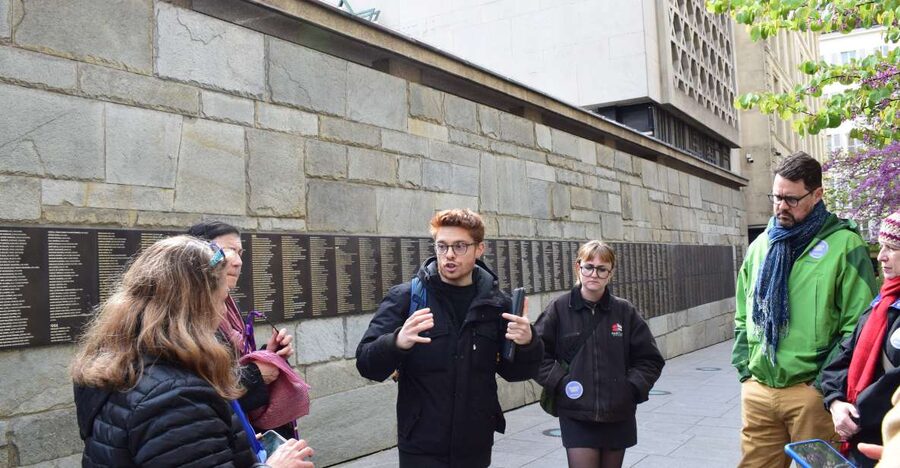
The first section lasts about 90 minutes. Your guide leads you through Le Marais, explaining how Jewish communities shaped the district from the Middle Ages to the present.
Le Marais is now known for handsome streets, independent shops, food, fashion, and lively cafés. The current atmosphere can make it hard to picture earlier Jewish life, so the guide’s explanation is important. You are often looking at an ordinary street corner while hearing about the people who lived, worked, worshipped, and traded there.
This is one reason a guided walk works better than a list of historic addresses. Much of the story is not obvious from the buildings. The guide supplies the missing context and points out how the area has changed.
The route includes Village Saint-Paul, where the streets help establish the feel of old Paris. The exact stop is not a separate museum visit, and you should not expect a preserved historical set. Instead, it is part of the walk’s wider effort to show how Jewish life fitted into the everyday city.
The route also passes Jewish-owned businesses and food shops. Several guides have added useful suggestions about kosher restaurants and local food, and the walk can leave you well placed for a meal afterward. Falafel is a recurring practical recommendation, especially near the end of the Marais portion.
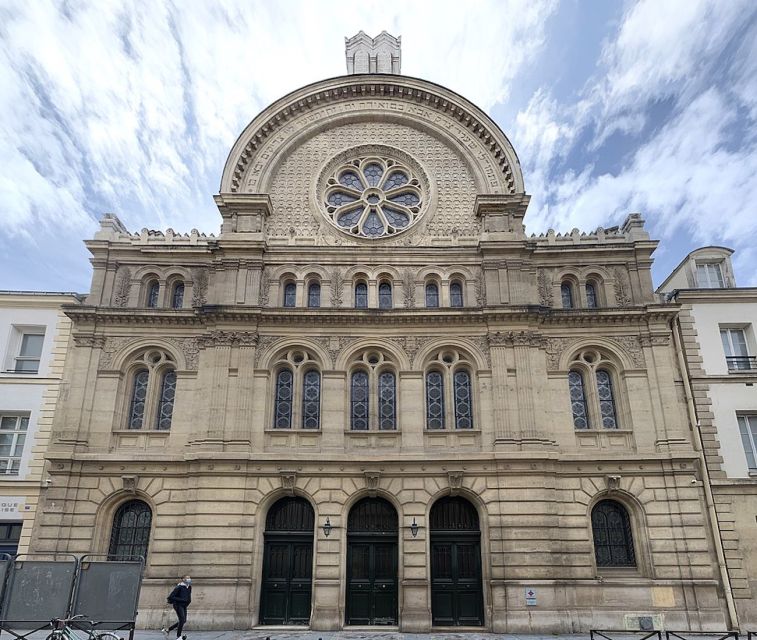
Agoudas Hakehilos Synagogue and Guimard’s design
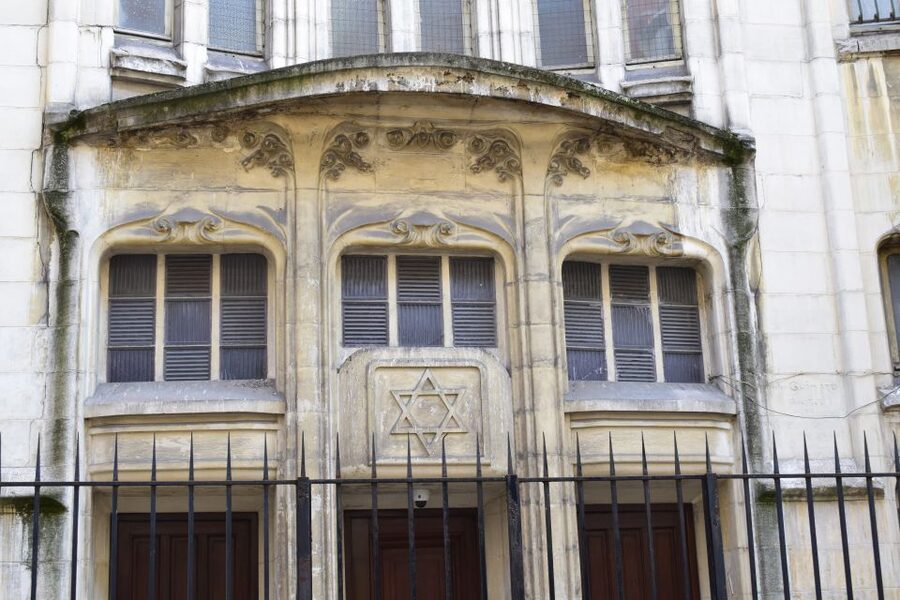
The exterior of the Agoudas Hakehilos Synagogue is one of the clearest visual highlights. It was designed by Hector Guimard, best known for the curving Art Nouveau entrances of the Paris Métro.
You can study the façade, its decorative lines, and its unusual style while the guide explains the building’s place in Jewish Paris. It is a good reminder that Jewish landmarks in Paris are not limited to grand, easily recognized monuments. Some are woven into ordinary streets and require someone to point them out.
The limitation is simple: you do not enter the synagogue. There is no indoor tour of the synagogues, and entry to monuments and historical sites is not included. If you want a religious service or an interior visit, this walk will not provide it.
Still, the exterior stop works well because the building is distinctive and the guide can connect architecture with community history. Allow yourself time to look up from street level. Guimard’s style rewards a slower glance.
More Jewish Heritage Walking Tours in Paris:
- Amsterdam Anne Frank: Small-Group Walking Tour & Local Guide
★ 4.8 · 12,789 reviews - Anne Frank’s Story – Guided Walking Tour through Amsterdam
★ 5.0 · 11,619 reviews - Prague: Jewish Quarter Walking Tour with Admission Tickets
★ 4.7 · 3,729 reviews - Amsterdam: Anne Frank Guided Walking Tour in DE/EN/IT/ES
★ 4.9 · 3,107 reviews
The Shoah Memorial: the tour’s most solemn stop
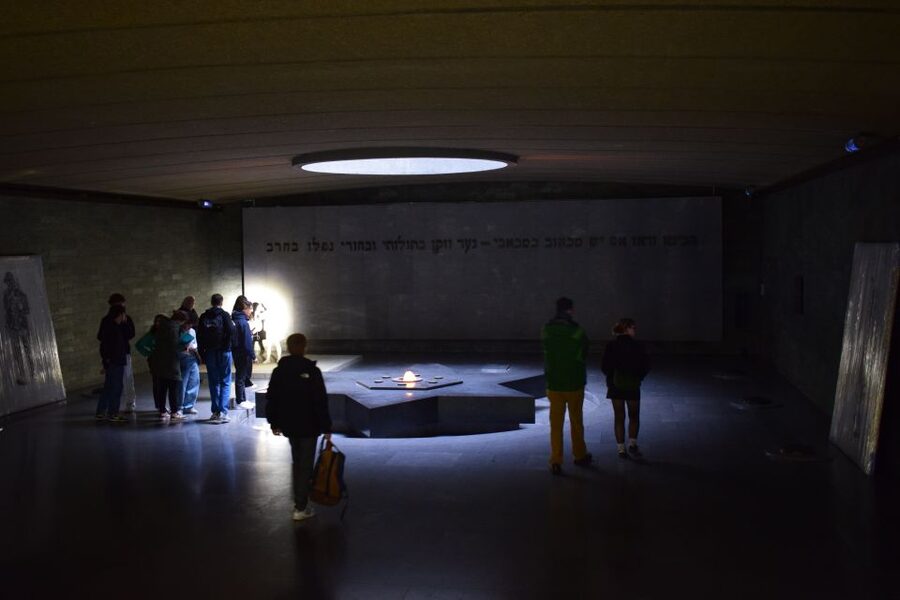
The Shoah Memorial gives the Le Marais section its emotional center. The guide discusses the memorial from the exterior, including the wall of names and the crypt.
This is not a light sightseeing stop. You hear about the destruction of Jewish life during the Second World War, as well as the French people who helped Jewish individuals escape or survive. The memorial makes those subjects more immediate because the discussion takes place beside a place created for remembrance.
The best guides handle this part with restraint. Several praised guides have been singled out for discussing painful subjects with sensitivity, including the persecution of Jews in France and the Holocaust. That matters here. The tour is educational, but it is also personal and reflective.
Do not expect the memorial to function as a full museum visit during this tour. The historical explanation is the point, and the walk continues afterward. If you want more time with exhibitions and documents, you would need to return separately and plan an indoor visit.
From Hôtel de Ville to Montmartre by public transport
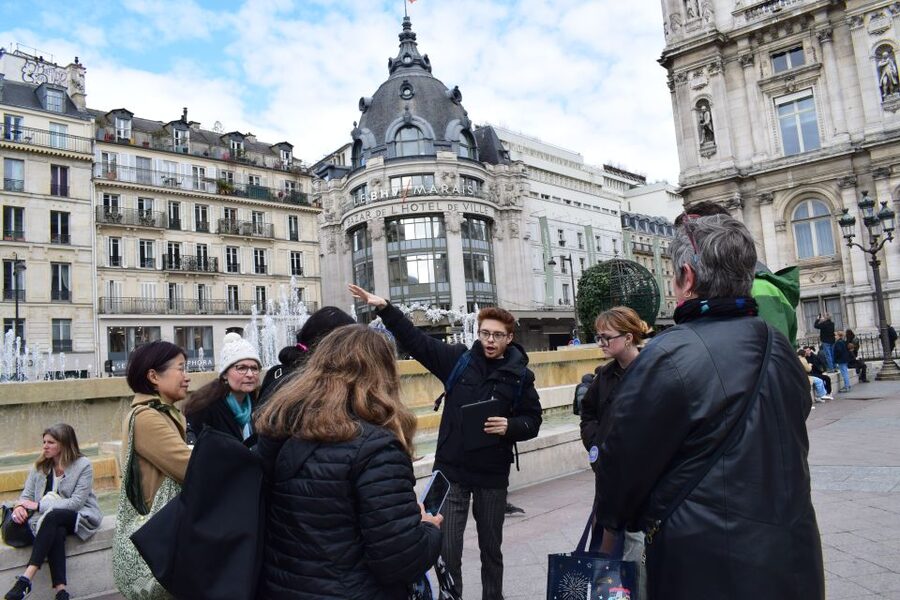
After the Marais portion, the route finishes near Hôtel de Ville, Paris’s City Hall. You then use public transport to reach Montmartre, with tickets included.
This transfer takes about 30 minutes. It breaks up the walking, but it also means the tour is not one continuous stroll. You will be moving through stations and city streets, so keep your group in sight and listen carefully for instructions.
The change is worthwhile because Montmartre offers a completely different setting. Le Marais is tied to community, religion, business, memory, and the city’s older Jewish quarters. Montmartre brings in cafés, studios, writers, painters, and the creative life of the late 19th and early 20th centuries.
This is also where the tour’s range can divide opinions. If you want only synagogue architecture and Jewish communal history, some Montmartre material may feel less focused. If you like the connection between Jewish identity and Parisian art, the second half adds an important dimension.
Montmartre at 7 Rue Ravignan and Le Bateau-Lavoir
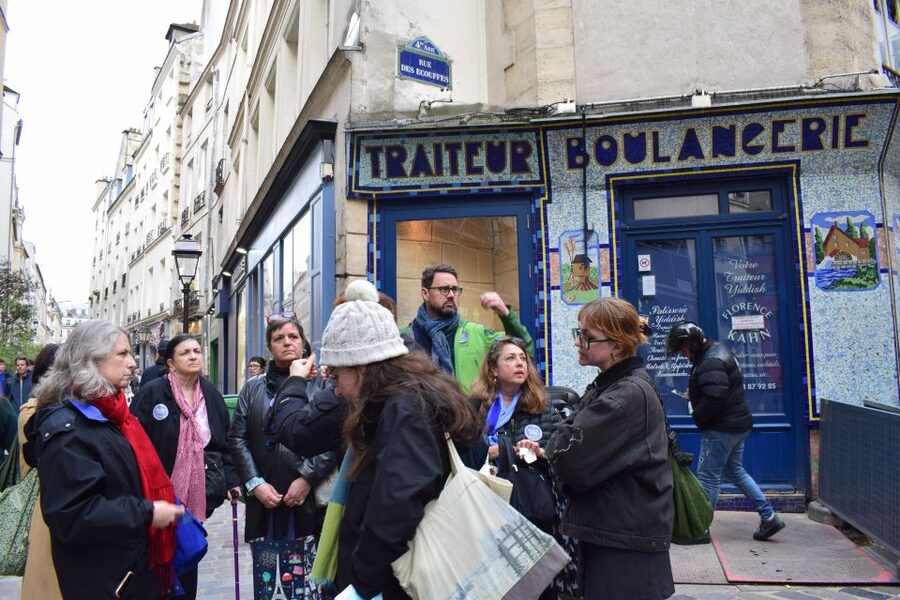
The Montmartre walk lasts about 90 minutes. It begins in the famous hilltop neighborhood, where narrow streets and old artistic associations create a different mood from the Marais.
At 7 Rue Ravignan, the guide introduces the creative world that once gathered in this part of Montmartre. The address is connected with Le Bateau-Lavoir, the former artists’ residence and studio building nearby.
You do not enter an artists’ museum as part of this stop. Instead, the guide uses the location to explain how artists, writers, and thinkers shared ideas and influenced one another. Jewish figures formed part of these circles, and the tour shows how their work and identity fitted into a broader Parisian culture.
Le Bateau-Lavoir is best understood through the stories attached to it. The building itself is not the entire attraction. The value comes from learning what the address represented and how creative communities formed around studios, cafés, and informal networks.
This portion also benefits from a good guide’s storytelling. The most successful guides have been described as engaging, warm, and able to make long stretches of history feel connected to the present street. Ask questions here if you are interested in art, literature, or the social life of Montmartre.
Passing the Musée de Montmartre and Rue du Mont-Cenis
The walk continues past the Musée de Montmartre. It is a pass-by rather than an included museum visit, so you will not receive museum entry with this experience.
At 16 Rue du Mont-Cenis, the guide continues the story of Montmartre’s Jewish artists and intellectual life. These addresses help you understand the neighborhood as a network of homes, studios, cafés, and meeting places rather than just a postcard view of Paris.
Montmartre is steep in places. The streets, stairs, and uphill route make comfortable shoes essential. The activity is specifically not suitable for wheelchair users or people with mobility impairments, and the full route can feel demanding if you have already spent the day walking.
Weather also matters. Rain does not cancel the historical content, but wet streets and exposed viewpoints make the experience harder. One group began in heavy rain and still enjoyed the tour, though you should bring suitable clothing and shoes. On a hot day, the combination of sun, hills, and a long walk can be tiring as well.
Sacré-Cœur and the view across Paris
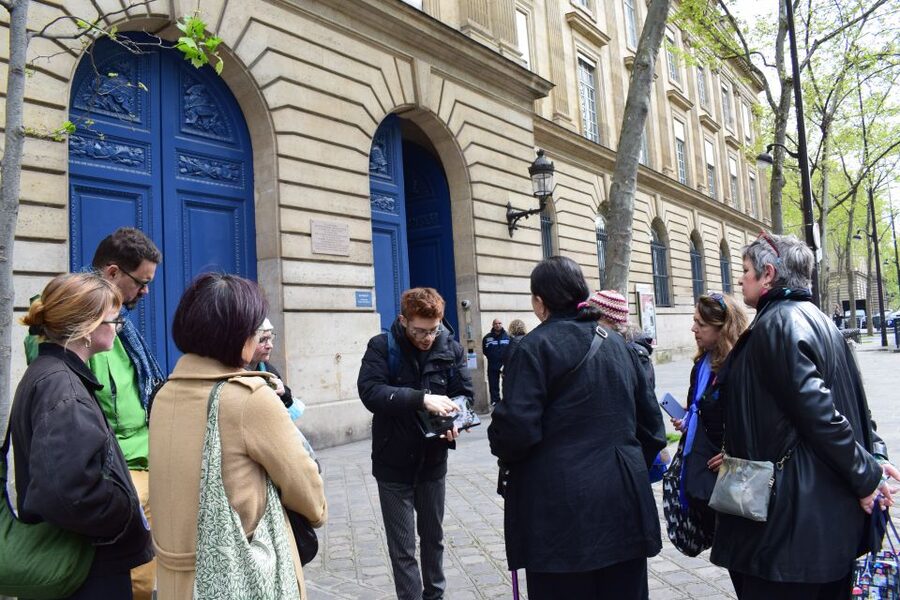
The final major stop is Sacré-Cœur Basilica. You see the basilica and finish at Square Louise-Michel, where the view opens across Paris.
The panorama is a strong ending because it gives you a physical pause after several hours of history and walking. From the steps and nearby square, Paris spreads below you, and the guide brings the discussion back to Jewish identity, artistic expression, and the city’s changing communities.
The basilica itself is a sightseeing stop rather than a full included interior tour. Entry to monuments is not part of the price, so check the plan if seeing the inside is important to you.
This ending also leaves you in a useful part of Montmartre for further exploring. The tour does not return you to the starting point, so plan your next move from the Sacré-Cœur area. You can continue sightseeing, find food, or use public transport from there.
Is $80 a fair price?
At $80 per person, this is not a bargain walk. The value rests in the guide’s interpretation, the small group, and the fact that the tour links two districts that would be difficult to connect efficiently on your own.
Public transport tickets are included, and a group of up to nine allows more conversation than a large coach tour. You also receive a focused three-and-a-half-hour introduction to Jewish Paris, French history, the Shoah, and Montmartre’s artistic circles.
The price is harder to justify if you mainly want entry to buildings. You do not go inside the synagogues, the Shoah Memorial, or the monuments. You are paying for a guided outdoor experience, not a package of admissions.
Private options are available if you want a more personal pace or have specific family, religious, or historical interests. A private tour may be useful for asking detailed questions, though the supplied information does not specify the private price.
Who will enjoy this walk most?
I would choose this tour if you want a serious, human account of Jewish life in Paris and prefer stories tied to real streets. It suits first-time visitors who want more context than a standard neighborhood stroll, as well as people with a family or personal interest in Jewish history.
It is also a good fit if you enjoy art and culture. The Montmartre section explains why Jewish Paris cannot be separated from the city’s artistic life in the late 19th and early 20th centuries.
You may want a different experience if you need step-free access, dislike long walks, or want extensive indoor visits. The route includes hills, stairs, public transport, and outdoor stops. It also asks you to give three and a half hours to a serious subject, not a quick photo stop.
The strongest guide reports name Benjamin, Benoit, Pierre-Louis, Achilles, Pilu, and others for their clear English, careful treatment of difficult subjects, and ability to answer questions. Guide assignment can change, so do not book solely around one person’s name.
Should you book the Jewish Paris walking tour?
Book it if you want context, personal stories, and a thoughtful guide more than a checklist of interiors. The combination of Le Marais, the Shoah Memorial, Montmartre’s artistic addresses, and Sacré-Cœur gives you a broad picture of Jewish Paris in one well-filled half-day.
Skip it if you need a slower pace, full museum access, or an accessible route. For everyone else, $80 is reasonable when the group stays small and the guide brings the history to life. Arrive early, wear good shoes, check the meeting entrance, and leave room afterward for food in the Marais or more time on Montmartre’s hill.
FAQ
How long does the tour last?
The tour lasts 210 minutes, or three and a half hours.
What neighborhoods does the tour visit?
It visits Le Marais and Montmartre, with public transport between the two areas.
What language is the tour offered in?
The live guided tour is offered in English.
How large is the group?
The small-group format allows up to nine people. Private options are also available.
Are public transport tickets included?
Yes. Public transport tickets for the transfer between Le Marais and Montmartre are included.
Can I go inside the synagogues?
No. The synagogues are visited from the exterior only.
Is entry to the Shoah Memorial included?
No. The tour discusses the memorial and views parts of it from the exterior, but entry to historical sites is not included.
Where does the tour end?
The tour ends at Square Louise-Michel near Sacré-Cœur Basilica in Montmartre.
Is the tour suitable for wheelchair users?
No. The experience is not suitable for wheelchair users or people with mobility impairments.
More History Walking Tours in Paris
- History and Hauntings of Salem Guided Walking Tour
★ 5.0 · 14,564 reviews - Lisbon: History, Stories and Lifestyle Walking Tour
★ 4.8 · 10,902 reviews - Boston: Freedom Trail History Small Group Walking Tour
★ 5.0 · 6,450 reviews - Historic Charleston Guided Sightseeing Walking Tour
★ 5.0 · 6,216 reviews
Just added around Paris
- The Official Emily in Paris Locations Walking Tour★ 4.9 · 383 reviews
- Paris: Montmartre Food Tasting Walking Tour with Secret Dish★ 4.8 · 107 reviews
- Paris: Emily Inspired Walking Tour★ 4.9 · 312 reviews
- Saint-Germain: Gourmet Chocolate & Pastry Walking Food Tour★ 4.8 · 495 reviews
- Paris: Walking Tour of Montmartre★ 4.7 · 470 reviews
- Paris: Ghosts, Legends & Mysteries Evening Walking Tour★ 4.5 · 241 reviews
- Paris: Walking Tour with Notre Dame or Ste-Chapelle Access★ 4.4 · 198 reviews
- Paris Top Sights Half Day Walking Tour with a Fun Guide★ 4.9 · 92 reviews
History Walking Tours, compared.

History and Hauntings of Salem Guided Walking Tour
Read our review →

Freedom Trail History Small Group Walking Tour
Read our review →
Historic Charleston Guided Sightseeing Walking Tour
Read our review →
Tapas Walking Tour with Food, Wine, and History
Read our review →
Savannah History and Haunts Candlelit Ghost Walking Tour
Read our review →
A History of Terror – Belfast City Centre Walking Tour
Read our review →Browse the lists this tour appears in