
Review · HISTORY WALKING TOURS
2-Hour Historical Walking Tour from Dublin
Dublin’s past is packed into a short walk. This tour makes the city easier to read, linking Trinity College, Viking Dublin, the Civil War, Christ Church Cathedral, and Dublin Castle through clear historical storytelling. I like the small maximum of 25 people, which should make it easier to hear the guide, and I like the $22.98 price, especially since you get a two-hour introduction without paying admission at each stop.
The main thing to consider is the tour’s academic bent. The guides are history postgraduates, and several lead with politics, religion, invasion, and constitutional change. That can be fascinating, but it may feel dense if you want a light stroll focused mostly on pretty buildings, local food, and Dublin culture.
Key points to know before you book
- Meet at the Grattan statue, not the Trinity College gates: The starting point is at College Green, opposite the front gate.
- Expect a serious history lesson: Guides such as Eoin, Jody, John, Daragh, and Colm have been praised for clear explanations, humor, and strong storytelling.
- The Book of Kells is discussed but not included: You do not get entry to the exhibition as part of this tour.
- The route covers major turning points: You move from medieval Dublin and Viking settlement to British rule, Catholic emancipation, and the 1922 Civil War.
- Allow a little flexibility: The advertised length is about two hours, but some outings have lasted two and a half hours.
- Wear comfortable shoes and watch the forecast: It is a proper city walk, and Dublin’s wind and rain can make a good coat more useful than an umbrella.
Why this short Dublin walk works so well
A two-hour tour is a smart way to begin a Dublin stay. You get a broad sense of how the city developed, then you can return to the places that interest you most. One guide, Eoin, reportedly began with 5,000 years of Dublin history in five minutes before adding detail at each stop. That is a useful method: first get the outline, then fill in the names and events.
I especially like the way this route connects the city’s physical sights to political change. Trinity College is not just an old university. The Bank of Ireland is not just a grand neoclassical building. Four Courts is not simply an impressive courthouse. Each place becomes part of a story about power, religion, empire, independence, and identity.
The group limit of 25 is another practical plus. This is not a private tour, so you will still be walking with other people, but the group is small enough that the guide should be visible and audible. Several participants praised guides for having strong voices and answering questions clearly.
The tour is also easy to fit into a busy day. It takes about two hours, uses central Dublin locations, and finishes near Christ Church Cathedral. You can schedule a museum, lunch, shopping, or another attraction afterward. Just keep in mind that the actual walk may run longer than the advertised time, especially when questions and discussion get going.
More History Walking Tours in Dublin
- Dublin Historical Centre Food Tour with 8 Food Tastings & Drinks
★ 5.0 · 1,718 reviews - Historical 2-Hour Guided Walking Tour of Dublin
★ 4.7 · 865 reviews - Dublin’s Haunted History Walking Tour
★ 4.3 · 345 reviews
Starting at Trinity College and the Book of Kells
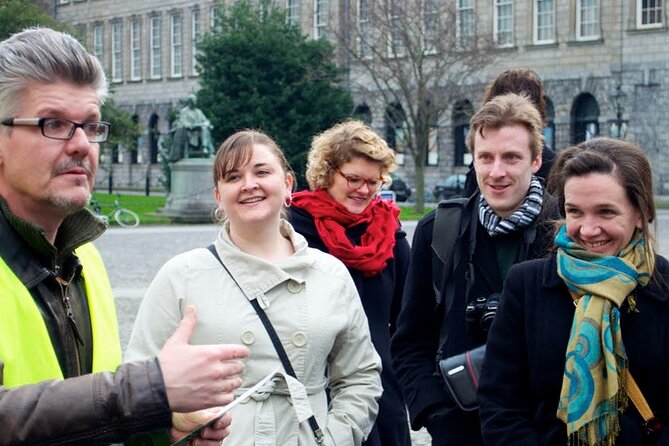
The meeting point is the Henry Grattan Monument, also called the Grattan statue, at College Green. It is opposite Trinity College’s front gate. This detail matters because one person missed the guide by waiting at the gates rather than at the statue. Check your confirmation carefully and look for the correct monument before the start time.
The opening stop is Trinity College Dublin, founded in 1592 and Ireland’s oldest university. The guide explains the college’s place in Irish education and public life, then introduces its most famous object, the Book of Kells.
The Book of Kells is an eighth-century manuscript containing the four Gospels in Latin. It is one of Ireland’s best-known cultural treasures, but entry to see it is not included in this walking tour. That is an important distinction. You learn about the manuscript and Trinity’s history, but you will need a separate ticket if you want to visit the Book of Kells exhibition.
The Trinity portion lasts about 20 minutes. It gives you useful background without turning the tour into a long campus visit. If you already plan to see the Book of Kells, this introduction should make the later visit more meaningful. If you are not interested in the manuscript, the guide still places Trinity within the wider story of Dublin.
Bank of Ireland and the politics of power
From Trinity, the walk moves to the Bank of Ireland. The building was originally Ireland’s colonial parliament, constructed in 1729. It was abolished by the Act of Union in 1800, when the Irish Parliament was absorbed into the United Kingdom.
This is one of the tour’s best examples of how a building can carry political meaning. The guide discusses Protestant Ascendancy, the period when political and economic power was concentrated among Ireland’s Protestant ruling class. The architecture is also part of the story, with the building representing the confidence and order associated with eighteenth-century neoclassicism.
The stop lasts about 10 minutes and is viewed from outside, with no admission charge. I would not expect a detailed architectural tour here. The value is the explanation of what the building represented and why its political history still matters.
Temple Bar beyond the pub signs
Temple Bar is now one of Dublin’s best-known areas, but the tour gives you a less obvious story. The narrow-street district was once marked for demolition. In the 1990s, it was repurposed as Dublin’s Cultural Quarter.
That change helps explain the area you see today. Temple Bar is not simply an old quarter that survived unchanged. It is also the result of planning decisions, preservation efforts, and a deliberate attempt to turn an overlooked part of central Dublin into a cultural destination.
The stop lasts around 10 minutes. You will not have time for a drink or a long wander, so think of this as an introduction rather than a full Temple Bar visit. I like that the guide includes the area’s modern redevelopment, since it shows that Dublin’s story did not end with medieval streets or the struggle for independence.
More History Walking Tours in Ireland
- Dublin: Macabre History Walking Tour
★ 4.9 · 95 reviews - Cork: Guided Historical Walking Tour
★ 4.7 · 310 reviews - Galway: Dark History Guided City Walking Tour
★ 4.8 · 236 reviews - Kilkenny: Historical and Hysterical Guided City Walking Tour
★ 5.0 · 126 reviews
Wood Quay and the Viking city
At Wood Quay Amphitheatre, the focus shifts to archaeology. Extensive excavations in the 1980s revealed evidence of the Viking city, founded around AD 840.
This stop gives you a chance to picture Dublin before its grand Georgian buildings, political institutions, and modern streets. The city’s name itself is tied to the Dubh Linn, or Black Pool, which is discussed later at Dublin Castle. The Viking material helps connect the name, the river area, and the earliest urban settlement.
The stop takes about 10 minutes. Much of the original archaeology is not presented as an open-air Viking town, so the guide’s explanation does a lot of the work. That makes this section especially useful if you want context rather than a museum display.
Four Courts and the Civil War
Four Courts is Ireland’s legal headquarters and one of the most politically charged stops on the route. The guide explains how a Civil War began there in June 1922, between those who supported the Treaty of December 1921 and those who opposed it.
The Treaty had brought the War of Independence, fought from 1919 to 1921, to an end. But independence did not settle every question. The disagreement over the Treaty split the nationalist movement and led to armed conflict between former allies.
This is where the tour’s serious tone becomes most apparent. You are not getting only a quick list of dates. The guide lays out the dispute and its consequences, helping you understand why the early years of the Irish state were so troubled.
The Four Courts stop lasts about 20 minutes, making it one of the longer pauses. If you enjoy political history, this may be one of the strongest parts of the walk. If you prefer a relaxed sightseeing tour, it may feel like a lot to absorb while standing outdoors. Pay attention, and do not hesitate to ask the guide to clarify names or events.
Christ Church Cathedral and the English invasion
Christ Church Cathedral is Dublin’s oldest cathedral, dating to 1030. The stone structure was rebuilt in the 1170s by Strongbow, a key figure in the original English invasion of that period.
The cathedral gives the guide a way to explain medieval Dublin, the arrival of English power, and the long relationship between religion and government. It also provides one of the route’s most visually important stops, even though the tour is focused on exterior context rather than a full cathedral visit.
The scheduled stop lasts about 10 minutes. Entry to the cathedral is not listed as part of the tour, so do not assume you will go inside. If you want to explore the interior, treat that as a separate visit and allow extra time after the walking tour.
The stated finish is at Christ Church Cathedral on Christchurch Place. Because City Hall and Dublin Castle are also part of the itinerary, confirm the day’s exact route and ending point with your guide if you need to meet someone immediately afterward.
City Hall and Daniel O’Connell
Inside City Hall is a statue of Daniel O’Connell, Dublin’s first Catholic Lord Mayor, elected in 1840. O’Connell led the successful campaign for Catholic Emancipation in 1829, ending anti-Catholic laws. That victory earned him the title The Liberator.
This stop brings the story back to civic life and individual leadership. O’Connell is not presented as a distant name from a textbook. His campaign helps explain the long effort to change Ireland’s political and religious rules through organized public action.
The visit is listed at about 10 minutes. Since the statue is inside City Hall, the practical experience may depend on access and the guide’s route on the day. The important point is the historical connection between the building, Dublin’s local government, and Catholic political rights.
Dublin Castle and the Black Pool
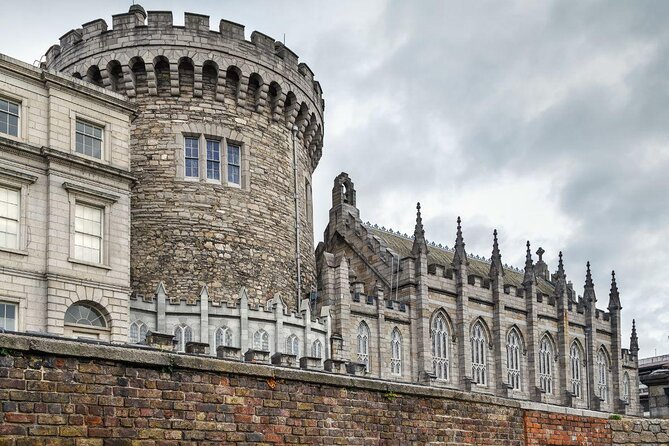
Dublin Castle was originally built by King John in 1204. It served as the center of British administration in Ireland until 1922, making it a fitting final historical anchor for a tour that covers invasion, government, resistance, and independence.
The castle also sits near the Dubh Linn, or Black Pool, from which Dublin takes its name. That small detail is easy to miss when you visit the castle on your own. A guide can connect the modern city name to the older geography.
The stop lasts roughly 10 minutes. It is not a full guided visit inside Dublin Castle, and admission is not listed as included. You get the political and historical setting, then can return later if you want a longer look at the state apartments or other rooms.
How much history is packed into two hours?
A lot. The tour moves from Viking Dublin and medieval Christianity to colonial rule, Protestant Ascendancy, Catholic Emancipation, the War of Independence, and the Civil War. Guides also bring the story into recent times, including discussion of modern events and Brexit.
That range is a major strength, but it demands attention. One participant found the political material too dense, while others specifically praised the detailed approach. Both reactions make sense. This is not a casual walk where you simply stop for a photo and hear two sentences about each building.
Guide style will shape your experience. Eoin has been praised for clear structure and humor. Jody is described as animated, passionate, and theatrical, with a background that includes acting. John has been praised for keeping a long tour engaging, and Daragh, Caolan Maher, and Colm have also been singled out for friendly and effective presentations.
The company’s guides are history postgraduates. That helps explain the level of detail. You may hear funny stories and colorful characters, but you should also expect political explanation and careful context.
Price, pace, weather, and group size
At $22.98 per person, this is a good-value introduction to central Dublin. You are paying for a guide’s time and subject knowledge rather than entrance tickets. The walk includes no paid admissions, and the Book of Kells is specifically excluded, so budget separately if that is on your list.
The route requires moderate physical fitness. You will walk for two full hours, and some outings have continued for two and a half hours. Comfortable shoes are a must. Dublin weather can be cold, wet, and windy, even when the forecast looks harmless, so dress for standing outdoors.
The tour is offered in English and uses a mobile ticket. Service animals are allowed, and the meeting area is near public transportation. Confirmation is provided when you book.
You can cancel for a full refund up to 24 hours before the start time. Changes or cancellations inside that 24-hour window are not accepted, with cut-off times based on local time.
Who should book this Dublin tour?
I would choose this walk at the start of a Dublin visit, especially if you want the city to make more sense before exploring on your own. It gives you names, dates, and connections that can sharpen later visits to Trinity College, Dublin Castle, Christ Church, and the city center.
It suits adults, older children, and teenagers who enjoy history. One participant specifically noted that a teenager enjoyed it, but younger children may struggle with the amount of political detail. The tour also works well for first-time visitors who want orientation without giving up an entire day.
I would be more cautious if you want a food tour, a pub-focused walk, or a gentle introduction built mostly around local stories. You may find the material too dense. I would also avoid booking it immediately before a fixed appointment, since the walk can run over two hours.
Should you book it?
Book this tour if you want Dublin explained rather than simply displayed. The strongest features are the well-trained guides, the low price, the central route, and the way the stops connect into one story.
Skip it if you want entry to the Book of Kells included, dislike political history, or prefer a short photo walk. For most history-minded visitors, though, it is a useful first look at Dublin, with enough detail to make the rest of your stay more rewarding.
FAQ
Where does the tour start?
It starts at the Henry Grattan Monument, also called the Grattan statue, at College Green in Dublin. The statue is opposite the front gate of Trinity College.
Where does the tour end?
The stated end point is Christ Church Cathedral on Christchurch Place, Dublin, D08 TF98.
How long does the tour last?
The advertised duration is approximately two hours. Some outings have lasted two and a half hours, so avoid scheduling a tight appointment immediately afterward.
How much does the tour cost?
The listed price is $22.98 per person.
Is entry to the Book of Kells included?
No. The tour discusses the Book of Kells, but entry to see it is not included.
Is the tour offered in English?
Yes. The tour is offered in English.
How large is the group?
The maximum group size is 25 people.
Is the tour physically difficult?
The tour requires a moderate level of physical fitness and includes about two full hours of walking. Comfortable shoes are recommended.
Can I cancel for a refund?
Yes. You can cancel at least 24 hours before the start time for a full refund. Cancellations or changes made less than 24 hours before the start time are not accepted.
More 2-Hour Experiences in Dublin
- Berlin’s Best: 2 Hour Walking Tour Third Reich and the Cold War
★ 5.0 · 5,486 reviews - Budapest City Landmarks Walking Tour in 2 Hours
★ 5.0 · 2,048 reviews - Leipzig: 2-Hour Guided Walking Tour in German
★ 4.8 · 1,612 reviews - Lucca: 2-Hour City Center Walking Tour
★ 4.7 · 1,314 reviews
Just added around Dublin
- Dublin: North Quay Guided Ghost Walk★ 4.2 · 144 reviews
- Dublin: Traditional Pub Walking Tour★ 4.6 · 295 reviews
- Dublin: Macabre History Walking Tour★ 4.9 · 95 reviews
- Dublin: Mythology, Folklore and Legends Walking Tour★ 4.9 · 703 reviews
- Dublin: Traditional Pubs Walking Tour with Local Guide★ 4.9 · 112 reviews
- Dublin: Delicious Walking Food Tour★ 4.9 · 137 reviews
- Dublin: Irish Music Walking Tour with Live Performance★ 4.8 · 137 reviews
- Dublin: Highlights and Hidden Corners Walking Tour★ 4.8 · 79 reviews
History Walking Tours, compared.

History and Hauntings of Salem Guided Walking Tour
Read our review →

Freedom Trail History Small Group Walking Tour
Read our review →
Historic Charleston Guided Sightseeing Walking Tour
Read our review →
Tapas Walking Tour with Food, Wine, and History
Read our review →
Savannah History and Haunts Candlelit Ghost Walking Tour
Read our review →
A History of Terror – Belfast City Centre Walking Tour
Read our review →Browse the lists this tour appears in